
I’ve been reading Brinkwood: The Blood of Tyrants by Eric Bernhardt (available in digital and print). This is a review with an eye for canon-text, mech-text, and anti-text, and I hope to gain insight into how minimise mech-text, and maximise anti-text. I hope it’ll lead me to reassess the principles I’ve previous drawn; or at least add to them. Disclaimer: Erik is a twitter mutual and I backed Brinkwood on Kickstarter.
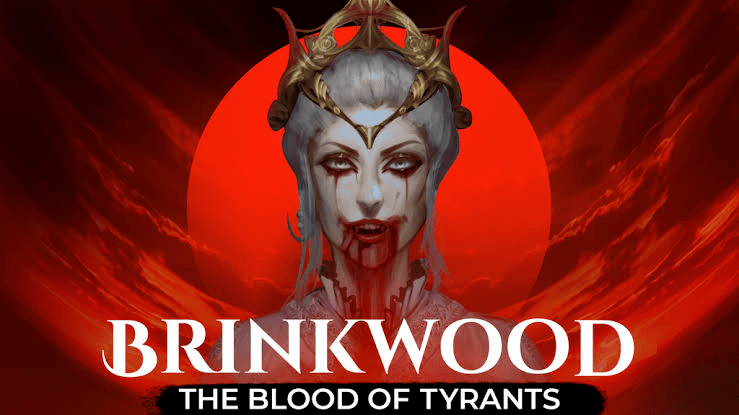
Brinkwood has a pretty clear premise (1): You’re Robin Hood, and you make pacts with fae to gain enough power to defeat Vampire Sheriff of Nottingham. This gives it a win state and a goal for ‘forays’ that limits player decision making to a significant degree that I find pleasing. Why is this limitation pleasing to me? By comparison, Doskvol, the city in which Blades in the Dark is set, is arguably a fantastic anticanon text. Why is less, more, for me?
The basic thesis of The Monomyth Thread, an article by Hy Libre (2) is: There is comfort, safety and enjoyment in “Playing to find out how our characters experience this specific story”, in contrast to the open-ended goal most games of the Apocalypse World lineage claim: Play to find out what happens. Brinkwood, has a clear arc for your character and your rebellion: The rebellion will eventually overcome the Vampire Lord, and your character will go from driven by tragedy to driven by hope. The pleasure is in the journey; there is comfort in knowing you’ll arrive at the destination irregardless, and that the surprise is in how you’ll get there. For me, this is a strength of Brinkwood’s, and brings a brevity and clarity in the text that I appreciate as well.
The Introductory chapter spends talks a lot about genre expectations, what the game is about, a few pages about the setting, and then a bulky getting started section including safety and subject matter. I fully recognise this is fairly boilerplate, but for me it’s difficult to get past. I understand the purpose here: We have a potentially unsafe subject matter, a very specific world and goals, and so Bernhardt needs to address these out of the gate. But the way it’s presented dilutes the effect.
I don’t have a solution, though. Do we need to talk about safety tools in detail in every book, do they need to be baked in like Wanderhome does, or can we refer out to the primary sources and expect people to be responsible for their own safety? Brinkwood is well organised, do we need a getting started section at all? As much as I understand the urge to define Castylpunk, pose dramatic questions, and talk about the potential themes different Vampire Lords might lend to the game, I think most of this is neatly folded into the text already, and the additional text feels like it doesn’t trust me, the reader, to grapple with the text on its own terms.
The worldbuilding in the Introductory chapter, though, along with the overview of the Vampire Lords, is excellent anti textual writing, especially the Vampire Lords. The setting summary is four headings, about twelve paragraphs, and while I feel it could be terser, it covers everything you need to know to drop into a complex world. The Vampire Lords have a mood-board list, and two or three sentences each. This could have been the entire chapter, and I would have been hooked instead of exhausted when I got to the mech-text that follows.
I like the Forged in the Dark rules a lot, because they articulate a lot of unspoken conventions such as negotiation, shared worldbuilding and phases of play and in doing so sets clear expectations that result in consistently fun sessions. In terms of absorption, opening with a list of changes, most of which are concerned with the existence of a developing rebellion or your pacts with powerful Fae, is a good way of focusing in on canon-text, in what is necessarily a mechanical, ‘copied from the SRD’ chapter, and there are innovations like Threat which make running a fluid, improvised game easier, which I appreciate a lot.
While I think Chapter 3 betrays some antitextual potential in the name of a smoother process, it’s pretty great. Every associate a player is assigned is dripping with promise, as is each tragedy. The example bonds listed are varied and inviting, but encouraging unique connections. The collaboratively designed Fae, the nature of Masks, and the ritual of the Pact are delightful and open ended and allow the whole table a huge impact on the story that unfolds.
Chapter 4 is an entire chapter about a significant new mechanic, Masks. As is the habit in Forged in the Dark games, Actions, intended to be widely applicable, are often over-described unnecessarily: “When you disarm, you remove the ability of another to harm you. You might use snarling and threats to convince an enemy to give up a fight, or a deft twirl of a dagger to knock a blade aside, or soothing words to convince a would-be ally that you wish them no harm.” For me, second sentence is entirely unnecessary, especially in the context of actions already been given this treatment in Chapter 2. The mask’s personalities and possible looks are very neat, messy, and evocative, leaving mystery as in the last chapter. The special abilities are mechanical as Forged in the Dark abilities tend to be, and these decrease their magic, but their names are evocative writing that expand on the possibilities given by the actions and the personality of the mask. The next few chapters do the same, and with similar effect. Lots of mech-text, not much in the way of canon-text or anti-text. Forged in the Dark games often do this (it might be fun to review CBR+PNK or another “Forged-Lite” game soon as a response to Brinkwood, actually), but it’s difficult reading for me. That’s not all negative: There’s a special kind of enjoyment and safety in mastery of a mechanical system, and Forged in the Dark games smartly spread their mechanics out over the entire narrative arc, using them to drive story in ways other than combat. I don’t want to optimise a 5E character, but I do want to optimise my Brinkwood character, because it promises complex and interesting stories will evolve from it.
So, skipping to Chapter 8. It’s a mech- and canon-text chapter about the Vampires, and it’s neat. Innovative in terms of categorising foes, and full of names that are mysterious and evocative – Dramcoats, Bit-bloods, and Wisps. Vampiric Abilities are left vague and brief, in the best possible way. Lords have five-line lieutenants with two-word schemes, and unique mini bosses like Kidnapped Dryads and Roaming Goremass. I think it chooses to expand upon some of these too much, and some too little, but overall this is an exceptional anti-textual achievement, and leaves you excited to improvise campaigns in the demesnes of these Vampire Lords. Chapter 9, at the other end, develops an approach to both individual scenes and complex end-game scenarios that is approachable, terse, and interesting. Very cool anti-textual work, which I appreciate, but less exciting than Chapter 8.
So we have a book of 150 pages, half of which are solidly procedural and the other half of which are not. The procedures in the book make clear that they’re expected to be followed, and I think that’s interesting, because in my experience Forged in the Dark games work as advertised. The rules actually do reduce ambiguity, set expectations for play, and make for a fun time. And, for the most part, they’re replaceable: Bernhardt literally writes that: “[…]pull on your experience with Forged in the Dark, your ruling will likely be accurate enough […]”. Having played Blades in the Dark, I could wing running Brinkwood with just a skim of the rules and the various play sheets in front of me.
The void in Brinkwood: The Blood of Tyrants is a fascinating one then. By contrast with the complex and well-developed Duskvol of Blades in the Dark, Cardenfell is only touched in in pieces, a map is given, but no locations (aside from a blink and you miss it map), characters are given, but they may not exist if you choose a different Vampire Lord, even factions are two or three sentences of description, without even schemes or clocks attached. Brinkwood leaves the world blank, with the primary actors being the Brigands and the Vampire Lords against which they rebel. Blades in the Dark wants Duskvol to be a real place before you set foot in it. When I run Blades in the Dark, I have to sift through a complex and unending list of factions and locations, choose which act and which don’t, which exist and which do not. Brinkwood factions and locations only exist when they are brought into play, and they are brought into play through conflict with the Vampire Lords, if that conflict is perceived by the Brigands.
It’s a fascinating backpedal, actually, towards the narrative-first verisimilitude of Apocalypse World, from the megadungeon-inspired verisimilitude of Blades in the Dark. It’s neat, it’s simple, and for me, it’s way easier to play, to run, and to prepare. Blades in the Dark was not, because for me it’s anti-text was sprawling, poorly organised, difficult to choose from.
The Forged rule set does impede understanding and reveal intent here, but by leaning on the work of it’s predecessors minimises the dangers thereof. The textual void, similarly, is compromised by a lack of trust in the readers to interpret the intentional broadness of it’s choices. But the lore and the rules being around structure and interaction, mean that reckless creation is encouraged, and the evocative and cryptic world-building leaves me buzzing. The main new principle I can draw from reading this is that the amount or organisation of anti-text is as important as it’s how evocative and cryptic it is. And this, interestingly, brings us back full circle, to the Monomyth Thread: The limitations, spoken and unspoken, set by Brinkwood, create a more pleasing antitextual playground more pleasing to me than the sprawling, diverse possibilities developed by Blades in the Dark.
How do you feel about this principle? How did you feel about reading or playing Brinkwood: The Blood of Tyrants?
1 Although honestly I’m puzzled why Erik didn’t choose to front up with it more clearly.
2 Disclaimer: I participated in the conversation that initiated the article and game in the Monomyth Thread being written.


 Playful Void
Leave a comment