
I’m reading through 2nd Edition as an educational exercise, and considering writing a retroclone for it titled Advanced Fantasy Dungeons. The purpose of the read through and writing the retroclone is more a design exercise as it is a necessary addition to my shelf. I started with the Player’s Handbook (1989), and in this post I’ll look at the Dungeon Master’s Guide. I’ll hit the ‘Races’ chapter in this post, as well, so content warning for racism. This is a long one, and you can just skip to the end for a summary of my thoughts. Let’s get started.
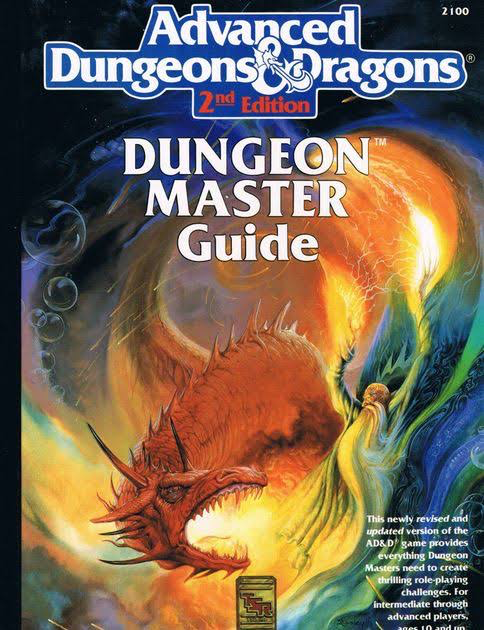
Interesting that this book literally opens with a screed against rules lawyering. Don’t just let the game sit there, and don’t become a rules lawyer worrying about each piddly little detail. Given the reputation this edition would develop. In addition, the parallel organisation of this book and the Player’s Handbook is an interesting choice. Whilst I think some chapters aren’t necessary, it’s a neat call-and-response in many, that focuses the dungeon master on the player characters.
Chapter 1 is Player Character Ability Scores. It’s interesting that it’s largely accepted that players will have multiple characters across the world, and that you might bring characters from one game to another. There’s a discussion about balance in this context, acknowledging tables are different and that moving from world to world might cause balance problems. But, the whole chapter is largely framed as “how to control players”, when it’s pretty apparent that expectation setting could cover most of this without the necessary advice, which was better and more respectfully given in the Fourth Edition DMG’s “types of players” section.
Chapter 2 is Player Character Heritage. It outright states here that the only reason class and level limitations exist are to make humans appealing, but there is no strong defence here for the approach chosen. Based on this and the previous chapter on the same subject, the same approach and spirit would be to choose two positive and one negative trait from a heritage list, to achieve the same outcome, and give humans some damned features, as there is already precedent for not having all of your special abilities.
Chapter 3 is Player Character Classes. Interesting concepts introduced here: What it “means” to have character levels, 0-level characters being 1d6 hit points and having 2-3 proficiencies (and no other stats), the idea that it’s rare to be a leader in the field and have levels because “Their talents in the field are too valuable to lose, and their effort is expended on their art, not on maneuvering and toadying.”, introducing political intrigue at around level 9 (although no recommendations as to how), and retirement. Retirement suggestions “Avengers Reassemble!” Style one-shots against absurd threats, which is honestly an awesome approach to higher level play.
One expectation that I haven’t seen stated before is having low-level play inform characterisation. As an expectation, this would actually be a lot of fun to mechanise in some way:
Did Rath the Dwarf save the day by fool-hardily charging into battle when he was a mere 1st level? If he did, the odds are good the player will try it again and will begin to play Rath as a bold and reckless fellow. On the other hand, if Rath was clobbered the first few times he rushed in, the player would begin to play Rath as a cautious, prudent fellow.
One thing I overlooked about classes is addressed in this chapter, in creating new character classes. Basically, XP to level up increases for every power a class has, which is why the absurd paladin has a bunch of restrictions. This is pretty clumsy an approach, though, and I think it’d be more interesting to take powers (or increase them) at each level up, from a list, and then keep the same experience chart, as a way to make characters more unique but retain class “balance” without weird artefacts like “must remain lawful good”.
Chapter 4 is Alignment. It opens with a paragraph that should have been the introduction to the book:
In all points of disagreement with your players, listen to their arguments when your understanding of an alignment differs from theirs. Even though you go to great effort in preparing your game, the campaign world is not yours alone–it also belongs to your players.
Which is nice, because while it wasn’t said outright until the 15th chapter of the game, the designers clearly think it’s primary, and it should be forefronted. There are some nice alignment definitions which clarify what an alignment actually is supposed to tell you;
Alignment is a shorthand description of a complex moral code. It sketches out the basic attitudes of a person, place, or thing. Alignment is not personality. Add characteristics that make [a character] interesting, adapting these to fit the character’s alignment.
But that the definitions fail to do clearly, in my opinion (as evidenced by my being challenged by the rangers’ good requirement and the bard’s neutral requirement).
Societal, location and religious alignments, if alignments remain in the same form with words like “evil” and “chaotic” in them, are racist as shit and have to go. It’s not crazy, though, to say a society or religion has shared beliefs though: It’s squishing beliefs into the nine-part-grid that’s the problem. I’m starting to wonder if a solution would be, similarly to classes and heritage, breaking the sections defining each alignment into concepts and having characters pick a few core beliefs for them, or their society, or religion, might be a more flexible and less loaded approach to alignment.
This is an example of where I really enjoy the world building in Second Edition, even though it’s sparse:
Sometimes characters try to use spells or magical items to learn the alignment of a player character or NPC. This is a highly insulting, if not hostile, action.
And this, implying people in this world know that their alignment is “lawful evil”:
Asking another character “So, what’s your alignment?” is a rude question. A chaotic evil character with any wit would reply “lawful good.”
Chapter 5 is Proficiencies. It continues here to lean on simplified NPCs (assume proficiency in whatever they’re carrying), identifies proficiencies as a barrier to creativity, and talks about changing the list to choose the flavour of a campaign. This last point makes me feel like to match the assumptions elsewhere in the game, an evolving proficiency list according to “tier” (level 1, level 9, whatever high level is) might make sense to reinforce the expectation for intrigue, politics and war to feature at these levels. This makes me wonder if I need to read Birthright as part of this series, to be honest, and maybe Battlesystem to flag these expectations out more, so far left vague by the rules.
Chapter 6 is Money and Equipment. It ties living conditions to healing, rest and to quest hooks (you can’t do noble stuff unless you have wealthy living conditions), as well as burglary which interests me as an underdeveloped subsystem. There is a horse personality table which is my favourite table in the game so far. There are a bunch of item saving throw and equipment damage tables, which are dull as. Second Edition wants to have equipment and wealth interact with the world in both directions, but struggles to facilitate it in a predictable or exciting way, because it leans towards “realism”. I feel like a more straightforward option here would be to allow devil’s bargains: Your magic sword is destroyed because you deflected the fireball, it has no effect on you or the villagers you protected.
Chapter 7 is Magic. The only interesting thing here is a rule to let wizards learn spells by research, above and beyond their “spell limit”, in a way akin to a long-term project in Blades in the Dark.
Chapter 8 is Experience. Characters should get XP for surviving desperate situations through their own wit or will and for accomplishing “story goals” like rescuing the princess, but more importantly by being your class: Fighting, Furthering your Ethos, Researching spells or magical items, or getting rich. I feel like these are yelling for more solid mechanic support: Each player sets a goal for a session, they get “desperate xp” similar to Blades in the Dark, they have a clock for their Ethos or Research goal or for each level’s gold or fight goals.
Characters should level up every three to six adventures, which according to the Player’s Handbook are two to three sessions each, and each consisting four to eight hours. That’s conservatively 24 hours of play per level! These designers had a lot of time on their hands! Honestly I like the idea of slow play, but this speed feels blind to the reality of how much play most people can achieve. I think my idea in the previous session, though, satisfies the designers desire for consistent progress without levelling up every session (which they’re critical of as the lowest possible bar).
Chapter 9 is Combat. It says it’s not a combat game, and not to be concerned with the rules so much as what’s happening at each instant of play, describing the ideal combat as: One orc ducks under the table jabbing at your legs with his sword. The other tries to make a flying tackle, but misses and sprawls to the floor in the middle of the party!” Which leads me to believe that the rules in the Player’s Handbook are being utilised by the designers very, very differently. Part of this is why a longer turn is cool: There isn’t a lot of scene in 6 seconds, but you can do a lot in a minute. The challenge, then, is rebuilding or restructuring the combat chapter to support the kind of combat the designers want it to support.
Other points: Armour doesn’t absorb damage, it prevents it. No definitions for hit points; injuries can be specific or complex as the story requires. Different armour types are strong or weak against different damage types (slashing, piercing, bludgeoning). The simultaneous declaration is general (“I charge!”) and specifically to avoid tactics and make it more anarchic (“but now I can’t fireball them!”). Called shots are harder, and cause normal damage plus something special. There is no opportunity. Charging makes you vulnerable, but causes more damage. Firing into melee is inaccurate. There is a section on throwing boulders, which implies boulder throwing is a major part of the game. I approve.
The saving throw definition is remarkable and appears to imply a more major role in the game: The saving throw is a die roll that gives a chance, however slim, that the character finds some way to save himself from certain destruction, or at least lessen the damage of a successful attack. And it redefines them into broader categories: Strength of will, physical fortitude, magical attack, physical transformation, stamina, dexterity and spells (which is ‘other’). I find it a stretch to believe these 6 categories aren’t responsible for the eventual transition to ability-score based saving throws, via the three-category saving throws. It just also supports wider use: Saves for everything, armour for preventing damage. So what’s to-hit actually for? Did these designers envision PC-only rolls? If they did, fascinating!
Magic resistance is probabilistic, which I love. The morale check is a convoluted 2d10 roll under, that just needs to be simplified with something like advantage, disadvantage, or a dice pool. There is level drain, which always sucks and is too complicated. Poison rules are uninteresting, they need unique effects. Death is inescapable at 0 hit points.
Chapter 10 is Treasure and Magical Items. There are assumptions potent magical items, potions and scrolls are for sale; although later this is dismissed as reducing the fun. Land deeds, privileges, titles, offices are all treasures as well as gold. There is a section on “why are there hoards of treasure everywhere, and why are they still here?” Absurd relic rules are here, as in future editions.
Chapter 11 is Encounters. An encounter must present the possibility of a meaningful change in a player character’s abilities, possessions, or knowledge, depending upon the player’s decisions. This is honestly a damned good definition. Planned encounters consist keys and triggers, random ones provide a build and release in tension (“will they still achieve their goal?”). They speak of “wearing down”, but not of increasing risk associated with being in the wilderness or dungeon. It gives solid advice on notation and on including non-combat encounters in your tables. Advice to introduce complications if random encounters cause significant imbalance is great.
Chapter 12 is NPCs. It’s a little listy, however this gem is in the list: Assassination is not a discreet occupation per se, but a reprehensible mind-set. Hirelings and henchmen are all people, and it is difficult to find the right people and to read them: This tidbit would benefit from a random table more than the Military Occupation Wages table. Spellcasters are off-the-grid or else are hucksters; another neat piece of world-building. Walk-on characters should have an exaggerated personality trait, physical trait, and habit. Create only as much as the players will see.
Chapter 13 is Vision and Light. Infravision is heat vision, meaning they can’t see cold-blooded creatures and can blinded by heat. Lots of repetition from the Player’s Handbook, and I feel simplifying the endless lists, distances and resource management into a more straightforward subsystem is appropriate.
Chapter 15 is Time and Movement. The discussion around timekeeping between adventures focuses on managing multiple parties in the same world, but while there’s no chapter on downtime, it’s heavily implied that downtime happens in these gaps. A more consistent downtime subsystem would be beneficial. I’m happy that “terrain effect on movement” is optional, because honestly it’s incredibly dull for me. There is a differentiation and separate rules for “just lost” and “hopelessly lost”, which is hilarious.
Chapter 15 is A DM’s Miscellany. It doesn’t add much, simply more rules exceptions and sub-systems for specific cases. The appendices appear to be tables, but there are some fun things: Potions are unidentifiable. Maps are considered magical items due to their value. Rods, staves and wands require a command word.
Summarising thoughts: While continuing to be overwrought, the designers intent is clearer in the DMG than in the PHB, and actually appears to have been informed by a radically different play style than I ever interpreted as a child, or as the editions that followed. Shared world-building, minimal DM roll, system-minimisation (although clearly this latter tendency is clearer in the realms of social and politics than in combat or travel), multi-character and multi-party play is very clearly developed here.
The previous hallmarks I noted in the previous post are to a degree re-interpreted here, particularly combat, heritage, classes and alignment are clarified and all in an unexpected direction. Proficiency is recognised as potentially problematic, and the key question to come out of that is why has a solution to this problem not been found in three subsequent editions? Environmental interaction subsystems are doubled down on, with a bunch more DM-facing and PC-facing systems, re-iterating their importance and the necessity of finding a way to support it without so many separate sub-systems.
I did not expect to come out of this and expect the DMG to point me towards a radically different take on a Second Edition retroclone, but here I am. Advanced Fantasy Dungeons remains a very interesting prospect if some of the more complex barriers can be overcome.
Let me know your thoughts (if you have any), here or on twitter. This is interesting, and I’m interested in other peoples opinions, particularly alternative readings! I’ll try to find time to read some of the Monster Manual next week – this should be easier, because I’ll be taking samples. So far, essential reading feels like the Paladin, Ranger and Priest’s Handbook, perhaps the Bard’s, potentially Birthright and Battlesystem to round out the intrigue and war pillars that exist in Second Edition along with Social, Exploration and Combat that do not exist in more recent editions and that aren’t adequately covered so far. If you’re familiar with these older books, is there anything else I should look at, or look at instead?
Idle Cartulary
26th March 2022


 Playful Void
Leave a comment