
I’m reading through 2nd Edition as an educational exercise, and considering writing a retroclone for it titled Advanced Fantasy Dungeons. The purpose of the read through and writing the retroclone is more a design exercise as it is a necessary addition to my shelf. I started with the Player’s Handbook and then the Dungeon Master’s Guide. In this one I’m going to spot-read through a few supplements specifically to fill gaps implied by the design of the core books, and then look at a module or two and a bestiary to look at where I want to seek compatibilities. This is a long one, and you can just skip to the end for a summary of my thoughts. Let’s get started.
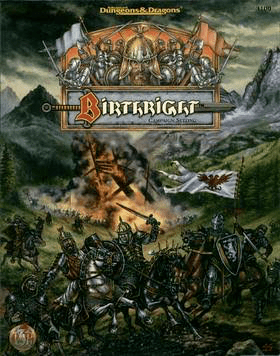
I’m going to start with the Birthright Campaign Setting, as one of the big surprises was that war and political intrigue was envisioned as a major part of this edition. Birthright cares about the minutiae of managing a kingdom more than I imagine any players will, but intrigue and war are directly incorporated in the Domain Turn, which basically is a series of larger-scale actions including the movement of armies, the cost of moving them, and politics in general. The idea of incorporating a formal Not Adventuring Phase has already been floated in response to other rules implications, so using this Domain Phase as part of the core rule set makes sense.
In Birthright, Domain Turns are seasons, if a PC has a domain it’s assumed they have a cast of characters surrounding them, random events initiate each season, you gain and spend power and chunks of 2000gp, to raise armies, build and upkeep holdings and castles and hold court. How you do these things impacts your popularity among the people. Domains have a level of population and development, and for each level you can build 1 holding of each type: law, temples , guilds, resources, plus as many armies, courts, castles, lieutenants, trade routes, and treasuries as you can afford to support. There’s got to be some kind of domain character sheet to manage all this, but I suspect it’s simpler than it appears.
The fun Intrigue is domain actions: Agitate, Espionage, Build, Grant, Decree, Muster, Order Troops, Declare War, Diplomacy, Finance, Trade. There are also character actions, which means this is literally just a downtime phase. Each action is a little subsystem, but I think these could be aligned – they already are – and simplified. Honestly, they scream for clocks: Random progress, you can hurry it along with power or gold, you can set two actions in motion per season, plus adventure. The size of the clock might relate to the action or to the intent of the action, and the subsystem structure clumsily supports that, rather than the tables of bonuses and penalties, I’d just do an increase difficulty list and decrease difficulty list, or do a position/effect thing.
The designers of Birthright clearly were wargamers, but my sense is that again, AD&D 2e players don’t want a wargame, they want to direct armies and fight in battles as decisive strike forces. Army building is already in the core rules, but Birthright expands it to larger scale, using unique troop types. To capture this, I think a Risk-like simple force size approach would be more interesting, with social forces being worth 1, 2 or more troops, but costing exponentially more. Declaring war gives you four moves, but you can buy more with more Domain Actions. Movement also costs 2000 gold or 1 power. Defenders can choose to retreat rather than fight, but won’t learn the power of the opposing force. There are terrain rules which contradict the DMG, and I’d simplify to passible by land, sea, or air. Castles count as a free troop. We need some kind of rule for strike forces: Perhaps a decisive strike (an adventure) would add a troop to the attack – this is a strange and unexplained omission. Wars end with peace treaties or total defeat.
Overall, this is a really neat framework for a downtime phase for AD&D 2e, keeping systems simple and familiar. There’s an advantage to systems across pillars (to borrow a fifth edition phrase) mirroring each other, but for downtime to be fun it needs to be quick and simple because it’s relatively solo. I also feel it should be tied to mid-level proficiency: When you get a holding at 9th level, you get access to rulership proficiencies, but perhaps you don’t get all actions at once, maybe you choose your sets. This way, the party might need to work together as rulers as well as as adventures: More rhyming systems, more maximising utility of existing systems.
Next up, The Complete Paladin’s Handbook. I’m looking for more information on alignment, and that appears to be in Chapter 3: Ethos.
- If laws are just and applied fairly, it doesn’t matter whether they originate from a democracy or a dictator.
- The paladin must act within his means: It is no failure not to stand one warrior against an army.
- Kill to promote the greater good, or to protect himself, his companions, or anyone whom he’s vowed to defend.
- Patrons impose commands, instructions, and traditions that must be followed to the letter.
- Always be courteous, honest, honourable and valiant.
This is better than “lawful good”. Give the paladin a list of solid rules they can’t break unless it would be pointless to their patron, and then have them defend their borderline choices choice before court. Cool. There are rules for courtly love, which needs to be core paladin downtime in my opinion. Should all classes have unique downtime? Wizards do!
The Complete Ranger’s and Bard’s Handbooks fails to address the alignment requirement in any meaningful way, although the animal companions become interesting NPCs, rangers get an ethos similar to Clerics, and an interesting reputation mechanic that functions neatly as a proficiency (the first sign of the d20’s supremacy) is introduced for bards.
There are remaining gaps in dungeon exploration, suffering from the focus on wilderness exploration and movement subsystems. Wandering monsters are mentioned but no rules are noted, but in random encounters it mentions a 1/10 chance, every 6 turns, plus loud noises, and encounter tables by level. This is clumsy and feels like a transitional phase to the complete lack of dungeon structure in later editions. It’s assumed in a bunch of sections, but its not clear to me if the designers regarded it as a residual appendage or something so essential it didn’t need to be mentioned.
The rules in the DMG on “monster reactions” (which, I admit, I missed until I went searching for systems supporting social pillars of play), are the flight-friendly-indifferent-cautious-threatening-hostile scale, but apart from in the bard reputation optional rule and the performance rules, they aren’t reference. This is to suggest that the concept here is that there are minimal social rolls unless you have a special power or ability, but that the right talk, bribe, etc. can move you up and am down the scale. It doesn’t state outright that this could be universalised, but it’s implied by the bardic rules I think.
I think these all of these rule sets would benefit from being drawn forward from a common point, instead of being unique systems. Ethos could be standardised or even worked into alignment. Reaction and encounters could mirror other systems sensibly, potentially drawing from downtime or proficiency structures, or reflecting the theoretical environmental interaction simplifications.
Now looking at the Monstrous Compendium 1 for extended creature stats. All entries get ecological data (climate, frequency, organisation, intelligence, alignment, diet, active cycle, habitat, society and ecology) although these are absent if they’re not relevant. In terms of mathematics, we have treasure, AC, movement, HD, THAC0, Attack #, Damage, Special Attacks & Defences, Magic Resistance, Morale, XP and Tactics (called combat). The DMG gives this abbreviation for random encounters: Creature—APP #, AT #, THACO #, D #, AC #, HD #, MV #, special notes on attacks and defenses.
When reading through a selection of modules (A Wizard’s Fate, The Price of Revenge, The Iron Orb of Duergar and Kingdom of the Ghouls), they add Morale and Treasure. References to any other mechanics apart from spells are very rare (I found references to wisdom and strength checks (only mentioned, now that I look back, in the PHB glossary as a roll-under), save vs massive damage, percentile penalties to thieves skills, and damage as weapon).
Summarising thoughts: I think I have enough gaps filled by now to begin developing an approach to Advanced Fantasy Dungeons. I doing think it will end up being a retroclone, but instead a kind of paraclone or anticlone: What second edition could have been had the designers had free rein, or perhaps what third edition would have been if they had focused not on the detail but the intent of the second edition design.
The difficulty will be to avoid pulling more modern design decisions into it. It’s screaming for clocks and usage dice, and finding a solution that isn’t anachronistic will be challenging. Do I have to? Both of those solutions came out of retroclones of earlier editions. Do I need to set myself limitations, or should I design whatever I desire and see what comes, keeping in the spirit of the original text?
Speaking of which, that spirit is well summarised in fifth edition terms: A fantasy role playing game, built on five pillars: Combat, Exploration, Social, Intrigue and War. A role playing game that changes its nature as characters gain experience: Not all pillars are available at all experience levels, downtime changes and supports different actions while still supporting play over large distances and long time periods. Support for a broad range of solutions to any problem, but those solutions are unique to specific characters to give them their own spotlight in multiple domains. I think this is the game that Second Edition is trying to be.
So, I’ll start trying to write that game. Should I do it, live, on this blog, or work offline and publish it all at once, or publish it in development on itch.io? Please, let me know in the comments!


 Playful Void
Leave a comment