
If you’re walking in on the middle of the Advanced Fantasy Dungeons series, there’s an index here.
I realised working on monsters, that I didn’t have a saving throw table for each class or for monsters (which are, in second edition, as warriors). The saving throw rule is:
If you are attacked, make a saving throw by rolling 1d20. If your position is controlled, roll with advantage, and if it is desperate, roll with disadvantage. On a full success, take no damage and no effect. On a partial success, take half damage and temporary or partial effect. On a failure, take full damage and effect.
The save you roll depends on the type of attack: Domination for psychic, enchantment, or death magic, Poison for physical fortitude, Wands for magical attacks, Transformation for anything that changes the nature of your flesh, Steel for physical attacks and Ill-Fortune for all else.
Second edition has this table to calculate your saving throw. Based on this we have for each class, a strong and two weak saves.
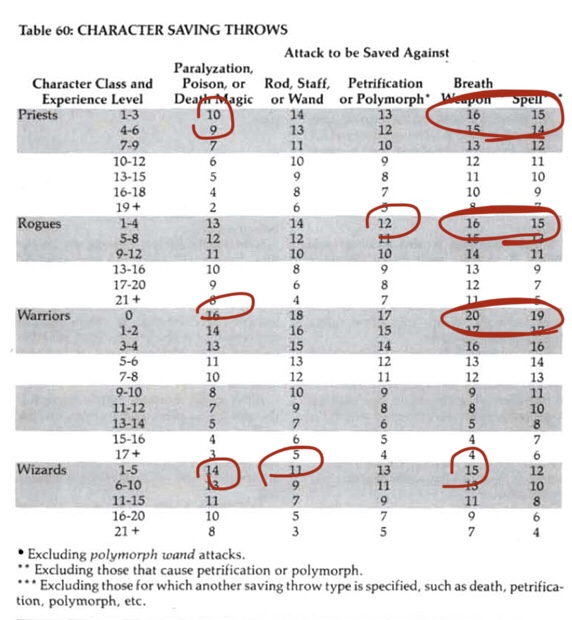
Or, focussing on strengths, you could say that warriors are strong against steel and poison, wizards are strong against wands and transformation, rogues are strong against steel and wands, and priests are strong against domination and transformation. Nobody is strong against ill-fortune, and there are plenty spare combinations for the supplementary classes I expect to appear.
But what does strong mean? And what are we rolling against? I like incorporating position here, but really positioning should change consequences, and be GM-facing (more or less). Maybe I need to go back and talk about consequences and positioning as part of the basic procedure – because it really should be. If I do that, I can forget about it here, and different classes can have advantage on different saving throws. Disadvantage, is not mentioned, mirroring ability checks.
If you are attacked, make a saving throw by rolling 1d20. Roll with advantage if your class has advantage on that saving throw. On a full success, take no damage and no effect. On a partial success, take no damage and full effect, or half damage and temporary or partial effect at GMs discretion. On a failure, take full damage and full effect.
The save you roll depends on the type of attack: Domination for psychic, enchantment, or death magic, Poison for physical fortitude, Wands for magical attacks, Transformation for anything that changes the nature of your flesh, Steel for physical attacks and Ill-Fortune for all else.
If I’m mirroring ability checks, we need a unique saving throw score, just like an ability score, between 0 and 20. We should generate saving throws exactly as we generate ability scores or, we should relate them directly like in fifth edition. It adds unnecessary complexity to randomly roll them; but it also gives the potential for interesting contrasts and balancing; I’m inclined to give both as options at character creation.
To generate your saving throws, either roll them as you’d roll for your ability scores, or derive them from your ability scores: Domination is equal to your intelligence score; poison to constitution; wands to dexterity; transformation to charisma; steel to strength and ill-fortune to wisdom.
Warriors have advantage against steel and poison, wizards are strong against wands and transformation, rogues are strong against steel and wands, and priests are strong against domination and transformation.
Looking at this rule, honestly, it feels a bit overpowered: Advantage on one saving throw is enough, because it’ll stack with heritage options like the halflings. In addition, the generation rule seems overly complex.
To generate your saving throws, either roll them as you’d roll for your ability scores, or assign the value of each of your ability scores to a saving throw.
Warriors have advantage against steel, wizards are strong against transformation, rogues are strong against wands, and priests are strong against domination.
But, by divorcing saving throw scores from class, I’ve caused a monster problem; albeit a minor one because only boss monsters use saving throws. Basically, do I scrap saving throws for monsters altogether (and relate them to the success of the PC’s roll), or do we give them a specific array? Or we give certain monsters the ability to inflict disadvantage for a saving throw? Or we just make inflict disadvantage on an ability check or saving throw a hard move? That last one, I think. So, when a monster says “save as”, they can cause disadvantage on those kind of attacks as a move (wands and transformation for example). I’ll have to add the the monster conversion rules:
A monster requires the following statistics:
Number appearing, attacks/damage, save as, armour, hit dice, movement type, morale, treasure type, special notes on attacks and defences.
All numbers are compatible with the basic and second edition versions of the game, except for armour and morale.
It may be beneficial to in addition add information for the GM’s inspiration, on frequency, organisation, intelligence, ethos, diet, sleep cycle, climate and habitat, society and ecology, or tactics.
If using a monster in B/X, if their B/X morale score is <5, their morale rating is 5; if their B/X morale score is 6-9 their morale rating is 10; if their B/X morale score is >10, their morale rating is 15. If the monster is in Second Edition, use their morale rating.
To convert an NPCs armour class in B/X or AD&D 2e to Advanced Fantasy Dungeons, consult the armour table and assign an equivalent armour type.
To convert a monster’s “save as” in BX, simply impose disadvantage on attacks for their equivalent class: Warrior equivalents impose disadvantage against steel, wizard equivalents against transformation, rogue equivalents against wands, and priest equivalents against domination.
Thoughts going forward: Disadvantage needs to be clarified in its role and it’s consistency across systems, I think, and likely this belongs in the GM section as a GM action. Having eliminated positioning entirely (but it still being a useful concept), I think that needs to be incorporated into the basic rules and procedure and GM actions.
I also realise that there’s no way to increase ability scores or saving throws; should increasing scores be possible? Second edition says no for ability scores, but yes for saving throws, which suggests saving throw improvement should be a common class advancement. I haven’t written class advancements yet, so I can add that in easily.
Finally, I need to revise the basic procedure section and the GMing section to include the concepts of desperate and controlled positioning, and how those things affect consequences. This is about consistency between systems, and the inconsistency that’s been baked into the piecemeal way I’ve developed this should be ironed out as I work things together into an alpha document.
This has been a part of the Advanced Fantasy Dungeon Series! Let me know your thoughts on saving throws! I don’t think I’ve missed any glaring things, but on the other hand I missed saving throws until this late stage so anything could happen.
Idle Cartulary
5th June 2022


 Playful Void
Leave a comment