
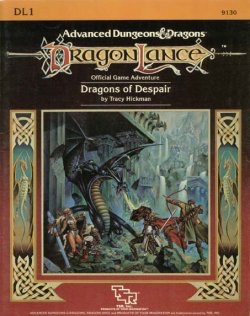
A few years ago I ran the AD&D DL series of modules, the Dragonlance Chronicles. They are a perfect example of the worst inclinations of the Weiss-Hickman plot-driven rail-roading modules that began with Ravenloft and continue to this day. I decided to pick it apart and place it into a sandbox. It worked.
However, I think the design I did wasn’t successful because of the methods I used to sandboxify a linear, plot-driven series of modules. I think that the success of the campaign was largely due to a minor introduction I made in order to simply communicate what the important aspects of the characterisations from the novel were: I gave each character a one-line internal conflict. This was both challenging and potentially dramatically dangerous, because it pitted a lot of PCS against each other, but also set up fruitful relationships with NPCS, again in ways that seeded drama into moments later in the campaign.
There was no relationship mechanic here, and no procedure for generating them. For this campaign, I went bespoke. But I think that these could be semi-randomly generated, and that’s what this post is about.
Why internal conflict and not external conflict?
The primary goal of the internal conflict is to complicate decision-making, not to provide opportunities for drama. The big dramatic moments will come when the internal conflict is resolved; in my experience, this occurred organically, and created interesting play opportunities when it did. An example of this is that a slow-burning pair of PCs with a troublesome marriage resulted in one of the pair turning coat on the heroes, which turned the tide in a major battle.
Creating an internal conflict
So here’s my basic working definition: An internal conflict refers to a struggle between two opposing values. Our list of values (this isn’t the right word, quite, but I’m not sure exactly what the right one is):
- Desire, such as your desire for power over others through magic.
- Need, such as the need to keep your vampirism secret or face doom.
- Duty, such as your duty to protect your sworn lady irregardless fo risk to yourself.
- Fear, such as your fear that your brother will not thrive without your protection.
- Obligation, such as your obligation to obey your Lord Father in his commands.
We need to take these values and combine them to create our conflict:
- I desire to be a powerful wizard more than anything, but to do so I would have to abandon my brother.
- I desire the love of my fiancé, but my duty to my Goddess will always come first.
- I will be executed if I return home, but I fear being captured by the villains that pursue me.
So, let’s randomise this process. You’ll need to repeat this process twice, once for each value. Roll 1d10 for your value. On 1-2. Desire; 3-4. Need; 5-6. Duty; 7-8. Fear and 9-10. Obligation. Roll 1d10 for what in the world the value relates to: 1. Home; 2. God; 3. Family; 4. Friend 5. Enemy faction; 6. Friendly faction; 7. Sibling; 8. Magic 9. Riches; 10. Body. Roll 1d10 if you need assistance in determining the relationship between the value and the world is 1. Devoted; 2. Antagonistic; 3. Dependent; 4; Unaware; 5. Treacherous; 6. Protective; 7. Authoritative; 8. Dedicated; 9. Coercive; 10. Aggressive.
If your table is using world anchors (you may have noticed that the third of those lists is adapted from world anchors), it might be beneficial to tie one or more of your values to your world anchors.
Finally, be sure that there is some intrinsic tension between your two values if necessary, by adding an extra clause to your sentence:
- I desire to be a powerful wizard by studying with the great wizard Grabimoru (Desire/Magic/Dependent), but to do so I would have to abandon my brother who lives to protect me (Obligation/Family/Protective).
- I desire the love of my fiancé who wishes only to keep me safe (Desire/Family/Protective), but my duty to my Goddess will always come first, and she wishes me to bring her healing back to the world (Duty/Goddess/Dedicated).
- I will be executed for treason if I return home (Need/Home/Antagonistic), but I have a duty to keep the tumpkins safe from the murderous grolgs (Duty/Friendly faction/Aggressive).
Linking internal to external conflicts
A secondary goal of the internal conflict is to provide the GM with opportunities for temptation. Cursed magic items, grey-aligned gods and wizards, bribery and corruption: Internal conflicts provide chances for PCs to lean into these things without simply being characters who make poor choices (most players don’t like to make suboptimal decisions). This is where the GM has the opportunity to create external conflicts from the seeds these internal conflicts grow.
Resolving internal conflicts
You can definitely do this by discussing it with a player; they can say “No, I think it’s time that my character makes the decision to no longer put his brothers needs before his.” It may involve discussion with more than one player if necessary. It’s up to the player whether or not the resolution of the conflict is the end of the story for the character, or whether they develop a new conflict for them.
Well, I was hoping I could have a simpler list, roll d66 for an internal conflict, and maybe that’s possible too. I suspect if I spent enough time analysing literature I’d find that there is a limited number of internal conflicts that we could compress to a table, but I don’t have energy or time to do that analysis. I’d love to see someone who did!
There are a number of ways we can use this! Firstly, we can get players to generate them for their characters, discuss them with each other, and decide whether any of the people involved are PCs. But perhaps a better solution would be for the GM to use the spark tables to generate a d10 or d66 table of campaign-specific internal conflicts, that each character can be randomly assigned. If I were to do this, I’d ask that the relationships be evenly split between PCs and NPCs if possible. I feel like a list of internal conflicts would be a more fruitful approach than the typical d10 hooks that we get more often in campaigns and modules.
10th February 2023,
Idle Cartulary


 Playful Void
Leave a comment