
Bathtub Reviews are an excuse for me to read modules a little more closely. I’m doing them to critique well-regarded modules from the perspective of my own table and to learn for my own module design. They’re stream of consciousness and unedited harsh critiques. I’m writing them on my phone in the bath.
Oz is a 200 page city-and-more supplement for fifth edition written and illustrated (and with cartography) by Andrew Kolb. It’s a spiritual successor to the similarly produced Neverland, this time featuring the world of L Frank Baum’s Oz series rather than that of JM Barrie’s Peter Pan. I have the print book, so screen shots are taken from previews on Amazon, Drive Thru or Kolb’s personal website.
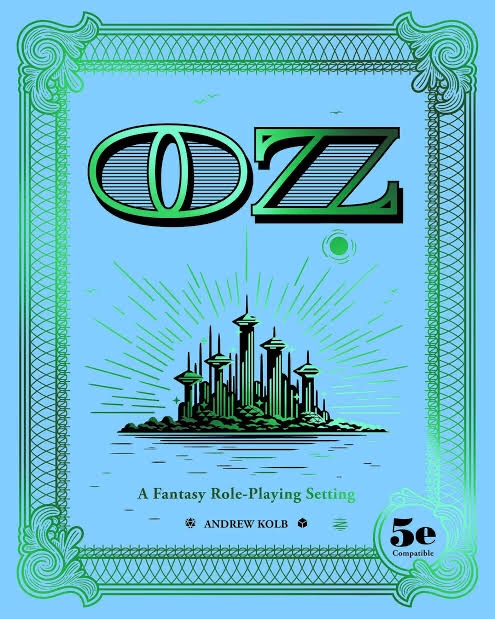
On first impressions this is an intimidating text. Three column layout, tiny point size this is a very dense text from the get go. This is a monster of a book, an A4 paged, metallic embossed hardcover with a cloth book mark, full colour interiors, and affordable with the margins only available to publishers like Simon & Schuster. It’s not a premium product: There are plenty of these on the shelves, and it feels like a gaming product with style, belonging next to your copy of Tomb of Annihilation if you’re a quirky fifth edition player. It’s undoubtedly a more polished product than most elf-game products on the shelves, especially for something so idiosyncratic by a single author, and a sight better than anything else aiming for the fifth edition market.
The structure is similar to Neverland, although simpler: Rules and introductions, then bestiary and NPCs, then locations and finally a chapter of resources. I’m not sure what the right approach to orienting someone to such a huge non-linear text, but while it’s overwhelming, the first “what’s going on” spread does a decent job. When I say overwhelming, I mean “21 major characters and 12 major factions in 2 pages”, if you want to benchmark what I consider a bit much, and how could it not be a bit much in so little space? A nice addition is explicitly calling out themes so that the thematic resonance isn’t missed at the table; I know I have mixed opinions on whether the author should be discussing the themes of their work so explicitly, but honestly this particular work doesn’t communicate those themes particularly well through the text, and as someone whose experience of Oz is limited to the Scottie Young comic series, it’s appreciated.
Oz opens with what I’m beginning to suspect is the universal sin of module writers in the 20’s: Choose which four of the twenty one characters I just summarised to you will be the main four. I reiterate this a lot, but there is a place for non-specificity and this is an unreasonable ask when you don’t know the structure or politics of the piece. Just tell me about who’s in charge in your creation please! This whole spread is an exercise in offloading scene-setting to the reader in the name of replayability, which I feel completely misses the essence of what replayability means in elfgames like fifth edition.
We transition to rules, where a lot of energy is oddly put into defining terms, particularly point crawl and ‘local crawl’ (a generic dungeon crawl term). It’s odd because they are self explanatory to those of us who understand the terms, it doesn’t help anyone who doesn’t. They are also repetitive: there are different types of points to travel between — a subway map with multiple intersecting but separate lines — but the rules for each individual line are usually identical and always similar, and so spending multiple paragraphs on it seems redundant (derogatory) to me. There is also an advanced rules section which is largely pointless and dry, although the mapmaking section is pretty cool, featuring a method I saw first in this JP Coovert video method for streets, and a building designer that is excellent. The method needs support — tables — but those tables are in the back of the book, and no reference is given to them here — I had to look for them, a failure in my opinion. Referencing in general is present but not always when you want it to be. Overall, a bit like the rules in Neverland, these are overwritten for what they achieve, but there is gold in them there hills.
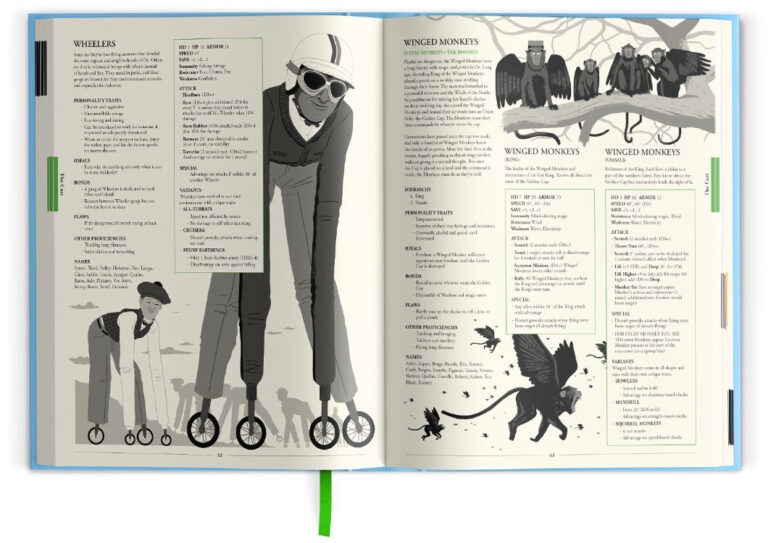
The creatures in this bestiary are very Oz-flavourful in a much more interesting way than Neverland’s were Peter Pan flavoured, and interact with the editions mechanics in imaginative ways. A serpent who spells out words to be resistant to, clockworks that become more strong the more you fight them, paper people with spells written under their clothes. Fun, unique stuff. My concern that major NPCs are scattered throughout this section, a choice inherited from Neverland that I don’t enjoy. Interesting, the trait/flaw/bond structure inherited from fifth edition character creation has had added to it a unique descriptor (for example “Wicked & Wonderful Leader: Animal, commanding, powerful, unpredictable”) which honestly in cases where it’s present is all I’d actually need to run the character (in combination with the chapter 1 information). This is the good stuff, and I’d love for Kolb to trust me more with this kind of writing rather than (we’ll get to it) the stuff he wants me to make up myself. I’m overall honestly a big fan of this bestiary, but it is worth acknowledging there are entries for as bland things as “animal, small” here too, so it’s not all roses.
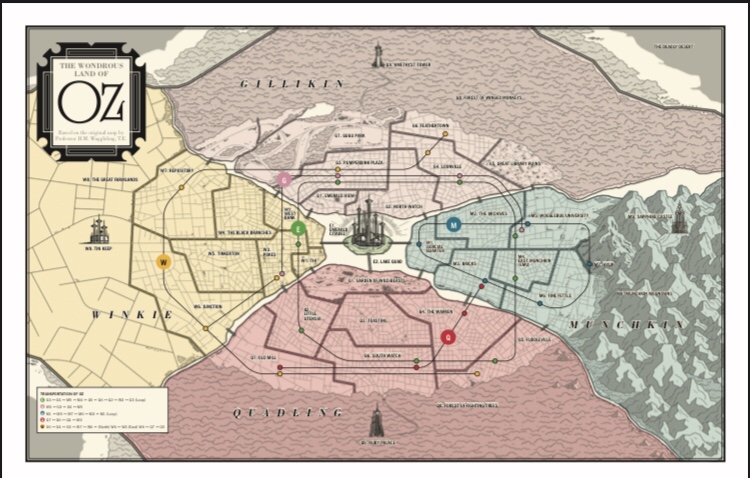
In the location section, the quick area reference is essential because of the complexity of the city (it wasn’t in Neverland, as the hexcrawl was relatively straightforward). But again after Neverland there are two maps! I just don’t understand this choice; they appear to be identical, one more abstracted than the other. The abstract one is much easier to read but doesn’t have information on terrain type. Front and endpapers also contain two different versions of the non-abstracted map than are in the book; one, the messier version, with better keying. But the cleaner map would tolerate the busier key better because it’s cleaner. That’s four separate versions of the same map with similar information in the one book. This design decision strikes me as absolutely bizarre. One could argue everyone will have a different favourite version but it’s a map, and this reeks of lack of faith in your design.
In the gazetteer, it is not at all intuitive what order locations are in in. At first I thought there was a train line followed by its stops, before I realised that it was by letter which wasn’t alphabetical but rather by first initial or the region name. For such a wordy book, this is something I probably shouldn’t have had to figure out. Unlikely Neverland, a variety of layouts are used to facilitate the different information for the different types of points here, which is a smart choice. Within each layout, the overall forms are pleasing, but the inconsistent placement of the same sections across different spreads makes information finding more difficult than it needs to be (for example the “first impressions” section moving about, a section I’d consider important to keep consistent). On train line entries, nice maps modelled after the London underground provide excellent usability. Unique NPC names for most locations make NPC generation a breeze, but again names are on one page, and the tables are on the other. The “stops” map appears on almost every page in the same location, but it’s probably the most recognisable section due to its unique colour use, and really doesn’t need the consistency; neither does “mood” which gets the same placement every spread and also has the same content. There enough of these perplexing decisions that I suspect some of the layout decisions are purely logistical (“how can i fit this on a page?”), or perhaps legacy (“I’m familiar with their placement in Neverland”) but disregarding those practicalities, they could be more intuitive.
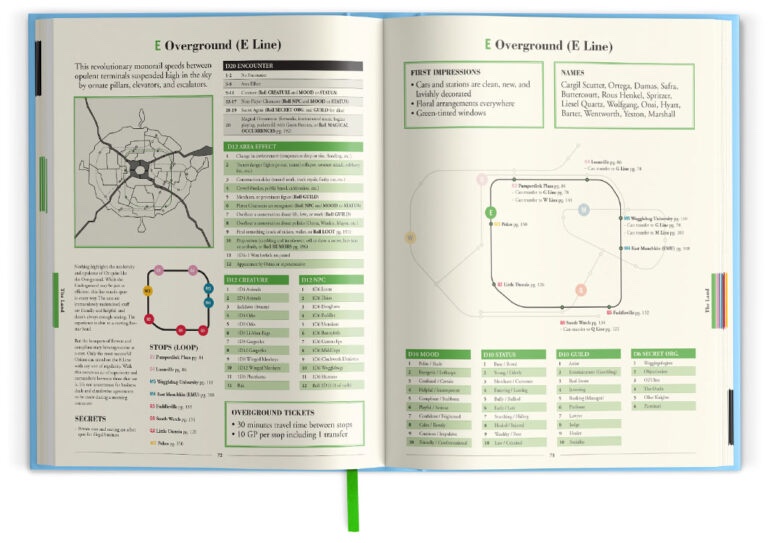
The contents and description of these is dry but flavourful, and delivered gradually in a pleasing way. Each location gets a single sentence summary, it’s location in the city, a longer description and a few secrets, delivered in increasing length. There are always a first impressions, usually some unique names, always train connections. Remaining spreads are used for navigation, events, specific characters, and more specific secrets. This is honestly a smoother and better iteration on Neverland’s system, but still generating on a visit to an area will take at most 4 rolls and potentially a few searches for pages (no bestiary page references in sight). This is an excellent version of this approach, but my favourite parts are universally the sections with specific characters and events in them, which are dry but well written: “Para Bruin. Captured by a group of bandits long ago and trained to box. Now free and happy to work for honey. Serious and suspicious of others” or “Fresh Dusting Bakery & Cafe. Tunnel leads to a safe space for those with dangerous or uncontrollable magic.”
Another significant improvement over Neverland is that locations that need maps, unique details and keying, appear in this section as well. This messes with the layout consistency in a third way, but makes it much easier to use them because they’re sitting right there next to their stop or district. I know this is the opposite opinion to what I feel about NPCs in the bestiary, but for good reason: NPCs need to be understood to run whole swathes of the book, so deserve to be separated from animals and grunts; locations on the other hand are usually best gathered geographically.
The final section is for resources, and it’s a pleasant hodgepodge. We have nicely non-mechanical “relics”, and floor maps for common recurring locations like banks and parades. We have random tables for adventures that for me are displeasingly nonspecific (“discover the identity of a prominent researcher”) when they could have tied directly into the locations and bestiary. An A-Z of random tables, some good, most disappointingly generic. An example is a d12 ceremonies, which, rather than give us twelve interesting Ozian ceremonies as it assures us “Oz is all about ceremony”, it gives us general categories of ceremonies. Contrast this with the small talk table which is much more hooky despite being generic (“They keep quiet, but have a relative in power”) and the actually strong plot hooks and rumours tables (“An envelope containing a dose of the Powder of Life meant for Ozma is delivered to a PC.”; “Patchwork girl has been accused of stealing on four separate occasions”). I’m of two minds here: A lot of this stuff will be more useful to more people because it’s generic, but I genuinely believe that it robs Oz itself of its greatest strength, which is the weirdness of the land it draws from.
The resources section ends with a much appreciated m “external and complementary resources” section, a much briefer “sketches and design notes” section which I found more obnoxious in Neverland, and a few pre-made characters that are absolute bangers; an angry turtle and a clockwork boxer. None of this “stock characters with a relevant hook” malarchy, these are pure gold, pulling absurdity into fifth edition by way of James West’s Black Pudding.
Overall, this is a book that tries to be usable at the table and largely succeeds. Kolb’s writing style is dry at best, and when he isn’t leaning into the specificity of his setting, it falls very flat, but in the places where he does lean into the specificity of the setting, it soars. The layout and organisation of this book are leagues ahead of Neverland and most of the competition, although it is not without its mistakes (or perhaps compromises), and while I remain surprised Neverland hasn’t had a more significant impact on module design, I’d be very surprised if this more polished version doesn’t have an impact in a few years time.
I brought Neverland to the table a few years ago, and I think that Oz is more flavourful, better organised, and easier to use than Neverland was. Not something I’d often say of a city supplement compared to a hexcrawl. I think I’d grow weary of Kolb’s constant need to let me know that I’m making the world my own, though. I want to hear his take on Oz more, and less vague prompts for my own take. When he’s showing me his version, Oz shines.
I’d be remiss not to compare this to other city supplements, like Fever Dreaming Marlinko and Magical Industrial Revolution. For me, these two products in particular are flavourful in their bones, and do not fall prey to the assumption that I need help to make it my own. On the other hand, each of the three have their own unique flavours, and neither replicate each other in that regard, nor are they particularly compatible with each other if you want to develop a fantasy city of your own. If you’re looking for a city to run, my recommendation would probably lie with Fever Dreaming Marlinko; but if you’re looking to make your own city, or you adore the atmosphere of a darker, more political Oz, this book has a lot to offer. I really like this approach of taking public domain properties and turning them into settings, there’s something fun about it, but I’d like to see other voices try their hand at these large-scale beloved-public-domain-to-sandbox conversions.
11th July, 2023
Idle Cartulary


 Playful Void
Leave a comment