
I was supposed to go to a miserable family party today, but my wife is sick, so instead I’m going to read BREAK!!, one of the most long-anticipated games in recent memory. I’m not going to call it a review, because I don’t have time to play BREAK!! right now (maybe I could run a playtest in BREAK!!?) It’s more of me answering the question of whether BREAK!! is something that will ever come off my shelf and hit the table.

For those who don’t know, BREAK!! is a diy-elfgame inspired by manga, anime and roleplaying video games in the vein of Zelda and Final Fantasy. It was a huge kickstarter hit, and the beta was just released to backers. I’m going to call it Break from here on in because the punctuation is jarring.
From the first pages, Break is beautiful, in a maximalist layout kind of way. Most pages have full colour art, sections are colour coded, random dice rolls are on every page for the GM, complex headers communicate where you are in the book and which way to move. Font choices are simple but effective. Break is aiming for the same league as Pathfinder 2 and 5e, and it shows.
The choice of structure and the introductory sections reflect this aim, as well: The introduction (aside from a sidebar for the RPG initiated) is aimed at newcomers to the hobby; it opens with 200 pages of character options, competing on Princess Play and OC grounds with the well-funded leagues of Paizo and Wizards of the Coast.
As a forever GM I burn out on character options, but boy these are unique in terms of availability in roleplaying games, mechanically well supported, adequately complex, and manage to compete on the same terms as the big two while maintaining continuity with a completely different tradition.
I don’t think I’ve discussed my problems with all the poorly realised criticism aimed at 5e by indie designers, but the tl;dr is that the criticisms all come from GMs because 5e is really bad at supporting GMs i’m their role. But it’s really really good for players who love the scaffolding that the nigh infinite player options provide in creating the character of their dreams, supported not just by their imagination but by the rules of the game, and in the growth of that character. BREAK!! Does a decent job of replicating the early stages of that scaffolding (although it would take significant work to catch up with their release schedule).
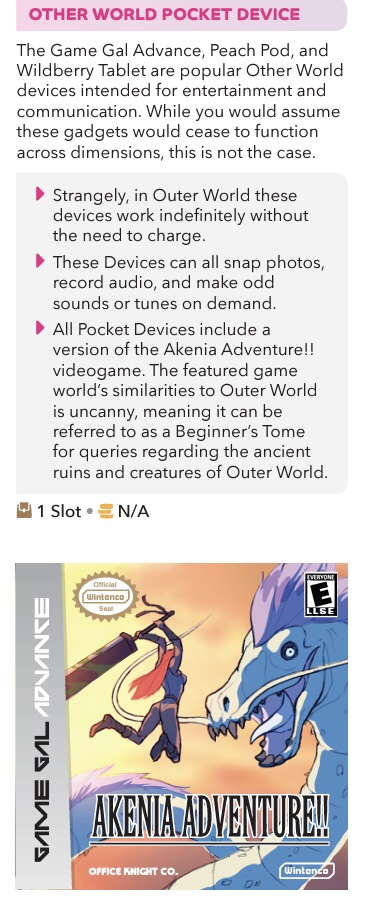
I won’t go into detail, but we have callings (not classes) from our world with mobile phones, two contrasting princesses, and people who just aren’t special at all, all who appear balanced and mechanically unique. They get species, traits, histories and quirks. I enjoyed making a character (apart from gear, buying gear in games of this scale always sucks), and it didn’t take very long at all. Oh, and the gear here is cool, most having unique powers attached to them instead of just a damage dice. And they’re flavourful. The negative: The gear section is ridiculously long.
Honestly I think Break nails the player-facing side of the game, at least in terms of standing proud against the competition. Does it nail the GM facing side? Here, 5e is a low bar to clear, but Pathfinder 2, while requiring a 101 college course to master, once you have it it’s easy to run.
The dice are d20 roll under; I prefer the simplicity but I think it’ll be alienating for the players it’s poaching. It’s got numerical bonuses and advantage and disadvantages (a rose by any other name, “Edges” and “Snags”). It’s overexplained, in the grand tradition of its competitors, but as much as it grinds my goat it knows its audience.
Look, I don’t love the journeying rules in Break, but they are so much better than the core travel rules in anything in the same field, I could kiss the authors. Anyone who reads this blog knows I spend a lot of time struggling with travel, but Break chooses well-trodden paths that suit the style of of the audiences they’re aiming for, while actually proceduralising them nicely for easy of use. Good GM support. Oh, just love there are special rules for giant monsters. Creature maps and strike points. It looks like it’s be a great time. Monster Hunter campaign coming right up.
Journeying is one of a bunch of what they call “Focused Rules”, which are basically procedures for specific types of interactions. Or, a more apt analogy for the inspirational material: They’re minigames. Negotiations, combat of course, perils (traps and collapsing roofs), downtime and crafting are included here. Some of them are great, some of them I think are a bit too much. I don’t know how likely it is that everyone at the table has a copy of this tome, but without it say goodbye to crafting or downtime being a part of your game. Regardless, these procedures are great ways to support your GM and players in a broad range of play reminiscent particularly of roleplaying videogames.
Ok I hate lore, even well written lore, but I have to say Break nails it, where you can flip to the continent for a list of ways to describe and embody it, then to the region for more detail. It’s not quite “use it at the table” good, but it approaches it.
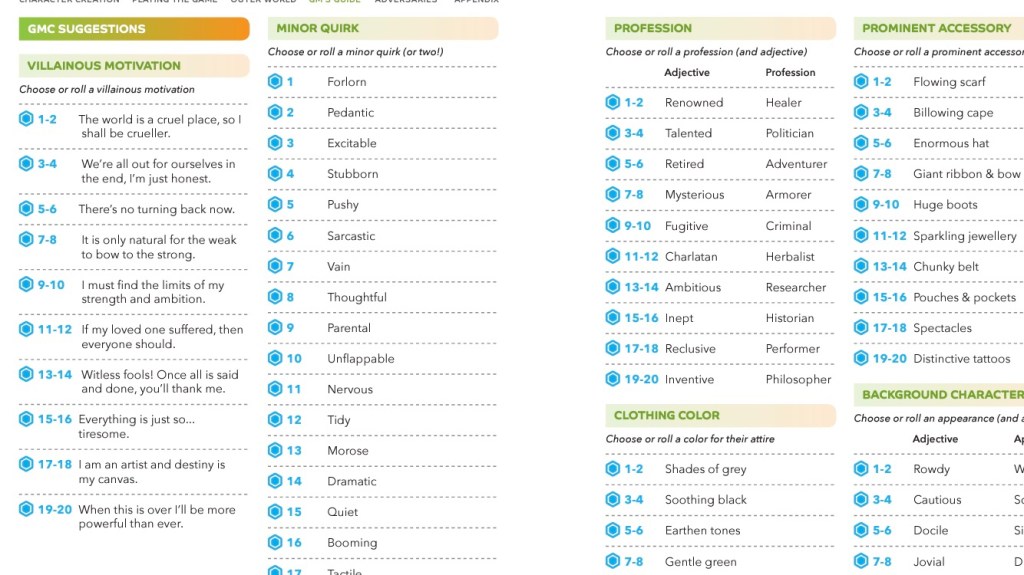
Eugh, the Being A Game Master section. There are a bunch of these “how to RPG sections” I’ve skipped over, and gosh I find them repetitive and mind-numbing. They’re definitely written with the 12+ age category in mind. And keeping that in mind, they’re also trying to subtly retrain you out of bad habits you might have learnt from other games that don’t provide so much support. That said, if I were to run Break, as someone only intimately familiar with two or three of its referents, the spark tables are pretty excellent. It’s another example I think of knowing your audience, and it’s just not me.
There’s a bestiary. It’s pretty, with cool creatures in it. They each get a spread. It seems a bit much. There aren’t dedicated rules that I could see for mooks vs bosses and final bosses (actual game terms), it feels excessive to have a two page spread each for a dozen mooks. I’m certain there must be rules about this somewhere but I couldn’t find them, even by perusing the index and by searching the pdf. [Addition: GreyWizard, one of the authors, piped up in the comments, locating where mooks and bosses were delineated. and there’s no concrete advice in terms of encounter design and enemy difficulty. This feels like the diy elfgame coming out in the creators, but i don’t like it as a design choice here.] Here, the GM scaffolding falls short, which is a concern for a combat heavy game (there are a bunch of summaries and chest sheets in the appendix, which would help a little, but not enough).
This is one of my peeves with this type of game: It takes a lot of familiarity with the rules for me to properly understand them. I strongly doubt there are major flaws in a game with a ten year development cycle, but it doesn’t mean that flaws aren’t going to creep into my game because of the depth of complexity. I’m only getting the pdf, and I think that was a waste of money, because I could never run this without the book in hand and I’d spend months getting up to scratch with the rules.
But that’s what it’s trying to be, so I can’t fault it. BREAK!! Is what you get when you try to write a competitor to 5th edition, with a completely different Appendix N, and a solid knowledge of the elfgame blogosphere at your back. It is packed to the gills with love, attention to detail and character. There are a few missteps I think, but for the audience that it will appeal to you this outpaces 5th Edition at its own race. Like, if I could sell my old 5e group on it, and I played it for a while, I reckon I’d grok it and enjoy it a lot. I think I’d have more trouble selling it to them than Pathfinder 2, though, which would take a similar amount of effort for me to learn and run. And when push comes to shove, the pitch is key for me wanting to fork out $160 including postage for a full colour tome.
23rd July, 2023
Idle Cartulary


 Playful Void
Leave a comment