
Bathtub Reviews are an excuse for me to read modules a little more closely. I’m doing them to critique well-regarded modules from the perspective of my own table and to learn for my own module design. They’re stream of consciousness and unedited harsh critiques. I’m writing them on my phone in the bath.
Howl is a 44 page module for Cairn by Colin le Sueur, re-released this year. It’s a horror adventure with folkloric themes, that has yet to be released in print format. I’m reviewing the PDF. It’s stated influences are Ravenloft and english folklore, but I’m seeing a module in the style of Against the Cult of the Reptile God, which is an old favourite of mine.
The “Running the Adventure” section is three sentences. The modules text proper starts on page four. Howl is an exercise structurally in getting to the point, and I am here for it. The summary of the adventure is neatly presented and limited in scope in such a way that I have trouble making room for alternative ways to progress; this can be a good thing for a small scale module with a specific story to tell.
This is a major challenge I think for small modules set in their own unique settings. The setting brings character and uniqueness, which is valuable, but if you give me a unique setting I’m less likely as a player to abide by the meta of the exercise: There is one interesting thing here, please investigate it. If I’m instead given relatively little in setting, it’s easier to incorporate the story of interest into my own, and the players are more likely to want to abide the meta. Here, I’m not sure the investigation will be at the front of the players or the characters minds, because they have multiple competing interests that aren’t directly addressed by the module.
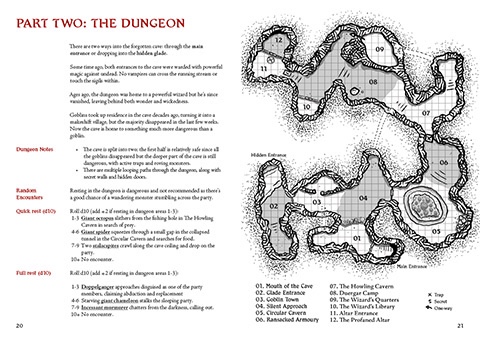
Howl is the first example of an adventure I’ve read that uses the Classic Explorer Template by Clayton Noteskine, and excellent tool that I fear will result in a plague of similar looking adventures. As the first, though, Howl looks excellent, particularly the body text with bold simple colour choices and minimal in text font switching. The trade off is an overused sidebar, containing some headings and tags for the body text, in addition to mini maps and exits. These mini maps are a great addition, an a huge improvement on using abstract maps in isolation, a trend I’m seeing more and more in zine modules of late. Art and maps range from excellent to poor, the latter a result of the scourge that is the desire for spot art in adventure modules. I’d rather no art, than art that doesn’t add to the module, although there are a broad range of ways to do so.
The module begins with an elegantly handled shipwreck, where success provides the party with additional hirelings — survivors of the crew. If you want a scene with a necessarily foregone conclusion, this is how you do it. I’d probably prefer if it was more overt: You won’t save the ship! Do what you can to save the crew! This would also help to set the tone so the party is more likely to address the horrors that are to come.
The writing here is workmanlike and applied with Gygaxian thoroughness, making for very toyetic scenes, but not always the most evocative. An example is the first encounter with the beast that is the center of the adventure:
The shadow of a hulking black beast with menacing red eyes glares down at you, as if peering into your soul; after what seems like an eternity, it turns and disappears into the darkness.
I want my writing, especially read aloud text, to be full of descriptions I’d never have thought of. This one, a key moment in the adventure, needs more bang in it. I can see the author is capable of this more evocative writing:
The pond opens into a sprawling underwater cavern, impossibly deep. At the limits of vision, strange shapes undulate and writhe in the shadows. Studying the shapes adds the name “C’tegra” into the character’s inventory…
So it’s disappointing to see it not applied evenly; my gut feeling is that the clarity of the structure here works against the authors inclination for prosody. This makes for an exceptionally usable text, particularly a very fun and toyetic dungeon in part 2, but detracts from the horror elements significantly.
But, you’ve heard me say this more than once already, the content here will make for some very enjoyable sessions, if you accept that you might have to bring your own horror. There are mysterious vials, magical lions with manes of moss and mushroom, glow-poisons, unique spells. Two solid factions to interact with. An excellent small dungeon. My only criticism of the dungeon is that the factions aren’t as well signposted as everything else in the adventure. It would have been an easy fix, I think.
The town follows a fairly typical structure, but one that I’m not especially enamoured with, which is that certain characters have certain information, turning the social situation into a potential fail state. I think it would be more effective if all the rumours and secrets were separated from the characters, ensuring information is always available.
The big twist ending doesn’t quite land for me. It is intended to expand the world into a Ravenloft-style dark kingdom, with an evil queen (and if you’re reading my work outside of reviews you know I have Opinions about this), but the manipulation doesn’t quite make sense, the revelation also doesn’t quite make sense, and this is a long standing problem with vampire lords in elfgames in my opinion: Nobody’s quite sure why they’re there. I have figured my personal answer, and I suspect the answer for Howl lies in the sequel which is yet to be released, but at the moment this is a little unsatisfying.
Howl overall then is an excellent village and dungeon after the tradition of Against the Cult of the Reptile God. Drop it into your campaign for a few sessions of good eerie dungeon crawl fun, which you can run right from the book. I’d probably drop the shipwreck and the final twist as right now, it would be more fun to take what you find and learn here, and continue adventuring in your own world.
Idle Cartulary
Playful Void is a production of Idle Cartulary. If you liked this article, please consider liking, sharing, and subscribing to the Idle Digest Newsletter. If you want to support Idle Cartulary continuing to provide Bathtub Reviews, I Read Reviews, and Dungeon Regular, please consider a one-off donation or becoming a regular supporter of Idle Cartulary on Ko-fi.



 Playful Void
Leave a comment