
I Read Games reviews are me reading games when I have nothing better to do, like read a module or write or play a game. I don’t seriously believe that I can judge a game without playing it, usually a lot, so I don’t take these very seriously. But I can talk about its choices and whether or not it gets me excited about bringing it to the table.
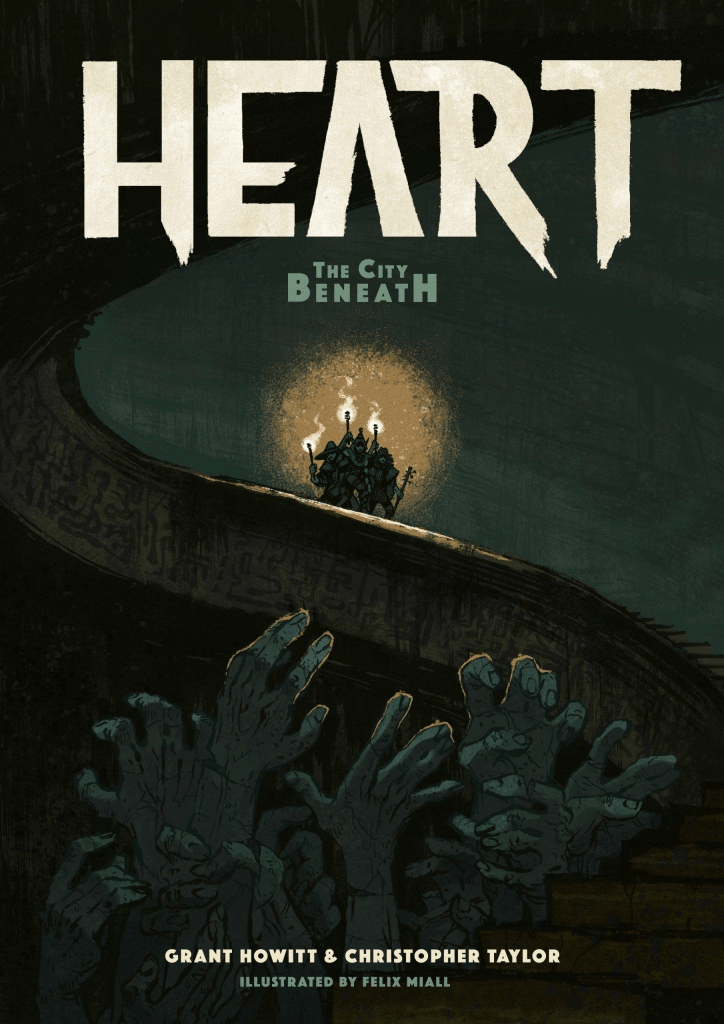
I was going to playtest my new module Hiss today, but I couldn’t get numbers, so instead I’m going to read Heart: The City Beneath. Heart is a large format hardcover game by Grant Howitt and Christopher Taylor, that uses the Resistance system popularised by Spire and is set in the same world, but this isn’t a game about rebellion, it’s a game about dungeon delving. I heard great things about Heart, and I’ve been excited to sink my teeth into it. My first exposure to it was the heavily modified version played by Friends at the Table for their Sangfielle campaign, which was exceptional, but which I admittedly burnt out on after a dozen episodes as I do with most FATT seasons.
Heart, like Trophy Gold, believes that dungeon delving is inherently an existential horror fantasy: “Each player character is fundamentally doomed, as most of the high-level abilities kill the user when triggered. This isn’t a game about long-term exploration and growth. It’s about flawed, obsessive people making bad decisions.” I love horror dungeon crawls, but my concern with the storytelling about the inevitable doom of your characters approach is that it removes the kindness and optimism from the game that usually exists in the form of your characters actions: They are brave, they think they’ll be ok, and in traditional dungeon crawling, the game is born of those who survive, not those who are doomed. Here instead of retirement, they always die.
Heart is wordy as all get out, from the get go. The writing isn’t punchy, but it’s good. It’s written for people new to the hobby, so a page on “what does a player do” numbs me a little, especially as, and I’m sorry about this Grant, I find it hard to believe any new players are picking up the horror dungeon crawl spin off of the dark elf rebellion game as their first roleplaying game.
It’s also pretty. Striking colours, well set out for a dense multicolumn layout. It could use space, but the claustrophobic choices, if perhaps not intentionally, are evocative of the theme. The art is consistently excellent by Felix Miall. There’s something exciting that occurs whenever a single illustrator does a whole book.
The basic rules to the resistance system are six pages in the book, and are summarised in 1 page at the end of the book. It’s a resource management game at its core, with five resistances, which are basically hit point pools, and a some skills, and areas of knowledge. You make a pool of dice, roll it, and act accordingly. The interpretation of the dice roll is a little fiddly, but nothing if compared to, say, the Genesys system which I’ve had successful games in, so I dare say you’d get used to it quickly.
Most of the rules are character creation, and most of that are classes, which are not even slightly generic and are flavourful in a way that isn’t to my taste: “the Vermissian Knights do their level best to understand the parasite reality and protect others they find there” is a great class, but both the knights and the Vermissian itself get a decent amount of exposition. I’d honestly rather this be a “Psychic maelstrom” of Apocalypse World type of vague amorphous concept, which is something this book does with the Heart itself. The class powers are interesting and flavourful, stuff like “You get everyone out alive, if not intact” and “Incarne’s presence thrums through you; you are resplendent, terrible, and hard to look at directly.” with mechanics attached to these excellent descriptions that are admittedly, far less exciting although useful (“Once per situation, if you are wearing your Debtor’s Reds and incur stress, you can mark stress to Supplies instead of another resistance.”).
The Rules in Detail section takes a relatively elegant ruleset and completely murders it. Suddenly the tier of challenge relates to different dice sizes of stress, there are two ways to determine the results of actions depending on how many dice you roll, healing stress occurs in different ways, combat has actions, fallout is in a huge multi page list of specific types that you’ll have to remember eventually. It’s a mess. I don’t mind a complex game, but the complexity here feels like flaw and not something that will contribute to strategic decision making. There are a few positives, though, like the structure for “delves” (off-road travel) which are neat and well structured, akin to a GM driven variation on skill challenges which make them very easy to run.
I despise the Running the Game section in Heart. It needs to read and learn from Apocalypse World 2e, because it’s a solid 20 pages of tips, that probably should have been reduced to half of that more more likely a quarter of the length. If it’s all truly that important (it’s not) it needs structure instead of paragraph after paragraph of conversational text. Technically, it appears there are large swathes that you can ignore, but I still have to scan it all and it’s a huge incomprensible drag. It even ends the advice with “you’ll never stop being nervous”, which is supposed to be reassuring, but honestly fails to be after twenty pages of things to remember while you run a massive complex book, and it’s not true at all,at least for games that aren’t Heart.
I rail against gazetteers on this blog all the time, and the World of Heart section here is no different. I was first exposed to Heart in Sangfielle, an actual play where the players all designed the world together and hacked Heart to fit it. That world had absurd amounts of lore and depth, but they made it themselves. It had power. The best thing in this section is the summary, because I’d actually use it, but it’s also the driest piece of writing here. I want it to be like this but dripping with flavour! That said, I do like the general usability of the individual landmarks, and if I limited myself to preparing to run 1 tier (equivalent to levels) and the delves between them, maybe it would be manageable.
The bestiary is five-star, honestly. Buy the pdf just for the bestiary ideas. There’s a hive of flightless owls, and burning pitch people. It’s good stuff. The legendary creatures — bosses — have generic names but fascinating descriptions and power sets, which is a weird choice I usually associate with science fiction, and I think undermines the world building elsewhere in the book.
The problem with Heart is that by reading the rules, I can’t see what the complexity adds, given at it’s heart (no pun intended) it’s no different to the skills system of, say, Trophy. Complexity is necessary and beneficial when it adds strategy and tactics to the game. Blades in the Dark and Lancer do this in different ways, but the complexity very clearly behooves them. I cannot see, nor get excited, about the implications of the complexity here.
Back when I read Spire, my impression was “this is cool, but it’d be better if it were Blades in the Dark”. The forged in the dark system just would have worked better for the story it was trying to tell, which was aptly demonstrated by Brinkwood using forged in the dark to tell a story of rebellion. As I read Heart, and am increasingly bewildered by its slow-drip rules that keep appearing the further into the book I read, I think something similar: Why don’t I adapt the good bits to some other elfgame with better rules?
Because there are good bits. The locations are good, and the spontaneous pointcrawl is a good idea that feels the mutant offspring of Nick L.S. Whelan’s flux space and Emmy Allen’s Gardens of Ynn depthcrawl. The vibe is Annihilation by Jeff Vandermeer meets megadungeon. I like that encumbrance and equipment is all folded into a resistance, it’s an elegant solution. But I don’t want to play these rules. They’re cumbersome eggs to begin with, and then they start to scramble them.
If you’re willing to put up with a wretched ruleset, or you’re already familiar with and enjoy the resistance system, and you like the idea of Annihilation meets megadungeon, the vibes here are impeccable. If not, I wouldn’t rush to buy this, although it’s a beautiful product. Listen to Sangfielle, which nails the vibe, read Annihilation. Buy Wet Grandpa or another module with annihilation vibes. Or if you’re really keen, and you loved the world of Spire, maybe buy this with the aim to adapt the contents to your game.
17th September, 2023
Idle Cartulary


 Playful Void
Leave a comment