
When I’m running a draft dungeon, I love giving the player characters a fairly sure escape option if they encounter something that they’re not prepared for. This is how I do it.
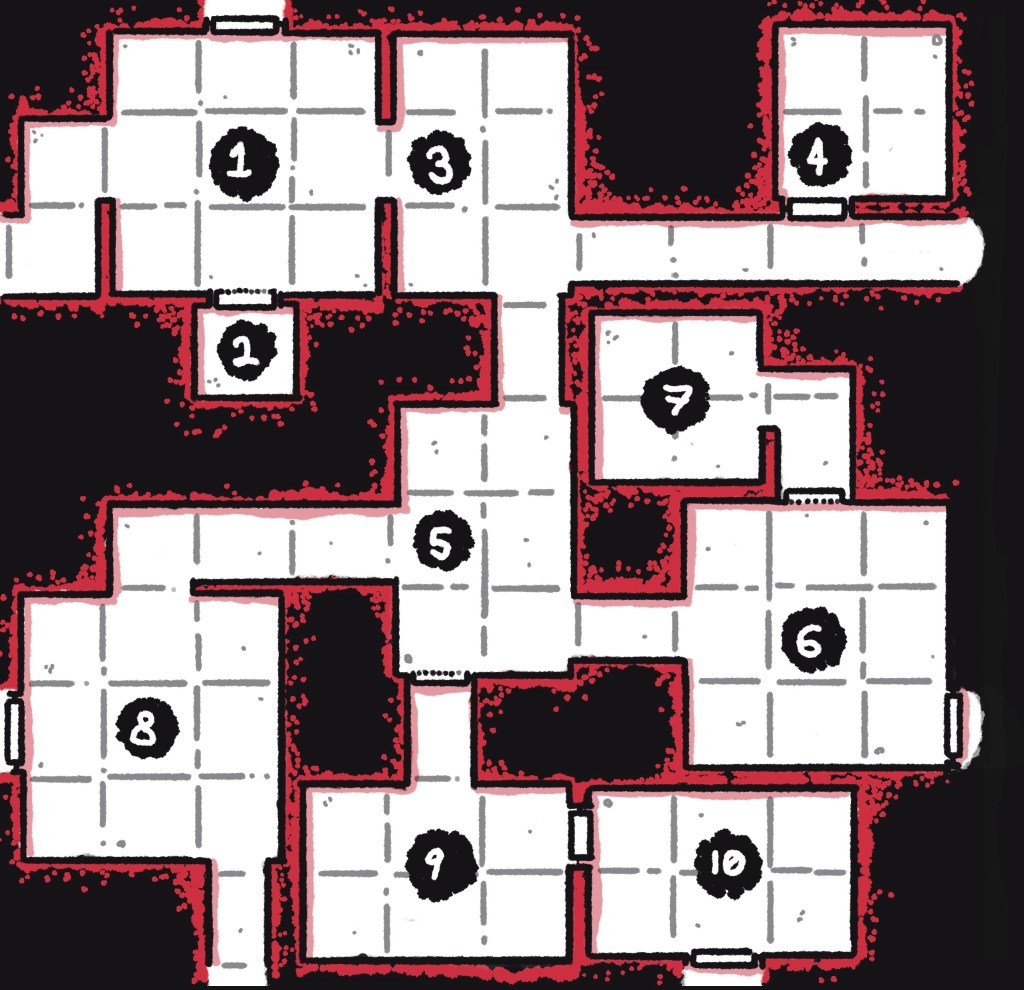
The players characters entered through the eastern door in room 6, and find the secret door to room 7. Oh no! An ogre! They’re not prepared for it. They choose to flee: They get a chance of losing the ogre, at risk of getting lost in the dungeon. They need to flee through 4 rooms to escape as the ogre has 4HD.
I count 4 rooms. There’s only one exit from 7, so they are in room 6 (first room). There are two exits from 6, and I roll west to room 5 (second room). There are three exits from room 5, and I roll north to room 3 (third room). There are two exits from room 3 and I roll west to room 1 (fourth and final room). They’ve escaped the ogre. My description is a frenzied and impressionistic overview of the rooms they’ve been through, and then I describe their destination room in detail as Id explain any room.
That’s if there are no hiccups! What if there are traps or monsters in the room? If there is a trap they would trigger, they receive damage and stumble onwards as part of the fleeing description. If there is a monster, the monster is surprised, and I allow a choice: Do the players dash past them or do they interact with the monster. In the first case I roll a reaction roll to see how the monsters respond) — they only chase if they roll hostile. In the second case, I’ll give them an exchange to interact with the monsters before the Ogre arrives for a more complex encounter.
If there’s a hidden or secret door that I roll, I’ll usually allow it (depending on the kind of secret — I’m more likely to allow a trap door covered with a rug than a statue that requires a puzzle to be solved unless they’ve already solved it) and give a bonus room, as the ogre is more likely to have trouble chasing, and I’ll describe it as hiding in the secret room while the ogre searches for them.
I enjoy this, particularly in larger dungeons, as you can accidentally end up on another level of the dungeon and with no clue where you are. More difficult opponents are harder to flee from (or perhaps impossible in a small dungeon, resulting in a surface world confrontation or chase).
Gus L suggested that you could choose dungeon landmarks rather than exits to travel between, which is a neat idea in a larger dungeon particularly if you were designing it around a major xenomorph-like creature. You could also add additional rules around using tricks to distract the ogre or to flee faster, if you wanted to, or to incorporate territories in your dungeon to flavour your flights. These I think would be great again, if the dungeon was intentionally the kind of dungeon where it’s balanced towards more difficult challenges.
One proviso: In my opinion, this works quite well in most systems, but some systems with softer levelling take a little more customisation; I play Cairn a lot, and I use a factor of HP there (half HP to be precise) just because creatures tend to be tougher there. Your mileage may vary, but I want it to be not too tough to escape in terms if number of rooms, because there are additional risks in terms of traps, other monsters and getting lost to consider as well.
Hope you enjoy this little mechanic,
Idle Cartulary


 Playful Void
Leave a comment