
Bathtub Reviews are an excuse for me to read modules a little more closely. I’m doing them to critique a wide range of modules from the perspective of my own table and to learn for my own module design. They’re stream of consciousness and unedited critiques. I’m writing them on my phone in the bath.
Tomb Robbers of the Crystal Frontier is a 62 page module written and illustrated by Gus L. The version I’m reading is for OSE, but it’s also available for Errant. It’s a module designed to introduce the inexperienced to the experience of dungeon crawling, and while the introduction implies that this is for the players, the referee gets a decent lesson too. A bonus module is also included, Common Grave, as well as a wealth of appendices expanding on the Crystal Frontier, itself a unique and interesting fantasy setting with a strong western twist, although the dungeon itself could drop into any setting, albeit as a fairly gonzo addition.
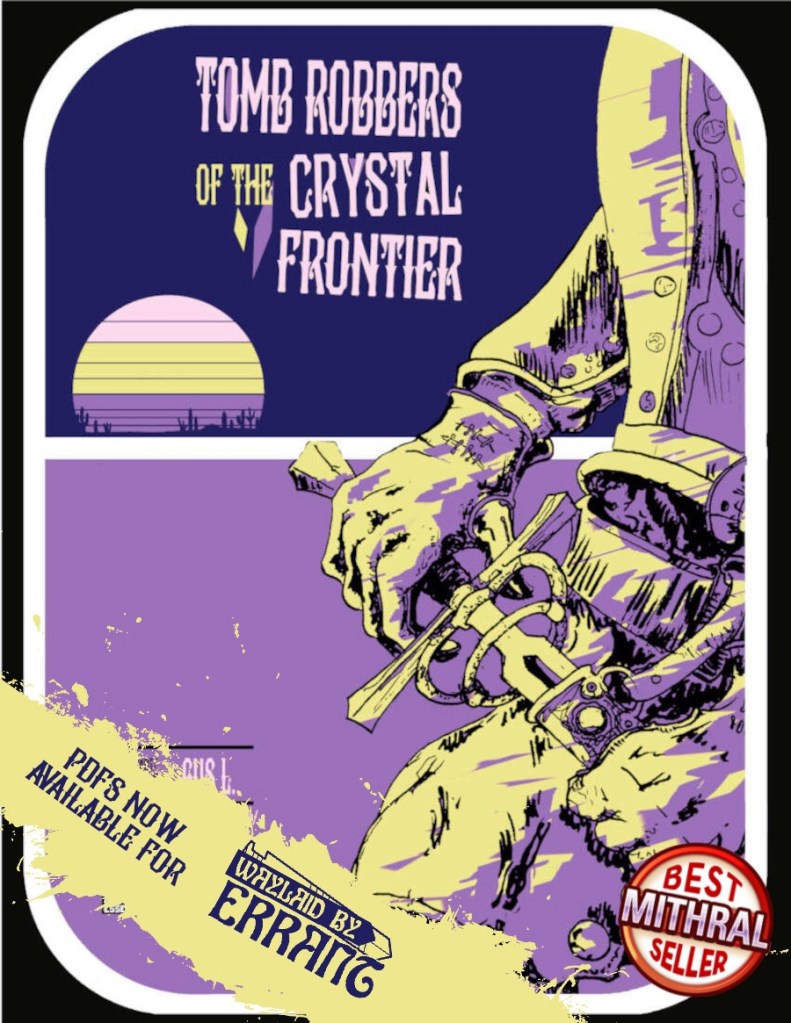
I’ll start with the thing that initially strikes you: This book is hot. Gus’s art is excellent and stylish, as are his maps, which are very legible in addition to striking. There’s a piece of art for most spreads, but colour on every page, as the signature lavender is used to differentiate a range of texts, as well as some decorative flourishes. The layout is incredibly striking, and up there with Ultraviolet Grasslands with regards to strikingly good looking modules. However, the lavender highlights can be deceiving: there is some differentiation between stat blocks, alternating table rows, and referee advice (referee advice is all bold for example), but not enough, I feel like the lavender may be a little overused as a background colour, as it means you can’t differentiate at a glance between these things, and perhaps the lemon highlight might have been better for differentiating one of these. Bolding is used judiciously in the main text (although overused in stat blocks and referee advice), and no italics or other typographic variations are used making for a very clean looking page with clear indicators for points of interest. While I like the choice of font as a cover title choice and high level headings, I think it’s overused in lower level, small text headings where it’s less legible and appears transformed in various ways depending on the need of the page, which is jarring.
The referee advice is clear and succinct, providing a defence of the elements of a dungeon crawl that the author believes are essential to play being enjoyable. I think it’s excellent, and helps the referee, especially a new one, answer the question of “why” when it comes to the procedures. I really like the way it describes combat, in contrast to the Principia Apocrypha: “Asymmetrical-encounters encourage treating combat as a puzzle rather than a gamble.” I’m reading the original version of the module, for Old School Essentials, and the main lack here is the fact that I find encumbrance in Old School Essentials somewhat clumsy and finicky to interact with. There is a new version of the module for Errant, which uses a slot based encumbrance system, and I feel like this version would lean into some parts of the author’s advice much more strongly.
The dungeon itself is keyed clearly in a traditional style, with a strong voice evocative of the unique setting. Interesting choices are made early on about revealing the history of the dungeon that I appreciate — a viewing room, but one that punishes you excessively lingering there. It’s a little too wordy for my taste — some of the traps could have afforded less explication in my opinion — but given the stated audience of the module is introductory, clarity appears the priority here. It does appear to be aggressively edited for a particular degree of brevity, which is about half a page per room. This is perfectly digestible, although for me the choice of prose rather than dot points for this particular dungeon would slow play.
“But Nova!” you say, “While the text is wordy, there’s a map in the endpapers that contains a complete, much briefer key to the dungeon!” I want to love this, and I love the idea, but I’m left a little unclear as to what the purpose is: I can’t run most of these fairly complex rooms from the map by itself even if I knew the rooms well and it doesn’t reference page numbers. My gut is that it is best positioned as a way to get room descriptions across in a simple way, but it’s a little too terse on this point. A very clever idea, that needs to be iterated on to maximise its usefulness. A rare occasion where I’d have preferred a busier page, I think.
It’s an 18 room dungeon, and room for room these pack a punch. One particular excellent feature (it helps that the author is also the illustrator), is the trap visualisations for areas 8, 11, and 12, making some complex traps far more legible. Blank players visualisations for these traps come attached, as well. The rooms are heavily interrelated, so paying attention in room 2 will help you draw connections throughout the dungeon. There are key factions — characters, really in this case — that will almost definitely interact in such a small space. There are killer traps, but they receive a huge amount of foreshadowing. This dungeon would be a pleasure to play in.
But it could be easier to run, I think. The summary of the factions at the beginning are too brief, for me to run from, but the appendix is overwhelmingly detailed for me. I could boil it down, and admittedly the prose is a pleasure to read, but it’s a layer of prep I don’t want in a short dungeon crawl. The referencing in text is unclear and often a source of confusion rather than clarity. The intent is to make clear the connections between rooms and factions, but it’s unsuccessful. This is somewhere a page or room reference would have been far preferable, as used in Lorn Song of the Bachelor and Reach of the Roach God. I think some of the appendix contents might be best placed elsewhere, especially the faction and crystal rules, which appear likely to be a major part of play. In the context of the clear intention for this to be a minimum setup straight-to-the-dungeon module, the appendixes expanding the local settlement Scarlet Town and frontier in general, feel like they belong elsewhere, perhaps in a future Crystal Frontier setting or sandbox (if I recall, the Crystal Frontier is the authors home game). A few missteps here then.
The bonus Common Grave is a disappointment by comparison to the titular module, not featuring a fraction of the attention to history or to character. Still well-described, it becomes an exercise in risk management, choosing extracting treasure from the many tombs in fear of impending random encounters. It’s pitched as a low level module, but I wouldn’t play it before playing the main module as it’s less successful as a teaching tool, and afterwards it would be a disappointment. Sadly, there’s no clear levers for this module to incorporate additional character or to communicate the history in the text to the players, and it wouldn’t be amenable to hacks, but it might be salvageable as a tournament style crawl, in competition with a real or fictitious second party. I wouldn’t buy this for the bonus module.
Tomb Robbers of the Crystal Frontier is an exceptional module. Its clarity of intent goes a long way in creating a strong, cohesive whole. Almost all of the authors guiding principles are clear and well elucidated, and work in concert with the content. It’s not a long dungeon, but not short, with probably enough content for three or four sessions, and it outperforms both Lair of the Lamb and Tomb of the Serpent Kings at their stated goals. Something that would be a pleasure to run for either beginners or for a more experienced group, in my opinion, and one of the better dungeon modules out there. I imagine it would perform even better in Errant, so if that’s a system you’re interested in running, I’d pull it off the shelf.
Idle Cartulary
Playful Void is a production of Idle Cartulary. If you liked this article, please consider liking, sharing, and subscribing to the Idle Digest Newsletter. If you want to support Idle Cartulary continuing to provide Bathtub Reviews, I Read Reviews, and Dungeon Regular, please consider a one-off donation or becoming a regular supporter of Idle Cartulary on Ko-fi.


 Playful Void
Leave a comment