
Bathtub Reviews are an excuse for me to read modules a little more closely. I’m doing them to critique a wide range of modules from the perspective of my own table and to learn for my own module design. They’re stream of consciousness and unedited critiques. I’m writing them on my phone in the bath.
Lorn Song of the Bachelor is a 48 page module, with simplified stats that cover a range of retroclones, by Zedeck Siew, with art by Nadhir Nor. It’s a bit challenging to categorise: On a background of conflict between a colonising company and the local culture, the Gleaming Fins, a monstrous crocodile wreaks havoc, and the key to resolving this three way conflict lies in an ancient recreational center that has been warped by the psychic power of the crocodile. It’s a dungeon-crawl, to be sure, but there’s a lot more to it than that, and the lead-in to the dungeon itself is some of my favourite writing in a module. A bit of context here: I was actually doing a close read of Lorn Song of the Bachelor for a guest spot I did on Dice Exploder last week, and I realised that I’d never reviewed it and now, while I was immersed in it, was probably the best time to do so. So I wrote this in the days following that recording, and I’ve put off publishing this until after the episode comes out, as there is some overlap, and I wouldn’t want to steal any of Sam’s thunder.
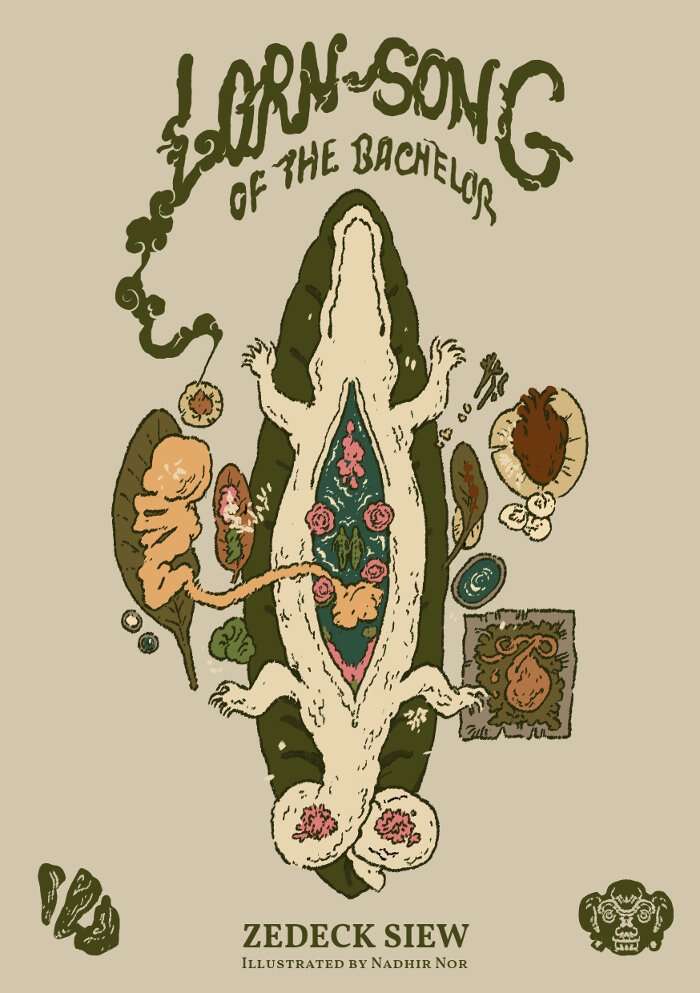
Lorn Song of the Bachelor is a beautiful 48 pages. Published as a book, it’s zine length, and between its generous white space, Nadhir Nor’s artwork that often feels sparse despite being abdundant with detail , and the bold headings I suspect that by word count it could have fitted in half as many pages. Some people would rail against a module being ‘padded out’, but not I. I think because of the layout by Dai Shugars, it absolutely sings. A module that would be hard to read in shorter format due to its density, is a pleasurable narrative read, as well as being useful to play by virtue of clear headings and consistent patterns with regards to locations and descriptions.
Zedeck’s word choices are subtle and intriguing, drawing you inexorably towards the final room of the dungeon, creating a symmetry between world, dungeon and monster that is beautiful, makes the world easier to understand, and enables an interactivity with the way the players interact with the world that is without peer here. The only negative here, is that the best way to read this book is not at the table — which is my preference — but rather to read it cover to cover more than once before you bring it to the table. But it’s readable from cover to cover given its brevity and the compelling writing, in a way that modules rarely are.
The reason Lorn Song begs to be re-read is because its dedication to terseness and to interconnectedness is difficult to appreciate a first read. It is possible, if you played this directly from the book, that you’d experience some of this interconnectedness emergently, as it’s very intelligently ordered to facilitate a sense of narrative throughout a read, and so you’re likely to encounter certain facts in a certain order. But I suspect multiple read throughs, and having the referee truly immerse themselves in world that is created in Lorn Song, would result in a more integrated and compelling experience.
Normally, I’d quote the words of the module here, to prove that indeed the writing is beautiful, but a great deal of the beauty in Lorn Song is hidden under the surface, with certain aspects of the writing being deceptive in their apparent simplicity, but revealing layers in the context of the whole. It is rare the sentence or clause that doesn’t feel chosen very particularly. A few lines will often up-end the entire work, but similarly, if you miss those few words, your experience will be unique. and perhaps not as intended.
In comparison to some other works of Zedeck that I’ve reviewed, Lorn Song is discreet and unselfconscious, and I sense conflicting trends in his writing: Lorn Song offers very little except for its words and its arts, making a little accommodation for statistics. It does not tell you how to run it, it does not talk about itself. It does not defend its choices. It simply is. In contrast with more recent works like Roach God, which provide rules and methods and explanations, it is silent about itself. In such a way, it kind of deserves the beautiful treatment more than Roach God does, which, despite the glories it does reach at its best, at its worst feels like a grab-bag of goodies from a beautiful home game, rather than an independent and coherent work. Lorn Song stands strongly, on its own, and asks you to interpret it.
And in the way that the best art does, Lorn Song makes me ask questions about why it is the way it is. For example, page 22 is spent on a short series of tables that together describe the passages you pass through in the dungeon that follows, known as the Old Ruin. There are more words spent on describing these passages, than are spent on any given room in the Old Ruin, although the rooms are given more space and illustration. Why is this here, I wonder? Is this intended to suggest that the journey here is more important than the destinations detailed ahead? This choice comes at significant cost to the referee and the other players, in this case: The referee must spend their energy generating and synthesising some quite wordy descriptions, and the players lose information that might inform them about the rooms ahead.
Certainly there are missteps here. While Zedeck’s writing is a hugely redeeming factor, there a number of generators here — one for Gleaming Fins folk, one for medicines — that would be best refashioned as more specific and briefer sections. There is a bestiary at the back, which has been relegated there for the sake of payout, but which renders the text a little less useable (although this is a common foible, and I forgive it this because it makes for such a compelling and readable module).
The one place that Zedeck speaks about this work is in his notes, on the last page before what I suspect is the inside cover. Here he lays out his thesis in the open-endedness and subtlety that the text displays so far. This defence is buried in the center of the notes, as it opens with an explanation of the Bornean story upon which Lorn Song is based and ends with a suggestion to support Bornean creators. But it’s the kind of brief and intelligent defence that doesn’t do the text any harm in its explication.
Lorn Song of the Bachelor is not Zedeck Siew’s most ambitious work, and hence does not reach the heights of Reach of the Roach God, but it has a directness and unselfconsciousness to it that I find incredibly charming. I saw a quote once, and I cannot remember who to attribute it to, or the exact words, but it was along the lines of “A film-maker will keep making the same film, over and over again, for their entire career, trying to find what drives them to make it”. Lorn Song of the Bachelor feels the purest representation of whatever Zedeck has been attempting to make, and I look forward to what future attempts might look like.
Idle Cartulary
Playful Void is a production of Idle Cartulary. If you liked this article, please consider liking, sharing, and subscribing to the Idle Digest Newsletter. If you want to support Idle Cartulary continuing to provide Bathtub Reviews, I Read Reviews, and Dungeon Regular, please consider a one-off donation or becoming a regular supporter of Idle Cartulary on Ko-fi.


 Playful Void
Leave a comment