
I Read Games reviews are me reading games when I have nothing better to do, like read a module or write or play a game. I don’t seriously believe that I can judge a game without playing it, usually a lot, so I don’t take these very seriously. But I can talk about its choices and whether or not it gets me excited about bringing it to the table.
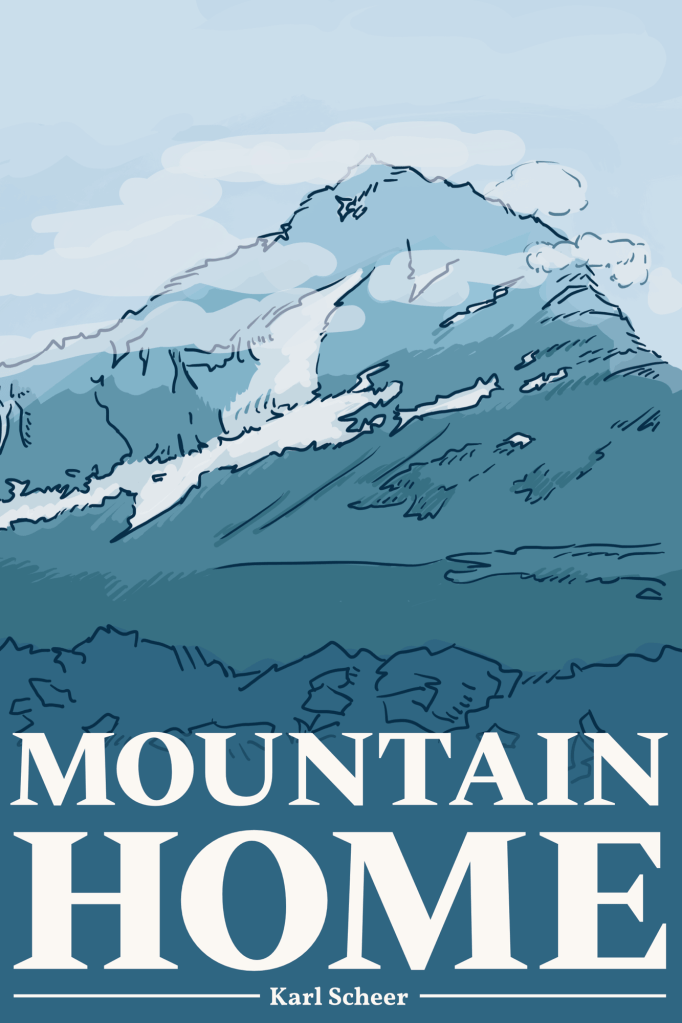
I threw a party for my 4 year old today, and now I can’t feel my feet, so I’m reading Mountain Home instead of doing necessary housework, while my feet soak in peppermint butter. After reviewing DIE:RPG and it being one of a multitude of fairly straightforward games, poorly organised to their detriment, that I had recently reviewed, I thought I’d review a complex game that is well organised, as a counterexample. I didn’t intend for Mountain Home to be that counterexample, but ah! Serendipity she visits us! Mountain Home is a 200 page game by Karl Sheer (duties including game design, writing and layout) about dwarves colonising a mountain. It’s in its final form, after a long development period in slowfunding on itch.io.
For anyone who is familiar with the Forged in the Dark framework, just how Forged in the Dark is Mountain Home? The answer is very, both in terms of sections and overall complexity. It’s been a while since I’ve run Blades in the Dark, but in terms of the core mechanical chassis, from memory this diverges almost not at all except for a few appropriate superficial changes, such as changing the actions to dwarfier versions, renaming vices to obsessions, trauma to weariness and position and effect to risk and reward. Everything you’d expect is there: Devil’s Bargains, Resistance Rolls, the phases diagram, playbooks. This is all covered in the first ten or so pages, although explicated in detail later. Ten pages in, I have an idea of how to play the game, that isn’t predicated on my previous knowledge of the system. It’s all here, softened for the PG-rated new theme, clear for beginners, and familiar to old Forged in the Dark hands.
But immediately it diverges: The playbook requires a little more customisation (less messy on the actual attached sheets than in the core book, sadly). Each of the characters (“founders”) gets a guild as part of their starting resources. A whole organisation! Based on the gang rules (I think that’s what they were called in Blades?) but everyone gets them and they’re a little expanded here. The playbooks themselves are almost all focused on resolving conflict through non-violent means (the Shieldbearer being the exception) and are flavourful as all get out: “A perpetually warm beer that heats your blood and prepares you for battle”, for the Artisan, “Just Like Old Times” for the Elder. They’re simpler than Blades of the Dark playbooks, but later we’ll see that simplicity is a trade-off for complexity elsewhere in the system. These early divergences are interesting, intriguing, and utterly at odds with the violent themes of its antecedents.
So we have the introduction to the rules, then the playbooks — and just the playbooks — and then we have How to Play: the aforementioned explication of the rules. This is both brief and thorough. It spends no time on poetics here: It describes the game clearly and in as few words as possible. And, if you’re familiar with Blades in the Dark or any other Forged in the Dark game, there are no surprises, except for some unique actions. You really can breeze through this chapter of you’ve played a few sessions of almost any derivative. And more concepts that contrast with its antecedents keep cropping up, despite a close mechanical hew: A cycle of phases, for example, usually a few days to a week in Blades in the Dark, are unambiguous years here. A game is expected to last about fifteen cycles for a much more leisurely pace, not indefinitely and ending in destruction.
The next chapter details the Settlement. The Settlement replaces the Crew, and again the pattern holds. It has tiers — the same ones! — and advancements and treasure! But wait, an end condition? Let’s talk about end conditions. These are really interesting, and a divergence from the typical Forged in the Dark pattern in a more contemplative and collaboration-forward direction: These are thematic goals, what answers we want from the story of our dwarven settlers. It feels akin to something we see more often in world-building games or like prompts more commonly seen in Dream Askew / Dream Apart and its descendants. This is a neat little addition, and again, moves gameplay subtly — this is a moment of your session zero, no more, but it shifts the direction of the entire campaign, because it dictates when the campaign ends, and that is when the questions you as players have about the settlement are answered.
Instead of Settlement types equivalent to different crews, we have goals — these are really just the story you’re interested in telling, whether you’re Thorin Oakenshield recovering a lost land or being driven from Erebor in the first place, among other options from stories I’m not immediately familiar with. Familiar stuff, just like Blades in the Dark! This is barely its own design — wait! Settlement map? There is no city here, and the tension of a zero-sum criminal game is absent; instead, we have a blank map and the tension of exploration: Because terrors lie in the deep, and other subterranean peoples, and dangers. But your settlement needs bargains and merchants and pubs, and you only find mushroom farms and gem mines in the depths so, really, the only way is down. I mentioned earlier that end conditions reminds me of narrative world builders, and here we have more world-building game influences. How do we do that exploring though? Oh, we have an expedition phase, not a score phase. This phase is follows this same familiar Mountain Home pattern: engagement rolls, methods, and then…wait, only one violent option, And the others are diplomacy, survey, forge or return home? The settlement phase does the same: It’s the same, the same, then there is…trade disputes? Union strikes? Earthquakes? Barrel taps?
What we see here is a really clever disguise, a lulling of the reader into a sense of security through the retention of familiar rules in straightforward ways; then once we arrive, realising that they are rendered in utterly different lights, and timeframes, and with utterly different objectives. This is not the lightly reskinned Blades that you see in Brinkwood, or in Sig, or in Scum and Villainy, and it’s not the brazen reimagining that is Band of Blades. This is a subtler beast. I’ve written this chronologically in order of chapter, and if you’ve been paying attention, you can see the game the information design is playing: A group of familiar mechanics, tried and true since 2017, followed by something new and surprising, usually something that turns the violent core of Forged in the Dark on its head. This is really clever information design.
We’re at the point in the book that the game expects all the players to read to: At this point, you’re very clear that this isn’t your teenager’s Doskvol, but rather your grandfather’s Council of Elrond simulator (there’s probably a better analogy to a PG-rated political text, but it’s not coming to me right now). I think 130 pages is a bit much to ask of every player to read prior to playing (or choosing to play), realistically. But, if you do get this far, you know exactly what you’re in for, and you’re probably already picking yourself a playbook and have a goal in mind, and if you’re still keen: The first session section comes next, and it’s time to play! I’ve mentioned before that this game appears inspired by world builders: Here, we do collaborative world building. There’s no Doskvol here. You make it yourself, in session zero. This is the point where the mask comes off, in my opinion: You’re in? Well, then Mountain Home’s cards are on the table: This is a collaborative world-building game, not just a politics simulator. Together we shape the politics of our exodus, what happens on the journey, and the spirit of the personified Mountain Home itself. Now, it must be said here: I think the degree of freedom here is a misstep for me. I’d prefer a slightly more concrete world with more evocative suggestions for threats and peoples. It’s really relying on your knowledge of the source material to fill in the gaps, and I think it’d be a more interesting game if it filled those gaps — the ones external to the dwarven settlement — with something concrete and evocative, even if I agree leaning to the anti-canon side of concrete is a good choice. I’m well documented to want games to bring the imagination and not require me to come firing on all cylinders all the time; or rather I’d like them to give me a track to race on rather than build my own. But wow! This is an interesting twist on the framework, yeah?
The running the game section — the GM section — comes next: This is bespoke stuff, clearly drawn from years of playtesting. The principles are beautiful: Carve the World From Jagged Stone, Delight in Their Creation, Emphasize Common Personhood. I’m a fan of directive-driven play, although I know a lot of players bounce off it, and I don’t think I’ve seen as compelling directives in just about any other game. And explaining the principles takes two pages! Amazing! Brevity is a blessing in a complex system. I already have a lot to juggle as a GM. A lot of this advice is, appropriately, recycled, and are to do with the grandfathered in mechanics; but new stuff on expeditions and inventions are really thorough and terse, the kind of thing you can flip through and fill out in ten minutes while the table snacks in between phases and then come back for the expedition phase to start.
Finally we have the lore and world building advice for the GM, because they need to bring the dwarvishness to life, and a bunch of spark tables to help when you get stuck. This is fantastic for the kind of exploratory and political play you anticipate here. But, it’s not equal to Doskvol, for the reasons I mentioned earlier: we get a lot on dwarves — understandably so — but not enough on the world they’re exploring. This is supposed to be collaboratively created, but as I mentioned earlier, I’d rather evocative and more specific prompts than these vaguer spark tables that are given. Duskvol understood that the important things to detail are the challenges you might face, but Mountain Home trips up here. Maybe. Maybe this is a rare failure of explanation in a well-explained text, because there is subtle but intriguing through-line here that player vs. player conflict is expected, because they represent distinct political forces within the settlement. There is a lot of time devoted to safety, and GM principles that include “Challenge Their Unity”. I think this would benefit from a more explicit discussion in the game text, as it’s both an interesting and challenging direction that this game is appears expected to veer into, over its 15 year cycle. But I wonder if the lore focus on the internal politics and culture of the dwarves is an implicit indication that this is a game where we are going to be largely plagued by internal conflict, rather than external conflict — certainly this is borne out by the settlement phase’s lists. To that end, the faction and claim generation stuff here is stellar, and lean into that in a way that makes more sense than in isolation.
I have a few design criticisms of Mountain Home, though: The sheets aren’t in the book. I’m not aware of a print version of this, but it’s tricky to flick between pdfs on a phone where I wrote most of my reviews, and space is infinite in a digital book, so there’s no reason they couldn’t be shown where they are referenced. The book is clearly designed such that you have the sheets in front of you when you read their explanations. Some of the lists, like buildings, really should be on the settlement map rather than in the book. But the sheets do exist, and they’re good ones: They elide a lot of the complexity, making the game much more welcoming from the first day, and I love the visual metaphor of the increasing depth of the dwarven delve being layers of paper on the table.
This is a complex game, as are most Forged in the Dark games. An immense mechanism of interlocking systems. But the structure of Mountain Home leads you gently through it, giving you moments of familiarity between twists and subversions, leaving one section into the next via questions raised in that section. The layout is not flashy and the art budget is modest, but the power of that art and layout is maximised by a focus on full page art for chapter separators (or to identify playbooks), and clear headings and heavy use of white space. Would it be nice to have more dwarfy art? Of course. Does it use those gaps to its advantage? Also yes. The combination between smart information design, clear consideration for section linkages, and clear if not flashy use of headings and in-text flags and differentiation, make for an immensely legible read despite the complexity of the overall systems.
It’s also interesting and important to that design commentary that there are a fair few examples of the lyricism of the author’s writing — I quoted a few flavourful moments earlier — particularly in the lore and oracles at the end, and so it suggests that the reversion of the voice in Mountain Home to a fairly technical and dry voice is a conscious one. There’s an artistic choice here, prioritising the clear communication of a complex idea over the choice to wax lyrical. There’s a humility to this decision that I really appreciate; a prioritisation of the integrity of the game text over the ego of the author. But there is a trade-off here: For me, at least, that lyricism is something I yearn for when reading a text especially of length, and while the compelling by system interaction and the constant surprise in this particular game keeps me reading, more concessions to the more beautiful writing in this book would be deeply appreciated.
It should be noted, though, that that complexity in concert with the lack of a pre-existing Doskvol equivalent means a lot more load falls on the GM, or at least the players as a whole if we assume that world-building is entirely collaborative. The GM irregardless really has to have this book under their belt, cover to cover. Familiarity with the broader tools is a necessity; I’d probably print a binder with all of the necessary rules and procedures and tables at hand. An explanation of how this gameplay loop looks at the table would also help: I imagine a session would be full of toilet breaks and snack trips where the GM frantically prepares something for the future; else the GM might prepare the whole claims map in advance and nary another moment of prep aside from faction actions. I’m curious the intent there, though, and some examples of play would help me bridge this gap.
There also is very little concession to wanting to play Mountain Home in different formats. This is a game that knows what it wants to be. There is a short section talking about solo play and about one-shots or shorter campaigns, but it’s clear almost from page 1 that it wants to be a 15 or so session campaign, and it’s tailored strongly to be that. I don’t feel like I need permission to hack or modify a game, and in fact it could be argued, having played the same games at many different tables, that we all house rule our games, often unconsciously. So for me, the focus on a core play loop is a huge strength in Mountain Home, rather than spending time and energy explicating game loops that are less than ideal in the eyes of the designer. I’m not saying there aren’t advantages in a broader approach: I personally would find it hard to commit to 15 or more sessions of any game. But the clarity of artistic vision is revelatory here, and the focus of the design benefits from it. This game is better for the knowledge of what it wants itself to be.
This is an unashamedly colonialist fantasy, although it carefully treads around the settler colonialism in most of the text. Only a few examples imply indigenous inhabitants, and the mountain is at once expected to be hostile but also empty places to delve. Of course, there are myriad ways around this: In the stories this is based on, the evil in the mountain is a literal demon, for example. And the existence of the personified mountain means there’s a lot of room for conflict that doesn’t come in the form of a displaced population. And finally, I’ve spoken about how there is a subtle undertone that the conflict is supposed to be internal to the settlement, not external. But in a settler colonialist fantasy, the lack of any comment on the potential for sensitive and complex topics to be broached stands out. In a similar way, one of the core stories this is inspired by is a clear analog of the Jewish diaspora, and it’s odd that in a game that focuses exclusively on this topic doesn’t make any motions towards acknowledging that either. Acknowledgement would be, in my opinion, sufficient if not interesting. I don’t possess a great desire to expunge our art of complexities or of reflections or analogies to real life, but rather to the contrary we should encourage it. It is the lack of any comment that brings me hesitance here, not the presence of the potential connections. And to me, leaning into these complexities would make Mountain Home better, even if it had meant hiring a sensitivity reader or cultural consultant or two. I really want Mountain Home to have more to say. My first impression, especially in the light of the avoidance of specific themes, is that it wants to avoid complex themes at all. But perhaps this is doing the game a disservice. The inspirations are really worn on its sleeve, and those inspirations are the game Dwarf Fortress and the book, the Hobbit, primarily, although there are others. The Hobbit is squarely a children’s book seen through a child’s eyes. It skips past scenes of violence altogether, and is largely concerned with a child’s view of politics and of interactions between mysterious fairy-tale quantities — ethereal elves, evil goblins, massive giants, iconic dragons. It is unconcerned with realistic politics, appropriately so in a children’s book, although it betrays its author’s biases certainly. These themes are central here to the exploration and to the design of playbooks and in the absence of concrete enemies. And Dwarf Fortress is a mechanical beast; it’s a creature of surprise borne of unexpected interactions and complex algorithms. And while the success of the complex interactions and oracle tables here is hard to assess without a full 15 sessions of play, you can see clearly these themes are also the direction the game is pointing in. It does feel, as I mentioned earlier, like these themes would have been better achieved with a little more specificity, and I wonder how much that specificity was avoided out of a desire for open-ended creation and how much out of thematic anxiety. But when push comes to shove, while there is some sense of awkwardness in the specific avoidance of certain complex themes, those themes aren’t off the table or in the table for you by default, you’re well supported by safety tools, and the themes the author is interested in are on full display. So, to call the avoidance of specific themes a failure in this game is probably unfair.
To close the loop with DIE:RPG that I promised at the top of the review, it is really easy to see by comparison how one can arrange and explain complex systems and unfamiliar subjects in a way that makes them grokkable. For me, at least, I have less of a grasp on how to play dwarven settler politics than D&D isekai, so conceptually Mountain Home is more challenging rather than less, and it’s definitely more complex a system. But thoughtful design and, I suspect, considerate playtesters, as well as editors that were happy with a back and forth over multiple phases, can render the opaque transparent. I also think there are broader economic factors that impacted the final forms of two games, that are worth discussing: Namely that DIE:RPG was a large scale, high budget kickstarter success from a relatively major publisher (keeping in mind a major TTRPG publisher is still a small business) and Mountain Home is a slow-funded labour of love that took 5 years to bring to completion. For the uninitiated, crowdfunding is a marketing-focused way of getting funding for a game, that relies on additional content to drive increased advertising and revenue. Crowdfunding campaigns like DIE:RPG earn hundreds of thousands in weeks. Slow funding is effectively paid playtesting: Games release in limited and affordable, usually artless “ashcan” form, and as the money rolls in, the cost of purchasing increases commensurate to the status of development. Slow funding campaigns are much less public about their earnings, but they take years, not weeks. There’s a lot of talk in the hobby about the negative and positive impact of hype-based crowdfunding, but I think there are manifest in these two games some of the core differences: Mountain Home is focused, well-playtested, and its text is measured and well-integrated. DIE feels scattered, it meanders in its explanations and the back half of the book often feels at odds with the front half of the book. There are clear indications that the deadlines and pressure associated with a crowd funding campaign affected DIE:RPG for the worse, but until reading Mountain Home closely I don’t think I had really realised that slow funding has such a positive impact on the design of the final product; perhaps it allows a more focused and systematic approach to design that minimises challenges being overlooked, and minimises the jarring or exhausting unnecessary “additional content” I so often bounce off. I’m interested in looking at other slow-funded products to see if this is a trend, although I’m also hesitant to review unfinished games.
I’m not sure how this fits into my review, but honestly the biggest challenge for me, reading Mountain Home in close proximity to DIE:RPG, is that DIE:RPG is trying very hard to be capital-A Art, and Mountain Home is not, and I want to talk about that. Because I don’t think it’s true that Mountain Home is not art, but I think it’s aspirations are to a kind of folk or pop art, rather than making gestures towards high art or the “Art Scene”, and this reveals itself in the way I respond to it. Games like Mountain Home and Mausritter are inarguably to me artistic masterpieces, albeit in diverging ways, but they don’t trigger my art radar as much as DIE:RPG does largely because DIE:RPG is about big emotions and trauma and childhood whereas Mausritter is about mice knights and Mountain Home feels like ASCII art and childhood stories. One could really say that I’m responding to the fact that DIE:RPG is more heavily art-coded than the other two games, and that to me is a problem, because the way you position or code your art should not impact whether it is actually received as art by the audience (that is, me). Of course railing against this is largely pointless: I’m never going to change the way art is received by the public, and there’s nothing wrong with aspiring to be pop or folk art. Art is art. I can, however, reframe the coding of TTRPGs for myself: TTRPGs, irregardless of theme, are inherently a participatory performance, and irregardless of what emotion that performance elicits — childlike joy, political intrigue or exploration of trauma — and because of the nature of the medium itself — it is the medium of TTRPGs that should be considered art-coded, potentially more so than most traditional non-participatory art forms.
Back to Mountain Home, though: Mountain Home is a compelling subversion of the Forged in the Dark formula, inspired by children’s books and videogames. While it is workmanlike and not flashy in its presentation, that brings with it a clarity of purpose and thoughtful informational design that makes it very accessible despite the challenges its subversions and disparate inspirations bring. I would love to bring this game to my table, and if I could get it to my table in the next week, I could run it with little more preparation than printing off some tables and sticking them in a binder. And from me, I think that’s a pretty strong recommendation to check Mountain Home out.
Idle Cartulary
Playful Void is a production of Idle Cartulary. If you liked this article, please consider liking, sharing, and subscribing to the Idle Digest Newsletter. If you want to support Idle Cartulary continuing to provide Bathtub Reviews, I Read Reviews, and Dungeon Regular, please consider a one-off donation or becoming a regular supporter of Idle Cartulary on Ko-fi.


 Playful Void
Leave a comment