
I Read Games reviews are me reading games when I have nothing better to do, like read a module or write or play a game. I don’t seriously believe that I can judge a game without playing it, usually a lot, so I don’t take these very seriously. But I can talk about its choices and whether or not it gets me excited about bringing it to the table.
Elephant in the room: Rogue Trader isn’t a roleplaying game. Kind of. At least, the future versions of the game definitely aren’t a roleplaying game: The 2nd edition was called Warhammer 40, 000, and the 10th edition is the most popular war game in the world. Published in 1987, written by Rick Priestly, the almost 300 page Rogue Trader, though, is a bizarre beast, focused not on army lists, but on individual “personalities” and their accompanying units, and has equipment lists, and revolves around the players being Rogue Traders, basically state sponsored privateers from the Ages of Sail. Roleplaying games as we know it emerged from war gaming, and in Rogue Trader, you can kind of see the roleplaying game devolving back into a war game. But it represents an interesting direction that roleplaying games could’ve taken, that I’m kind of taken by.
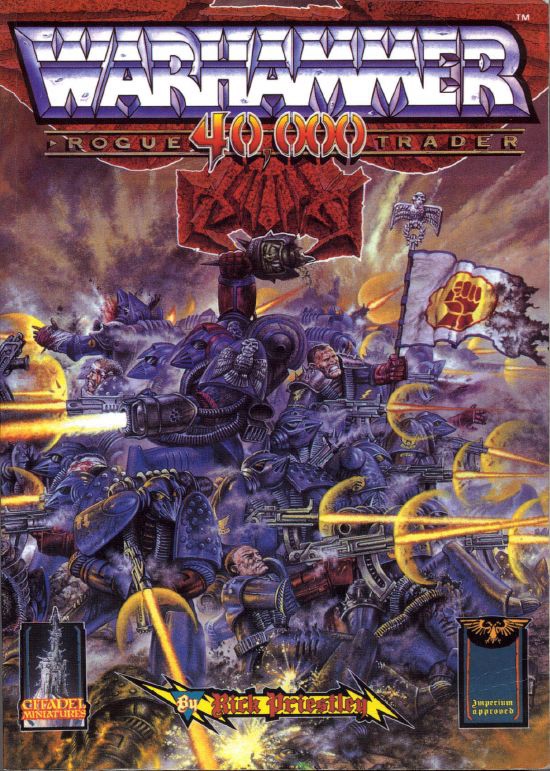
The book is clearly aimed at combat, but it’s also intentionally vague on the matter: When I got to the last section in combat, I was thoroughly convinced this was a skirmish-sized combat game, that used a referee. Not until the section on player characters, “idealistic, young, inexperienced adventurers” in “adventures in which all of the players are on the same side – fighting opponents controlled by the GM.”, did I see the only mention of the “mass combat, battle and large scale carnage” that is now characteristic of the game; in fact later in the equipment section, it explicitly describes itself as a skirmish game about “clashes of small bodies of troops”. A solid quarter of these rules are dedicated to player characters in this solo hero style of play. And finally, the third of the book that is purely lore feels scarcely engaged with the idea of war at all, and is mainly setting up an arena for faction play, in a very interesting fiction-forward way.
In that spirit I’ll be reading the game with that roleplaying adventure game in mind, rather than what eventuated, a bourgeois mass combat war game with a focus on scale and absurdly expensive miniatures. And I’m doing it with little to no knowledge of the Warhammer 40, 000 universe, aside from what I remember from playing Space Crusade and the Amiga Space Hulk videogame as a kid. I know there are six-armed aliens and paladins in mechanical armour, and very little else.

I’ll start with the section on playing heroes, which isn’t at the start. It’s explicitly intended to be simpler than Warhammer Fantasy Roleplay, the first edition of which was released the year before, but the reference to this is meant to imply that this mode of play is similar to that game, i.e. roleplay. Hero characters can be in charge of a unit, but it isn’t considered important in the game, i.e. they have what is known in the AD&D of the time as henchmen. Hero characters are mostly stronger than base units, level up, and are more likely to have mutations and psionics powers (which we’ll learn later, means likely to encounter relevance of the God-emperor). In this mode of play, those twists are random and reserved for heroes and enemy personalities. This gives a picture of a role playing game that features skirmish scale combat — 2 players, their hero and their hero’s unit, against the referee, participating in some kind of narrative arc. The narrative style described is mission-based, and includes a plot generator — it’s more flexible than the style we saw in 4th edition D&D and in Lancer, but it’s similar, with the players springboarding off a brief given by the referee, and then the referee responding to the action in that session in preparing the next brief. Pretty cool, very 80’s. I’ll be reading the combat rules with all this in mind.
The organisation of the book puts primacy on terrain, then on the individual units. Combat is obviously supposed to be primarily revolving around range combat and cover, with base size (this is meant to sell Citadel miniatures after all) not being a major consideration. Order is complex and rigid: Move – Shoot – Punch — Psyk, plus two extra turns that feel more targeted at the potential larger battle game that plays a part of it — reserves where you get new troops and rally where you bring routed troops back to the field. These are explicitly optional, though. Order of action is different in each phase — Move and shoot are alternating sides, but close quarters and aerial combat use the initiative score of individuals. My gut feeling is that these contradictions are mistakes, actually, and the intent was either one or the other, because the split doesn’t make sense in terms of turn order.
The actual combat roll is a little complex, I think. Calculate your range. If it’s half the max range of your weapon or less, get a bonus (depends on the weapon) or if over half, a penalty (depending, again). Roll 1d6, and consult a table, which gives you a value to roll over based on your ballistic skill (but that isn’t your actual ballistic skill). If you roll a 6, it explodes, to allow difficult hits. If you hit, cross reference your weapons strength with your targets toughness, to see if it does any damage, and if it does you do a minimum of 1 wound, or maybe roll a die for damage for more powerful weapons. Then, the target can make a saving throw based on their armour, to ignore the damage. There are various other rules leveraging these rules, but it’s clumsy as, even if it’s a little charming. I’m a little curious as to whether all this has been streamlined in the 40 years since, but not enough to look it up. All the small rules leveraging this and edge cases like grenades, close-quarters, aerial combat honestly make for a pretty interesting combat system — I love the charging rules, flyby attacks, grenade rules — I just feel like it’d benefit from a little more parallelism than it has. A lot of this complexity could be shaved away without much loss of salience.
There’s some strange and very cool worldbuilding here, regarding armour, and especially regarding dreadnought armour (apparently space marines are curled up in the foetal position inside those suits of armour, and can’t leave it without injury, and are incredibly weak in these full body prostheses), and robots (which are apparently substitute slave labour everywhere) are incredibly powerful but you have to give them orders a turn or two in advance like in Robo Rally.

Other cool, weird things in this chapter I’d love to see more embraced by this weird little game: It recommends dice cups at the beginning; I got excited we were going to get a Perudo-based combat system. There’s a big section on psionics and on mutations, that wouldn’t feel out of place in Gamma World or 2nd Edition AD&D. It’s honestly a little shocking to me how much this game tries to walk the line between roleplaying game and wargame.
The equipment section opens with some solid Gamma World rules: Tech levels and learning to use unfamiliar equipment rules. It details planet-destroying equipment well beyond the scale of the game. The weapons range from bows to gravity guns to swords to conversion beams. It’s honestly a little goofy pitting all these against each other on a battlefield and I dig it. Vehicles and robots are here, and bionics, as well as a bunch of non-combat devices like snorkels and sunglasses. The latter equipment is surprisingly as fleshed out as the weaponry and armour, and really points towards a role playing game or at least to a much broader mission remit than before. Like most equipment lists, they’re pretty dry, but they support a broad spectrum of play styles.
We come to lore. I’m excited to see this unfinished version of the 40k universe, just based on what I’ve already read in this book. The galaxy is largely unexplored. Warp space is the source of psychic powers. You can’t jump into solar systems. Warp gates are slow permanent tunnels. You can enter warp space and there are creatures, like Enslavers, that live there and feed on psychic energy. Navigators are mutated humans that steer through jumps. Humans are superstitious, and confuse religion and technology. “This is not a rational age” The God-emperor is real and actually rules, but even in this form murders innocents to allow humans to travel throughout the galaxy by creating a galactic beacon network to guide navigators. There’s a priesthood and inquisition. Mutants, psykers and aliens are considered existential threats. It’s a feudal system. Space Marines are basically unchanged, which is interesting. They live in castles. But there are other, less special Space Warriors which have absolutely been eliminated in times since.
The titular rogue traders are “free- lance explorers, conquistadors and merchants, given a ship, a crew, a contingent of marines and carte blanche to roam the worlds beyond the Imperium” — they’re space privateers, seemingly based on the age of sail. This is much cooler and nastier than the name actually suggests.
So much detail given on the imperium is again weirdly suggestive of roleplay. Tech-priests, astropaths that are responsible for communication, the judges (of course also jury and executioners). Witch-hunters seek out psychic or mutant cults, terrorists or individuals. Psychics and mutants represent the two ends of the emperors’ grand spectrum: The future of humankind and its corruption. Psykers therefore must be part of the fold or killed; mutations eliminated or risk the destruction of humanity. It’s all just so compellingly fascist; it also seems to assume we’re playing these fascists without much insight or commentary, but it is Britain in the 80s, so I doubt it was actually as uncritical as it seems. It definitely falls prey to focusing on the powerful and not the masses. This might be a misreading by me, though, again, because I’m not British. Maybe what I’m seeing here is actually an assumption that you’ll play the fascist colonialist empire, and you’ll be interacting mainly with the uncivilised savages of the galaxy. Marne this is just another colonialist fantasy, just a grittier one? It is interesting how much all of these factions have potential for faction play; they just would be better I think were they more ground level.
There are hobbits, dwarfs and ogres here, basically underdeveloped mutant races, with no interest at all. Psychic space-elves get more attention, travelling the galaxy on mechanical planets. Orks are here, as boring and racist as they seem in the context of the supremacist-fascist humanity, and their gretchen slaves starting to remember what they’d become. There are savage frog-people the Slaadn. Cultureless orangutan-people (yikes). The tyranids are here and their organic spacecraft. There are random encounters here, that decidedly have no place as an army, like warp-spectres. ghosts and vampires and dinosaurs, and void-dwellers that are explicitly not able to participate in battle because they defy physics. Oh, gene stealers are here — they’re different from tyranids! I didn’t realise! At this point it devolves solely into a roleplaying game bestiary. I don’t hate that at all though. It’s just interesting to me.

I’ve left a few things out: A cursory scenario, a bunch of painting advice (basically a full on guide!), and song optional rules. But that’s more or less it for Rogue Trader, and honestly I’m impressed and I love it. I love the parts that feel like progenitors to the modern, grimdark 40k, but even more I love how much sillier it is. The presence of halflings and dinosaurs and vampires in this galaxy, and the positioning of the players as galactic, state-sponsored pirates invading and taking advantage of indigenous populations, are strokes of weird and bizarre genius to me. But there are all the missteps of late 80’s design here too: The factions aren’t especially game-able, and it’s incredibly tone-deaf in its approaches to both its core fascist-supremacist-colonialist conceit and things like the orks and eldar. Most of the satire is in the art, which is clearly 2000AD inspired but, ah, less inspired. Basically you could characterise this as “what if D&D but you get to play Judge Dredd and you’d read a lot of Heinlein and also in SPACE” and I mean that as a compliment.
Like, I’m never going to play Rogue Trader. This book is terrible, and future editions developed in a direction that I have little to no interest in — the 10th edition is further away from what’s cool about the concept than this is. But it’s kind of an OSR system by accident, with so much in common with OD&D. But gosh, a micro-tactical version of this, with a stronger referee-based role-playing chassis, and more bickering and petty takes on these weird factions, would be so cool. And the very idea that the galaxy is so big and that communication and travel is deeply flawed could be leant into. This would result in the explicitly feudal medieval church vibe of the imperium becoming a network of petty and corrupt individuals pursuing their own goals and ignoring the desires of the God-emperor altogether because of how slow communication and travel is. That’s the implicit set up here. The space marines in this rather obvious reading are suckers believing in a dead radio god, pleasureless and trapped in a tin can, not heroes. This feudal piracy concept is such a cool set-up. And it’s an interesting, compelling one. But where they took this world — at least how I perceive they took it — is not for me.
But, like, Fantasy Name of the Rose in space with pirates? Hell yes.
P.S. 40k fans, please know that I don’t care to read up on the modern game or the decades of novels, and that I’m aware that there was a Rogue Trader CRPG like last year, and hold yourself back from commenting inanely about these. If you have interesting things to say about this version of the game or about its relationships with its contemporaries, I really want to hear it, though.
PPS. It’s tradition that I say why I had the time to read and write this: I got a tattoo and then had insomnia after my daughter wine at midnight screaming about ghosts.
Idle Cartulary
Playful Void is a production of Idle Cartulary. If you liked this article, please consider liking, sharing, and subscribing to the Idle Digest Newsletter. If you want to support Idle Cartulary continuing to provide Bathtub Reviews, I Read Reviews, and Dungeon Regular, please consider a one-off donation or becoming a regular supporter of Idle Cartulary on Ko-fi.


 Playful Void
Leave a comment