
I Read Games reviews are me reading games when I have nothing better to do, like read a module or write or play a game. I don’t seriously believe that I can judge a game without playing it, usually a lot, so I don’t take these very seriously. But I can talk about its choices and whether or not it gets me excited about bringing it to the table.
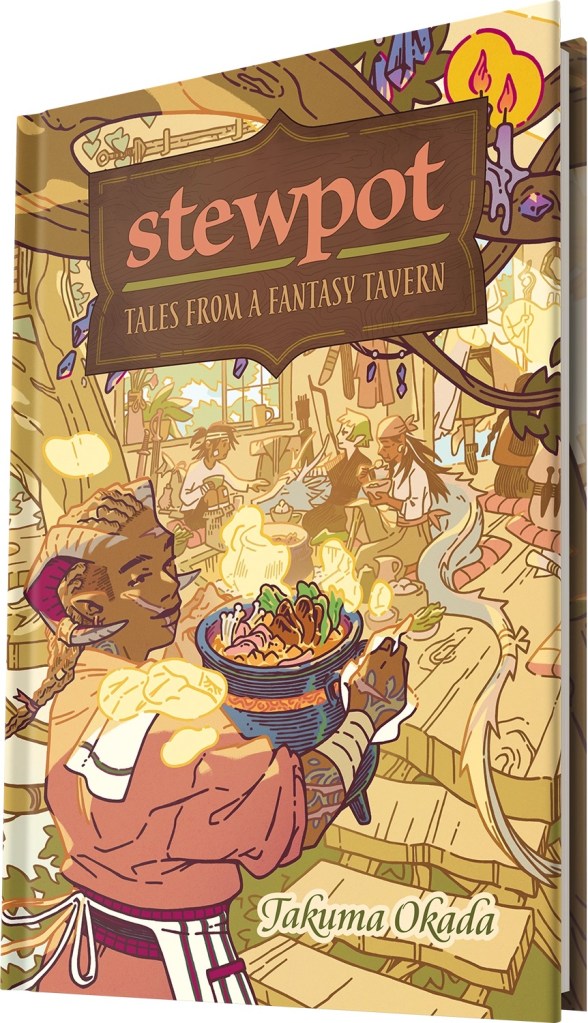
My kids are playing at an adventure playground at the beach, and I came prepared with my new copy of Stewpot, so I decided to read it, finally, underneath this macadamia tree. Stewpot is a 146 page game by Takuma Okada, based on the framework of Mobile Frame Zero: Firebrands. In it, you and your friends create retired adventurers, and together settle down as the co-owners of a fantasy tavern in a fantasy town. The edition I’m reviewing is the new, definitive Evil Hat version,
Today up, we have tavern creation, as simple as name, environment (city or wilderness), look and a few ratings which affect the upcoming minigames. Character creation is also a straightforward affair: A name and a look, an adventurer job (i.e. class), and three associated experiences, and a job around town. The meatiest of these are the adventure experiences, such as “Taunt: Draw enemies towards you” or “Adder’s Fangs Deadly poisons and their antidotes”. My problem here, is that these don’t really result in a character or a setting with a lot of hooks. The character you get is the most rudimentary description a new 5th edition player gives: “oh I’m Kash the Tiefling Warlock, my patron is Bhaal and I have Eldritch Blast”. For the setting, it relies entirely on the table spontaneously coming up with something together, either now, or more likely during play. For me, that’s simply not enough. Here, Stewpot is trying too hard, I think, to rely on and embody the generic Faerunian fantasy that has been so popular since 2014, and in its reluctance to be weird and specific, loses some of its’ edge. The goals, though, are admirable: It’s trying to leave space for these characters to be developed retroactively.
The structure here is simple: Play a “starter” minigame, followed by as many minigames as you wish (taking turns), followed by a “finisher” minigame. The only restriction is that you must choose a specific minigame, accompanied by a break to stretch and eat, every three other minigames. These minigames range from mechanically unique and with a degree of complexity, to completely freeform with few prompts. There are 20 games, although 3 of them have roles prescribed by the rules. Otherwise — in a nice touch — you simply choose what you want to play on your turn, guided by the icons which tell you if a game is freeform, if it’s mechanical, if it upgrades your tavern, or if it’s a good game to start with. Those icons are a clever piece of work in my opinion because they both capture the needs of types of players interested in playing the game, but also make choosint a game — out of 18, remember — much easier, particularly when you’re not (yet) familiar with them. That said, I really wish there were other ways of choosing — as simple as numbering them 1 to 20 and allowing people to choose them randomly if they’re stumped or either don’t have a sense for their developing narrative, or are uninterested in directing their own story. It would be more in the spirit of the game that inspired it, to be honest.
The bulk of the book is, of course, the descriptions and rules for this massive number of minigames. I love these — they are thoughtful, plentiful, and run the gamut of potential ideas for the kind of story you’d expect to tell for a story of this type, as well as catering for a range of different player types at the table. Without going into depth, it’s hard to describe them briefly, suffice it to say that here Okada really nails the brief. The primary criticism, if you could call it that, is that while there’s an icon for “freeform roleplay”, that icon appears on 17 of the 20 minigames — so for people who are reluctant to freeform roleplay, there’s not a lot of room for easing them into this Stewpot. The first minigame, “The First Step”, is entirely freeform — you just describe a scene — with nothing but your character sheet and discussions regarding the nature of your tavern and town to guide you. This could be a deep dive for a lot of people, and I’d have loved more consideration for those people here in getting their toes wet. There’s something to be said here as well, about the quality of the prompts, something I spoke about at length in multiple reviews over the month of December last year. This reminds me a lot of Expect Three Visitors — it depends heavily on the players’ existing knowledge of D&D and other roleplaying tropes, and relies heavily on examples, rather than investing as heavily as it could in clearer or more complex prompts. I think more complexity in the prompts would be very, very welcome, over and above the lists of examples.
The book is gorgeous, though. The art, featuring a plethora of artists, has an imagination that the text often lacks, and as such supplements the vanilla fantasy of the text with much-needed weirdness: Inns on turtle-back, or undersea mermaid inns, Bear-adventurers, Mouse-wizards, blademasters slicing kraken sushi, and lots and lots of delicious meals. The art couldn’t really be better — it brings cosy, and brings it hard. The layout is gorgeous, ornate, and fully decorated, and has lots of space, rendering it very legible. To be honest, the amount of white space is too generous for me, often splitting up lists and concepts across spreads and page-turns, which would be more legible given less space. The leading here is generous at the body text level, but in headings and lists it is often 200% or more, which, in a book presented in single column, makes me wonder if it was intentionally padded out to make the page count more book-worthy (this impression is worsened by the 20 pages of recipes in the back of the book, although they claim to be a stretch goal). I’m sure Evil Hat knows publishing better than me, but I’d have preferred a slimmer book if bulking it up comes at the deficit of legibility.
The core conceit — a fantasy tavern — is a gorgeous, immediately evocative one to those of us with a long history with Dungeons and Dragons and its related literature, immediately evoking to me the Inn of the Last Home, and many other such tropes. There are, too, so few opportunities to play characters with experience and the maturity that comes age, with these characters generally being relegated to mentor and quest-giver roles in fantasy stories. Giving these characters centre stage, and the associated freedom of improvisation that a lifetime of remembrances brings, is just so compelling as a baseline for a game. I’m sold instantly.
But my feelings are complicated. Stewpot was one of the first indie games I ever played, using it as an epilogue to a 5th edition campaign back when I played that weekly, well before the release of this new Evil Hat edition. It feels like I’ve been waiting for this edition to come out for maybe 5 years? There’s a world of differences between my perspectives then and now, though. We came to the game with a bunch of strongly differentiated characters, each with an existing history, although many of it unexplored, and an existing world. Stewpot, in that context, was an expansion of and a loving dedication to the characters we’d spent 18 months with (perhaps more? it’s been a while), completed not long after the pandemic began. But now, with two kids and most of my friends in the same life phase, a regular game is no longer a part of my life. I play pick-up, with short term, disposable player characters, a range of players coming and going, and little long-term development of them. The character creation provided here is intentionally sparse — it’s designed to leave open spaces to fill in through games like Sidequest, A Fleeting Moment, or A Bard’s Tale — but I fear for many people it requires too great a leap, to get to the character from the creation process, which effectively amounts to “I’m a wizard with fireball”. You can consider Stewpot a game of character creation, and from that perspective, I think it leaves all the right gaps. But right now in my life — and noting that 5 or more years ago I felt differently, so you may feel differently now — I’d like more support, of the kind that was provided to me through the play of an additional campaign, to provide background.
My complaint here, in a way, could be considered a complaint about Firebrands-framework games. Both the King is Dead and Firebrands expect a similar amount of improvisation; you build the world, and your character, simultaneously. I can’t imagine too many players of Firebrands actually played Mobile Frame Zero for the worldbuilding, before they picked up Firebrands. If you consider the support around those two games, Stewpot is a far more supportive game: twice as many minigames as either of those, with a premise that banks on lifetimes of shared experiences playing Dungeons & Dragons or thousands of hours of watching Critical Role. The menu-of-minigames structure is a clever one, and fruitful I think, but I wonder what it would look like if it leant more into the specificity of setting than it already does.
Overall, Stewpot is a masterpiece, but only for the right table: One comfortable with freeform roleplaying, easy improvisers — a table full of referees or theatre kids. For most players, though, it doesn’t scaffold enough to make play easy — these are the players for whom using this game as an epilogue for existing characters is ideal, as the previous campaign would provide that scaffolding. What it is not, is a way to ease players uncomfortable with silence and a blank slate into free-form roleplay. But if, like me, you’re hooked by the conceit immediately: Just buy Stewpot already, and figure out how to make it work for your table, because it’s one of the cosiest fantasy games I’ve played.
Idle Cartulary
Playful Void is a production of Idle Cartulary. If you liked this article, please consider liking, sharing, and subscribing to the Idle Digest Newsletter. If you want to support Idle Cartulary continuing to provide Bathtub Reviews, I Read Reviews, and Dungeon Regular, please consider a one-off donation or becoming a regular supporter of Idle Cartulary on Ko-fi.



 Playful Void
Leave a comment