
I Read Games reviews are me reading games when I have nothing better to do, like read a module or write or play a game. I don’t seriously believe that I can judge a game without playing it, usually a lot, so I don’t take these very seriously. But I can talk about its choices and whether or not it gets me excited about bringing it to the table.
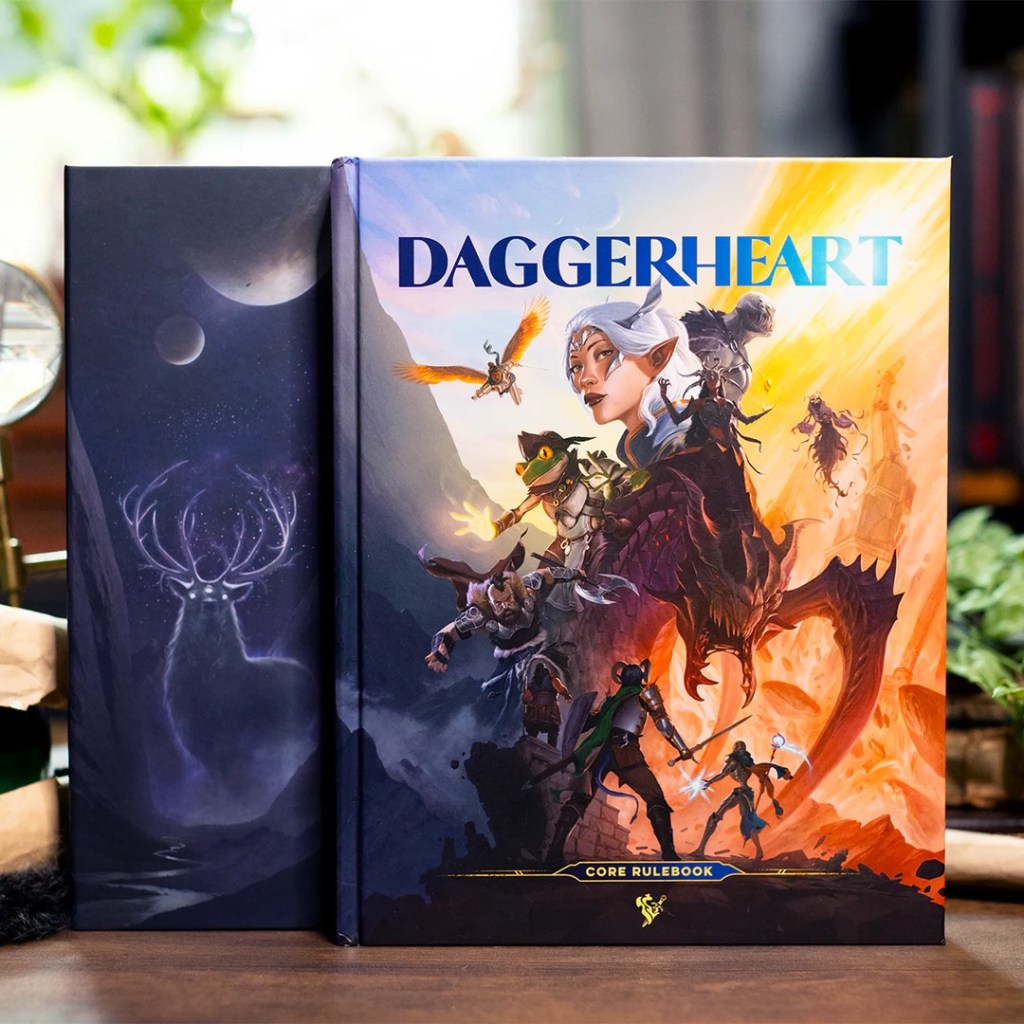
I’m exhausted from a big house clean up, so while I take the kids to the park, I’m reading Daggerheart. If you haven’t heard of Daggerheart, a 400 letter format D&D killer from the Critical Role team, you’ve probably been hiding under a rock (fair given the pending apocalypse). Even if you are, you mightn’t be aware of the team they’ve brought together: many tens of contributors, lead by Spencer Stark, but joined by Meguey Baker, John Harper, Banana Chan, Sebastian Yuë, Pam Punzalan and many, many more, in varied roles. I don’t know how much work all of these people (or the dozens whose names I don’t recognise) contributed, but the bar is high. Daggerheart styles itself as collaborative, heroic, narrative game that focuses on combat. What I hear when they say that is: This is a game designed to play Critical Role. Let’s see if I’m right.
This is a game focused on conflict resolution, so it has a primary roll, just like D&D: Here you roll a d12 for hope and a d12 for fear, add a bonus and compare it to the difficulty level. If hope is higher, the referee is cued to make the situation better, and if fear is higher, worse. This seems an elegant way of adding in a little story-game narrative suggestion without eliminating that list of skills and abilities that this style of game typically has. Damage dice are polyhedral, like 5e, and the referee rolls a d20 instead of 2d12. Interestingly, you’ll also need a stack of tokens to track things on your character sheet including bonuses, and a deck of cards (you can print them, if you want). Maps and minis are also optional in the same way that they are in 5th edition: Not really.
Once this is covered, the book moves on the principles of play. I’ve said before, I love it when a game sets out explicit principles: and Daggerheart has the unique advantage that I suspect a lot of its players are keen enough to actually read the rulebook, but disappointingly these are loosely paraphrased from classic story games. I prefer some bespoke principles to these, but as this game is aimed at an audience naive to the games ludography, I suspect this is intentional. There is a little space here devoted to the “world” of Daggerheart — likely so that mentions of Daggerheart’s equivalents to the multiverse don’t fall on deaf ears. This is not the first and I suspect will not be the last place where Daggerheart is trying, if not explicitly, to feel like 5th edition, either to court that audience or to reflect how Mercer runs Critical Role. Another place where it does this is in character creation: There are 9 classes each with 2 subclasses, and although names don’t always match, these feel incredibly 5th edition. There are 6 stats with modifiers in the familiar range, and ancestries cover the classics such as orc, elf, firbolg and “drakona” (I’ll give you 1 guess what that is). A fun addition is communities: The place you’re born, not just the ancestry, impacts your characters. A nice addition, but you can see the tension the authors are facing in trying to step away from the problems of ancestry without distancing themes from D&D too much. Daggerheart does officially bid farewell to languages: Everyone can speak and sign to everyone (this is the right moment to say that Daggerheart puts a huge amount of effort into inclusivity: multiple sections cover playing disabled characters and supporting them — Daggerheart is a queer, disabled, and inclusive world). Finally, you have hope, fear, evasion, stress and hit points. I like that hope doubles as the equivalent here of inspiration and of experience points. The rest are what they sound like, covering familiar ground such as AC, damage, and exhaustion. You still start with the classic D&D items like 50 feet of rope, but mundane equipment is deprioritised here (although copious space is devoted to mementoes and magic items later). Finally, skills and proficiencies are replaced by experiences, which can be gained or lost. This is a neat overarching umbrella and allows for much more interesting action that the old 5th edition list, but I wonder if the infinite potential here might be a disadvantage to the audience, who are used to the limited slate of 5th edition applied broadly. The issue is that when you’re treading a line between system mastery (with the cards I’m about to cover), these flexible experiences feel abusable by the crowd they’re flirting there. It’s a tension I don’t think they succeed at navigating, but that may turn out to be an invalid concern. Finally, you choose your domain cards — these are your abilities and spells. You pick 1 per level from your classes 2 domains, 2 at first level. Very 4th edition. I think, in person, people will enjoy these cards. Now, explaining this was a lot, but I suspect it’s straightforward practically once you understand the system, and provides enough different interactions to reward a little system mastery while keeping it loose and giving more story levers n the form of communities, connections and experiences than a typical 5th edition character would. The character sheet, which is far more forgiving than 5th editions, bears out that theory, although note that you’ll have a small hand of cards as well as your sheet.
Going through the classes and ancestries, there are no surprises. For me, they capture a lot of the archetypes you want from 5th edition, with very little innovation except in that the use of the cards mean the class descriptions mostly max out at 2 pages (some exceptions — druids have shapeshifting rules that stretch a while longer for example), and the ancestries at a half page. No Daggerheart classes are as complex as their 5th edition counterparts, but they’re all similarly complex, gaining a similar number of abilities or spells at each level, and no matter what your level you’ll only have 5 “equipped” at a time. It suits me, but players who love to figure out how to milk interactions may struggle. One 10/10 decision, though is that you can either play a Myconid, or someone who is half myconid. I can’t wait for the myconid/drakonar fan fic.
At this point we get into rules proper, and there aren’t too many surprises. It feels like 5th edition with some extra narrative sparkle. I like that they define a character taking the spotlight as a move, and domain cards can therefore hinge you whether you take the spotlight — that’s neat. Tag Team rolls are a neat way to mechanise the team working together in a way 5th edition always wanted you to but never incentivised: You could have your hulking orc fastball special your gnome at the dragon with this, which is cool. The addition of tokens to cards allow for some fun potential combinations for certain classes too. It’s a nice, flexible mechanic and I’m sure it’ll go cool places. Interestingly, Daggerheart measures in inches not squares, or in range bands: This again reflects combat in Critical Role, where it’s either theatre or the mind, or it’s in an elaborate, never squared, map.
Just like the Player’s Handbook, huge swathes of Daggerheart are dedicated to lists: Equipment, ancestries, etc, but nevertheless character creation and player facing rules end at page 139, and it veers to referee facing stuff: That’s three quarters of the book for the referee. That’s an unprecedented amount of support, rivalled only by Pathfinder 2e — but here we’re doing narrative as well as mechanical support. It opens with referee principles and best practice, which are solid but (again) generic, but then integrates the Baker’s concept of moves into a 5th edition framework very elegantly without forefronting it too heavily. The referee is suggested that moves are triggered by player actions: Fear, consequences, or other opportunities. They tie what kinds of moves are recommended with those suggestions. They even suggest improv prompts for different versions of hope/fear and success/failure. There are examples of play, to make the framework practical. This is good referee support. There are 2 pages of example moves, that are effectively a Daggerheart version of the ones from Apocalypse World. Good stuff. It then covers how to use the “fear” you accumulate for max drama (from all those fear dice the players are rolling) and also covers how to set difficulties with tons of examples. It goes through how to use countdowns (using a die to count down from a number) to run a bunch of different scenarios in a way that mimics clocks but that feels more tactile. This is all good stuff. It then adopts what I feel is the Robin Laws concept of Beats as narrative prep (perhaps lifted from Slugblaster, which gets a credit), which while linear for my style, works very well for heroic narrative play. It’s got examples and ways to make battles interesting and to avoid a grind-style battle — in terms of combat balance, it’s really straightforwardly laid out: This is the formula, pick from the tiers. It’ll take play to see if the tiers and the algorithm are correct, but on the face of it it’ll be easy to make a heroic combat encounter, and adversaries are grouped so you know you need this many minions with your boss or whatever. And it tells you how to build your own! And with it are the rules on environmental hazards — focused on raging rivers rather than traps. It has advice on one-shots and campaigns, how to incorporate character backstories, and juggling multiple personal player character arcs. This is all excellent stuff, if you want to run a campaign like Matt Mercer.
After the bestiary (it’s a bestiary, natch, it’s fine), we go to campaign frames: This is Daggerhearts system for world-building to the point you can sit down with your friends to play. It takes you through the process, then gives you 5 examples with varying scales and complexities and their own rules. I can’t understate how cool some of these are, and how much they’d open many eyes to some wild possibilities that just didn’t exist in 5th edition, particularly the Motherboard and Collossus frames. Just great stuff. I’m just surprised, to be honest, Exandria isn’t here — I know Wizards of the Coast had published a sourcebook, but I can’t imagine Darrington Press has lost the rights somehow?
Briefly on the layout and art: This is meant to look like D&D and it does. It does it better than D&D 2024 does, to be honest. The art is incredibly evocative, if you’re into the digital painted style, but it doesn’t have a strong identity. The text is complex and unwieldy, and refers to yet to be stated rules too much. That said, it does that with page references, it is generous with space, sections are clearly signalled, it uses colour incredibly well, and the pdf is digitally indexed very well. For the mess that it is and the complexity that books of this scale need to be, it handles it admirably.
Honestly, I’m really impressed. This is better referee advice than we see in Pathfinder 2nd Edition or D&D 2024. I could run this, despite being a mother of 2 young kids with no time. My friends who want a heroic fantasy and aren’t interested in the OSR: This could fit into my schedule. It’s neat and elegant. The tradeoff is that player characters are simpler: This will a betrayal to players who like the complexity of 5th edition or Pathfinder. But you know what? I could never run those systems in my current lifestyle, and I could run this next week without a hitch. Is it groundbreaking? No, but it isn’t intended to be. This takes the best parts of the current indie community, aims them at perfecting but adhering to the conventions of modern D&D, and it mostly succeeds.
My big concern, of course, was that this would be an expensive book: It places a huge amount of the game into the cards, and without them, you couldn’t run a character. It expects the players to buy the book and the cards: But to be honest, it’s more affordable than I’d expect for the set (although not in stock). The overhead is high but not much more than 5th edition (where you have to buy 3 books), and spread around the players. And the clever mapping of the classes across the deck of cards (the “domain circle” means that 1 deck will serve 4 players if they choose their classes spaced out. It’s becoming affordable, almost (it’s a matter of perspective: Cairn and Mausritter are both available for free).
Is Daggerheart for you, though? If you don’t enjoy the current 5th edition or Pathfinder zeitgeist, or don’t have pressure to run a game that suits it, no it isn’t. This ain’t gonna convert any OSR heads or story-gamers to Critical-Role-curious. But, if you want to run or have friends who want you to run a Critical Role style campaign full of half-planned narrative beats and intertwined character arcs, with the veneer of the classic game? Honestly, this is better than 5th edition for that. Likely better than anything on the market — D&D2024 and Pathfinder 2e are leaning in the other direction, I don’t get the impression the terribly named unreleased Draw Steel is aiming at the same target, and unless 13th Age 2nd edition is a complete rehaul, I like this better. Daggerheart hits a bunch of the actual play friendly notes as well in terms of familiarity and ease of play (I’m not going to go into that at length, but I covered them here), and based on those I genuinely could see this taking over as the preferred system to run actual plays in. Was I right that Daggerheart is a game designed to play Critical Role in? Yeah, yeah I was. Your mileage may vary on whether that’s what you want, but for a huge audience, that’s a killer pitch.
Idle Cartulary
Playful Void is a production of Idle Cartulary. If you liked this article, please consider liking, sharing, and subscribing to the Idle Digest Newsletter. If you want to support Idle Cartulary continuing to provide Bathtub Reviews, I Read Reviews, and Dungeon Regular, please consider a one-off donation or becoming a regular supporter of Idle Cartulary on Ko-fi.


 Playful Void
Leave a comment