
Bathtub Reviews are an excuse for me to read modules a little more closely. I’m doing them to critique a wide range of modules from the perspective of my own table and to learn for my own module design. They’re stream of consciousness and unedited critiques. I’m writing them on my phone in the bath.
Wonderland is an absurd tome of a book — over 210 pages in A4 format — by Andrew Kolb, one of a series of public domain-based modules including Neverland and Oz. Wonderland, by contrast with the hex crawl that is Neverland and the city crawl that is Oz, is a megadungeon. In it you delve ever deeper, trying to find the secret at the dungeons’ core: The Sleeping.
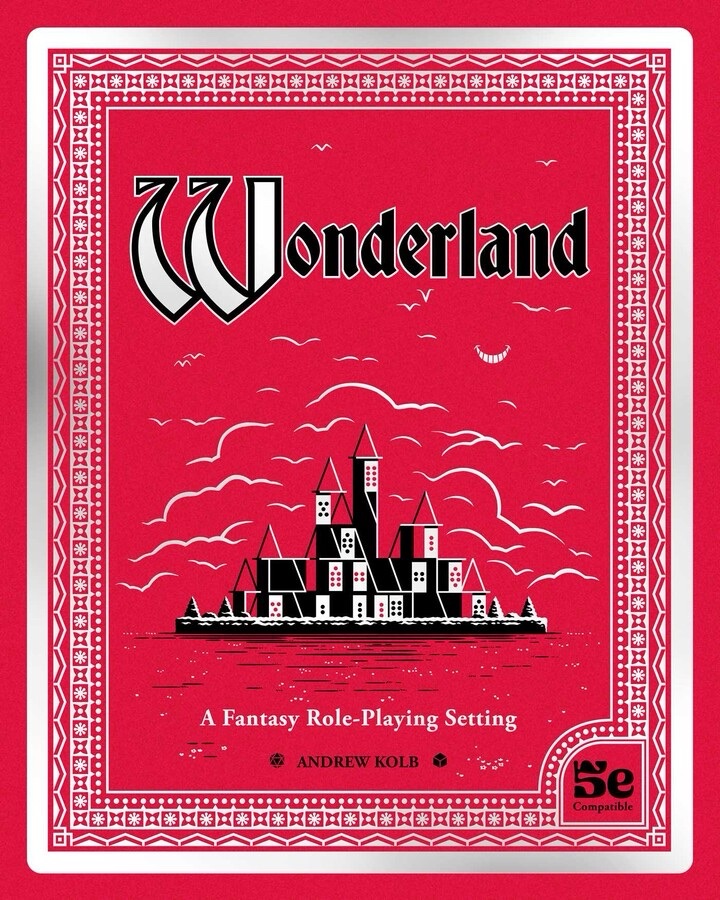
Wonderland is a hard book to tackle. As with other Kolb books, my sense is that its scope exceeds its capacity, as it covers Wonderland, its mirror-realm Looking Glass Land, reality, and the realm of dreams. The latter 3 are all under-expanded, and the truth of the matter is that Wonderland alone is sufficient for many months of gameplay, There are 14 factions in Wonderland, and 4 levels, which is plenty. And a lot of that is modular: Meaning you’ll have to generate it either on the fly, or before time. What do I mean by this?
Well, each level has a potentially huge number of potential layouts, with each area being a tetromino (a la tetris), that is arranged within a chessboard. There are requirements when setting up the areas within a level — leaving a modicum of predictability — but otherwise the areas aren’t spatially related in any particular way. Within each area, the mapping is traditional in nature — there’s a dungeon map for each tetramino area. There isn’t a specific rule for when you “scramble” the tetraminos between a level — every time, or when “power level increases” are two suggestions. The presence of the level maps at the backpapers indicates a preference for Wonderland to change every entry, I suspect. This ever changing dungeon is reflective I think of the themes of Wonderland, but it undermines a core principle of megadungeon design: You get to know the spaces and manipulate them over time. Geographical knowledge is power.
Otherwise Wonderland is run like I’d expect a megadungeon to be run: 10 minute turns, an emphasis on gold and random encounters in resource management, an implacable hunter pursuing the player characters through the space, and an emphasis on using ingenuity to solve puzzles (with a big twist in this particular dungeon being an abundance of size-based puzzles, as you shrink your foes, grow to overcome traps and obstacles, or shrink to escape through tiny doors, etc.). There’s even a town — Dinah — for you to retreat back to.
There are a lot of small notes, rules, regulations and the like to follow in the “running the game” section of the book, but the truth is that they’re kind of Kolb trying to communicate the absurdity of Wonderland politics in a way the referee can implement. If you read through the books while running this, you wouldn’t need a note like “Royalty are likely to impose a tax just to obtain the specific treasure the PCs have”; that arbitrary pettiness is part of the world’s DNA. What I do feel is that the way all of this is laid out — front loaded in the first 13 pages — makes for a very overwhelming introduction to the world. Given the 3-column layout this book uses throughout, I think a lot of this stuff would be best spread out throughout the books, in sidebars or in the areas of the world that they occur. There’s already a lot of repetition in the keys — I’ll get to that — so placing this here or in the bestiary seems like a mistake, simply because there’s so much in the introductory chapter. That said: Kolb acts similarly in both Neverland and Oz, so it’s his preferred way to organise information. If you’ve run either of those, you have an idea of the kind of preparatory work you’d be required to do, which is similar here.
As with Neverland and Oz, Wonderland is written for Kolb’s own modified 5th edition ruleset. I’d probably run it in Shadowdark, now, as it’s an easy conversion. Familiarity with 5th edition will help a lot, and the stat blocks are pretty complex although self contained and usually appear they’d make for a lot of fun. The bestiary combines beasts and cast members, keeps individuals on a single spread or less (never crossing the page). Stats are separated from the personality of the characters, but it’s very evident you’re expected to be engaging with a fair bit of combat, and a huge amount of space is devoted to it. A lot of the bosses even have multi-phase forms — it’s videogamey and fun, although some fights have pretty pitiful manifestations (White Queen just cracks a little? Just don’t give her a second form). Pretty cool if that’s the kind of game you’re after.
The key itself follows a similar format to previous Kolb work: Full spread per area, with a focus on tables, and only a few paragraphs of text in most places. It’s a little less dense in general than most Kolb work, with a lot more space, likely because it’s hard to account for the shape of the tetraminos. If this worked for you in the past, it’ll work for you now. For a megadungeon, where you’re going to be revisiting the same spaces repeatedly, I think it works better than it did in, for example, Oz. The headings you get repeatedly are: Description, first impression, block specific mechanics, looking-glass differences, a counter, area quirks, door quirks, accidents waiting to happen, creatures, NPCs, conflicts, loot, in addition to 2-3 area unique tables. A few areas use depthcrawl rules to emulate a more complex space —one in each level, a mine, a forest, and a maze. These are all a simplification compared to the depth crawl in say Gardens of Ynn, but the carryover complexity from the standard layout works to fill out the very brief descriptions for each depth. Overall, it’s nice, and if I ran this the areas would grow in the telling, the book slowly filling with additional notes, but I prefer things to be a little more concrete in terms of the key.
There’s a short section — 4 pages — devoted to Pandæmonium, 1 page being summoning “draemons”, another being details on the 9 circles. As with the land of Fairy in Neverland, this is underwhelming and needn’t be there. Draemons take up 6 pages of the bestiary, and Lilith takes up another. I can’t really grasp how this factors into anything, though: I have the print edition, so I can’t word search, but Lilith doesn’t seem to factor into any of the locations, including pandæmonium. Her character description suggest she might be a key quest giver, but I can’t see how to locate her, and the draemons explicitly don’t do her bidding. This leads into one major problem with Wonderland: despite a 2 page “what’s going on” at the outset, I can’t for the life of me figure out what’s going on. I literally searched the text for mentions of Lilith to figure out where the potential story seed might lead: I couldn’t figure out how the players might find the seed, let alone where it might go. It appears the major factions — the four royals associated with playing cards — are factions vying for power, how and why and what they want are completely unclear, either in the introductory reactions or in their bestiary entries. The Sleeping is by design not defined, and what happens when they awake isn’t stated. It’s…shockingly unclear given how much I’m required to ingest and read in order to grasp it.
Small things worth noting: One unique thing about Wonderland, that’s worth noting, is really appealing at the table but wouldn’t work well online: It wants physical props. Encounters want to be associated with playing cards, treasure is held in your “treasure diamond”, you’re supposed to represent the level with a chessboard. If you leant into the physicality of the rules here, you’re going to see a lot of mileage in these aspects of Wonderland. The back of the book is packed with stuff: A few special locations, a bunch of random tables covering accidents (traps), adventures, rhymes if you need help rhyming a character, crimes for the Heart King to invent, draemon names, summoning circles and sigils, random encounters, and evidence if you’re taken to court, places in the real world you might exit to, flaws in looking glass creatures, what jesters charge, locations on specific levels and more. What I notice (I don’t know if you did) about these is that they all, every one of them, belong somewhere else: With the Heart King, with the Court, etc. Maybe 2 or 3 of these belong at the back of the book — loot and odds and ends for example. Plot hooks and rumours belong at the front!
The layout and art is consistent and easy to follow, largely because of the clever colour coding in the sidebars as section headers. It’s never hard to read, but you’re expected to know a lot of stuff across the book in order to run it. Some of this is easy to access — inside covers are the tetrominos and the level layouts — but much of it is not. Stuff that’s actually repeated on every spread — like the random encounter table and a few other pieces — might be best replacing the back cover level layouts. The table of contents is great, but I wish there were an index. And I’ve mentioned across this review a huge number of information design issues that really make this megadungeon harder to run than it should be. The collage art is fun, and feels very Wonderland, but it’s just not my jam. Aesthetically, the dungeon maps feel put together by an online tool, which clashes with the surrounding aesthetics and also feels a little cheap given the overall effort put into this book and previous efforts.
Having read (and I think reviewed) a few of Kolb’s previous books, I’d like to assume in good faith that he prefers to leave things vague and unsaid, as a way to provide the referee with additional agency in how they run the factions. But in this megadungeon, the lack of clarity in what the various factions want and how the act makes it feel arbitrary and frustrating to run. Players need predictability to enjoy a megadungeon campaign, and when I, the referee, don’t know who wants what and why they’re acting a certain way, that predictability is not present. If that information is there and I can’t find it despite searching, it’s a serious information design issue. If it’s not: I think you need to find reasons for the factions to interact with each other and with the players if you want this megadungeon to be interesting. If I’m buying a megadungeon, I want these reasons to be provided. Combine this with the randomised layouts, which are assumed to happen each approach, and you’re removing another piece of information that repeated delves into a megadungeon provide, and hence an element of predictability that make them fun to play in. You can make layouts change: Nightwick Abbey does so, successfully. But it’s too many aspects of the space unclear and unable to render manipulatable by the players. I can recognise that both of these may be present because Wonderland thematically wants to be arbitrary and unpredictable, but that simply doesn’t work for a megadungeon. It’s your job as the author of a Wonderland megadungeon to find ways to render the absurdity of the setting in a way that’s legible to the players and allows faction play and knowledge-building. Wonderland doesn’t provide this for me.
That said, I like so much of Wonderland. I want to run it, I really do. If I did, I’d have to do a few things: I’d need to figure out a network of politics between the factions, and they’d need to be dynamic actors in the space, rather than passive ones. That would be some work. I’d need to place Lilith and Pandaemonium at the forefront of the story, I think: I’d probably not make Dinah an entrance to Wonderland at all, but rather position Lilith as a quest giver that offers the player characters a portal in exchange for doing something for her. We don’t visit pandæmonium, but it drives things. Each of the factions want something from the player characters, too. I’d have to minimise the mirror world stuff, as well, or else change it: As is it just doubles the size of the dungeon, but in a profoundly uninteresting way. Perhaps I could I could make it a stable unchanging version of Wonderland, so there’s a reason to use mirrors, at the risk of exposure to the mirror monsters. This might mean I get rid of Almost Alice, the Wonderland hunter, in favour of her Looking Glass equivalent. See how this is blowing out in scope? There’s a core to this megadungeon that’s really compelling, but I’d have to give it a hell of an overhaul for me to consider it good.
So, Wonderland is super compelling. But it’s deeply flawed and I suspect it won’t function well as a megadungeon for long-term play. Look, when push comes to shove, the advantage of Kolb’s books is that they’re cheap. If you have the time to overhaul it — like thousands of referees do to thousands of published adventures — the bulk of this will result in a memorable time. It’s possible, if you’re the right type of referee, and if you applied the ongoing prep methods that I went through in Advanced Fantasy Dungeons or something similar, that you could wing it sufficiently that it would work. It’s possible. But it doesn’t feel guaranteed from the text in the way that I want it to be.
Wonderland is a hell of a piece of work, but flawed structurally and as a megadungeon. If you’re the kind of person in the market for a megadungeon with an surrealist angle, and you’re willing to either spend the time refurbishing it or feel confident that you’ll be able to wing it with the right tools, it’s a good pick for you. I suspect it’ll be a good pick if a megadungeon to you is more of a combat grind than a political playground: The creatures here are remarkable and surprising. If you want something you can just show up to at the table, week after week, without much forethought, though, it won’t work for your table. I think that while Kolb’s imagination translates these public domain works well in terms of writing and theme, conceptually the city crawl and hexcrawl was much easier fits for the subject matter than dungeon crawl is in Wonderland. I’ll still look forward to Kolb’s next release though.
Idle Cartulary
Playful Void is a production of Idle Cartulary. If you liked this article, please consider liking, sharing, and subscribing to the Idle Digest Newsletter. If you want to support Idle Cartulary continuing to provide Bathtub Reviews, I Read Reviews, and Dungeon Regular, please consider a one-off donation or becoming a regular supporter of Idle Cartulary on Ko-fi.


 Playful Void
Leave a comment