
Bathtub Reviews are an excuse for me to read modules a little more closely. I’m doing them to critique a wide range of modules from the perspective of my own table and to learn for my own module design. They’re stream of consciousness and unedited critiques. I’m writing them on my phone in the bath.
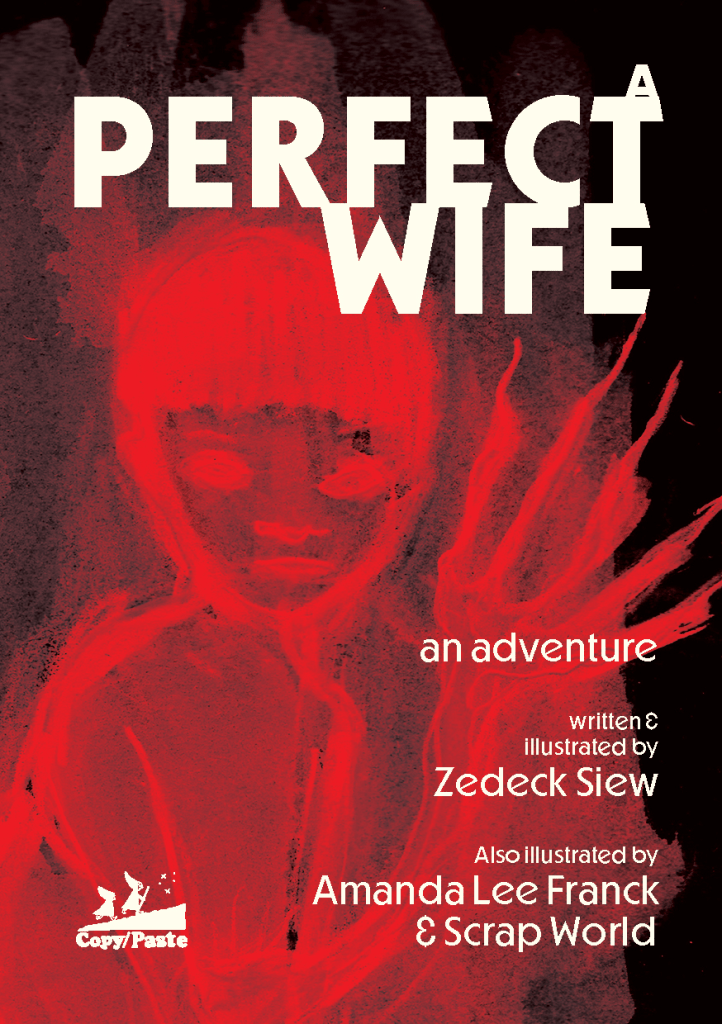
A Perfect Wife is a 46 page system-agnostic module written by Zedeck Siew and illustrated by Zedeck Siew, Amanda Lee Franck and Scrap World. In it, a supernatural terror haunts a modern day neighbourhood, murdering every fortnight, and you are asked to investigate. It is an expanded version of something published on Siew’s blog in 2024. I backed this in in the recent crowdfunding campaign.
This is a capsule game; it has some very simple rules that appear to be based on Chris McDowall’s Into the Odd framework. You choose your character according to how you know Sara, the titular Perfect Wife; that character has no physical prowess or special skills, but does have some connection or resource. These rules are designed to draw your character into spaces and situations that benefit them, and then place them at complete and abject fear when facing the supernatural horror that is plaguing the neighbourhood. They are scattered, however m, throughout the book. The book is well-indexed — hyperlinks and page references throughout the text, but as every opportunity for violence doesn’t link back to page 17 you have to find rules pages, scattered amongst the rest of the module. While the rules do occur when you’re first likely to encounter violence, my memory is perhaps too unreliable to remember where that was, particularly in digital. Given there are appendices, they may have been best placed there, given the decision to not forefront them seems very intentional.
The art here is gorgeous, and the eclectic combination of Scrap World and Amanda Lee Franck’s paintings, and Siew’s sketches, works very well in the otherwise minimalist layout. I think the layout could have benefited from a little more flash when the art isn’t present, although it works just fine, as the amazing art and content would have been better displayed in my opinion in a different frame, although exactly what that frame might have been is a more complex question. The information design is complicated by the aforementioned atypical organisation, but this is balanced to a degree by extensive referencing meaning that this approach doesn’t significantly impact play — you’d be flicking around a book anyway, in any ordering, and it’s easy to find what you want when you have hyperlinks or page references scattered throughout the text.
If you are a fan of Siew’s writing, this is amongst his best work. The only modern-set module I’ve read of his, it brings an immediacy and precision that makes this feel more imminently runnable and understandable from a thematic and geographic perspective. I am very, very keen to get this to the table, even though I don’t typically enjoy playing in modern settings. This feels like a real place the author has lived in filled with people he’s met, not something imagined. The supernatural feels as if I’ve missed something about the real world, and it’s integrated into real-world horrors in a smooth and very precisely targeted way. One consequence of that: perhaps you should check your table for content warnings around the precise horrors it portrays before running it. This is horror writing at its best, if you enjoy horror.
However, I think the precision, eeriness and mystery of the writing does betray the application to play in a few ways, which breaks my heart to see. The goal of the player characters, for example, is only obliquely referred to about half-way through the module, and why Sara chose to hire them when she did is not explained, and neither is why she’s suddenly interested in human trafficking at all, when the women being trafficked are quite explicitly not the women being murdered. A lot of secrets run parallel to the investigation, rather than draw the player characters closer to the solution; I can see how the player characters might find the monster, even before it comes to stalk one of them personally, forcing the issue, but I can’t see that the player characters will figure the mystery, or grasp how to solve it definitively, within the limits of the text. This module is full of what I’ve referred to in the past as forsaken easter eggs: Things only the referee is privy to, but are essential to progressing. In his previous work, Siew’s intentional restraint has been largely a book to imagination and to play; I think here, in a primarily investigative module, the opacity is not as beneficial.
The Perfect Wife — displaying typical Siew insightfulness — ends with some tools intended, I think, to help resolve this issue. An appendix talking about how Malaysian culture approaches the supernatural and monsters, and how magic works in the context of the story, to begin with. A second appendix talks about the pontaniak — the monster at the heart of the story — and its place in literature and the themes of the module. It tells us things about the module itself that the module never spells out, which will help the referee understand how to better run A Perfect Wife if they’re not of Malaysian culture, but won’t help the players understand some of the cultural and social strings pulling on the characters. Finally, the optional rules cover other spirits that might aid the player characters in their investigation: Some odd interactions with these spirits may be the only way you can find out how to defeat the monster. Portrayed as optional rules, I think they may be the only way provided by the text, for the player characters to defeat the monster.
That of course, assumes that the module is intended to be solvable. I’m not entirely sure that it is, and this might dictate how you sell this module to the table you intend to play it with. The real monster is a man, a man with connections and power whom your characters are not equipped to deal with. The establishment supports this man. You might prevent him from getting what he wants, but only at the risk of setting the supernatural monster free to do more harm, unchecked. This module, read as a story, has a lot to say about the nature of monsters, who the real monsters are, and what true power is. The horror in this scenario is the fact that we are helpless before the powerful, whether that power be supernatural, political, financial or societal. The horror here is deeply concerned with class and gender. These are all very relevant and painful horrors to be playing with, and that A Perfect Wife does not provide an answer or solution to the problem the player characters are hired to solve, speaks to a reluctance to treat the real world inspirations of that horror with the flippancy that, say, the modern superhero movie does.
One way that I can think of, to sidestep that flippancy and have a result that is familiar but still horrifying, is running this in Trophy Hold, softly holding to the rules obviously for setting and theme. The rules that exist aren’t a far reach, anyway, and provide the players ways to access the inaccessible information, in a way that might feel less against the spirit of the adventure. This is how I’d approach it, I think, rather than running it as the intended capsule.
A Perfect Wife is just a compelling, gorgeous, necessary piece of art, in subverting our expectations of success in modules like this, and by truly desiring for the horror to strike the hearts of the players, it fails to be a module that is easy to engage with. In my experience it’s rare to find the group of players seeking a module in this style who would respond to this subversion well, if they weren’t expecting it. This is the kind of thing I’d play in a day, and plan to have a discussion about the themes and ramifications afterwards, because there’s likely to be some bleed — culturally, that swings wildly to my “emotional skydiving” friends (thank you to Sam Dunnewold for that term I first heard on Dice Exploder), rather than my typical dungeon-crawler crew. That said, it would be wildly hypocritical of me to not feel like this kind of precision, subversion and communication of theme is exactly what I feel the module as an artform should be more widely recognised as being capable of. In that light: You’re a damned fool if you don’t read A Perfect Wife, and if you have that perfect mix of players, you’re a damned fool if you don’t play it. Art often isn’t fun, and is nevertheless worthwhile. If you want to dig deeper into the potential our little nascent art form has, are interested in modern horror, and are either willing to do some lifting in terms of system or improvisation and expansion, you can’t go wrong with picking A Perfect Wife up.
Idle Cartulary
Playful Void is a production of Idle Cartulary. If you liked this article, please consider liking, sharing, and subscribing to the Idle Digest Newsletter. If you want to support Idle Cartulary continuing to provide Bathtub Reviews, I Read Reviews, and Dungeon Regular, please consider a one-off donation or becoming a regular supporter of Idle Cartulary on Ko-fi.


 Playful Void
Leave a comment