
Bathtub Reviews are an excuse for me to read modules a little more closely. I’m doing them to critique a wide range of modules from the perspective of my own table and to learn for my own module design. They’re stream of consciousness and unedited critiques. I’m writing them on my phone in the bath.
Straight Arrows is a 64 page campaign setting and module for Mothership by R. A. Creedon, with additional art by Bee. In it, you tread a tightrope between competing factions while kidnapping rich addicts for the benefit of the shady Arrow Biomed as the titular Straight Arrows, and you spend your time on the once beautiful world of Ithaca, now in its’ dying days.
The module opens covering the 7 major factions, as well as a few smaller gangs, that populate the once-beautiful city of Hewitt Springs and plunder the planet of Ithaca. For each faction are listed a bunch of “Deeds“, things that the player characters might do that get the faction’s attention, which indicate how the member of the faction knows them (if indeed they do). It’s an elegant little reputation system. My major issue with the factions themselves, is that they aren’t actually described in a way that makes them playable in and of themselves. While more information is presented in the module itself, they don’t have clear agendas; they’re presented as difficult to parse paragraphs. You can tease this out (and admittedly for one of them, it is very clear), but it could’ve been more compelling presented as a set of competing interests. I do like that the Spring Street Gang is presents as a subculture and they are far more interesting than the other factions for that fact.
The Straight Arrows themselves are paid well, encouraged to turn on each other, and gain a bunch of character-driven questions at character creation. I quite like these “Job Interview” questions as a concept, although they might bounce off some less story inclined groups. The good ones inform your character’s perspective on addiction, with the idea that all the characters are in some kind of conversation about what the right thing to do is. “Is the war on drugs a real war? Why do you say that?“, “How do you feel about how the unions are addressing the drug crisis?“, but the less interesting ones have not much to say about the world, particularly the Android and Scientist questions. More iteration and perhaps reaching wider in editorial would have made these more meaningful, but this is an excellent conceptual addition here and to any module with a cohesive theme.
There’s a whole section on drugs, because addiction drives the world and drives the story. These are fine; my personal experience is that nothing I’ve seen has made addiction interesting in a TTRPG, because it’s pretty damned difficult to persuade someone to risk an addiction with all the information truly on the table. This one takes some swings: It makes most of the drugs here useful, and some of them are interesting — clearly the authors thought so too, with the “endies” getting 3 pages of coverage. But nothing here is grabbing me; I don’t see why I would choose to use any of these as a character, and getting many of them would be an adventure in and of themselves. Straight Arrows does present itself as a campaign setting as well as a module, so that isn’t a stretch, but I don’t think even the expanded detail on endies is worth the trip, unless you were going to generate an entire tangent based on the results of your vision.
Archer Farm is largely uninspired, to be honest. I was hoping for some kind of secret dungeon crawl here, for when inevitably the player characters turn against their evil pharma overlords. But it’s just a resort in space. I do like a few of the characters who dwell on it — but the fact that Mandy, who takes kidnapped rich kids on bush walks and looks after the deer, will die if she leaves the farm will never come up that I can envisage: It’s a forsaken easter egg, with no meaning to anyone except the referee. Looping these individually interesting facts into accessible and useful positions would make it absolutely sing.
Next up is the city of Hewitt Springs — finally we get some way to interact with the factions that opened the module. Here, we have the 10 districts, with nice iconic descriptions. The random events that are described here are rarely clear enough for my liking — “the resident is negotiating a business deal with Null Soul” requires me as a referee to intuit a business deal, which is too big an improvisational task for something that will likely result in a tangent if the players develop any interest about the resident. This is a habit: “middle managers carouse with women much younger than them. The women are tastefully dressed but wear subtle gang colours“, is clever, but which colours? Oh, actually, once I look it up (which I shouldn’t have to), I find out that many of the gangs don’t have colours. The city is deeply concerned with bars and clubs, in a similar way to the recently reviewed Arkos, however unlike Arkos, I don’t feel engaged in these bars and clubs, because these are attempting to be working-class sci-fi bars and clubs which aren’t much different than the real world, where Arkos were fantastical places I’d want to visit.
The module ends with a list of patient retrieval missions: Rich people you’re kidnapping for your corporation. There are three of these, plus a patient generator. These are of varying complexity; by the time I get to the third, it feels like the author has run out of ideas; the first is a few pages, the last is half a page. There are no locations associated with these — they often move around the already covered locations, but aren’t there in the location text, and don’t interact otherwise with the world. There are also a bunch of patients that are on the farm already — I think this is interesting, but underdeveloped. I’d love for these characters to be hooks into the outside world, but those connections just aren’t developed. The patient generator just isn’t thorough enough; basically, you’re choosing from 5 target types, with their own complications and routines, or what happens when they flee, but the truth is that once you’ve gotten through these 5 types you’re probably going to be disinterested in re-visting them. This space would’ve been better off spent with 5 more entire patients, in my opinion.
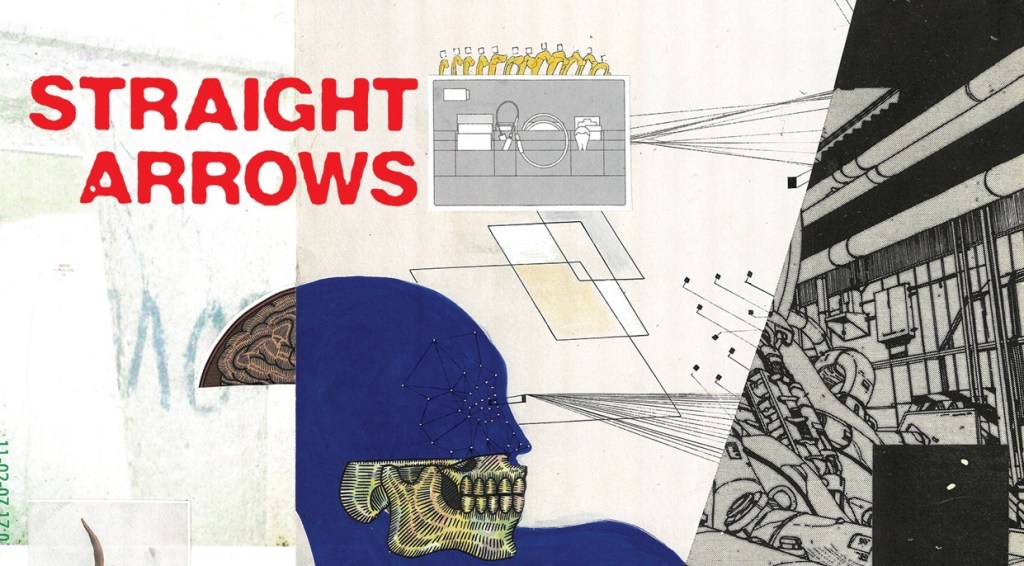
Straight Arrows has a collage layout and art style; it’s gorgeous overall, bringing a unique to Mothership DIY glitz that I adore (honestly, some of them feel like actual photographs of a collage, rather than what I assume it is, which is a cleverly laid out digital facsimile) but it is not always easily navigable. For example, Archer Farm doesn’t get a header at all, or at least it doesn’t until 3 pages after the section on Archer Farm starts. But those mis-steps are few and far between; mostly, this is very pretty, and easy to read, with a stand out collage style. Love to see this more popularly utilised, instead of the typical Mothership style which is continuously aped.
As a social module, dependent on characterisation and interaction, there just aren’t enough connections between disparate places and people here for it to really gel in play for me. The “d100 randos” table, for example, are precisely that: They have no connections, they have no place in the world. Characters float in their locations; NIMBY’s protest specific locations eternally, nobody lives anywhere or cares about other people, except theoretically. In a module that “caters to character-driven horror”, it has shockingly little interest in any of the characters themselves or their connections to the world of Ithaca. But, the writing here is largely interesting and evocative, I enjoyed many of the characters who were there (even without connections), and the authors clearly had something to say with the world of Ithaca and the locations and factions in it. That’s a really strong start, but the cake just isn’t fully baked in my opinion. More questions needed to be answered about this world and these people, before it’s completed, and I don’t want to answer those questions myself.
Because of that, Straight Arrows never truly lands for me: I don’t want to run this, despite some interesting choices and some clever characterisations. The issue for me, is that I don’t want to play Mothership in this world, and spending a lot of time on or based around Ithaca is how this socially-focused module will thrive. There is so little joy in this world outside of the escapism of drug addiction, that I simply cannot gather enough interest to play here. The world is tough already; good horror is a reflection of the world and the fears we face, and magnify it. The other week I reviewed A Perfect Wife, which is an excellent example of a module doing this kind of horror well. This, however, is basically the real world with space ships. The people in this module are people I meet all the time. It’s not weird or fantastic enough for me to want to play here. It doesn’t allow me to express anything, except to be a pawn of capitalism with no recourse and no hope: That’s my real life, ya’ll, I don’t want to play here.
That said, if you’re looking for a gritty world to base your Mothership campaign in, are interested in shopping out some kidnapping missions and developing out your own list of agendas and roles for these factions in the larger world, and have fun exploring themes of addiction and poverty, then Straight Arrows is a pretty exceptional place to start. It really nails it’s world-building, I just want a little more of everything that’s here, and would want to expand it a lot. If that’s your jam, and if this is the perfect starting point for what you’re after, Straight Arrows is the module for you.
Idle Cartulary
Playful Void is a production of Idle Cartulary. If you liked this article, please consider liking, sharing, and subscribing to the Idle Digest Newsletter. If you want to support Idle Cartulary continuing to provide Bathtub Reviews, I Read Reviews, and Dungeon Regular, please consider a one-off donation or becoming a regular supporter of Idle Cartulary on Ko-fi.


 Playful Void
Leave a comment