
Bathtub Reviews are an excuse for me to read modules a little more closely. I’m doing them to critique a wide range of modules from the perspective of my own table and to learn for my own module design. They’re stream of consciousness and unedited critiques. I’m writing them on my phone in the bath.
Empire of Hatred is a 47 page module for Mörk Borg by Sam Sorensen (covering graphic design, interior illustration, and translation from Koine Greek), and with the cover by Lee McGirr and Tash Couri. In it, you are part of a caravan carrying resources and the corpse of a saint, to a place called False Antioch, a journey for which there is no map. This is a hex crawl, so it invites comparison with Sorenson’s excellent Seas of Sand. I should note that in addition to Mörk Borg, it requires Feretory and Heretic, the official supplementary zines, for specific areas. I got a complementary digital copy of Empire of Hatred from the author.
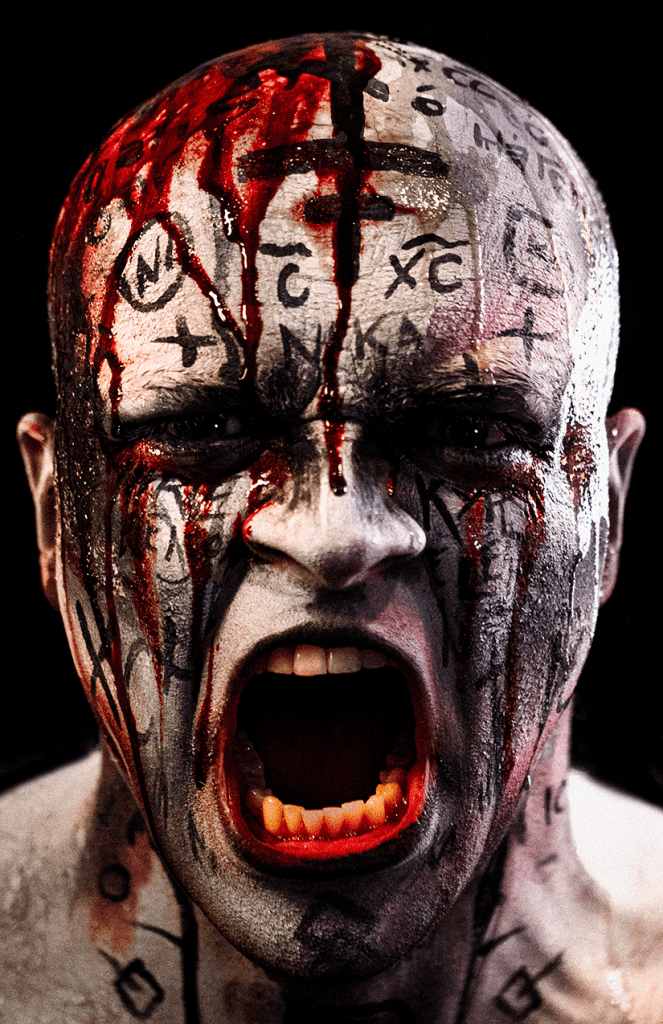
I’ll start with the layout: It’s minimal, but with clear headings, appropriate highlighting, and easy to read. page references are present when necessary, although I’d appreciate them going to external texts as well such as Heretic and Ferretory so I know where to look. The textures and font choices are on theme without detracting from readability. The map in the book is monochrome and not a joy to read — this is a case of too much indentation trying to be communicated with too little bandwidth, and would benefit either from a different use of icons, additional use of colour, or perhaps a different hex numbering system to make it easier to read. There is a larger, printable map that minimises these issues to a degree, but the design here could still be clearer.
Empire of Hatred doesn’t mess around. It opens with a spread with additional rules covering long-distance travel, and then dives straight into the locations proper. The rules are simple — 24 mile hexes, speed is by terrain, you get weather every watch and 1-in-6 chance of encounters every watch. Settlements have randomly rolled resources, which once determined are simply drawn from the core books. There are guns, which aren’t further explored, and I assume the rules concerning them are in Feretory or Heretic. I think the presence of gunpowder and guns is an interesting, anachronistic choice, because it also presents itself as being translated (this wasn’t written by Sorenson, remember) from the time period between 300 BC and 300AD.
The hex crawl itself is through 9 regions across an area 850 miles long and 575 miles wide. It’s massive, and the key is here is a brief hexfill rather than a full location description — we’re maxing out at 5 lines of description for a complex location here. This means that the weight of interaction lies in two places — in the random encounters (which you’re likely to be encountering at once per two days of travel), and in the referee’s capacity to improvise. This is a very specific style of refereeing, dependent on emergent interactions, and it is more similar to Wolves Upon the Coast than Seas of Sand. Not every hex has a hex fill, it appears (I could be wrong), so it’s hard to estimate the number of locations covered without individually counting, but there are certainly hundreds of them here. Certainly, the mall could be clearer in how it signifies the regions.
When you wade into the key, Sorenson’s writing is as its’ best. The broader region descriptions “The lonely and scattered trees shake and twitch in the hissing wind.” are typically picturesque, and the details are typically inviting: “fountain sits amid the rust and dust, spitting filthy ochre water. Beside it stands a heavily-armored berserker, Zimri, panting heavily.” or funny “A rattling box bobs up and down on the surface, kicking off ripples. Muted blasphemies sound from inside.” The clever thing about the best of these brief entries is that they have a hidden structure: The first phrase is an invitation (a fountain? in the burnt wasteland? I’m thirsty, and that man seems fine!), and the second phrase is hint regarding what is wrong (the man attacks, water dripping from his mouth!), and the third the explanation for the referee (gain the Bloodthirsty rage feat if you drink a full goblet). A lot of them are instead intended to be a prompt for the referee to expand on the world herself, which may or may not be your preference. I think these are excellent prompts, but I’m not in the business of buying modules for their prompts — I want to know why the wickhead is ensuring you’re giving chase, and where it is leading. Potentially what I’m lacking here is a close familiarity with Mörk Borg and its expansions; Wickheads (and many of the creatures you’ll encounter) are from the core book, but many of the creatures and terms here aren’t, so a charitable reading will require you to know which of the 3 books referenced contain Voodoo Fire to understand said wickhead. The issue here is I’m not sure what’s intended to be improvised and expanded and what isn’t — unless I go through Empire of Hatred, marking it up with where in the relevant rulebooks things are mentioned and where they’re not and I should improvise. If you’re an afficiondo of Mörk Borg, this won’t be an issue, but I strongly suspect you will be improvising your unique version of these plagued lands irregardless. That was a long digression: The hexfill here is great, Sorenson is firing on all cylinders, but it leaves a lot to improvise or assume.
The brevity of the key indicates that random encounters are supposed to play a major role. The random encounters here are very brief, and not expanded upon — often 1 word. The issue of being unsure what’s in the books and what’s created recurs here: Is a Ratbit an existing creature, or something for me to improvise? Is it a threat, or incidental? The random encounters are clearly not all intended to be violent — you’re on the side of the empire, so imperial soldiers aren’t intrinsically a threat, nor refugees, nor the recurring character Mikhail the Merchant. Most of the tables (there is one for each region) has a reference to a character within the key for that region, which is something I typically look for. These are good random encounters, that rely heavily on the reaction roll and the referee’s interpretation of it to bring the thunder and surprise. Weather varies between regions, but tends to be mechanical in nature, and isn’t fantastical, compared especially to magical sands of Seas of Sand, especially. It does consistently suggest an inhospitable region, which fits the black metal aesthetic and apocalyptic themes. I think that a wise party could use the weather to their advantage, but it’s not quite predictable enough for this to work — I’d love for the players to lure an enemy into the lightning of the Mother’s Mountains after dumping their armour, but there’s an equal chance they’ll lure them into clear weather or high winds instead. I think that a shorter or more heavily weighted table would make the weather in each region more iconic, and I’d probably do exactly that — make the weather more assuredly windy in the plains or lightningy in the mountains, even if it’s just making the roll a d3 rather than a d6.
There are a few missteps here, and they all come down to Sorenson’s assumption of intelligence in his audience, which in some cases creeps into inconvenience. For example there are 35 mentions of infection and 16 mentions of plague, but aside from “plague wracks their lands” in the introductory paragraph it isn’t clear what the plague is or what it might mean. This is a great example of where Sorenson expects us to refer back to the rulebook, but the rules for infection are a single line on page 31, and I’d still like the nature of this plague to be detailed for something that is occurring multiple times per page. The big thing that I struggle with, though, is the lack of any attribution of personality to any of the characters. Mikhail the Merchant is the big one — he’s a character you expect to develop a relationship with as he recurs repeatedly, he has a souls-like laugh and a cryptic sentence if you encounter him in Golgotha where his shop is, but he’s someone I’d love to have some damned understanding of. The writing about Mikhail is something I’d probably smile at had I written it myself, but as a referee, I’m groaning that I don’t have more to go on. But you are given very little on any characters here. Nothing on Tome-father Dismas, or Damaris and his dead god, very little on Gestas the Impenitent, no clue why Priestess Tirzah salts her congregation when they die, et cetera — I scrolled through a few pages to find these, there are far more. There is no shortage of characters here, simply a shortage of agendas and of reasons to interact with them or engage with them. It feels like I’m playing Dark Souls, but cannot piece together all of the clues to tell a story.
Sorenson does a lot of work in the community, but one significant contribution that will live well beyond him I suspect, is In Praise of Legwork, an essay about the City State of the Invisible Overlord and what is great about it. What I find surprising about Empire of Hatred, though, is that it doesn’t do the legwork the Sorenson praises — or at least in some ways. In that essay, Sorenson does say that “depthcrawls and other generators provide shortcuts to making huge spaces (megadungeons, labyrinths, etc) without needing to do all the legwork in between“, and here there are hundreds of hexes, thousands of square miles of area, and many, many hexfills. But he also rails against “just make the players (or GM) come up with everything themselves.“, which is precisely how I feel Empire of Hatred is asking me to do. What I want out of Empire of Hatred then, that it’s lacking, is for Sorenson to “take the time and effort to come up with better content than somebody improvising it live at the table“; but I suspect this clash finds its source at a disagreement on what a referee is improvising live at the table — because, let’s be honest, that’s a core part of not just the referee’s job, but all the player’s jobs. Sorenson wants me to improvise characters and factions and political and religious clashes, and perhaps even a grand backstory to this decaying empire. For me that’s the legwork.
That all said, if you’re looking for a black metal hex crawl, where you’re exploring a bleak and plague-ridden empire that feels like you’re peasant rather than a hero in Dark Souls or Elden Ring, that’s Empire of Hatred, right here. Sorenson’s writing absolutely slaps in this, you can smell the rotting corpses through the page and it leaves a huge amount of questions that, if you’re interested in answering them, will result in a fascinating and deep history. What you are doing, as a referee, though, is committing to answering them, I suspect. There will be so many questions raised by this module, you won’t be able not to. The alternative approach is that you enter into this campaign as an anti-canon one: You discuss with your players that what Sorenson has provided is the surface, and that the depths you’ll discover together. Your goal is to write the psalms, the secret histories. You improvise them together. You’re not simply on a caravan, you’re scholars there, scribing history. That might be a compelling take, to a table full of storytellers. Regardless, while I think Empire of Hatred is a fascinating piece of work, you need to be into black metal, be very familiar with Mörk Borg, and be willing to either do or share a lot of legwork, to get the most out of it. But I suspect if you do, you’ll be in for a memorable time.
Idle Cartulary
Playful Void is a production of Idle Cartulary. If you liked this article, please consider liking, sharing, and subscribing to the Idle Digest Newsletter. If you want to support Idle Cartulary continuing to provide Bathtub Reviews, I Read Reviews, and Dungeon Regular, please consider a one-off donation or becoming a regular supporter of Idle Cartulary on Ko-fi.


 Playful Void
Leave a comment