
Bathtub Reviews are an excuse for me to read modules a little more closely. I’m doing them to critique a wide range of modules from the perspective of my own table and to learn for my own module design. They’re stream of consciousness and unedited critiques. I’m writing them on my phone in the bath.
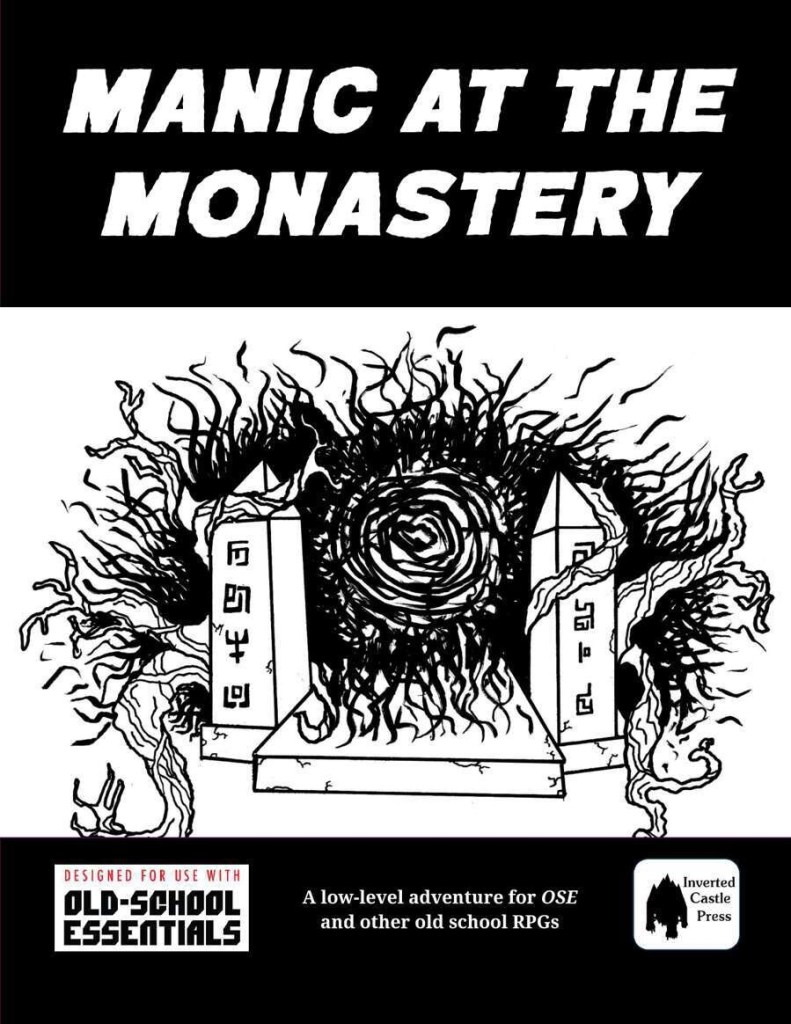
Manic at the Monastery is a 26 page module for Old School Essentials written, mapped and illustrated by Will Jarvis with additional illustrations by Brandon Yu. In it, you explore an ancient psychadelic monastery. I was provided a complementary digital copy.
We open with a spread covering the 2 levels of the monastery, and 2 flat distribution random encounter tables, followed by 2 pages of background (only the second is referee’s information, but I don’t think the referee is supposed to provide the players with the first page either), and then a table of rumours and a table of hallucinations. The rumour table isn’t quite meaningful enough for me; if I’m providing the players with a few rumours, I want it to make them all want to do different things in the monastery, and I want them to say different things. Part of the issue here is that it doesn’t differentiate between hooks — these are reasons to venture into the monastery — and rumours — things you might know about what’s going on there. If we split off the 5 that are hooks, and reframe them so they’re reasons to go there, then we have 5 actual rumours, and these 5 won’t change how we interact with the encounters or draw us to interesting places. I want this stuff to be meaningful, and it doesn’t quite do it. We need juicier worms to lure us in, here.
The hallucination table is a challenge; you want your players to be up for a certain type of play, or anything that causes their characters to act in ways contrary to their choices can be rough. I think there might be more interesting ways to manage hallucinations that wouldn’t risk this — it might have been interesting had the hallucinatory effects had real-world consequences, like sharing universes with certain monks, seeing solutions to clues you can’t see without the drugs on board, etc. I think with some creativity, you could really make the psychadelia of this dungeon shine, but sadly, I don’t think it succeeds in thinking outside the box. In my opinion, if you have a cracker of an idea — and in my esteem, fungal hallucinating monastery is indeed a cracker — you really need to figure out a neat way to make that idea sing. A d6 table doesn’t cut it, in this particular case.
We then arrive at the key itself. I really like the key. It’s creative. The first ambush — pelted with rotten fruit and confusing insults (I’d have loved a confusing insult or crude lyric table). Hazards include agitated mules you need to calm. The monastery feels lived in by the monks here. The monks have relationships and agendas, but also manifest monsters when they sleep without realising it. It’s cool. But occasionally, things lose their detail: Why does the Abbot’s desk or the writing room not contain any hints? There’s a rivalry between two monks. Why? And why would the player characters care enough to take a side? There are secret doors and traps here that in my opinion need a some kind of parallelism or hint regarding how to open — the monks making the appropriate gesture, perhaps, or other statues that match the desired poses. One monk will have his madness calmed by the voice of his love. Things should mean something; lore should be imparted. There’s a tension here, where the seeds of excellence are planted, but not fully broad to fruition. It feels like the cake here is not fully baked. On the other hand, the writing is funny, and interesting, at a room-to-room level. It’s the overall interactivity and connectivity that is lacking. And there’s potential for connection looming — this clearly links to other modules in a series in an interesting way. This is a cool project, and well written, and easy to run, it just isn’t cohesive and doesn’t quite sing.
The random encounter tables have a flat distribution on a 1d8, and occur on a 1-in-6; resulting in a likely 8 encounters out of 16 total. If you want your random encounters to tell the players something about the space, you probably want to use a bell curve with those numbers, so you’re more likely to get the snappier ones, or else use a smaller die. However, I’m not sure the intent is for this to communicate much at all: none of the encounters are associated with creatures wondering from specific locations, including the only named encounter, and none of them really communicate much about the monastery except for that many of the denizens are developing hallucinations and hinting towards the source of these hallucinations. They’re one step better than completely random — all of the encounters are customised to the monastery — but they don’t say much about the space at all.
Layout in Manic at the Monastery is an adaptation of the OSE house style, with clear headings and sections, clear use of highlighting, bullets and colour. It’s not flashy, but it does the job, and plenty of flashier layouts actively impede understanding. The maps are hand-drawn, legible and detailed, and cut-outs recur which helps with understanding the geography of the space. The art is fine, but is relegated to spot art, and again, is functional rather than flashy.
Manic at the Monastery as it is, is a solid beer and pretzels dungeon, that you’ll get a bunch of sessions on. You’ll be relying heavily on your player buy in unless you re-write half the rumours into hooks, and you’ll have to do some heavy lifting with the characters to make the social play really sing; but the truth is, this is second nature to many referees, and if it is for you, this has some clever ideas, some interesting locations and special rooms, and a bunch of unexpected traps and hazards. It’s cool stuff! But I’d rather that cool stuff be built out a little more, for me to know a little more about these characters and why certain things work in certain ways. I need a wee bit more background than I get on certain things, and a wee bit less background that I get on others. It could use a polish, in my opinion, but it’s solid, and if venturing into a monastery to fight an alien tree while hallucinating from an evil spore attack seems like your jam, I’d look no further than Manic at the Monastery.
Idle Cartulary
Playful Void is a production of Idle Cartulary. If you liked this article, please consider liking, sharing, and subscribing to the Idle Digest Newsletter. If you want to support Idle Cartulary continuing to provide Bathtub Reviews, I Read Reviews, and Dungeon Regular, please consider a one-off donation or becoming a regular supporter of Idle Cartulary on Ko-fi.


 Playful Void
Leave a comment