
I Read Games reviews are me reading games when I have nothing better to do, like read a module or write or play a game. I don’t seriously believe that I can judge a game without playing it, usually a lot, so I don’t take these very seriously. But I can talk about its choices and whether or not it gets me excited about bringing it to the table.
I took the kids to the beach, and they’re entertaining themselves now that they can swim, so instead of worrying they’ll drown I’m reading Harvest. Harvest is a 95 page game by Luke Jordan, where you and the other players explore their home, and Island, when it demands one of you sacrifice their life — and one of you to wield the knife. It’s a horror game, but one of lingering and existential fears, not of jump scares. The obvious touchstone is The Wicker Man, but I’m less familiar with the other touchstones mentioned.
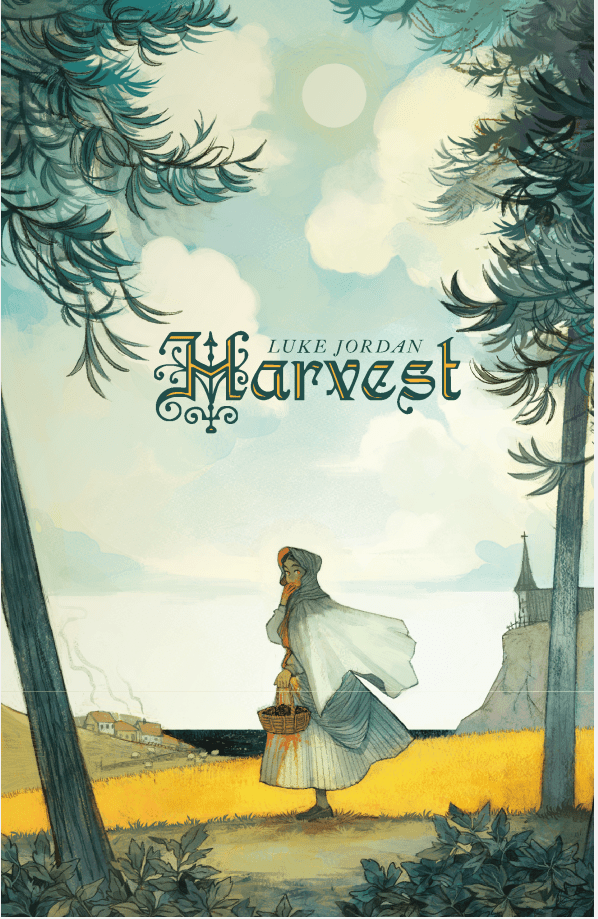
Harvest is a referee-less game, where each of the players takes a particular character that lives on the island. Jordan is one of the best writers in the hobby, and Harvest is therefore filled with luscious prose and plentiful reasons to read it. You open your game of Harvest with an invocation: A one page read-aloud text that sets the scene. Everyone is on the same page, and the themes are immediately clear: This is a game that is about taking refuge from Empire, and the price that must be paid for such privilege. You then cover some sections of the note on themes that follows it — effectively a safety discussion. I think this could be more neatly done, but it covers the bases, and I feel that in a horror game being clear that if you don’t want gruesome depictions, the game might not be for you, is the right approach. Then, you together create your island, using the “broadside” (Harvest’s term for playbook) that’s provided. You together choose which of the six roles you’ll occupy, and create a character for yours, building ties together which imply things about your character’s histories. You then take your two piles of cards, shuffle them and place them on the table, and begin your play.
One way that Harvest sets itself aside from the games that inspired it, such as Dream Askew and Dream Apart, is that it’s generous in what it provides. The “As Taught To A New Player” includes a bunch of steps after “begin your play”, as I stopped above, talking about learning the method, taking intermissions, and more. There are two pages on creating your island, something that — to me, at least — is implicit in the broadsheet itself. The effect is the opposite of anachronistic — it feels like a game written in the 1800s, when it is set. But it strangely draws attention to the otherwise obscured role of facilitator (it is mentioned in the “As Taught To A New Player” briefly), as for who else is this gorgeous prose intended? And some of this prose betrays gaps in the design of the game; for example “The final mark is the most fearsome. They will not speak of it” is indicated in prose that the players at large aren’t asked to read and is not mentioned on the broadsheet. Is all of this intended to be read aloud? I would be inclined to; it’s a pleasure to read out loud. But that’s not dictated by the rules, that I can find, and the length of these sections would make some tables’ eyes glaze over. The text fails itself here, sadly.
Mechanically, there are a few things going on. There’s a simple token economy, where you give and take from the community depending on the moves you use; tokens escape the economy through powers’ unique rules and are replenished as acts progress. There are two oracles — one of cards, and one of a die — to assist in characterising secondary characters (the first their personality, the second their role in the island’s community) — these are a little complex, but it’s a nice support framework for a referee-less game. An omen deck which governs the progress of time and hence the narrative as the night of the sacrifice approaches — these cards are drawn whenever a broadsheet tells you to, generally as a result of a players actions. This characterises the act (act here meaning the section of the game) and propels the events of the narrative forward. All of these mechanics have a meaningful part to play in the game; everything clicks together neatly, and like clockwork, to tell a story that is far more limited in scope than other Belonging Outside Belonging games I’ve played. It’s very clever; I’m reminded about how impressed I was by the elegance of Fiasco’s mechanics when I first played them, in the way they favilitate a more structured narrative without the iron fist of an overlord.
I had no idea what a broadsheet was in the context of this book when I first read it — I thought I’d missed a special big printout, perhaps with a map of the island? The only context I’d head the term in was a really big newspaper — I literally had to google the definition of the word. This feels like another case of the text failing itself, or at least the editors and readers having too much familiarity with the work to catch the things that make no sense to outsiders. That said once you figure out what they are, Jordan is one of the best writers of prompts out there, and when you get to the broadsheets — the bulk of the game — you see this very clearly. You might have “Countless tiny freckles”, be under the thumb of “A coven of sirens from the dark waters off the Island—grasping, hungry, and owed a debt inherited from an ancestor.”, or want to stamp out “Giving infants false names to confuse fairies.” or be unable to get rid of “A rattling cough you can’t shake.” It’s all like this. It’s all vibrant, useful, inspiring stuff. This is the meat of a Belonging Outside Belonging game, and it’s very, very well done in Harvest. I’d have no trouble occupying these roles. My main issue with the broadsides comes with how to use them in conjunction with the powers. You pick a power — basically, you can think of these as subclasses to the roles classes — but they instruct you to add their contents to your broadside. But where is the space for this assumption in the broadsides? There is none. Otherwise, they come across as a typical case of circle or highlight the prompt you’re using, until you’re asked to add to them. I think I’d just address this by attaching the power broadside to the role broadside, and doing more circling, etc. But it is another case where it feels like the text fails itself. This is a problem, because the powers are one of the two ways Harvest guides narrative progression — in this case the particular arc of your character, and the movement of tokens. Obscuring that is an issue that really should’ve and could’ve been addressed easily through better information and visual design.
The other key method Harvest uses to guide narrative progression is the Ritual Almanac. Each act of the almanac —there are 3 — has its own character (in my opinion, a flavourful, appropriate and misleading choice of words — I thought you had to pick a main character for the act initially), and the oracle deck gets refreshed with tokens to work their way across the broadsheets. The omens are randomised — you won’t get the same omens twice, and each time one occurs, the tokens head to the characters present to witness it. When the tokens are exhausted (7 tokens for the first and last act; 14 for the second), the act ends with a unique prompt. I don’t have a good sense for how quickly these tokens will get used up, and I suspect it will move differently as the player count goes up, but I’m guessing from their natures — stuff like “The morning tide runs red. All water on the Island—well water, spring water, rainwater—takes on the cloying salt-and-copper tang of blood.” — at least 2 players will encounter each, which means we’re going to burn through the first and last acts in as few as 3 scenes, and finish the game in potentially 12 scenes. This puts it in the ballpark of a Fiasco game, and hence I’d expect to mark the game length at 2 to 3 hours, depending on how tightly your table frames scenes.
Layout in Harvest is mixed for me. It oozes 1800s horror. Blackletter headings, illuminated drop caps, decorative elements, bespoke interior art that feels woodcut by Doomed Sarcoma, and ligatures out the wazoo. It works, just fine. I find the ligatures, though, incredibly distracting despite it screaming Victoriana. There is definitely an overuse of very floral italics in the latter two thirds of the book — very challenging text blocks to read at times. But it’s fine. The table of contents is excellent and makes navigating the book far easier. I think perhaps a larger issue with buying the print book (I did not; I have a pdf) is that I’d feel the need to print the entire back two thirds as necessary play aids: Page 24 to 94 all belongs with you at the table, particularly if you’re playing with the full set of roles. This betrays the print book in a lot of ways: Belonging Outside Belonging has a history of feeling out of place in anything other than a zine because of the deep dependence on play aids as the bulk of the text, and with Harvest I strongly feel like the best structure isn’t the one the publishing industry wants, but rather a 20 page zine and a digital package of broadsheets. As much as the print book is likely to be beautiful based on these files, I don’t think I need it on my shelf for this reason.
I managed to get a lot of criticism into this review, but the truth is, the core of Harvest is absolutely an excellent folk horror game. Jordan’s writing remains without peer where it counts. It’s atmospheric, and leaves so much room for your table to bring their own flavour of slow, creeping horror. Having worked my way through the book in detail, it’s going to be easy for me to run, mechanically it’s elegant and supportive, and the prompts are so juicy and flavourful. But I had to wade through a challenging text to get there; the Victorian affect does it no favours, and the decision to stand by that in terms of product design does it few favours either. But, as I mentioned, you’ll be playing largely off the printed broadsheets anyway. Once you’re playing, and have a grasp, Harvest is smooth as butter.
Idle Cartulary
Playful Void is a production of Idle Cartulary. If you liked this article, please consider liking, sharing, and subscribing to the Idle Digest Newsletter. If you want to support Idle Cartulary continuing to provide Bathtub Reviews, I Read Reviews, and Dungeon Regular, please consider a one-off donation or becoming a regular supporter of Idle Cartulary on Ko-fi.


 Playful Void
Leave a comment