
Bathtub Reviews are an excuse for me to read modules a little more closely. I’m doing them to critique a wide range of modules from the perspective of my own table and to learn for my own module design. They’re stream of consciousness and unedited critiques. I’m writing them on my phone in the bath.
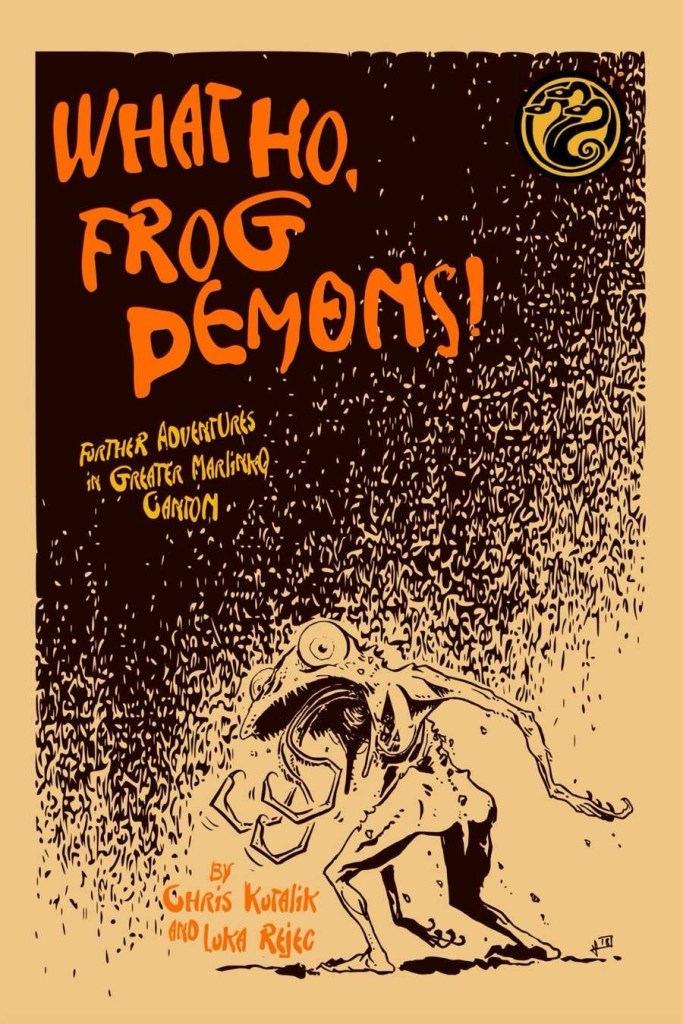
What Ho! Frog Demons is a spectacularly named module set in the Hill Cantons, a series with the previously reviewed Slumbering Ursine Dunes and the perennial favourite Fever Dreaming Marlinko. It’s written for Labyrinth Lords by Chris Kutalik and Luka Rejec, and illustrated by Luka Rejec. This is a big ‘un at 110 pages. Let’s sink our teeth into it. I received a complimentary copy.
The first thirty pages or so are the hex-crawl, which takes a unique approach, the about half of this being a brief hex-fill for a large number of hexes, some being keyed in regions rather than individually. The hex map is keyed in coordinate fashion, which isn’t a preference of mine, and I find quite challenging to read. The descriptions are a maximum of half a page each, and often only a paragraph, and they feature the same florid tone as the previous outings in the series, which somehow manages to feel luxurious, conversational and terse all at once. The second half of the hex crawl is a table of 36 randomised encounters that, once rolled, are now permanently co-located in the hex. These are effectively random encounters with spice, and up to a page of detail making them capable of a lot more complexity than your average random encounter table. The advantage of this approach is that you can make some of these random encounters places, which supports having a larger number of random encounters, and additionally it increases replayability. Initially I was sour on this method, because it leans towards a quantum approach that isn’t what I’m looking for in a module of this size and detail. But when it became more clear this was replacing the typical encounter tables, I warmed to it a little more.
The next sixty pages are two major points of interest: The titular frog-demon temple and Ctyri Ctvrt Manor at its surrounds. Interestingly, the manor gets the majority of the word count here, and not the frog-demons, although a frog demon does guest star in the Manor adventure. Frog Demon Temple is wordy as, with three pages spent on introductions before we get to any juice. The wandering monster table here is a multi-layer monstrosity whose contents I quite enjoy, although I feel like it belongs in an expanded d100 table rather than with so many dice rolls. There are only 12 rooms, and I’m really interested in playing out this interaction between dense keying (no empty rooms) and 1-in-6 turns having a wandering monster. This is a cute, characterful and funny dungeon (successfully funny, in my opinion), but really a diversion, which is a surprise given it got the spotlight.
Beets for the Beet God is a bigger, more complex beast, though. An infectious beet-zombie virus is spreading fast, and if not contained will envelope the entire canton! There’s a point crawl around the surrounds, and the manor itself. The point crawl overstays its welcome, largely due to the necessity of there being three levels of escalation per point of interest; it also feels like it should be a hex map, given it takes a turn to travel between any two places on it. The manor is a 20-odd room location, with entries ranging between paragraph and page. This manor has a lot more meat on its bones, and it feels like it would be a pleasure to run.
It finishes with a frog demon generator and a village generator, both of which are serviceable, especially the village generator. These provide the referee with a way to facilitate player interaction.
With layout, I’m seeing some similar challenges to those that I faced in Slumbering Ursine Dunes. While the same single-page, wall of text approach is there in Fever-Dreaming Marlinko, it doesn’t strike me as hard there, and I’m not entirely sure why. Delving a little deeper, I think we’re tipping 100 characters per line here, which could be making it feel more impenetrable? This is already a massive book, though, so increasing point size to decrease the number of characters per line probably wasn’t an option. Perhaps a double column layout would have rendered more processable; as is, my eyes drag reading this. I had to spread this read through out over a few because it was challenging on my eyes. That said, the heading choices are bold, clear and simple, and I really appreciate the layout choices in terms of information design. Emphasis is far more judiciously used here than in many modules, which does improve wayfinding considerably. Luka’s art is lovely and full of character, and jankier than usual, in a way that screams classic module in a really appealing way. Used to his more polished recent work, I honestly adore this side of him.
Overall, What ho! Frog Demons is a flawed but fascinating module, that innovates on a few interesting things that clearly haven’t caught the popular imagination. It contains two fun, weird locations that are well keyed, a hex crawl that I find less compelling (but a huge improvement on Slumbering Ursine Dunes’ point crawl) but hugely usable and very unique. I have yet to read Misty Isles of the Eld, but combine this and the rest of the series I’ve read so far and you have a really unique setting, light hearted, in a system widely compatible, and inspired by eastern European architecture (and perhaps cultures, too? I can’t speak to that with any authority). The series as a whole is probably one of the consistently strongest I’ve read, despite my criticisms. You can get all four books for $40, as well as a ton of free content on the Hill Cantons blog: Enough for a lot of play with very little work. And why else do we buy modules, but for creative people to lend us their ideas in the smoothest manner possible? What Ho! Frog Demons, like the rest of the series, is well worth picking up.
Idle Cartulary
Playful Void is a production of Idle Cartulary. If you liked this article, please consider liking, sharing, and subscribing to the Idle Digest Newsletter. If you want to support Idle Cartulary continuing to provide Bathtub Reviews, I Read Reviews, and Dungeon Regular, please consider a one-off donation or becoming a regular supporter of Idle Cartulary on Ko-fi.



 Playful Void
Leave a comment