
Bathtub Reviews are an excuse for me to read modules a little more closely. I’m doing them to critique a wide range of modules from the perspective of my own table and to learn for my own module design. They’re stream of consciousness and unedited critiques. I’m writing them on my phone in the bath.
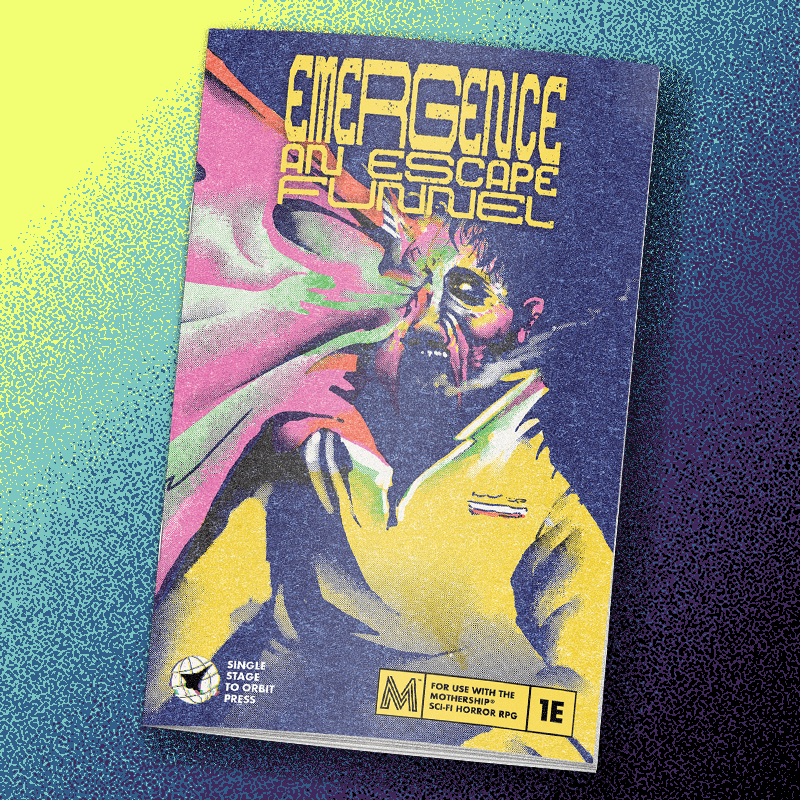
Emergence is a 32 page module for Mothership by Carson Brown with illustrations by Brandon Yu. Emergence is a 32 page funnel for Mothership — the only other one of which comes to mind is the Drain, which I reviewed here — but Emergence, despite being a funnel, occupies a very different thematic space than the Drain. In it, you play inmates of a correctional facility, after a cataclysmic event (of which you have no information) gives you the opportunity to escape. I backed this on their recent crowdfunding campaign.
We start with a 2-page explanation of how the Correctional Complex normally works, what its’ history is, and what is happening right now. This is functional, but as a huge wall of text, I think it could’ve been judiciously edited down to a much more digestable chunk of information — probably just 4 points, I think. We then have the rules describing power and flooding (which are about 75% repetition from the inside front cover reference), and rules regarding finding evidence of what’s really going on, as well as how to actually escape the planet the Correctional Complex is on. Then, we cover an alien fungus, which has significant impact on the progress of the module. There are six factions then covered — these would benefit from better organisation. It’s not clear what each of these factions agendas or goals are, I can’t intuit how individuals or groups will interact with the players or the other factions from the write up, so this 2-page write up is essentially a waste of time. A recent example of someone nailing this write up is in Orestruck by Amanda P — I feel like the wisdom of “dungeons need factions” gets bandied about, but a faction needs to be interacting meaningfully with the players and characters around them in order to contribute to play meaningfully.
We then dig into generating the funnel characters by serial number — I like the touch that they don’t have names, as their memories have been wiped for the time they are inmates — and this number provides information about what happened to land them there, as well as their found item and trained skill, which is about all they get to go on from a character creation perspective. It also introduces information on a new rule, called Cohesion, which measures how well the players work as a team (although this, in a fun twist, is revealed to have a very different meaning, that they players can find out if they search deeply enough). Players can have a roster of four characters, and select an active one at any time. This whole section, to me, needed to be directed at the players rather than the referee — I’d want the players to be independently generating their rosters, and leaving me more or less out of it. There’s a lot going on in this module — all good, in my opinion, but deloading this and handing it off would have suited me better, and made the rest of the module easier to run.
Now, finally, we get to the key itself. The descriptions here are solid, but the location itself is not something that lends itself to evoking a sense of wonder, so I suspect it could be much terser and have the same impact. I really, really like the character descriptions “New hire, yet to fit in with the Screws, terrified of being outnumbered. Scrawny and nervous, Larry is no physical match for an inmate.“, and unlike the factions, these characters get clear objectives. There are highlighting issues here, though: Sub-rooms exist, and these aren’t always clearly flagged either in the main text or in their descriptive subsections, which makes for a bunch of double-takes. It makes for confusing moments, that recur throughout the module — easily fixed by highlighting the sub-room in the initial descriptive text, or setting the sub-description (which looks like a standard description, aside from the title font) aside with background highlighting or decoration. Many rooms have specific results that occur when flooding increases or power level (although power level is not consistently flagged, which makes me concerned I may have missed places where flood level is not flagged). It’s overall a really fun little dungeon, that is a little too wordy for my liking, and would’ve benefited from a more aggressive edit.
Emergence’ inside cover features the most common stat blocks you’ll encounter, an instruction to make a flood roll, and a legend for the iconography that helps the referee determine how flooded a room is and how impacted the room is to power outage. This is really cool! Except the iconography isn’t used in the map on page 14 (despite the information being present) and only the flood iconography is used in the key. They could’ve been made blank on the map, and the referee could have filled them in as things changes, or just been broadly used — lots of missed opportunities here. The back page features a 50 or so item search the room table — the page 14 map (which communicates the flood levels and power levels) would have been better on that back page or on the other side of the inside spread, and I think that the connections table on page 26 similarly is of sufficient importance to feature in an easier to access position. If there wasn’t enough space, these would have been smarter to be positioned on pages 16 and 17, also for easy access. The layout choices — Emergence features a whole lot more white space than most Mothership, usually to its’ benefit — hamstrings Emergence’ usability in these cases. Otherwise, simple highlighting is used, headings are clear (although the module is complex enough section headers would be beneficial), but given the strong use of colour elsewhere, I wonder if more information could have been communicated by taking advantage of that: The palette chosen is a striking, watercolour-esque, pink, yellow, green and navy, which is really well utilised and is very striking by comparison with most Mothership modules. This palette is intermittently used to help with navigation — it features on the backgrounds of important pages, such as the map on page 14, but as you dig deeper into the layout, this isn’t consistent. It looks great, irregardless, I just think more thoughtful use of the coloured backgrounds and the expanded art backgrounds could have held meaning and improved navigation. Coming back to the unique art style, though — with the colouring choices, it really slaps, and stands out from the other Brandon Yu work I’ve seen, and more Mothership modules could use this kind of art approach.
Emergence is a good funnel module, that would be excellent if it had had a more aggressive edit, a developmental pass to make sure the information design was better, and a more thoughtful approach to layout. The problem is simply that the cake isn’t fully baked here. There are likely worse modules you’ve had to work hard to run, this one I suspect will have a strong pay-off, and can serve as an interesting set up for future adventures, particularly if you’re looking for loose strings to tie your player characters into a broader universe. It’s very cool, very dangerous, and has an interesting mystery and some compelling characters hidden in here. The big caveat for a funnel, is that there’s a decent chance that this one might feels like it’s more suited to a 2-shot or 3-shot than a 1-shot. If that’s what you’re looking for, though, then Emergence is an excellent addition to the Mothership ecosystem, and I’ll be interested in seeing what Carson Brown works on next.
Idle Cartulary
Playful Void is a production of Idle Cartulary. If you liked this article, please consider liking, sharing, and subscribing to the Idle Digest Newsletter. If you want to support Idle Cartulary continuing to provide Bathtub Reviews, I Read Reviews, and Dungeon Regular, please consider a one-off donation or becoming a regular supporter of Idle Cartulary on Ko-fi.


 Playful Void
Leave a comment