
I Read Games reviews are me reading games when I have nothing better to do, like read a module or write or play a game. I don’t seriously believe that I can judge a game without playing it, usually a lot, so I don’t take these very seriously. But I can talk about its choices and whether or not it gets me excited about bringing it to the table.
To review Spine, I’m going to have to break format. I was sent a complementary digital copy of Spine by the author, Asa Donald, and I tried to read it, and it turns out I can’t judge this game on the merits of the read, despite the fact that on the scale of book to game, it’s majority book. And I think Spine is impossible to play in digital. It is, by design, a book designed to be printed. So, I contacted the author, and asked for a pre-release printed copy, and I played Spine. Spine itself is a giant argument that reading and play could be considered analogous, and Donald has written a series of essays and interviews in support of its upcoming release, so I’m going to keep it in my I Read series.
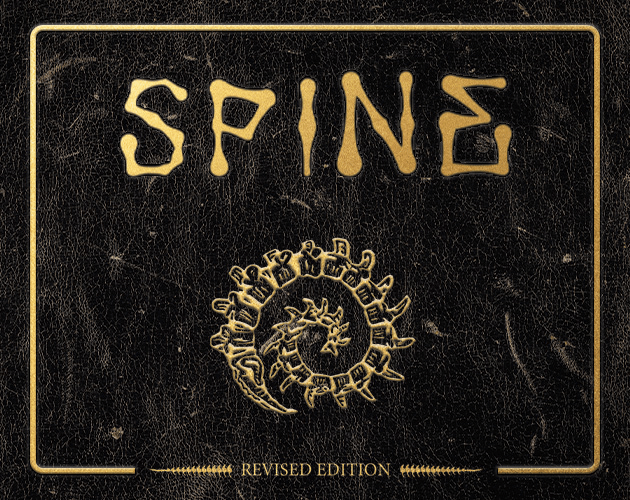
Spine, or “Siderius Plug’s Spine: Immortality in 99 Endnotes”, is a solo horror TTRPG by Asa Donald. It is very difficult to review Spine without spoiling it, so I’m going to describe the mechanics of the book, and from there, I’m going to spoil it. The book is a series of texts — 5 in total. You read the excerpt, and when you get to an endnote, you can choose to flick to the back and read it if you’re curious (which, if you’re me, you generally are). When you find an endnote, you’ll find more text, and a prompt. If you see a symbol in the prompt, you must stop reading at the symbol, or else you must answer the prompt, and if there is no symbol, you can choose to follow the prompt or not. The prompts vary wildly, but most often you’re asked to add marginalia to the book.
This is the best solo game I’ve ever played. I couldn’t put it down. After I played Spine I felt shaken and emotional. It felt like the book was actively responding to my actions at times. To feel a game with horror themes this deeply is, perhaps, a deal breaker for some players. While I’m not deeply engaged in the solo TTRPG scene, of those that I’ve looked at it’s absolutely unique. It is a game that will benefit from going into with little knowledge regarding what is to come, so if my recommendation or a description of the rules are enough, I would encourage you to simply order it and play it, keeping in mind the content warnings of possession, loss of bodily control, and verbal and manipulative child abuse. You can get the print at home version here, and the print on demand version here. That’s the review for you. Go forth and play.
From here on, it will be all spoilers all the way in.
I do not know, precisely, what Spine was about. It is a mystery, and one that it doesn’t provide the answer to, at least in one play through. I have theories, and then — perhaps — I died. My theories are written in its’ margins, and hopefully, if I’m right, the next player of the game will benefit from those theories. I think it is about a kind of generational curse, and the texts you read through are evidence of that curse throughout the centuries. Through my choices — and despite attempting not to — I fell prey to that curse. I think, perhaps, I have been possessed by a necromancer who had taken up residence within the book. But, I’m not sure. And perhaps the next player will have very different theories about what has happened. Perhaps I will be that necromancer, next time, taking their body, if they fail to remain strong.
The tools that Spine uses to tell this story, and to draw you into it, are worth discussing. Firstly, on the very first page of prompts, you’re likely to be primed for destruction: You are asked to beat the book until the pages are damaged, burn the book, or tear it, almost immediately. Destruction of the book is not a major theme of Spine, but this sets the tone such that you’re no longer reluctant to perform the small transgressions of excessive marginalia. You also begin reading with fear and trepidation; you see the symbol that signifies that you must read on out of the corner of your eye, and you discipline your eyes not to wander. A prompt warns you not to look on the next page, and you fold it out of the way, of place your hand over it, so you can’t see what it reveals, else risk your clock progressing.
The clock is unique — you’re drawing your own face in the back of the book, and when it’s complete, you lose. Maybe? The clock can be turned back, but you only have a few things to draw, and a few things to erase. You get little choice, early on, but further on, you start to make choices based on whether your clock is nearing midnight, or not. You don’t want to be trapped in a book for all eternity. Some of those choices mean the next player is more likely to be entrapped, though: Are you a good person? Are you trying to save the next player, or will you risk their life for yours? Are your messages invitations, or warnings? It provides a fearful incentive throughout your play experience.
Then, you start to find the twists, and those twists invite you to experiment: You notice that the endnotes skip from 15 to 17. Where is 16? Do you dare read it? What will the consequences be? And then, you find that sections of the text are missing. Can you piece together what is missing in the text, from the intact endnotes? Where do you choose to write the answers to those prompts? The gameplay gets experimental, but you, the player, are the one doing the experimenting. And the game encourages you, to compulsively participate and make decisions. Suddenly, I’m making notes and underlining things that I’m not being instructed to. Wait, is the text telling me a lie? Perhaps I’ll make a note of that — even though I haven’t been instructed to. Wait, is that a reference? Why? Is that endnote trying to trick me? Of course it is, don’t fall for it: Don’t read that endnote! Sometimes I’m talking to the text like it understands me and is responding, and sometimes I’m writing for the future audience. It’s a strange, vulnerable performance. And you’re drawn in, unable to put the book down. You’re tired, and you just want it to be over. You’re making poor decisions. The book tells you, “I know you’re confused and tired, but at least you’re almost done with the book. Then you can rest.” And your writing gets more and more deranged, and you’re writing more and more deranged notes, and defacing entire pages. I did not achieve my goal, but it was over, and I was exhausted, and shaking, and that is evident in the text.
Spine also plays with the relationship between player and character. The only rule to refer to you, the player, makes it ambiguous whether you are playing yourself or a character you’re creating, when you start playing, as are the clock instructions which tell you to draw a self-portrait. This is Spine’s intent: There are prompts that hinge on your decision, deeper into the game. Whether you succeed, what you discover, and other things hinge on your decision of whether to play yourself, or a character. This intentional blurring between player and character reflects the blurring between reality and text that the game itself is exploring, and also is likely one of the factors behind the significant bleed I felt while playing the game. To be clear: In play, it became quickly clear that I was playing a character, but then it blurred far more: “Am I the real person here, or is the person whose grandmother is Eileen Dott?” became a question you might face in playing, and it meant more because I drew my own face in the book, and I wrote my own name in the book, and I passed it on to someone else. I may not know the third player at all. You might not make the same decision, and your experience might be entirely different.
Now, I don’t know what the experience of the next player will be. One of the rules is to strike out prompts you’ve completed; this means that the rules have changed for subsequent players. They are playing a different game. And there are many prompts I could not follow, because I was the first player. I don’t know what the other player’s prompts might be. The story might be revealed to them in ways it was not for me. I suspect I might be a character in the next version of this story. Many of the prompts I followed involved destroying parts of the text — in the most extreme case, the next player will find an entire text out of the 5 missing and not understand why. My more deranged writing may be completely ineligible (to be honest, my neat writing might be), and could be considered defacement of the book itself. And because you know from the beginning that other players are likely to be reading this, what you’re writing is not only often with consideration of their experience, but as you get deeper in the book, directly communicating to future players. In this way, the next player of this copy of Spine is playing a game not only by Asa Donald, but also by me, because I got to choose which prompts to follow and which not to. And that is a very compelling and interesting premise — you could consider Spine an act of collaborative world-building and collaborative game design across time and space.
This is a book that demands that you slowly destroy it, and once you have begun that process, that you pass it on to the next player to continue that destruction. There are implications in the text that this book will last no more than 3 plays through before it is no longer a legible, readable text, and like — player 4 will definitely struggle to fit all their marginalia in. I have a long-standing complaint about Tim Hutchings’ Thousand Year Old Vampire, an acclaimed solo TTRPG: The book is too beautiful. The cover is stunning, the pages are intricate, the paper is glossy to write on, and the game itself doesn’t tell you how to play it – there are no character sheets or ways to track it. Hutchings would say that the reluctance I feel to destroy a book of such beauty is part of the art itself; I can see where he’s coming from, but for me, this is shallow artistic commentary hiding the fact that Hutchings just loves to make beautiful stuff. The game would be better, if it were uglier, on cheaper paper, and more amenable to writing directly on in pen and tearing pages out. Spine, on the other hand, is an anthology of extracts from essays. It has art – good art, mostly woodcut prints, but it also comes pre-marked up. It’s intentionally designed to be written in – lots of white space, because that’s where you’re supposed to be playing, and you need room for many plays. The paper is writable, the layout works for the intention, and more importantly: This is a game about books and what it’s like to be lost in a book. Your destroying the book as you read it is meaningful given its’ themes; this is akin to the General Manager in Triangle Agency having very little control over how the game proceeds being a meaningful commentary on work in corporate America. The theme of the destruction of the very product you’ve bought, is fully embraced by the game. In Spine, form follows function and supports the themes of the game itself.
Spine does make a misstep, though, and that is the fact that the diversity of prompts leans very heavily towards a few specific types. I personally found the puzzles in Spine very challenging (there are 4, one of them secret), but because they seemed an afterthought, I didn’t feel engaged with them. Similarly, there are only 2 or 3 drawing prompts (unless there are some I did not find, which is possible), and I think there could’ve been more. I think that if these kinds of prompts are part of the game, they should feature on more equal footing with freeform responses, text-editing and defacing that exist in the game already in greater numbers, because they add variety and because I’d be more engaged with the puzzles and the art if I knew I was building on them as the game went on. Instead, I get 3 very challenging (for me at least) puzzles in a block, and no more until I’d finished the game (at which point I declined to complete the 4th), and I was disappointed more art did not feature, after it featured in the first few pages. I think there was far more room for these to be incorporated, too: There are a lot of endnotes that could be differently utilised, if the authors had chosen. But, I suspect most people entering this game will come from the other direction: Surprise that there are prompts that aren’t marginalia, not disappointment there aren’t more.
In The Ink That Bleeds, Paul Czege wrote that playing a solo TTRPG is “a process of writing toward the existence of something in the game or a happening in it that feels right.“. In Spine, I want to survive and solve the mystery — this is what I’m “writing towards“. But Spine wants to devour me; that’s what “feels right” for this story — after all, it’s a horror game. It manages that tension so incredibly well, that I was charged with adrenaline in the final half hour of the game. No solo TTRPG has done that for me, even with all the complex mechanics to disclaim storytelling in the world (I’m sorry, the Wretched and its many derivatives). Walking this tightrope is truly remarkable. I came away from Spine a little changed, and Spine came away from me a little changed, and in that way my relationship with this strange, horrifying book feels like a relationship with the horrifying necromancer that may dwell inside its’ pages, rather than one with a game. Spine is truly remarkable. This is an all-timer, the only game which I finished playing and was unsure how to review the experience. The main caveat is: This is an incredibly successful horror game. I am not someone who experiences strong emotion during TTRPGs often, or easily, which means this may not be for you if you don’t want to unexpectedly strong emotions, ones that might be painful or that might surface past trauma. Similarly, it may not be for you if you don’t want to play through games with horror themes; my game did not hit all these, but the blurb suggests content warnings for possession, loss of bodily control, and verbal and manipulative child abuse. But if those things are not barriers to you, and horror is something you enjoy or tolerate: You should buy Spine or insist on being the recipient of it from your friend who has bought it. You can get the print at home version here, and the print on demand version here.
Idle Cartulary
P.S. As I’ve said above I don’t know what Spine would be like if I had been the second player. I want to know, though, so what I’ve done is sent my marked up, stained, and modified version of Spine to my friend Lady Tabletop of Alone at the Table for them to play and review. I’ll link here when it goes live. I can’t wait to see what their experience of Spine is.
P.P.S. Lady Tabletop’s live play through is now available here.
Playful Void is a production of Idle Cartulary. If you liked this article, please consider liking, sharing, and subscribing to the Idle Digest Newsletter. If you want to support Idle Cartulary continuing to provide Bathtub Reviews, I Read Reviews, and Dungeon Regular, please consider a one-off donation or becoming a regular supporter of Idle Cartulary on Ko-fi.


 Playful Void
Leave a comment