
Bathtub Reviews are an excuse for me to read modules a little more closely. I’m doing them to critique a wide range of modules from the perspective of my own table and to learn for my own module design. They’re stream of consciousness and unedited critiques. I’m writing them on my phone in the bath.
Rolling Coast is a 60 page module for Mausritter by Matthew Morris and Hugh Lashbrooke. In it you’ll explore a sprawling world of loud noises and bright lights as a young adventurous little mouse. I was provided a complementary copy by the authors; Rolling Coast is crowdfunding as part of Mausritter Month launching November 4th.
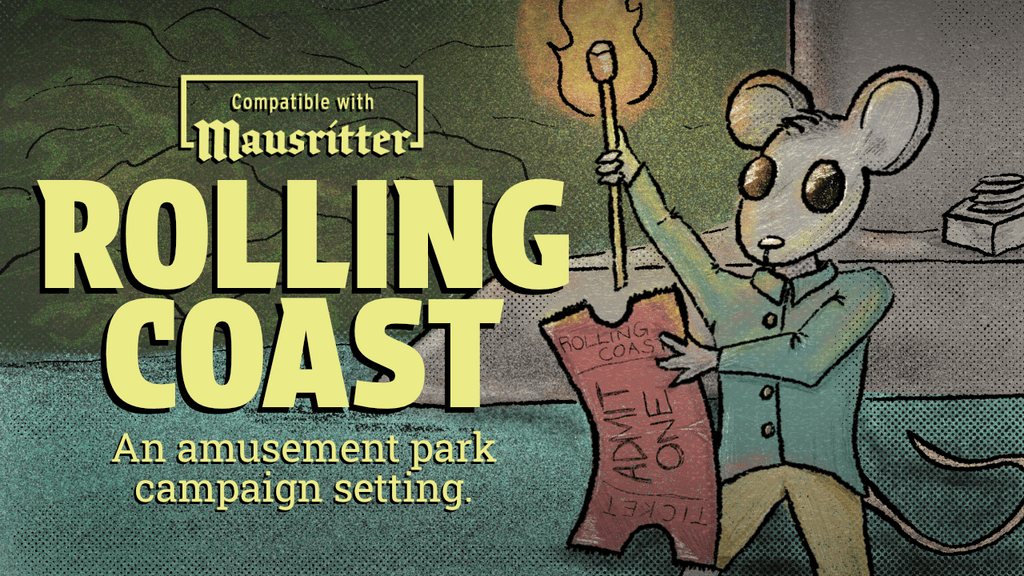
What we have here is a 19 part hex crawl, with 3 settlements, 9 locations, 11 factions, and a bunch of custom creatures and NPCs. The layout and formatting is very close to the Mausritter house style throughout. The art, mostly by Matthew Morris but with pieces by Piotr Kuberkiewicz, Fernando Salvaterra, Jon Morris, Rachel Lashbrooke, Penflower Ink, and Lux Taggart, is lovely monochrome line art, and plentiful. Headings are clear, and highlighting is kept simple, although as this is a longer book I’d prefer some section headers to help with navigation. Morris and Lashbrooke are big names in the Mausritter community, and I’ve reviewed a number of modules by both of them before – Stalls of the Blood Queen, Kiwi Acres, The Micery Keep, Whisker in the Wind, and What Lies Within The Pools. Kiwi Acres and What Lies Within The Pools are the largest of those modules, and neither them have the scope of Rolling Coast.
We open with the hex map and key, which relies on our familiarity as humans with the setting — an amusement park — to do the heavy lifting with regards to descriptions. You won’t be surprised if you’ve read other reviews of modules by Lashbrooke and Morris that the descriptions are excellent. “Large metal beasts coming through the day and night, only the bravest of mice venture into the blacktop sea.” is just one example how, even in these 1 sentence descriptions, this pair manage to bring a lot of implication into their descriptions, making the absolute most out of the familiar setting. In general, we get descriptions that are brief, rely on the referee for interpretation through their own understanding of an existing space, and minimise redundancy such that almost nothing is repeated. There are 11 factions in Rolling Coast, and they’re interesting, and feature additional stat blocks, special spells, or unique items that they might have. The hooks in the settlements and those in the adventuring locations are almost universally excellent. And in the Packratz Hideout, information is all packed together, so that you know the characters and their locations, and they’re related together. The adventuring locations almost universally slap for micro modules (which is what they are — each fitting into a set format of 3 spreads). The wishing well has an interactive, pleasingly looped semi-aquatic dungeon. The ambulance is a hallucinogenic nightmare (although I have trouble running these large rooms with many points of interest that often crop up in Mausritter more than I do with smaller dungeon-like spaces – the witch’s garden is another). The waste-dump is a combat arena you can compete in or bet on. Old Pantryville is a mini depthcrawl. Quillbane’s lair and the Sewer are traditional dungeons, and to top it off, there’s a mech-building building competition. There are 9 in all, all featuring the same excellent description, all with unique mechanics, twists and interactivities. It’s really good stuff and I’m excited to run many of them the same way I was with the Estate.
While I admire the craft here, I struggle a little with the information design consequences of the insistence on brevity and lack of redundancy. “Ferris wheel and park medic van – Home to an affluent settlement of 78 ice situated in the highest bucket of a derelict ferris wheel.”, for example, clearly refers to Wheeltop, whose description is on page 39, but it’s neither named nor referenced here on the map or its key. Similarly, the adventure location Perilous Excursion into Old Pantryville is clearly set in The Pavillion, but this isn’t mentioned in the key or map. When I’m exploring the factions, I find what I need spread between the Bestiary section, the Faction section, and the Adventure Location section for that faction. The characters in the Bestiary also suffer a little for the Mausritter style — because they’re all villains fighting for power, they come across very similarly. An excellent shortcut to avoid this is simply to add in a short quotation in their voice, and I wish that had been done here, simply so I could adopt their personas at a drop, or a list of relationships — this is done in a later settlement, The Packratz Hideout, but not in any of the other sections. Wheeltop is a major location, and hence has more spelt-out NPCs; this is great, and I wish it had been like this throughout the book. I do note, however, that while the hooks here, again, are excellent, they don’t belong in a random table, given they’re clearly connected to specific locations and characters in the space. The Adventuring Locations have floral names rather than descriptive ones, so I can’t see at a glance where they belong on the map.
I have found this incredibly brief Mausritter house style to be problematic in the past, and I’m seeing it again here, but it’s disappointing to continue seeing it after we’ve seen authors such as Josiah Moore going against this trend with significant success. This is the kind of module I want to pick up and play – I tend to play Mausritter a lot, because I have more time with my kids than I have with adult friends, but I don’t have any time for prep. I would struggle to run this in my typical format, because of this lack of internal referencing. This problem is clearly a decision of the authors that isn’t to my taste, because it echoes out into other areas – rumours for example, don’t provide any context or any idea where to find the context. They want the referee to absorb this module so they understand everything. But to run something like this the way I want to run it, I need a little more redundancy, or page referencing, or better organisation. I suspect 1 of those 3 would do the job, but without any of them, it’s hard to make sense of without reading it over thoroughly. It would be easy for this to have been arranged in such a way that things made more sense – the adventuring locations and factions being front-loaded so you understood the context of the broader map when it arrived, for example, rather than putting them at the back, and naming things for their locations rather than with floral names. If I run it — the kids will have to be old enough to appreciate the story from session to session — I’ll have to mark up page references at the least. The information design reflects in other ways, too. I don’t want to say the cake isn’t baked here — I think this is what the authors meant to put out, and it feels like a natural development of their past works. But I think that as their ambition grows, the consequences of that ambition require a rethinking of the information design because a 3 page or 20 page module is a different beast design wise than a 60 page one.
The most interesting thing about the Rolling Coast is the meta plot, something I don’t think I’ve seen in other large-scale Mausritter modules. There’s a cult here – the Fellowship of the Everlasting Wheel – who plan to restart the ferris wheel, which will bring disastrous consequences. As you play, the chances of progression on the clock increase (as the die gets smaller), until finally a major settlement is destroyed and the government with it. The tension of this major villain being initially and publicly friendly and supportive of the adventurers is a really fantastic addition to the module. To trigger these events, though, you have to roll the maximum on every size die to culminate, which is a fun way to increase the tension as the campaign goes on. But! I don’t think the math on the countdown to disaster works for this, and I suspect there isn’t enough content here — we’re talking a range of between 6 and 60 sessions, with an average of 33 sessions before the countdown finishes. I just don’t think there are 33 sessions here, let alone 60, unless you lean heavily into customising the campaign. The math problems also occur with random encounters. Mausritter doesn’t have rules for random encounters whole hexcrawling, but the 11 wonders encounters, will be exhausted quickly over 19 hexes and 33 sessions, whatever rule you use. The encounters don’t appear to be for use within the adventuring locations (as the official rules state) — they have their own. This suggests you’re not really supposed to be encountering them a lot, which in turn suggests the resource game in Mausritter (rations, foraging and the like), isn’t of great import to the authors. That’s fine – it’s not important to me, either. But, I think potentially these two birds could be killed with one stone, simply by incorporating the countdown into the seldomly used random encounter table.
There are a few odd things in this module that don’t really fit into the review neatly. There are a bunch of full page d66 tables, some of them containing interesting things. These are community developed tables, which is very cool, but they raise implications that aren’t really explained in the module itself. Are there a lot of taverns and villages in Snackburg? Is it the NPCs or PCs that have secrets? I think these should’ve been customised more for this particular location, as they raise questions and don’t bring answers. That said, the village traditions in particular are very cute. There’s also a very cute narrative short story that’s written out between the sections, illustrating the adventures of a party of mice in the Rolling Coast. I’m not a fan of authors writing their prose into their TTRPGs typically, but this comes across as very childlike and wondrous (it should be illustrated like a children’s book), and it brings a lot to the module to help newer referees get a sense of what the atmosphere is supposed to be.
Overall, the meat and potatoes of the Rolling Coast is really good mouse adventuring, in the lineage of the Estate. Those 9 adventuring locations are a lot of fun, and you could drop them into any Mausritter campaign. I like the meta-plot, too, although I’d speed it along a fair bit. I don’t think the tools are here to run the 11 factions and 2 of the 3 settlements, though, in a way that would be intuitive and easy, especially for someone new to running Mausritter, and they’re precisely the kind of people I feel would get excited about playing in an amusement park. There’s a decent amount of work to do to link it all together and I’d be doing a lot of marking up. I feel like the narrative frame is great for onboarding new referees, but the rest of the module doesn’t spend time coddling new referees at all. I’ll definitely be running those adventuring locations with my kids, even if I may not end up running the entire Rolling Coast despite the fun faction play it gestures towards. That said, if you’re looking for the backbone of a political intrigue-filled Mausritter campaign, with a location that’s filled with potential for expansion, and you’re willing to put in a little work (or are a master improviser), Rolling Coast is the mousy module for you.
Idle Cartulary
Playful Void is a production of Idle Cartulary. If you liked this article, please consider liking, sharing, and subscribing to the Idle Digest Newsletter. If you want to support Idle Cartulary continuing to provide Bathtub Reviews, I Read Reviews, and Dungeon Regular, please consider a one-off donation or becoming a regular supporter of Idle Cartulary on Ko-fi.


 Playful Void
Leave a comment