
Bathtub Reviews are an excuse for me to read modules a little more closely. I’m doing them to critique a wide range of modules from the perspective of my own table and to learn for my own module design. They’re stream of consciousness and unedited critiques. I’m writing them on my phone in the bath.
Rakehell: The Rift of Mar-milloir is a 96 page module for Knave by Brian Yaksha. I’ve heard grand recommendations for Rakehell before, but I remember bouncing off the generator-heavy Throne of Avarice, despite the stunning prose that Brian filled it with, and I’m hoping for a clearer insight into the creators mind here. This is a map and a setting, ostensibly the first in a series. I bought this myself on itch.io.
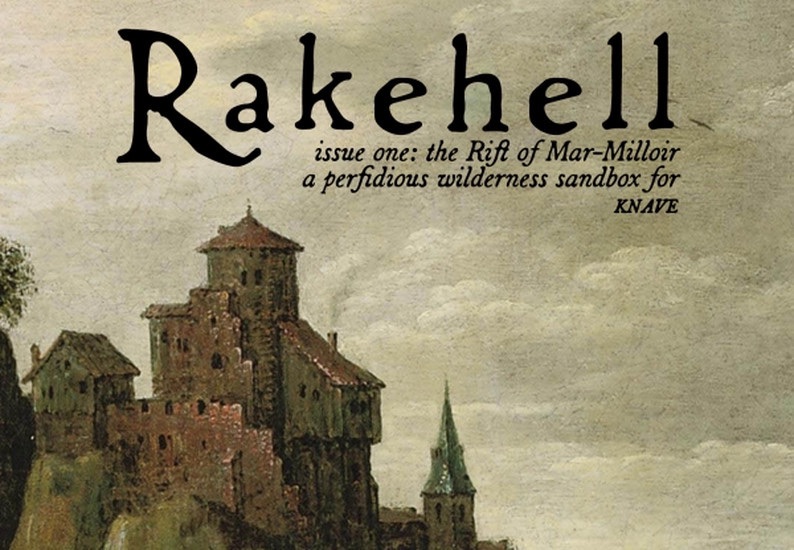
I’ll start with layout: It’s fine, and moody, with excellent art. It’s hard to make almost 100 pages of random tables look good, and it doesn’t succeed, but it does succeed in making them readable and easily findable, which is no small feat. The font choices are both legible and suit the aesthetic well. I like this layout and I love this art.
Yaksha’s writing here is as evocative and dripping with sauce as ever: “The Border Warden, his eye of obsidian and his rusted meat-hook of a hand made clear you were to go to the Rift. He told you how he’d peel you apart if you ever came back.” This kind of flavourful writing is consistent for almost 100 pages; it’s a really impressive feat. Even the title, is an evocative name if ever I heard one. Most of this writing is in table format, though. There are no villages, but there is a village generator. I could quite easily read, for example, the “Village in the rift” generator as just a village description, split in six. I’m unlikely to encounter more than six villages in my travels in the Rift of Mar-Milloir, and I tend to reuse places and people in my games anyway — connections build drama — so I’d keep it to six anyway. “A chain of homes, signs of exquisite masonry, built precariously upon a curving ridge. Small gardens are interspersed between the homes, and each chimney bustles with sweet smelling smoke at all hours of the day. The folk here don’t pay much mind to strangers, but keep their eyes on the weapons they carry.” (option 2) is an excellent village, especially when it’s called Slound-et-Muntag (also option 2) and are afraid of the wicked men in the nearby woods (also option 2).
The problem with this randomised table based approach — is that for me it’s hard to use. To find out about Slound-et-Muntag, I have to choose where it is on the map, flick through five pages of tables to generate it and then remember or write it all down. All this is a significant cognitive load in addition to the usual load of refereeing. Which is really disappointing, because for me the only approach I can imagine to prepare for that campaign is to copy the entire document into google docs and rewrite it myself. And I kind of want to: Like I said it’s absolutely dripping with sauce.
The crypts and caves generated here are one room affairs. They would’ve benefited from a page of wee random maps (just like MERP’s Barrow Downs, which I’m reminded of) to supplement them. It strongly suggests an intention for this to be centered around not dungeon play. And that implication made me realise I’m not sure exactly what play Rakehell actually leans towards: Wilderness travel, sure, but with a quantum map? That feels to me like it’s not the heart of it. Maybe, just maybe, the presence of random encounters and weird weathers indicate a survival game, but it doesn’t lean hard into that concept either.
To complicate matters, Rakehell finishes with the Brigand’s Manse and the Maw of the Mountain, and this is where my thesis is challenged: These two later additions to the module are traditional crawls, well designed and flavourful, but small enough to fit into a trifold pamphlet. I’d run either of these in a moment: They blend specificity where it’s needed with randomness in the right places. Because of the unique linguistic world building (it reminds me of Warhammer Fantasy a little, something I’m only fleetingly familiar with), I’d have appreciated names for the brigands, but their drives and what they’re doing, the dragon’s randomised horde, these are a perfect use of randomisers that are used less effectively elsewhere in Rakehell.
These aren’t the only places where Rakehell brakes free of the shackles of randomness, though. The ten factions are concrete and fascinating concepts in broad strokes; not specific but evocative: “You made a pact with the Rat-King and the Corvid Queen, to forgive old debts and to assign new secrets. They slither towards the Rift now, seeking to collect both.” Antevol, the gateway to the rift, has a concrete list of townsfolk and a black market both of which shine and take strong advantage of the sumptuous writing. But they still lack the concreteness of the two revised locations. It’s possible that — being a volume 1 — the second volume’s goal was to add more of these more concrete locations to Rakehell, or to fill out the map in a way that makes proceedings clearer. This seems like a great direction to take it in, and would likely ameliorate many of my concerns here in issue 1.
I realise that I’m both praising and criticising random tables here, and it makes me consider what I consider a strong or a weaker choice of randomisation in a module. There is a knife’s edge to walk, where too much randomness is a chore and a challenge to usability, and too little provides not enough surprise. Where you apply this randomness has a huge impact on the feeling (and ease) of refereeing the game, but also on the sense of risk and reward of playing in it. Villages and brigands and monsters are places where less randomness behooves them: You want to encounter these things and find something concrete, a window into a real place or a mirror upon something in the real world you can mimic or be inspired by. Treasure, encounters on the road, and incidental findings absolutely benefit from high randomness; you want these to feel serendipitous as a chance encounter does in our actual lives.
My struggle with Rakehell is that it does not differentiate the serendipitous and the concrete, and consequently requires me as a referee to do too much. It succeeds as a work of prose: Sumptuous and dripping with flavour. It succeeds as an aesthetic exercise: I understand the Rift of Mar-Milloir. Could I run it? It would take a lot of time that I don’t have. I don’t referee to sit at a table rolling dice while my friends share memes; nor prepare in advance for hours prior to my friends arriving at the table. How would I run it? I’d copy it out into a word document and pre-generate everything that wasn’t serendipitous. I’d use a Warhammer Fantasy name generator to name all the unnamed characters. I’d pre-populate the map with places and things. I’d pull a few gothic locations like Hound of Hendenberg or Beast of Borgenwold and drop them in as well. I think that would be a banging campaign.
If that sounds like a good time to you, then it’s worth doing the work to run Rakehell: The Rift of Mar-Milloir for your friends and your table. It’s gorgeous. For me, though, I want that all to have been done for me from the start, so I’ll have to wait for the sequel.
Idle Cartulary
Playful Void is a production of Idle Cartulary. If you liked this article, please consider liking, sharing, and subscribing to the Idle Digest Newsletter. If you want to support Idle Cartulary continuing to provide Bathtub Reviews, I Read Reviews, and Dungeon Regular, please consider a one-off donation or becoming a regular supporter of Idle Cartulary on Ko-fi.


 Playful Void
Leave a comment