
Bathtub Reviews are an excuse for me to read modules a little more closely. I’m doing them to critique a wide range of modules from the perspective of my own table and to learn for my own module design. They’re stream of consciousness and unedited critiques. I’m writing them on my phone in the bath.
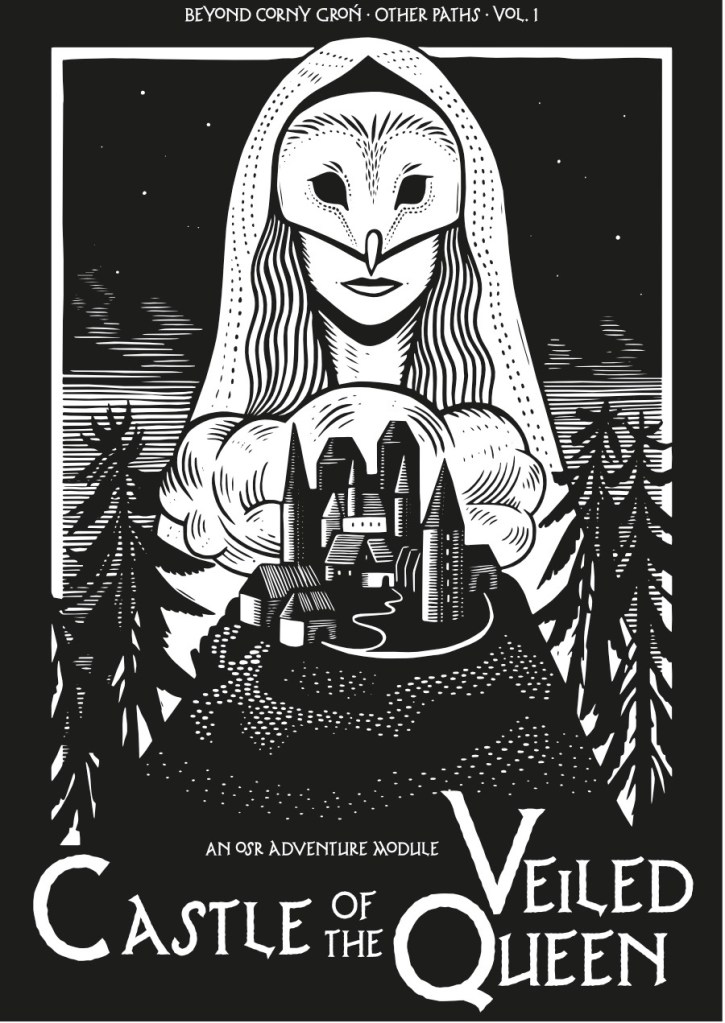
Castle of the Veiled Queen is a 45 page system agnostic module taking place in the Beyond Corny Groń setting — a setting that was very compelling, but was begging for some more concrete content. It was written by Kuba Skurzyński, with a number of art contributors. In it, you explore the castle of a princess, filled with residues of legends and wicked plots. I backed this for Zinequest.
Castle of the Veiled Queen opens with 8 long-form legends and plots, all of which are very compelling but not especially incisive; it then includes 6 rumours and 6 pieces of gossip that are more bite-sized. It feels on a first read that those first 8 long-form pieces of legend and plot are intended to be converted to something player facing, but I’m not sure that’s true: Many of the other 12 link into them in a meaningful way, and I think that the intent here is that the legends and plots are supposed to be the equivalent of “What’s been going on in the Castle”, so that the referee knows what the rumours all point to. This could all be clearer, and needs to adhere better to my Juicy Hooks suggestions to be a little more instantly playable. This would also benefit from some within text referencing — these hooks point to people and places in the text, but the referee has to know the castle well to know what’s going on. Despite all this, the actual content is really compelling and interesting, and there’s a lot going on — in a really good way.
Random encounters are good, tying directly into characters in the story, but again would benefit from references — they’re not all in the index at the front, but searching the digital format help you. Redundancy in these cases would be super useful, as the benefit of having this intratextuality is compromised by the referee’s lack of knowledge here. They keying is with an eye to location, rather than explicit gameability, which isn’t so much a bad move but a missed opportunity. There’s often no interesting single thing in any one keyed area; sometimes the interesting thing isn’t explicated, and is barely alluded to. This is the case with the gunpowder storage in the Barbican; it’s covered well on the separate gunpowder storage in the Eastern Wing, so perhaps it would have benefitted from a reference. They key is dense, but it’s dense in the way Keep on the Borderlands is dense: Not always with the things I want it to be dense with. The briefer character descriptions are pretty great, covering appearance, relationships and interests, but a few of the descriptions feel like they were written well before the author found this rhythm, and these aren’t as strong or brief. Keying often skips things that are on the map — aforementioned gunpowder storage — or the map doesn’t make clear which parts are the key — in the Moon Tower for example, it’s not clear which floor is which (I think, after some consideration, the third floor is the 1st floor, and the attic and roof are the top two floors, despite the map next to these being of the top four floors). Labelling the maps would’ve fixed this. The factions aren’t at the front of the module, which means they’re in the text. The issue with this, is that you have to extract the information in order to figure out how to incorporate them. The pixie gang in Moon Tower is very cool, and have some solid motives and ambitions. But it’s these aren’t explained, which means it’s hard to foreshadow them without significant foresight. This goes for most of the factions and plots — compelling, interesting, and difficulty to facilitate into play.
The Outlaw’s Path is a dungeon that sits beneath the entire castle. In and of itself, it’s an interesting dungeon — it loops in interesting ways, both in itself and with the castle above. It’s full of interesting characters. You’ve got reasons to explore it in and of itself, and also to use it as passage to other places in the castle. It compromises the layout of the castle, though, to a degree, as you can access five out of the seven castle’s locations through it. It’s a very cool little dungeon, though, and to be honest, it could stand on its own without the castle, largely because it’s a very gameable, interactive space — very unlike most of the castle.
There are lots of smaller issues, that to me make me feel that I likely missed more. You are given opportunities to blackmail the NPCs, but no specific NPC has any blackmail materials in their description, so what is this valuable or embarrassing information? There are a pile of forsaken easter eggs as well, mostly in the form of unique magical items that are very cool, but that I can’t foresee anyone figuring out how to use — the Judges Bench is one such magical item. There are a few egregious misuses of randomisers here, too — a soldiers of the castle generator, that will at most generate 10 soldiers (there are only 10 names), and hence could have been a 10th the size, or colourful descriptions like the other characters. Notable persons buried in the chapel could’ve been an opportunity to expand the history of the castle, either in terms of lore, or hyperdiegetically, but is rendered meaningless by a randomiser. Finally, there are some missed opportunities — time and effort put into the different time periods of construction of the castle and how it’s reflected in its’ architecture is very cool, but it doesn’t really impact either the folk living there, nor is it utilised as a puzzle, either of which would have made that information much more interesting and meaningful.
All of these misses are really disappointing, because in many ways the information design in this slaps. It opens with a full page index of every proper noun in the book. It refers out to Beyond Corny Groń with page references to save on space. Section headers could be clearer (they’re intentionally conflated with headings, a choice I don’t like), but they’re almost always present. Bold is used for all highlighting, except in world quotations, which are used very sparingly. Art complements layout, and is is extremely consistent with the existing works in the setting, as well as being unique and fun. There are a lot of maps by Jacek Kuziemski and they’re all pretty exceptional maps, but useable and pretty, with loads of cute touches like a rug pulled back to reveal a secret door.
Overall, The Castle of the Veiled Queen is a very cool location, and you’d be a fool not to pick it up if you’ve already got Beyond Corny Groń and plan to run it. For me to run it, I’d need to do a lot of legwork though. I want the faction (and character) interactions and agendas to be laid out for me from the get go. I want what will happen if the player characters don’t get involved to be clear. I want to know exactly what’s going on, so I can make connections on the fly. As it is, I have to extract all that information myself, and I just couldn’t be bothered. That said, everything in there feels worth playing with. Both the Castle of the Veiled Queen and the Outlaw’s Path below it are complex and compelling. I could see the castle being a base for a Corny Groń campaign, with individual sessions being ventures into Polish folklore based on the contents of that setting book, and things advancing in the background, between the politics and the folklore of the castle. It would really hold everything together used in that way. As a module in and of itself, I could jury-rig it with some work, but it’s not specific or directed enough for a heist even based on those hooks that suggest it: It’s a sandbox meant for immersion not a quick dip. But overall, I’m a little disappointed: It’s too close to Keep on the Borderlands, and I want something a little more like The White Horse of Lowvale. I am just starting to suspect, that’s the way they run, and they’re writing excellent support for that kind of classic style game.
If you’re after a dense home base for your Corny Groń campaign, look no further than Castle of the Veiled Queen, but if you’re looking for a one-shot, or something to dip your toes into in order to get a handle on Beyond Corny Groń after looking at that book and feeling a little lost and overwhelmed, I’m afraid this isn’t the right module for you. Nevertheless, the work that this team continue to do is super compelling, and I look forward to seeing what they do next.
Idle Cartulary
Playful Void is a production of Idle Cartulary. If you liked this article, please consider liking, sharing, and subscribing to the Idle Digest Newsletter. If you want to support Idle Cartulary continuing to provide Bathtub Reviews, I Read Reviews, and Dungeon Regular, please consider a one-off donation or becoming a regular supporter of Idle Cartulary on Ko-fi.



 Playful Void
Leave a comment