
Each holiday season, I review different modules, games or supplements as a thank you to the wider tabletop roleplaying game community. All of the work I review during Critique Navidad is either given to me by fans of the work or the authors themselves. This holiday season, I hope I can bring attention to a broader range of tabletop roleplaying game work than I usually would be able to, and find things that are new and exciting!
Void 1680AM is a 30 page solo, playlist building game, by Ken Lowery. You take the role of a radio broadcaster, play music as you see fit, and talk to people who call in to talk to you. It can be played in a single session, or it might continue over multiple broadcasts.
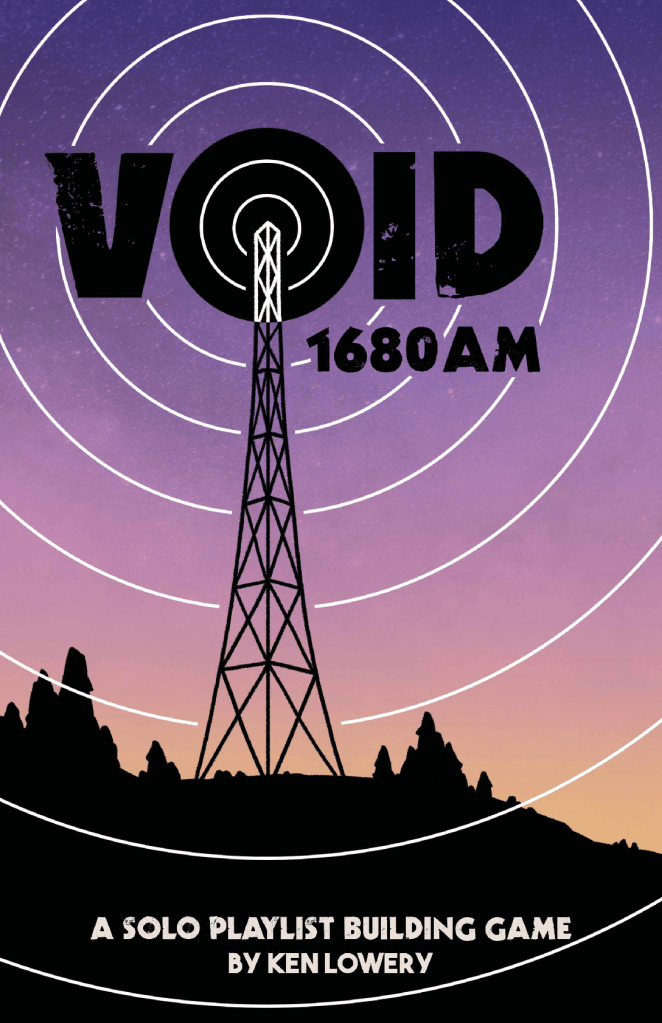
This game is a love letter to AM radio, a kind of radio that most people do not listen to anymore in a world of digital radio and streaming stations. The layout reflects this: Dirty, filled with what I assume are real electronic diagrams, written in type-written font inspired by electronics manuals from the 80s (or at least, that’s what they are to me). It’s simple, but effective. You’re not getting lost here.
To play, you need some way to record your voice, some way to build playlists with, and some randomisers – cards and dice. The love of AM transmission communicated here just screams that the designer wants you to be plugging in cassettes and recording onto tape, while actually broadcasting this, but most of us will find more ease using our phone’s voice recorder and streaming our songs. You begin by choosing the theme of your radio station, where you broadcast from, and then you start programming. A single turn is a block of 3 songs and some chatter before or after; before it’s an introduction; after, you have a conversation with the caller, and then you start again.
You choose your songs according to prompts that relate to the playing cards you draw; each block of songs, hence, has a place in a kind of emotional narrative, building with clubs, and crescendoing and then falling down to a conclusion with hearts. The prompts that accompany these playing cards – randomly drawn – are not particularly surprising, but they are well chosen. Who doesn’t have a song in response to the prompt “You’ve been out all night, and the sun is rising. What song reinvigorates you for the day?”.
The trickest part of the game is the stranger’s calls. You determine the caller’s age, whether they’re calling about a song that just played, are requesting a song in the next block, or whether they just want to talk. For each potential caller, there is a list of potential subject they’re calling about, and you can choose from two options. I do love that if you choose to continue the stories of your callers over multiple broadcasts, you’re provided with additional prompts for a second, third, and fourth call in. The text says “talk about your conversation with them”, but this is the one part where I don’t like how this game works. I know it’s a solo game; but I want these callers to be someone else, or at least, I want to be stepping into their voices and playing out the conversation. That’s how radio works, right? Unexpected, challenging conversations. Of course, the designer recognises this: You’re invited to record a call in for other players, and there’s an archive of calls at their website (although I couldn’t find the location of this archive when I searched). I don’t know why you wouldn’t use this, if you have the opportunity to. It feels the correct way to play.
This is a fascinating game. I like it a lot. I love that you can broadcast in on YouTube and on the designers real AM transmitter. I think the system is nice, for creating interesting, compelling playlists, and for creating compelling callers. I think that if I were doing this, and broadcasting, I’d want to be inviting guests so that it felt more like radio. The verisimilitude feels important to me. I don’t think it would be important to everyone: Building playlists is a fun way to play, as Ribbon Drive showed us over a decade ago. I love that this is using them in such a different way to Ribbon Drive, inspired by a different way of thinking about music. The modern internet guides us away from ephemerality, but I feel like perhaps the way to enjoy Void 1680AM would be to find a way to broadcast it, and let it disappear into the titular void. Then, the details matter less. The joy becomes in the choice of song, in more eclectic mixes, in wilder stories told by wilder callers. If you’re a music-lover, and you’re willing to put that little bit of effort in, or have an AM transmitter in your garage already, Void 1680AM seems like a no-brainer.
Idle Cartulary
Playful Void is a production of Idle Cartulary. If you liked this article, please consider liking, sharing, and subscribing to the Idle Digest Newsletter. If you want to support Idle Cartulary continuing to provide Bathtub Reviews, I Read Reviews, and Dungeon Regular, please consider a one-off donation or becoming a regular supporter of Idle Cartulary on Ko-fi.



 Playful Void
Leave a comment