
Each holiday season, I review different modules, games or supplements as a thank you to the wider tabletop roleplaying game community. All of the work I review during Critique Navidad is either given to me by fans of the work or the authors themselves. This holiday season, I hope I can bring attention to a broader range of tabletop roleplaying game work than I usually would be able to, and find things that are new and exciting!
Oswor is a 36 page roleplaying game by Nikita Lapkov with interior art by Paul Red, Dean Spencer, and Rick Hershey, and cover art and logo by DC Stow. In it, you play members of a resistance movement, looking to overthrow the immortal emperor’s tyrannical rule.
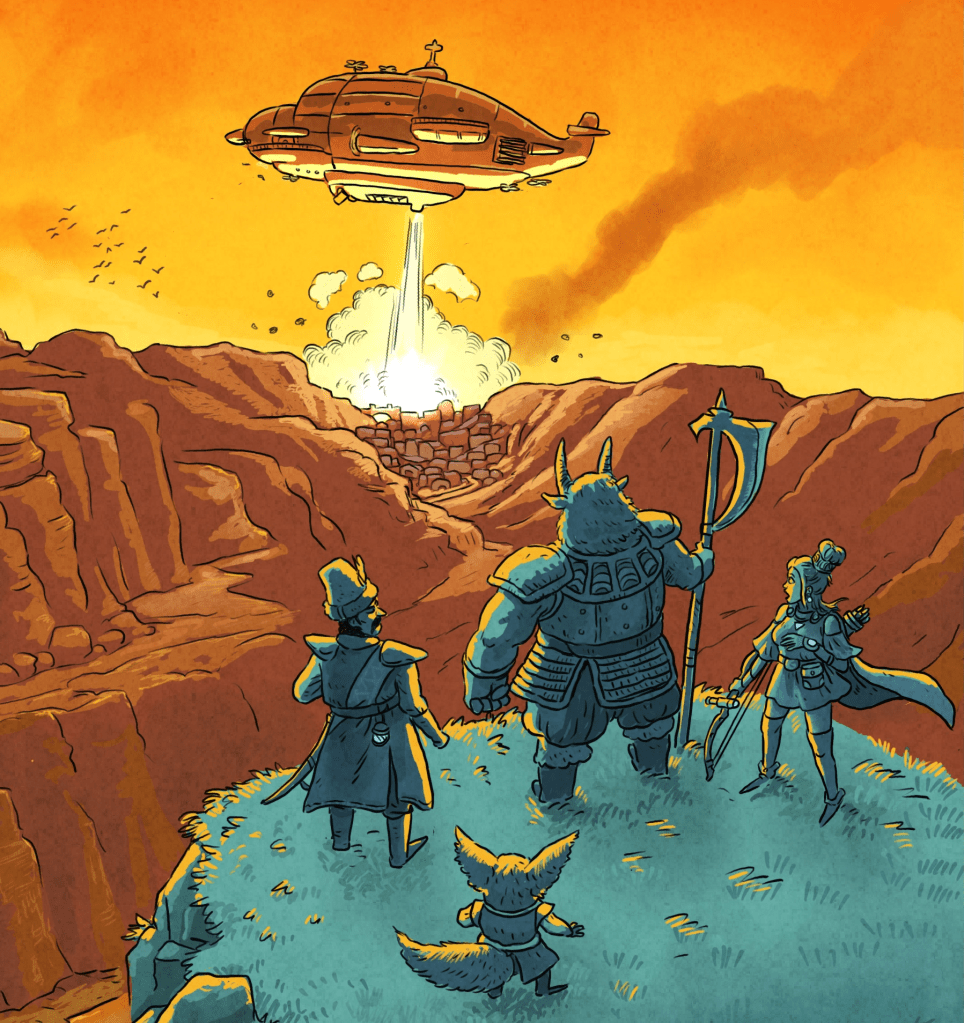
Oswor is inspired by Into the Odd, and follows that structure pretty closely; 3 stats, roll for your Ancestry and Guild, then you’re assigned a starter package based on your HP and highest ability score. The unique solarpunk flavour begins to sneak in here: the guilds include Lenses and Golems, the equipment includes solar refractor and shardlens, but also gladius and loud parrot. It’s giving Roman Empire meets solar-powered industrial revolution, which I think is what it wants to be giving. The neatest thing about the Ancestry & Guild table is that it implies that there is a ton of segregation: an Ursi cannot be a part of the School of Flesh, and Cani can only be part of the Armada. The three ancestries have been manipulated into little boxes by the emperor’s tyranny; in fact one of the ways you can be radicalised is that you want to live in a world where your job isn’t dictated by your ancestry. That radicalisation table is sloppier than the rest of the character creation tables: It feels like you could have a more specific radicalisation, because they tie into who you are, and I think it will be hard to riff on them, because at this point you don’t know the world. Like, playing a fox-person who always wanted to be a golem-builder, but is stuck in the army, gathering bits and pieces and making their own, until they are caught and are forced to join the resistance and die is a compelling hook for a character — but we can’t have that here, the characters don’t want the nuance. But in a resistance against tyranny, most people have a back story like that. Then, we have setting descriptions: This covers the guilds, class and ancestral conflicts, the emperor and his sons, and how the emperor is portrayed to different places, some big mysteries of the world. That kind of stuff.
It is very Into the Odd that the entire ruleset is squeezed into a page and a half at the end of character creation. They’re fine, and they’re basically Into the Odd. Great. I’m more interested in the world than the rules, here, anyway. The big question, to me, is does the rules choice of Into the Odd make me want to make revolutionary decisions as my character? Both Into the Odd and Electric Bastionland really rely on economics to drive play; they’re dungeon crawlers. If I’m going to be playing revolutionaries, I’m not repeatedly entering a dungeon, I’m collecting intelligence, then going on missions to achieve specific objectives. The rightly identifies that there’s not much of a difference between a “dungeon full of traps with a power-hungry mage” in its’ center, and a “mission, to get through a defense system, to defeat a mad scientist”, but there is a significant difference between these two in the behaviours that occur outside of the dungeon. In this case, Oswor tries to sidestep this by having each mission be delivered by a different informant, so the characters never have any clue what the greater mission is. But it’s far, far more interesting to have the characters involved, in my opinion, and a game like this wants to be involved in that planning. I already read a game this month, Chain x Link, which satisfactorily manages to involve the players in both the broader planning and the specifics of revolution, and it was so satisfying. Instead, successful missions progress along the “unrest” table, and if you manage to progress 3 steps along the column, you can take a crack at the emperor. It seems too easy to defeat the emperor using this — only 3 missions, if they’re targeted — and it relies on the resistance being a disorganised mess to continue play, embodied in the Missions table, where you randomly generate a mission, meaning you’ll be doing random, unrelated stuff, with no throughline. I can’t imagine many players who’d be interested in exploring a world like this, or in a revolutionary game like this, with no clear throughlines from mission to mission. I get the impulse, because this game is actually going to be pretty easy to run, and I love that about a game: But that facility betrays the natural rhythm of a revolutionary game to me. If I were to run it, I’d need to build some pretty robust tools for intelligence, making plans, and building teams. That game would slap, and could still be based on Into the Odd framework — I just think it’s important for a game to support the kind of play it’s inviting.
Oswor has a very interesting, developed solarpunk world that is really compelling, with tons of interesting decisions that make for a world that is ripe for exploration and igniting to revolution. It then fails to capitalise on this world, by falling too heavily back on Into the Odd’s framework and not developing it enough to make the game absolutely sing revolution. You might have the energy to develop the tools Oswor lacks, especially given how lightweight the rest of the rules are. And this world is so much better developed and compelling than the world of Chain x Link, the other revolutionary dungeon crawler I’ve reviewed recently, but Chain x Link’s ruleset is so much stronger for supporting the gameplay I want out of this kind of game. Your mileage may, however vary. Oswor’s world slaps, and if the details of a combustible world full of potential conflict, politicking, assassination and theft appeals to you, Oswor has so much more to offer than Chain x Link. If that’s what you’re after, and you’re willing to put in that extra effort, then Oswor might be for you.
Idle Cartulary
Playful Void is a production of Idle Cartulary. If you liked this article, please consider liking, sharing, and subscribing to the Idle Digest Newsletter. If you want to support Idle Cartulary continuing to provide Bathtub Reviews, I Read Reviews, and Dungeon Regular, please consider a one-off donation or becoming a regular supporter of Idle Cartulary on Ko-fi.


 Playful Void
Leave a comment