
Each holiday season, I review different modules, games or supplements as a thank you to the wider tabletop roleplaying game community. All of the work I review during Critique Navidad is either given to me by fans of the work or the authors themselves. This holiday season, I hope I can bring attention to a broader range of tabletop roleplaying game work than I usually would be able to, and find things that are new and exciting!
The Knight Errant is a 4 page micro-module for Into the Odd by Isaac Is Afraid, with art by Citaaticat. It won the popular choice in the Appendix N Jam, for which I was one of the judges. In it you discover the last member of a knightly order, frozen for eternity — the only lifeform on a dead planet. Will you save him?
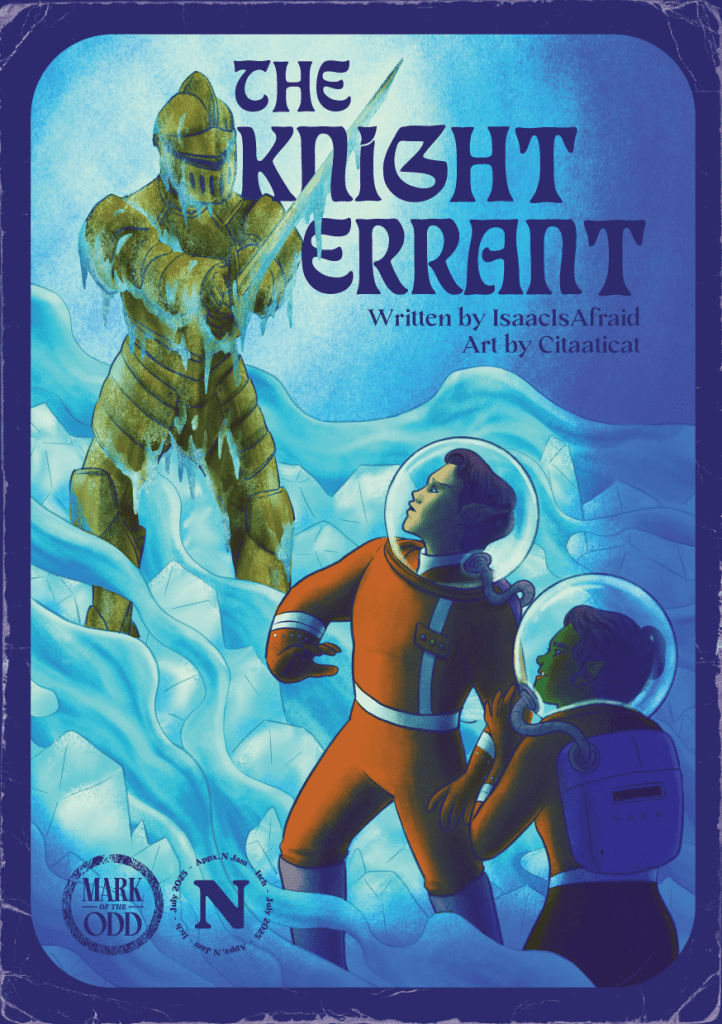
First up, for effectively a 4 -page module (the entire first page is a cover) this is absolutely gorgeous. It’s styled as a pulp fiction cover, as you can see from the cover art above, and the interior is also damaged, but readable. A simple royal blue palate features on the interior as well, used for some highlighting and as an inverted background for stat blocks. It’s absolutely packed with text, but not in an illegible way, due to its’ judicious use of tables and bullets, as well as how highlighting is explained within the text. While sticking to the page count, you couldn’t be better than this; although it does squeeze 8 or 9 pages of text into 4. As a judge on this project, I quickly realised, however, that our criteria heavily favoured visually distinct and well-produce pieces of work over more amateurish productions, which I’m not sure I’d be happy with in future choices of criteria — does The Knight Errant hold up in other ways?
I’m glad to say it does. As I said earlier, it doesn’t really sacrifice on word count. I think in a full-sized module of the same theme, we’d likely have a few more words, but not too many. They’d just be given more room to breathe. There are 7 rooms here, along with 2 stat blocks, a random adventure table, and adventure background. These rooms, unlike what you’d expect, are quite detailed, and the descriptions are solid, although after the terse stylings of The Iron Coral. There are a bunch of interactive elements: A laser-shrine that can be used against your enemies, glass on the floor that causes noise, clues about secret entrances if you observe enemies, multiple entrances, and lore drops. Often in small modules, there are forsaken easter eggs — here, each clue folds back in, such as the oath in room 5 that opens the secret door in room 4. It’s solid design. If I were to change anything, I think that there’s a decent chance that a certain type of party will charge through some of these encounters, and miss altogether that there’s a moral dilemma at the end of this: I’d simply have the squire in room 5 be a little more obvious in his simple sentences, to avoid this, as the moral dilemma is a compelling one.
The random encounter table is important to such a short module, and I’m not sure it’s well thought through. The four encounters included are all solid, and I like them a lot. By the book, you have a 1-in-6 chance of having a random encounter in every new room, when you loiter, or when you make noise, plus a 1-in-6 chance of a clue of said encounter. Let’s estimate that there would be 15 rolls in this dungeon — generous I think — and we’re getting 2, maybe 3 of the written encounters, of which there’s a significantly higher chance of a vision or a meteor falling from the sky than there are of the plot-advancing ghouls or the corrupting voice, given those latter 2 only occur roughly 1-in-36 times. Given the slim chances, I’d rework this table if I had more space: I’d add suggestions for each for the clues, and I’d adjust the probabilities so the rarer are more likely to occur. In small modules, you really want each of your random encounters to punch above its’ weight, because you’re not spending much time in the space.
What does it choose to omit? Well, it has no hooks, it has no rumours, relying instead on a tight frame of the player’s arrival on an alien planet. This is a good choice, given the constraints, although any dungeon will be more interesting with the addition of a few hooks that contain juicy worms: You could have a player who worships the Horror From Beyond, of course, one who pursues archeological knowledge, and one that wants to cage and examine one of the ghouls, off the top of my head, all of which would change the player’s approach to the dungeon. Similarly, given the constraints, the choice to have only 2 stat blocks is smart, and I think 1-2 monster types per 7 rooms is pretty reasonable. I do think that the behaviour of the titular Knight Errant needs to be better telegraphed, however. Finally, one thing that is left untold is the goals or intents of the Horror From Beyond, and given the fact that this is likely a one-shot given its’ unique sci-fantasy setting, and the fact that there’s a decent chance of the Horror From Beyond being freed, I’d love a short section that covers what happens in the wider galaxy when it is freed. The module has room for it: Both the about section and the background section could be trimmed.
Overall, the popular vote isn’t wrong: The Knight Errant is excellent, with a unique, pulpy theme, decent, if terse, writing, and compelling spaces. It does very well with the space it uses. I think it would benefit from expansion, though, in some specific places, and it would benefit from being not quite so dense in terms of layout. Could you run this without any preparation, though, if you needed a one-shot? Yes, you could, and you’d likely have a ball, although I’d do some fudging, beefing up the one NPC, doing a little foreshadowing, and changing the random encounter table to have equal chances across the die. If that’s what you’re after in a short module, The Knight Errant is worth picking up while it’s still free.
Idle Cartulary
Playful Void is a production of Idle Cartulary. If you liked this article, please consider liking, sharing, and subscribing to the Idle Digest Newsletter. If you want to support Idle Cartulary continuing to provide Bathtub Reviews, I Read Reviews, and Dungeon Regular, please consider a one-off donation or becoming a regular supporter of Idle Cartulary on Ko-fi.


 Playful Void
Leave a comment