
Make Dice Work For You is a series where I’ll regularly talk through a new way to use dice in your game. It came out of conversation surrounding What to randomise when you’re randomising, and what advanced techniques you can use for specific needs. I’ll where I know, but please help me out if you know a citation and I don’t have one, or if you know an example that I can add!
In Dice Curves we talked about the bell curve that occurs when you roll more than one dice and add the results. So, what happens when you roll more than one dice, and drop the highest or lowest dice? The most common version of this you see is called Advantage and Disadvantage, which was popularised by 5th edition D&D — there, where you’d normally roll 1d20, you can instead, if you have advantage, roll 2d20, and take the highest result.

Basically, this takes a flat distribution, and turns it into a distribution that leans towards the highest result. If you drop the highest instead, it leans the other way, in a very predictable way:
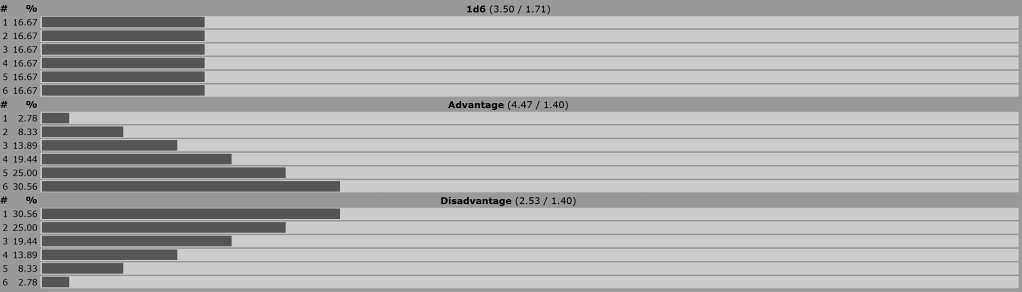
Who cares? Well, in the original version, this is effectively a bonus, but with different characteristics. The differences in these characteristics might be important to you:
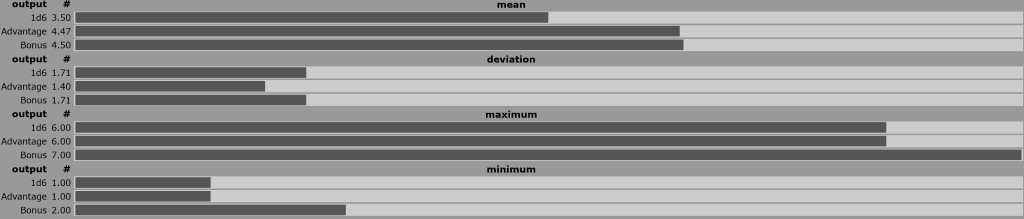
Here, median means the average rolled. You can see that for advantage vs. for a +1 bonus, the average result is basically the same, as are the deviations. However, the minimum and maximum results are different. So, advantage is a way to roll something with a bonus, without changing the possible range. The value of the equivalent bonus, for your information, changes depending on the size of the die — for a 20 sided die, it’s about +5 rather than +1.
Ok, so the immediate use case here is to generate a result on a list where you want to results on one end of the list to occur more often. You can use this feature in combination with a curve, as well, if you’re picking the highest 2 dice of more dice.
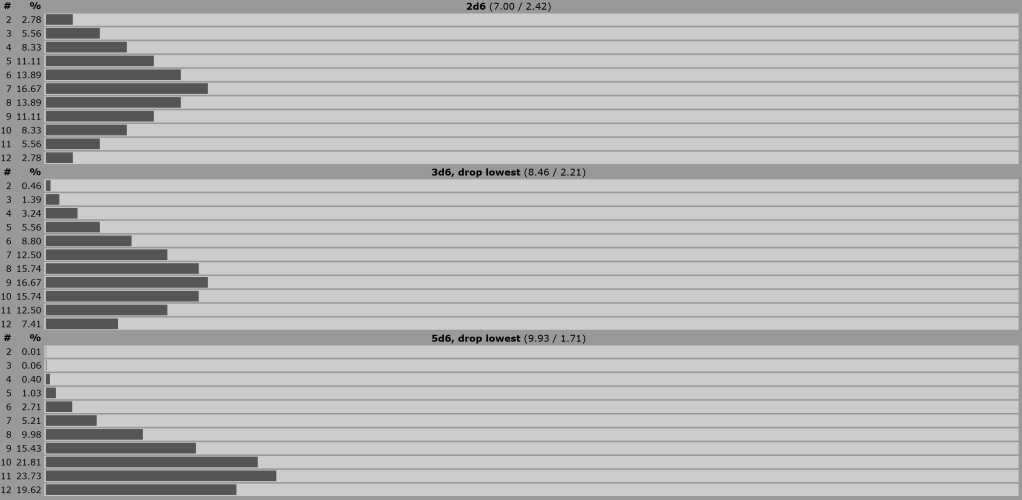
You can see here, as we add dice to the pool, we’re reducing the chance of a lower result, and increasing the chances of higher results, while keeping some kind of curve. You could use this to increase the chance of more dangerous or specific encounters occurring on a random encounter table, for example, instead of using a cumulative bonus.
One interesting side-effect of this, though is that it has rapidly diminishing results. You can see on this graph (I switched styles because it was getting a bit hard to read), that as you increase the number of dice rolled, while the chances of low results become very small and high results very large, those top few results don’t change so much.
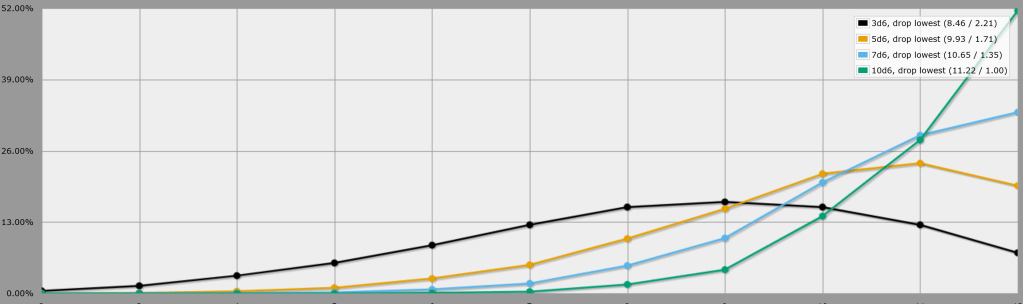
This means that if you’re using this as a test — like the original 5th edition D&D advantage was — the payoff of advantage depends on exactly what you’re rolling over. To put it another way, you’re mostly more likely to roll at least a certain number:
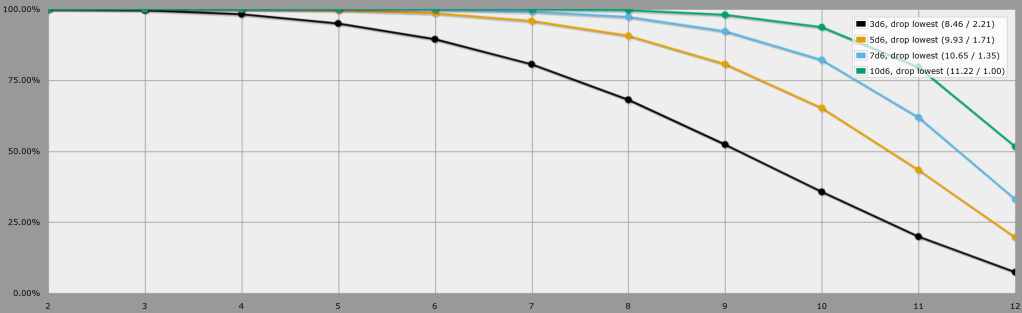
All of these examples are of taking the highest die or dice of a set, but the distribution is the same but reversed if you take the lowest die or dice of a set. Some clever person is going to ask what happens if you take the middle rolled result of a set. If you’re taking the result of 1 die, it works how you’d expect, which is it makes the bell curve more extreme than our basic 2 dice added distribution:
One final thing. You can use this method with multiple die sizes, for specific use cases; the most interesting thing here is that higher numbers in these cases are more stable. The main use case I can think of is that the higher die sizes signify changes in the situation, where those list items could never occur otherwise:

Basic Structure: Roll one or more dice and take the highest (or lowest, or middle) result, or drop the lowest result.
Effect: Preference the results higher on the list, while maintaining the same range of results.
Alternatives: Use addition or subtraction bonuses to adjust the numbers affected by the curve instead, but this will change the range of numbers in the list (you might want this!).
Hope this helps!
Idle Cartulary
Playful Void is a production of Idle Cartulary. If you liked this article, please consider liking, sharing, and subscribing to the Idle Digest Newsletter. If you want to support Idle Cartulary continuing to provide Bathtub Reviews, I Read Reviews, and other work, please consider a one-off donation or becoming a regular supporter of Idle Cartulary on Ko-fi.


 Playful Void
Leave a comment