
Bathtub Reviews are an excuse for me to read modules a little more closely. I’m doing them to critique a wide range of modules from the perspective of my own table and to learn for my own module design. They’re stream of consciousness and unedited critiques. I’m writing them on my phone in the bath.
Roach Motel is a 35 page module for Mothership by Norgad, which funded as part of Mothership Month in 2025. In it you are trapped in a maze with your mind wiped, and need to learn what’s going on in order to escape. I was sent a complementary copy by the author.

The opening few pages are introduction, first with an overview, then with a timeline, then with a more detailed 2-page summary of the organisation behind it all. I usually like this format, but in this case, there’s a lot of module-specific jargon — m-light, crown, blockers, Jamie, kill-dogs — that prevents me from really absorbing the information presented from lack of context. I know this amounts to “I need to read 3 pages to figure out what’s going on”, which is a very minor concern, but I think with a little reorganisation this could’ve been more intuitive. Then we have four hooks. I love these, largely because they’re each an attempt at changing the way the player characters will interact with the module ahead — an excellent implementation of what I’ve called Juicy Worms — that tailor your experience quite well. They’re also targeted at the whole party, instead of at individuals, which is a fun differentiator.
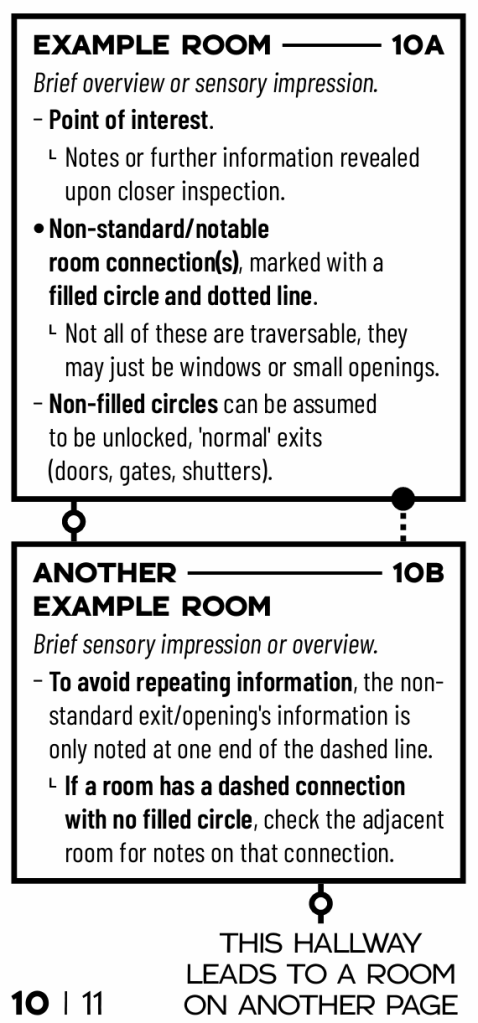
Then we start getting into the module proper. We have a page of NPCs and other cast members, first. Some of these descriptions slap: “Only two bullets left and he knows it.“, “…bends makeshift handcuffs; noncompliants’ bones suffer a similar fate”. Some of them, like the hive-mind bounty hunger, are conceptually excellent, but I think need a bigger twist to be memorable. I’ll come back to procedures, which is next, then we have some details on running M-Light, using Blockers, and how to run Jamie, the main foe. There are summaries of all of this in the inside covers except for running Jamie, and I kind of wish Jamie were covered, as I think I’ll be flicking back to this. Then we have an explanation of the mapping and keying; this is important, because due to the size of this dungeon, Norgad, well known for terse descriptions, is getting more and more extreme brevity, and relying on visual as well as written signifiers that you’ll have to remember. Do I hate this? No. Will some people struggle? I suspect so. I think that for a node-based “dungeon” like this and most that occur in Mothership, though, this approach is going to be super effective and easy to run, once you internalise the visual shorthand.
Procedures cover events — random encounters — and the alert level of the hounds; I think these are both best if simplified to one roll, but let me talk through it: The events table is rolled whenever the crew explores a room, and you roll 2d10 and an event occurs on a double. The number rolled determines the event; usually these events occur on more than one number, for example 0-1 or 7-9. This means there’s 2-3% chance of any particular event occurring; 10% chance of any event occurring. There are, I admit, a lot of rooms here — you’re going to roll this probably 100 times — but this feels like an exceedingly low chance of any of these specific events occurring, and particularly when some of these vents aren’t particularly impactful — “A rat scampers through the room, chasing down a fleeing cockroach” — I feel like this complexity doesn’t pay off. I’d rather more of the interesting events occur: “A Call for help, someone’s lost. Genuine, surprised if anyone answers.” I could see how potentially, the alert system might increase the incidence of perceived encounters though, and might balance this out: The Alert system uses an attention counter that increases over time, and when you under or equal to that counter on a separate d10, the hounds find you, causing the next Hound Encounter to occur. My gut feeling is, though, that if you’re changing the events roll in this way, you could simply incorporate the alert roll into the same one. How? Well, at a glance, if you simply take the highest die, and don’t say “or equal to”, the math turns out awfully similar, although not precisely the same, and it also introduces a curve where the risk of encountering hounds increases more over time, which provides a sense of verisimilitude. I’d make this change if I were to run this, I think.
The keying itself: I can’t talk about this without talking layout, to be honest. Norgad is really excelling. Each spread is an area, of which there are 10 in total, and each page has 3 columns. The leftmost column is a sidebar with overarching details about the area, and the events table. The other 5 (ish, it does vary depending on the area) columns are both a map and the key of the area. The keying is confusing when you first look at the map on the inside back cover, as I did, but when you read the book, each area is numbered after the page it’s on, which reduces the information you need to know to flick through the booklet; rooms in the area are alphabetical to facilitate this, and that’s the only possible problem here: There are a bunch of “G”s across the book. But, I suspect it won’t be a problem, practically, because you’re probably navigating using the book rather than the map on the inside cover. If you like Norgad’s writing style, I think it’s at its’ best here, but you are definitely going to have to be doing the heavy lifting in terms of holding the area description and combining the title and single sentence descriptions that most rooms have, which are usually as simple as “Swirling pools of colour” or “Underfoot, bones crack.” It’s great writing, but is it too brief? Maybe. Certainly the structure helps support your improvisation well, but I wonder if truly the single sentence description of “body odour and must” is anything other than an affect, when I will have to follow up with cardboard box fort anyway.
The last spread covers other spaces you might encounter that are outside the hotel, all that I like, none of which I’m clear where they fit into the module itself. I think they’re intended as a source for rumours, in the context of running this in Prospero’s dream; this isn’t mentioned on the outset though. It’s good writing though; when Norgad is given license to ramble, it’s gorgeous. Then we have a list of potential escape methods, and also fallout based on various outcomes. I love these as bookends, but: How to actually exit the facility is (I think accidentally) obscured, unless you read it very closely, and not marked clearly on the map at all. A major oversight, in my opinion.
The inside front cover is an absolutely wildly huge map — not every room is uniquely keyed, but there are probably 100 rooms here — as well as common stats and a summary of procedures. This is very, very dense, and in digital I find it difficult to read, although it might be better in print which is obviously the primary intent. A lot of icons are used to condense this information, which at a glance is a bit much, but if you read through it carefully first, it does make sense. The inside back cover is a d100 lost property list, which is fine, I guess. Better than nothing, but I’m starting to want more out of these long lists than simply stuff so I don’t have to think of stuff. I’d love for more of these to tie together with other aspects of the module itself, or, given that this module is connected to Prospero’s Dream, the developing official Mothership universe. I also, as I mentioned above, think that the left page of the inside back spread could’ve been better used, given it’s a full page artwork, and there were things I felt I’d refer back to. Overall, the module is hyper-dense, and low-art, much like Norgad’s previous work, but with really clean and workable layout that is nevertheless visually appealing. What little art and colour is used is gorgeous, although I think given the colour is present at all, it might have been utilised better throughout the text as a highlight.
I’ve got questions, though. I have trouble comprehending what the shape of play here will be from the text. Despite being a huge space, there isn’t a lot going on here in terms of faction play. The wanderers featured might join the party, but they aren’t going to drive a lot of organic action. The main drivers of play here appear to be Jamie and the Hounds. While you theoretically can encounter Jamie in other spaces and can be mesmerised by things other than Jamie, a search indicates that most of the time your exposure to M-light and hence mesmerism will be in Jamie’s home space of Observation. So, I think that what this will look like in play is fleeing and avoiding the Hounds while collecting clues about what happened and why your memories of certain spaces are missing, until you can get past Jamie and to the exit. In practice, going back to those event rules and hound encounters, I don’t think they’re likely to be triggered a lot because there’s not actually a lot of incentive to do the two things that trigger them: explore, spend significant time, or be loud. It might be more of an exercise in mapping a complex space, to be honest, and the lack of a player-facing map suggests this was intended as a sort of navigation challenge; I do think the “not-to-scale” nature of the map will make this a little more challenging than a to scale map, though. I would absolutely love to hear a play report of this, because while Norgad’s modules tend to be experimental, previous modules like Dead Weight and Brackish had more comprehensible shapes to them.
I’d be remiss not to mention Jamie in a little more detail: As a primary antagonist, this creature is fascinating, and well described to help the referee to run a creature without human drives or responses. There’s an aura of mystery to him that will pervade the module, even if you figure out a way around the puzzle that surrounds him. I don’t think I’ve seen quite as compelling a primary antagonist to a module. However, I think that the potential is stymied in a one major way: He will interact with the world primarily by using his capacity to mesmerise the other characters and order them using his command cards. I expected to find these command cards scattered around the space, but instead they’re all concentrated in a small space, 10 or so useful commands. I would’ve expected part of the race be that Jamie would be looking for more cards and experimenting with them, but instead they’re simply intended to be used as a keys to the lock that is Jamie and mesmerism. This space is deadly as hell, too — I’d want to be ready with backup characters — but also if you die it’ll potentially happen off screen. Is this a bad thing? Hard to say — the puzzle I expect is hard to solve and complicating it with more commands will make it harder to figure out — but I also feel like there’s a whole module here with this character or one similar to it that remains unwritten.
Norgad’s stuff is consistently innovative and interesting, and iterates on the earlier innovations each time he releases. If you’re interested in new ways to approach module design both in terms of writing and visual design, you need to pick this up; I imagine we’ll see iterations on this in the future, because the design absolutely slaps. On the other hand, I’m not sure how the module will run at the table. It suggests 3-5 hours of play, but my gut says it’ll take longer, and may feature more death than is indicated. The pitch is hard, because the mystery is difficult to talk around, and the prime directive of the module is solving that mystery. I don’t honestly know that I’ll bring Roach Motel to the table, unlike Brackish and Dead Weight. But, if this review has your interest piqued, I think it’s well worth checking out.
Idle Cartulary
Playful Void is a production of Idle Cartulary. If you liked this article, please consider liking, sharing, and subscribing to the Idle Digest Newsletter. If you want to support Idle Cartulary continuing to provide Bathtub Reviews, I Read Reviews, and other work, please consider a one-off donation or becoming a regular supporter of Idle Cartulary on Ko-fi.


 Playful Void
Leave a comment