
Bathtub Reviews are an excuse for me to read modules a little more closely. I’m doing them to critique a wide range of modules from the perspective of my own table and to learn for my own module design. They’re stream of consciousness and unedited critiques. I’m writing them on my phone in the bath.
The Waking of Willoughby Hall is a 31 page module, simply statted for most fantasy RPGs in the B/X lineage, by Ben Milton with art by Sam Mamelli. In it, your adventuring party is caught up in the aftermath of another, separate adventuring party’s raid of a golden goose from a giant’s castle, and is trapped in a haunted house which is slowly being awakened by the giant holy exorcising bell that it stole by coincidence from a local church. I bought this on Drivethru.
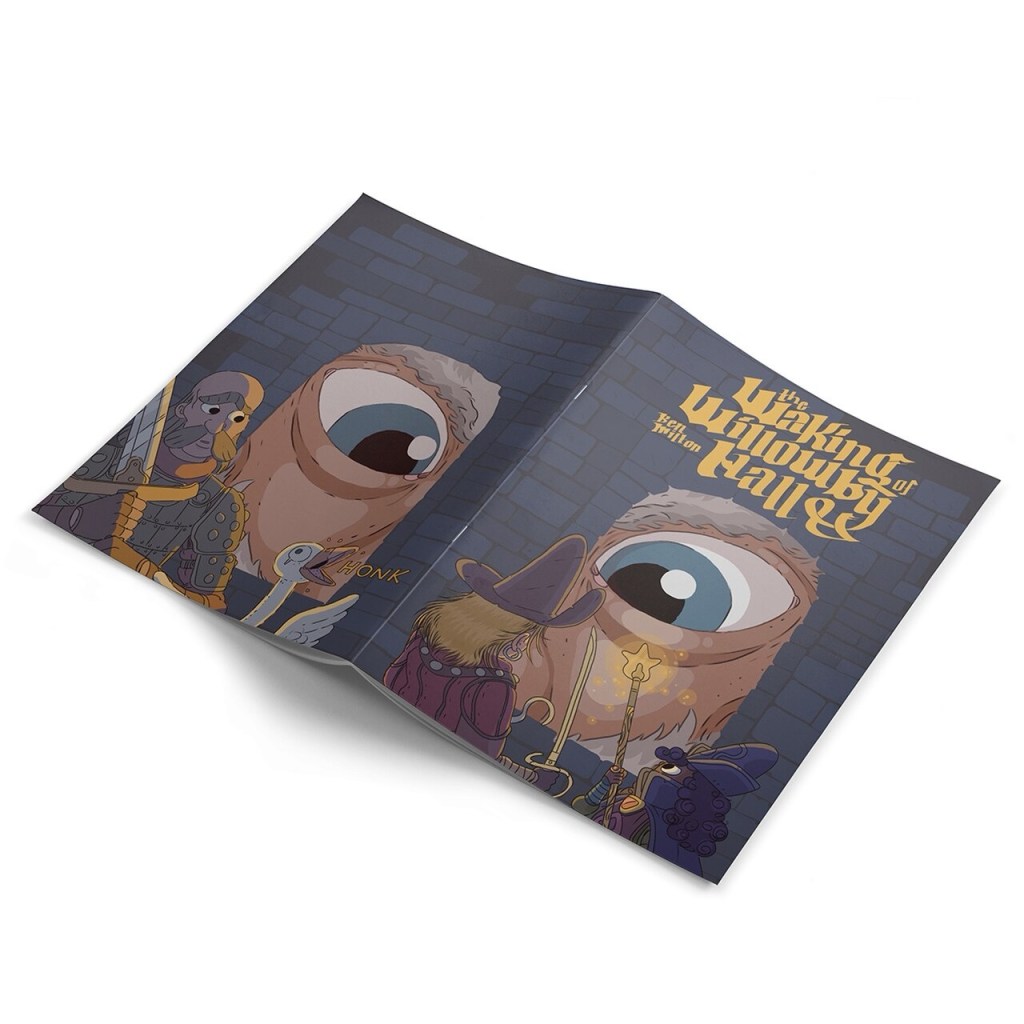
If you are a little overwhelmed by the set up, fair enough, so am I. It’s a lot. I can’t help but imagine a version of this module that feels less haphazard in its theming, and simpler for the players to wrap their head around without considerable opening exposition. The advantage, though is that it front-loads the module with factions to be used against each other, namely the giant, the rival adventuring party, and the feral goose. I especially like, out of these three, that the goose slips your mind until you encounter it, whereupon it acts like the goose in Untitled Goose Game.
Now, hand-guy extraordinaire of Questing Beast and creator of both Knave and Maze Rats Ben Milton wrote this, and we’d expect accordingly a strong opinion in this text of what a module is intended to be like. I think we get that, and it’s also clear than Ben has a stronger opinion on information design and layout in modules than would be apparent from his reviews, and that’s a good thing, in my opinion. We’ll come back to what I think this module says about what Ben likes in a moment.
What is immediately apparent is: No room numbers, but a fully labeled map with short descriptions right there on the page open the first five pages of the book. Cartography isn’t pretty, but boy is it clear and usable. I love the fully labelled map, but I think it’s misguided in its choices: I’m always going to turn to the page in the book (conveniently provided on the map, to boot) for a room, so I think the information on the map should be about exits and what you can hear or see through the entrances; a “key the hallways” type approach. But it’s damned fine as it is.
There are some rules covering the awakening of the hall and the actions of the giant as it pursues you (and the other adventuring party — it seems it’s not picky) and the encounter tables. These are elegant, but could have been clearer. I kept looking through the text for more things that happen as the hall awakens, but despite it implying otherwise, I didn’t notice any. I like the encounter tables, and there’s a lot of specificity and variety in them for a small 34 room (if my count is right) map; at 60 encounters you probably won’t see them all. But, perhaps I’m misunderstanding the nature of the action here.
Why? Well, the player characters are trapped in the house. It’s unlikely they’ll all survive the dash to safety, so there’s a decent chance they’ll (or some of them) survive by ending the curse on the house or by betraying the second party of adventurers. Perhaps this is the purpose of the unusual random encounter density: Because they’ll tread and retread the same spaces, getting to know their cast of friends and foes.
Most of the introduction is the bestiary; that bestiary is jarring and feels unnecessary until you wade into it, but what we get are quarter-page descriptions of every creature you’ll encounter, effectively turning almost everything you find in the hall into a faction of its own (the exception being the Death Knight’s skeletal servants). And they’re all bite-sized, despite taking up such a large space in aggregate, thanks to Sam Mamelli’s characterful work doing a significant amount of lifting.
One repeating theme here is clarity to the referee, to the point where the rare things that lack clarity are jarring. Clearly the author put a lot of effort into this, and it shows. An example is that the few words it would have taken to explain how Elias would preserve the hall or which forbidden knowledge he might be satisfied with are left out; there are many options in the text, but it feels strange that it’s not in the character description given the apparent intent of the overall design. I’m not opposed to texts that obscure this kind of information — I do so in my work and I’m a fan of things like the Isle and Lorn Song of the Bachelor that treat information in a subtler manner — but it doesn’t feel like it should be treated that way here.
The location descriptions themselves are simplified down to three layers of indentation and bolding as discriminatory choices, and no more than half a page per description. I don’t find the indentation particularly successful. The information loaded bullet styling that Miranda Elkins uses in Nightwick Abbey and that I adapted in my module Curse of Mizzling Grove would be an improvement here, as would the dagger motif used in Beyond the Pale. But I appreciate the simplicity, although it wouldn’t be effective in a more complex location. The descriptions are workmanlike, and not striking or evocative: Aside from what’s in them or what opportunities they present, the hall is a playground for random encounters and the faction interactions.
Let’s loop back to identifying the thesis of Willoughby Hall: Dungeons aren’t playgrounds or gauntlets to Ben, but rather a stage on which compelling and iconic characters interact. Layout and overall document design should prioritise clarity at all costs, sacrificing depth and complexity. Maps should be utilitarian and clear, not beautiful. Everything should be geared towards minimal page-turning, and so all fit on one or less pages. Indexing should be at a minimum, and so room numbers are forsaken in favour of page numbers. This desire for clarity sometimes results in mistaking simplicity for clarity, and hence not having the desired result, however.
The Waking of Willoughby Hall is a fun, light-hearted romp, that won’t nearly fit in many tables’ existing campaigns due to its specificity. That’s a charming specificity, but a limiting one. But it is a hell of a lot of fun, and easy as pie to run, even if it doesn’t nail every inch of its landing. I’d definitely recommend it as a one shot, even if it’s hard to recommend as a campaign drop-in unless your campaign has a very, very specific flavour.
Idle Cartulary
Playful Void is a production of Idle Cartulary. If you liked this article, please consider liking, sharing, and subscribing to the Idle Digest Newsletter. If you want to support Idle Cartulary continuing to provide Bathtub Reviews, I Read Reviews, and Dungeon Regular, please consider a one-off donation or becoming a regular supporter of Idle Cartulary on Ko-fi.



 Playful Void
Leave a comment