
Bathtub Reviews are an excuse for me to read modules a little more closely. I’m doing them to critique a wide range of modules from the perspective of my own table and to learn for my own module design. They’re stream of consciousness and unedited critiques. I’m writing them on my phone in the bath.
Echo Brine is a 57 page module for Shadowdark by Michael Faulk, Jeff Mitchell, and Scott Slater, with set by Michael Faulk and Graham Sternberg. In it, you seek for idols to destroy in order to bring down the barrier around the cursed Hemlock Cove. I think I was provided a complementary copy by the author.
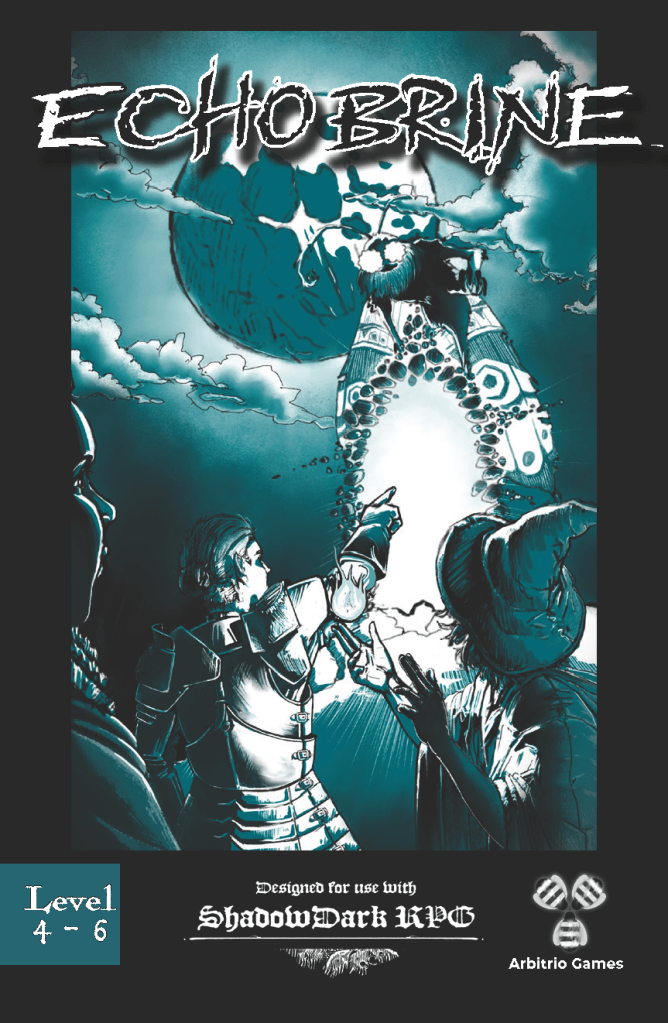
Echo Brine opens with a 3 page, full text explanation of what’s going on. It’s a lot, and I think it could be both simplified and more clearly communicated to the players through a solid hook. In a nutshell, an intelligent, psychic meteor fell into the sea by the town of Hemlock Cove. These shards of rock corrupted the townsfolk to build a portal out of idols so that witches could summon a dark god. Also worshipping this dark god are squid-people and come to destroy the portal are the moth-people. The local mayor got a famous adventuring party in to solve the problem, which forced the god to retreat. There are also some witch-hunters who’re scouring the town for the witches. Here, the player characters enter, prompted by a random rumour, or else invited by a dead adventurer, witch-hunter, or the mayor. This is a complex set-up, but I do think that part of the issue here is not that it’s too complex, but rather it’s hard to track in the way it’s presented.
The rumours I’m mixed on; individually they provide players with unique sub-goals, something I really like — they change the way the players engage in a way I write about in Juicy Worms. But nothing here (aside from the note “Conversely, they can have been sent a letter from Kess Harrow before they died, Mayor Must before he was lost, or Inquisitor Steele“) actually links them up to the XP goals or provides them with any information about what’s going on in Hemlock Cove. Deeper in, I find issues with the barrier, and these rumours could’ve been a fun way to point the player characters towards the tunnel, the beach or the Dowager for entry — but only one of these rumours points anyone there, and that one doesn’t actually tell you the goal is in the Dowager. It’s great that they provide a way into the world of the module, but why is this module leaving it up to the referee to come up with why the player characters are there in the first place?
Next up are some special rules and random encounters. I like these random encounters, which vary from a monster to very specific situations. There are 15 encounters, with 3 of those having 4-8 sub-encounters that you roll again. You’re going to roll every 3 rounds while crawling, 50% chance when moving between locations. If moving between locations means moving around the village, then you’ve 15 locations here, 31 if you include the crawling, which means — you’ll start repeating some of these random encounters, and some of them are really one-off events, so you should be crossing them off. I suspect a different approach to random encounters was needed, perhaps using a curve to increase the less specific encounters probability of occurring, or perhaps one of Warren’s RAMdom tables given a lot of these events are one-off.
The town is walled off with a magical barrier. There are three points of entry, but there’s no effort put into entering the town in the introductory pages, and the broader landscape isn’t explored, so this isn’t an interesting puzzle to solve. Not a single rumour helps access the barrier. You’re going to face the player characters wandering around this barrier aimlessly for a while, which is not an interesting start to the adventure in my opinion. I think for this to work, I’d have to give them some clues, or expand the map considerably to facilitate a whole adventure about accessing Hemlock Cove in the first place.
I quite like the key itself. Boxed text with bolded points of interest are followed by their deeper descriptions. Larger locations have an inside and outside boxed text, which is nice and clear. Ordering can be a bit off — where this bolded points of interest exist, they’re not always at the top of the description, which I think is a mistake, but it’s legible and usable. NPCs found within these descriptions aren’t too thorough, but I like that they all at least have information on what they want from the party. I really, like, however, the change in format for dungeon type locations, where overall detail and specific denizens as well as “what can change” are provided, before the specifics of the rooms in in the location. These area also called out in colour, which helps signalling for navigation. All NPCs are detailed at the back of the book, which I don’t love given they’re almost all location specific; their descriptions are a perhaps a little too background-heavy for me — I don’t care about Inquisitor Steele’s childhood — but I do care about what her agenda is, and that is highlighted clearly. If they’d been briefer, they’d likely have fit in the main text more cleanly.
The layout here isn’t pleasing to my eye, but is clever. I think a lot of thought has been put into highlighting and signalling for ease of play, but limited budget means repeated art for these purposes, dungeon scrawl maps, and some jarring spacing and ordering choices. But, it all works and is readable, with the only major issue being the information ordering issues that recur throughout. These really occur primarily within spreads or pages, though, so you’re not flipping through pages searching for things.
Echo Brine is a mixed bag, for me. I love the nautical theme, I love the search for idols as a goal for the player characters, and I like that there are factions buried in here, with individual characters that interact with each other in interesting ways. But, the information design here made it hard to process a lot of what is good here, and to run it I’d have to put some effort into expanding the module as it’s short on hooks and clues to make it a well-paced few sessions. If you’re looking for a nautical-themed, character-heavy, fetch-quest style module, and particularly if you’re interested in the Shadowdark ecosystem, there’s a few sessions of fun in Echo Brine for you.
Idle Cartulary
Playful Void is a production of Idle Cartulary. If you liked this article, please consider liking, sharing, and subscribing to the Idle Digest Newsletter. If you want to support Idle Cartulary continuing to provide Bathtub Reviews, I Read Reviews, and other work, please consider a one-off donation or becoming a regular supporter of Idle Cartulary on Ko-fi.


 Playful Void
Leave a comment