• Critique Navidad: Triangle Agency

    This holiday season, I’m going to review a different module, game or supplement every day. I haven’t sought any of them out, they’ve been sent to me, so it’s all surprises, all the way. I haven’t planned or allocated time for this, so while I’m endeavouring to bring the same attention to these reviews, it might provide a challenge, but at least, I’ll be bringing attention to some cool stuff!

    Triangle Agency is a 300-odd page roleplaying game by Caleb Zane Huett and Sean Ireland, with a bunch of art directors and layout designers on board including Ryan Kingdom, Ben Mansky and Michael Shillingberg. In it, you play paranormal investigators in a corporate setting, seeking to apprehend distortions of reality known as anomalies, minimise loose ends however you see fit. In this pursuit, you are allowed to use anomalous abilities, but only in the line of duty. This game contains sections that only the “General Manager” may read, as well as sections not even the General Manager may read, until certain things occur in play. What this means is, given I’m not playing the game in its’ entirety, that there’s risk of spoilers in this review, if you’re going to be a player, as I’m going to review this both from the “Agent” and “General Manager” perspective, although I’ll do my best to talk about the impact of the “Playwalled Documents” without spoilers, as they’re secret from everyone at the table. You’ve been warned.

    I’m going to start with the two most striking things about this book: The voice, and the layout. Triangle Agency is addressed as you, in character. It’s a rulebook disguised as a corporate onboarding manual. To me, whose experience with this genre is limited to the X-Files and Control, it feels intensely inspired by the voice of the corporate documents in Control with a dash of classic corporate comedy RPG Paranoia: Sectioned are censored, interdimensional intrusions being indicated by <> tags, and by the cheerful corporate demeanor disguising both the reality that me, the reader exists in, as well as the reality that the agent you’re playing exists in: “You get to pretend you are not living the stresses of your current moment and instead are enjoying a refreshing beverage at the imaginary table of your choice; the Agency is happy you’re happy. Win-win!” This tongue in cheek humour lays it on thicker than the source material, however, it also reflects the animal layer of fourth wall breakage occurring here (fifth wall?), so it works. I wish I could list jokes, but explaining why something is funny ruins it. Just trust me that you’ll enjoy reading this; the only challenge is making play live up to the book itself.

    Triangle Agency occurs in phases: Morning Meetings, where you play your daily lives until a briefing occurs, the investigation, where you identify leads to find the Anomaly and its’ Domain, then the Encounter, where you capture it, or in extreme circumstances, neutralise it. Going through this, you’ll be awarded commendations or demerits according to your performance. The resolution mechanism is to roll 6 4-sided dice, looking for 3s. A 3 is a success, and you can either alter the recent past, or use your abilities in a safe way. If you don’t roll any 3s, you follow the failure instructions of your ability, or an inconvenient consequence occurs. Whenever a dice doesn’t show a 3, means the General Manager gets an additional chaos, which they spend to make actions against you. Luckily you can spend your Quality Assurances to turn your not-3s into 3s! If you spend them all, though, future rolls mean one of your 3s won’t count! Oh and 3 sets of 3 is a crit, with a bunch of special powers that you can choose from. Overall, this is a really thematic, neat system, and I love that you’re just kind of normal people, who are asking your corporation to overrule reality in specific ways to assist you in your role; if you’re not using your powers, then failure is assumed. You don’t have any skills to speak of, you’re not trained. You’re completely mundane apart from your connection with Triangle Agency. The only mechanical addition is that your agency provides you with a score after every mission: Commendations allow you to get cool stuff, and demerits affect your company standing, although that the latter means is concealed being the playwall.

    The layout is designed to reflect the in-world’s authorial perspective, with eerily cheerful corporate graphics, bold colours and sans serif fonts, and jarring sidebars and interjections, with this combined with generous spacing, bold and clear headings and section tagging, and use of colour, numbers and judicious fonts for highlighting resulting in a really, really compelling read. The art, when it appears, is full page, bold impressionistic stuff, the kind of stuff you see on the walls of faceless corporations in movies, eerie and faceless and intimidating. It’s fantastic. The General Manager’s section becomes less coherent in its layout choices, and sadly, much less easy to read. It fit does this for reasons that make sense in the text, and i’ve you get there, the game starts breaking its own rules. I don’t love the commentary in these sections, although it’s still a striking choice, and I understand where it’s coming from. But also, I want to play the game, and it’s not helping me do that successfully anymore.

    What’s interesting about the incoherence of the General Manager’s section, though, is that it reveals why there’s three layers of rules here: In Triangle Agency, the General Manager is as much of a player as the other players, and they are being manipulated by someone else. The designer, perhaps? Slowly, as you move through the General Manager’s section, you learn how to run the game, use chaos points, how using those points impacts the world, but also, the onboarding manual you’re reading slowly breaks down, crashes, and starts to be changed and manipulated by outside forces. By the time you know how to run and design a mission, the ways the Agents can retire are revealed to you, and you can access certain places in the Playwalled area if it occurs. The major issue for me with Triangle Agency, is that for me there’s just too much here, and it’ll be hard to track. But also, that too much — is it really going to matter in play? Probably not, to be honest. There’s so much jargon here — if you remove an Anomaly’s Focus, they become a Hollow, for example. I learnt that around page 150, as the General Manager. It’s just a lot of setting, and it’s interspersed with the rules in an interesting and compelling way that also makes me feel very overwhelmed trying to read through it as a General Manager.

    So, what does this Playwall achieve, then? So far, it’s just been used as a joke, or to move things that would usually be just in the rules, so as a gimmick. Is it more than that? I guess it is…kind of? To answer this question, you have to have realised I skipped over character creation. Creating your mundane character involves picking the anomaly that changed you, the reality you came from, some relationships, and your agency competency. These give you a bunch of special abilities that you can use, with their own specific rules. They’re all very cool, and thematic. I’m not going to talk much about them, though, except to say that I’m pretty excited to use some of these powers. Throughout these powers, primarily, are references to things you can do that are Playwalled. Basically, rolling certain results will cause unexpected consequences. Some of these unexpected consequences have further progressions — for example, if 3 people choose one option in C6, V1 is triggered. Like in a legacy game or a choose your own adventure book, kind of? Some of them are anomalous items, that you can only find if you reach certain ranks or have certain qualities. Some of them break the fourth wall. A bunch of them allow you to unlock new sets of rules that don’t exist until you become aware of certain things; however, only you, the character, are allowed to know this fact, and you can’t share it, even with the General Manager. They’re intentionally difficult to read, I think: You’re not supposed to do what I’m doing. And I think that’s the key: What these do, from a game design perspective, is to add in story and layer in the Too Much I mentioned earlier so that you’re discovering things without the load of Knowing falling entirely on the General Manager; bringing all the players a sense of the unknown. It also brings that sense of the voice of the authors that is in the book and is so attractive, into the game proper. It’s a clever but big mechanic, and I feel like the core mechanical structure of the game is in contrast to the complexity of what lies behind the playwall. It is possible this is intentional: Storing the complexity off screen, acting as a tutorial system of sorts. But I feel like the welcoming basic rules are undetermined by the complexity that collects in the General Manager’s and Playwall sections.

    The competing needs of these sections results in what I consider poor information design. It’s difficult to navigate the PDF (I’m told there’ll be a better hyperlinked version which will help), it loads slowly because of its’ graphic intensity, the nature of the Playwall means that it’s hard to find the right page without spoiling yourself. The navigational choices are designed to work on paper, not in digital. This is intended to be a book. Buy it in print, if you can. But. But, it’s also hard to find things without search. Wait, so commendations can buy requisitions. Where is that? It’s not in the contents page, so I don’t know. What’s standing? I don’t know. It’s not in any contents page, and what’s more, the book constantly uses the term understanding, so I can’t even search for it efficiency in digital. Wait, actually the place where I discovered standing exists is the place where it’s defined, and I just thought that the Standing table was a throwaway joke, rather? These issues recur, and in combination with the layout swerves it takes that I’ve mentioned, just make this game very, very difficult to understand for someone like me. I feel like I need to take notes to run it.

    Phew, ok. Triangle Agency is so incredibly complicated. Firstly, it’s beautiful. It’s a work of art, both in terms of writing, in layout, in art choices. Just remarkable. It’s on par with Tim Hutching’s work in terms of creating something of absolute beauty and compelling form. However, the compromises made to create that beauty and form — just as I maintain with Thousand Year Old Vampire — oftentimes compromise the capacity for it to be used as a game. Is this worth it? Well, I think so, at least for some people. My brain simply can’t process this as something to play. I sat with this game for almost 3 hours, went away, stewed on it, and came back. It’s incomprehensible to me. I simply could not run it, because huge swathes of the General Managers section are quite literally unreadable to me without the kind of focus I never have available in my life. It sacrifices usability — and for someone with a brain like mine, accessibility — to achieve its’ artistic vision. If you have a brain that struggles with visual complexity, noise, and focus, I recommend you consider that carefully before picking this up.

    But! More buts! The game design here is also top notch. The systems reflect the world and themes extremely well. The Playwall introduces a bunch of mysteries and twists and a soft sense of player vs. player, as well as bringing the General Manager and the rest of the players into the same team, at the mercy of the author. It’s doing a bunch of interesting things, clever intuitive, and smart extensions of its inspirations. They’re just buried in a challenging text, and right now in my life, I’m not looking for a text to struggle with. And they’re trying to alleviate that struggle, for example, with the Vault, the additional book that features 12 anomalies that you can just use with Triangle Agency. That’s a lot of additional content that you could just play through until you’ve gotten the hang of it. You don’t even need get all the way through the General Manager’s section to run it! You can ignore all of those building the adventure bits until you get the hang of it!

    Triangle Agency is a complicated masterpiece. Is it for me? No, I don’t think so. In terms of the way it’s organised and displayed, it’s actively hostile to me and people like me. But I can recognise the care and thought, and the joy and love of the games and properties that inspired it, which radiate off every page here. I could definitely play in this, because someone would be dealing with the incoherence for me, interpreting it for me. But the load placed on me as General Manager is way too much for me to take on; it would be like going back to 5th edition. Shudder. If you’re willing to take on that load to bring something as massive, messy and magnificent as this to the table, or you have a friend who is foolish enough to, and you love the genres and referents here, gosh, Triangle Agency is a hell of a game. And, to be honest, this is one book that could sit on your shelf as a conversation piece, as it’s striking, weird and gorgeous enough, that you might rope people into playing with you just based on the cover and layout. I’d definitely consider Triangle Agency, but consider carefully what you want out of a roleplaying game first.

    Idle Cartulary


    Playful Void is a production of Idle Cartulary. If you liked this article, please consider liking, sharing, and subscribing to the Idle Digest Newsletter. If you want to support Idle Cartulary continuing to provide Bathtub Reviews, I Read Reviews, and Dungeon Regular, please consider a one-off donation or becoming a regular supporter of Idle Cartulary on Ko-fi.

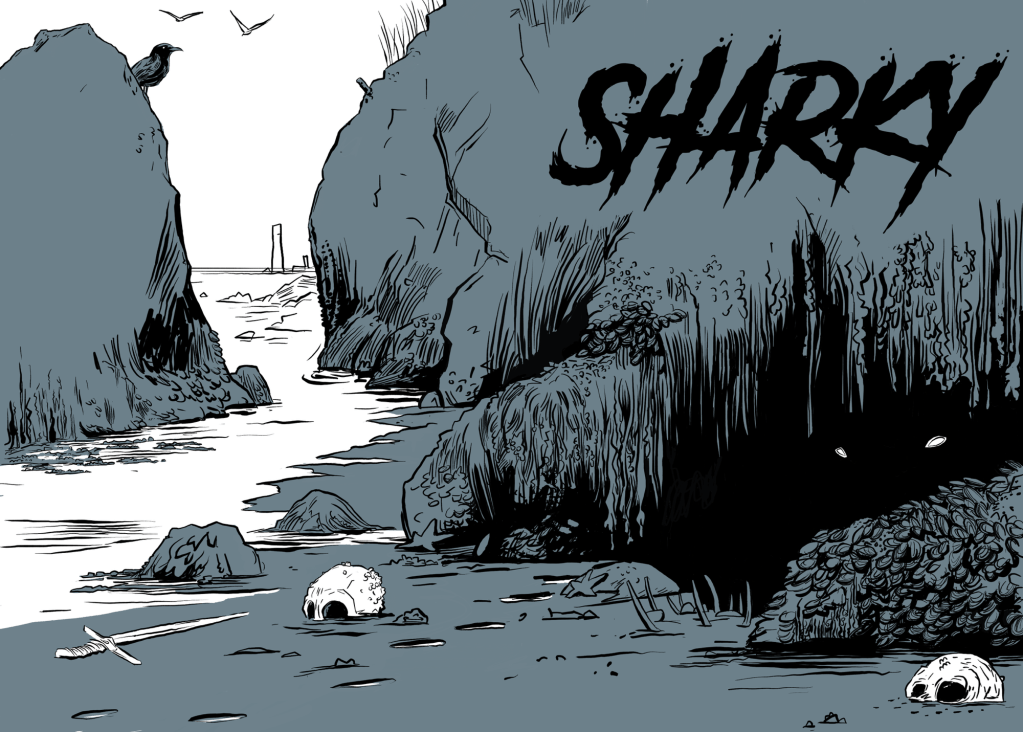
  • Bathtub Review: The Village of Hommlet

    Bathtub Reviews are an excuse for me to read modules a little more closely. I’m doing them to critique a wide range of modules from the perspective of my own table and to learn for my own module design. They’re stream of consciousness and unedited critiques. I’m writing them on my phone in the bath.

    The end of January marks my 100th Bathtub Review (not counting my I Read Reviews or Critique Navidad, so the number may be closer to 150 reviews in total), so I’m celebrating with an Introductory Extravaganza, where I review a different Dungeons and Dragons starter module every week for a few weeks. I’m going to cover The Village of Homlet (AD&D), Sunless Citadel (D&D 3e) and Lost Mine of Phandelver (D&D 5e). Why am I skipping 2e and 4e? Well, 2e didn’t have a definitive introductory module (in my opinion, please argue elsewhere), and I just don’t really think I’ll have much productive to say about the house style for 4e. And, I thought it would be more interesting to tag on The Iron Coral for Into the Odd and Blancmange and Thistle for Troika! We’ll go in chronological order, so first up is the Village of Hommlet.

    The Village of Hommlet is a 21 page module for AD&D (1st edition) by E Gary Gygax, with art and maps by the Daves Trampier and Sutherland. It’s explicitly an introductory scenario designed for new players to AD&D, and is supposed to tie into the first megadungeon for AD&D, The Temple of Elemental Evil.

    The layout, as with most of these late 70s TSR products, is abysmal. They’re printing in as few pages as possible, so we’ve got no margins, small type with minimal padding, packed into a two column layout, with pretty unclear highlighting and flagging of relevant information. It packs over 100 locations into those 21 pages, in addition to the multiple pages devoted to maps, introductions, and random encounter tables. Certainly, if you’re looking for quantity in as few pages as possible, the Village of Hommlet delivers. For me, though, the negatives of packing so many words into so few pages outweighs any positives associated with print cost, minimising page-turning, or ease of access. The cramped, low-padding layout makes it physically challenging to read and blurs the text, and the the lack of white space and art breaking up proceedings makes it hard to identify where information is on the page and where it is in the module altogether. Even modern day adherents to this style — either out of misguided belief it’s actually easy to read or out of a sense of devotion to the aesthetic — typically correct these issues to some degree. The information design is also challenging. The maps are all placed at the back of the module, rather than accompanying their keys. I suppose the intent is for them to be torn out and read in tandem, but as is it’s pretty difficult to know what you’re supposed to read and where to find it. But of course it’s no surprise that something published 5 years after the original 3 little books suffers in terms of graphic and information design. Let’s get onto the positives.

    While for the most part I find Gygax’ writing opaque and boring, he has a gift for iconic, easy to visualise characters, and also occasionally drops dry humour in, as with the infamous Bree-yark joke in B2. Here, it’s in the potential religious sayings of Saint Cuthbert: “Foolishness can be beaten” or “Preach quietly but have a large cudgel handy” are options at the oracle. The Dungeon Master’s information section is actually quite generous, explaining exactly how things are laid out, how to differentiate information in the key, and how to modify the starting scenario for a more experienced table. The degree of support could be improved, though, there’s a clear assumption that while the players may be new to AD&D, the referee is exposed to alot of jargon without explanation. It encourages improvisation, although I always rail against the expectation here that the referee should memorise the entire module before play as an unrealistic one. I do like the advice that if anything happens to impede or harm more level representatives of factions, their leaders are likely to hear about it and that will impact future interactions with members of that faction.

    Hommlet itself is an interesting and politically complex place, hamstrung by Gygax’ florid style and a lack of explanation. There are three primary factions, and most members of those factions in the village report back via courier. Named characters are all fairly evocative and easy to play, although take some extraction on behalf of the referee. The connections are there, but not spelled out, which either will result in mistakes being made because I have trouble “memorising everything in advance” or at best, serendipitous events as everything slots neatly into place.

    I like the factions in Hommlet, as all three major ones are religions, and it gives strong small town, petty protestant interactions vibes, particularly between the druids and the cult of St Cuthbert. Grounding the factions in real situation is appealing to me, as I have a decent grasp of how they’d interact at a town level, and I suspect the Cult of Elemental Evil is supposed to give freemasonry vibes in the sense that the lower levels are innocents in it to get away from their families. The major issue here is I am not clearly presented with these factions’ goals — indeed by design, as the Cult of Elemental Evil is intended to lie largely in a future module, and at least one representative from each other faction is prominently Off Dealing With Them. It’s pretty clear we’re not expected as referee to be juggling these factions activities in the background, here, and that characters in them rather than agents are simply club-members, but I’d have like further guidance in any case.

    One major misstep is the fact that very little leads player characters to the primary adventuring location (“the Ruined Moathouse”) from the village itself. While the module is incredibly dense and difficult to read, so I admit I may have missed something, even searching it digitally came up blank and there are no rumour tables or a wilderness to explore. I don’t think the Village of Hommlet needs those things necessarily, however something is needed to point the player characters in the direction of the adventuring location. Part of the issue here, I think, is that Gygax doesn’t want to tie things too solidly to the second module in the series, which means unless the player characters are systematically robbing the village, they’re unlikely to be lured in the direction of the moathouse or the cult of Elemental Evil.

    Which brings me to the more significant flaws in the design, here, which tie into the epic character arc in AD&D leading to high level play, very slowly. What the Village of Hommlet needs is more obvious machinations and signs leading to the cult of Elemental Evil; we need to be able to use this as a base for our campaign, while also slowly stumbling upon creepy and weird situations. We need everyone to be seeding us intentionally with rumours reflecting the three factions perspectives. And then we want them to send us to the moathouse, leading to our first major encounter with the cult that comes later. The problem is that leaving the cult entirely to a future module cuts this natural flow short.

    The moathouse, however, is an excellent early level adventuring location, at least after the style of early Dungeons and Dragons; you’re coming across a fairly random selection of monsters with little thematic consistency, but aimed at the correct level, with enough gold available to level up. Both levels are fairly large (17 and 18 rooms), and the dungeon level loops pleasingly and is full of surprises. I’d prefer more cohesive theming, but it’s an unreasonable expectation in the context of pre-1980 modules. You’ve definitely got a decent number of sessions and at least 2 levels in this module.

    Overall, Village of Hommlet feels to me like an undercooked Against the Cult of the Reptile God. If I were to choose one, it wouldn’t be the Village of Hommlet; but the Village of Hommlet has so much potential that I want to see a modern take on it, which leverages the politics of the various religions, how one of those three religions has been co-opted by evil, and leads into a small, low key outpost for a greater evil. This is good stuff! I just wish this module actually had it all in there, at my fingertips, instead of it all being inferred and expected for me to generate it in prep.

    More interestingly, the Village of Hommlet has a lot to say about what AD&D is: You’re supposed to be based out of a village or town, venturing into the nearby wilderness to pillage dungeons filled with uncomplicatedly evil foes. named characters in town are either fellow adventurers with ulterior motives to join you as henchmen, or else they’re representatives of factions playing politics with the lives of the locals. Aside from that, the town is filled with unnamed services. This is a very familiar structure, repeated elsewhere in AD&D and commonly repeated in the decades since. The Village of Hommlet sets that expectation clearly for the rest of the edition, but it relies heavily on the oral traditions of Dungeons and Dragons to actually provide onboarding, particularly for referees, which is interesting only 5 years into the existence of the hobby.

    Idle Cartulary


    Playful Void is a production of Idle Cartulary. If you liked this article, please consider liking, sharing, and subscribing to the Idle Digest Newsletter. If you want to support Idle Cartulary continuing to provide Bathtub Reviews, I Read Reviews, and Dungeon Regular, please consider a one-off donation or becoming a regular supporter of Idle Cartulary on Ko-fi.

  • The Ugg-Tecture of Language

    Many years ago a game called Ugg-tect went out of print. It is my favourite game I never played, and has entered mythical status in my personal canon. In it, you are cavemen who can only provide directions for building a building by making “ugh” sounds and hitting your friends with an inflatable club.

    The problem with languages in elfgames like D&D is that they are binary. So much of the fun in elfgames comes from plans failing. In reality, I can be bad at French, but in elfgames, I can’t be bad at Elvish, so it’s not a vector for fun, or memorable success. How can I be bad at Elvish in my game? Here’s an untested system.

    Everyone speaks human, called common because humans always insist on centring themselves. You can immediately tell where someone is from by their accent in common. But, if you attempt to speak in someone’s native tongue, you gain a bonus to your reaction roll (usually +1). If you’re not human, you get your native language too, in a dialect (“wood elf”, say). You get language slots equal to 4 plus your Intelligence and Charisma bonuses.

    Every language has four levels of fluency: Simple, daily, confident and fluent. If you speak fluently, you suffer no penalty. But for the others, you must instead mime half, one third and one quarter of the words (respectively) you attempt to say to someone in that language. For each language slot you spend on a language (including common and your native language if you have one), you move up one level: Nothing to Simple, to Daily, to Confident, to Fluent.

    If your intelligence and charisma are 13, and you’re elvish, you might only speak daily Common. It then pays to seek out elvish speakers for complex communication. Or you could choose to be confident in both elvish and common and mime every fourth word in your sentences; everything has a little risk. But if you’re talking to elves, they’re inclined to react well to you.

    Bonus: Related languages. Goblin and orc are like the Spanish and Portuguese: Similar enough to be understood, different enough to be dangerous. You can speak a related language at a level lower than the language you know, but they’re probably pretty strongly opinionated about the similarities between your languages: You take a penalty to reaction rolls if you’re using a related language.

    Anyway, this is the kind of silly language system I want in my games. It feels a bit more like being in a cosmopolitan country where you’re the fool who can’t speak the local tongue, but you’re doing your best. I’d be generous with earning new slots, I think, to compensate for the tomfoolery getting old. But it is present enough that it makes considering language fun.

    Let me know if you try it, or a variation.

    Addendum: One alternative to replacing words with mime (raised by Josh McRowell as being from alternative caveman game, Poetry for Neanderthals, which is in print) involve: providing each level of language with a syllable count. At simple, you can speak only in one syllable words, and daily you can use one or two syllable words, and confident you can use up to three syllable words, and at fluent you can use any number of syllables you wish. However, if you use a word that doesn’t fit your syllable limit, make a reaction roll: You may have made a terrible mistake! This may be more practical in play, than my original idea, but retains the meat of it.

    Idle Cartulary


    Playful Void is a production of Idle Cartulary. If you liked this article, please consider liking, sharing, and subscribing to the Idle Digest Newsletter. If you want to support Idle Cartulary continuing to provide Bathtub Reviews, I Read Reviews, and Dungeon Regular, please consider a one-off donation or becoming a regular supporter of Idle Cartulary on Ko-fi.

  • Critique Navidad: Fight or Fright

    This holiday season, I’m going to review a different module, game or supplement every day. I haven’t sought any of them out, they’ve been sent to me, so it’s all surprises, all the way. I haven’t planned or allocated time for this, so while I’m endeavouring to bring the same attention to these reviews, it might provide a challenge, but at least, I’ll be bringing attention to some cool stuff!

    Fight of Fright is a 30 page game by Alex Marinkovich-Josey with art by Grace Elsenheimer. In it, a group of trick-or-treaters is given the powers of the costumes they wear, to defeat evil terrors, although they risk losing themselves to their costumes.

    You create your characters by picking a kid, a costume and some props, and noting the actions and abilities they provide you. Then, as a group, answer some questions to learn how you’re all linked together. You have 4 dice between 3 linked pools — low numbers fall from your Fight or Fright pool into your Plight pool, making you vulnerable to the power of evil. This mechanic is a neat, catch-all mechanic clearly inspired by Lasers & Feelings, but I love the added pool that functions as both hit points, as a kind of panic saving throw, and also as a pacing mechanism. You move dice between pools using in-game actions, but you roll your pools to fight like your costume or act out of the fear of being a kid, and when you do that it works just like a Forged in the Dark game. And you eat candy to replenish your powers! The rest of the book is refereeing advice — it describes the kind of foes you might encounter (magically animated decorations or other kids taken by the Thrall), describes 3 types of scenes and how to run them, and a few trick or treating locations. The layout is simple, but good. There’s a little line art, but nothing overwhelming. There are no pleasant surprises, but nothing critical that makes the game harder to run.

    The basic rules and character generation here is pretty great for a halloween game. My issue to this is mainly from the referee side, and I have seen this issue time and time again in this post month. Realistically, this is a one-shot game: You’re not playing this long term. It’s a novelty game! And given it says in its text “Running the game…can be a daunting process” it’s frustrating to me that there’s still the expectation that the referee improvises the majority of the adventure, based on a few short suggestions. This should come with a built in module, illustrating how the framework that’s given should work — that way you don’t have to say “I know this is daunting”, which comes across as patronising in my opinion, but rather it comes across as “this is daunting, but we’ll help you”. Don’t make me do your design for you; I refer back to my review of Dead After Dinner. This is a game to play with kids: We already have an exemplar in the form of Mausritter. Kids modules don’t need to be huge, sprawling affairs, but don’t expect referees to spin them up from thin air either.

    Fight or Fright is almost the perfect Halloween one-shot, it just doesn’t give you enough to run straight out of the box. If it had an extra section with an example of a night out, or had a few extra modules, this would be a fun little game to pull out once a year with the kids. As is, if you don’t mind improvising an adventure — or you have a Halloween themed module from another system to run — this is a really fun choice.

    Idle Cartulary


    Playful Void is a production of Idle Cartulary. If you liked this article, please consider liking, sharing, and subscribing to the Idle Digest Newsletter. If you want to support Idle Cartulary continuing to provide Bathtub Reviews, I Read Reviews, and Dungeon Regular, please consider a one-off donation or becoming a regular supporter of Idle Cartulary on Ko-fi.

  • Critique Navidad: He Ain’t Gonna Jump No More!

    This holiday season, I’m going to review a different module, game or supplement every day. I haven’t sought any of them out, they’ve been sent to me, so it’s all surprises, all the way. I haven’t planned or allocated time for this, so while I’m endeavouring to bring the same attention to these reviews, it might provide a challenge, but at least, I’ll be bringing attention to some cool stuff!

    He Ain’t Gonna Jump No More is a 60 page game by Tom McRedy about the climactic invasion of Normandy in 1944. Wrap your head around this: It’s a WWII hex-crawl based on Wolves Upon The Coast. Right now, having not yet read this book, my mind is reeling: What the hell am I getting myself in for? Let’s dive in and find out what an OSR WWII battle-simulator looks like.

    As the title suggest, in this you play paratroopers, dropped behind enemy lines. Your paratrooper is randomly generated, and are, as soldiers, largely similarly equipped. You can imagine in a WW2 game, a lot of attention is placed on equipment lists, but while they take up space, they are all unique and flavourful, and they are what will set you apart in the absence of classes and spells and what not. The rules are simple, OSR-style rules, roll under your stat, using a number of 6-sided dice equal to the difficulty. Rules for save are always the same, on a 20-sided dice, over a certain number. You want to avoid these, as they’re difficult. It’s hard to hit someone with an attack, as you have to roll greater than 20 on a 20-sided dice, meaning this game is all about stacking modifiers. While gunfire rules are a little more complicated to reflect automatic fire, that complexity is reflected in clever rules about jamming, ricochet and overpenetration. Overall, while this 20 page rulebook is dense, the rules are exactly what you need to run a WW2 game, and no more. This is intended to be a gritty, messy crawl, with fragile people dropping into fearful situations with no recourse.

    The rest of the game is the 40-page referee’s guide. The surprise for me is how dense this game is: You’re playing on a timeline, that goes from 3am to midnight. There are 9 major objectives scattered across the map, 3 settlements, and 4 exits all detailed. There are 11 targets of opportunity: Things that you can achieve that will help your side out, but aren’t primary targets. Just loads of encounters and things to do. You hit the ground in a random place, you could lose your stuff in the air or injure yourself in the landing, or get hit as you parachute to the ground. Then, you still have to find each other when you get there; once you’ve regrouped, you have to find a senior officer who’ll give you new orders. Until then, you’re seeking whatever the nearest objective to your drop site is, and trying to recover vital supply drops. At midnight, the invasion ends, and you compare the player’s achievements with the objectives they achieved, giving them a point score, which is bolstered by gaining decorations and medals, which occur for specific actions, as well as claiming trophies and the like.

    The referee meanwhile is tracking what’s going on throughout the battlefield: Reinforcements are arriving and advancing to assist you, but you don’t know where they are or what they are. Aerial bombardment has no contact with you, but is proceeding to destroy strongpoints, following a certain route that the paratroopers do not appear to have knowledge of. The German counter-attacks are also occurring at specific times and in specific places, matching the timeline provided at the start, which details the allied movements primarily. To do this, the referee needs a working knowledge of the geography of Normandy, of the German presence there, stats, a random encounter table, reaction rolls, and hex fills.

    The referee really leans into the FKR style of play, placing the majority of mechanics and rulings in the hands of the referee. I don’t disagree with this: It feels very appropriate for the topic. But the issue is, the players kind of already have to be super familiar with how to interact with this war-torn world to figure out how to win. An example is that, if you access a radio, you can call in naval fire support to destroy a target; you need to choose which ship is best for your aims, as well. This is all in the referee list, but I’m pretty certain my players, unless told this was a pretty sensible option for large objectives, would be looking for explosives to replicate what they see in modern action movies, by default. They wouldn’t even consider this option.

    All I have to say about He Ain’t Never Gonna Jump No More is: Wow. I have so many thoughts. This is an absolutely unique work, drawing on a bunch of sources that I don’t think I’ve seen concretely in the OSR realm before. It draws tournament play concepts from the early hobby in a way that I’ve talked about in Dungeon Regular needed to make a comeback (although I wonder if in this case the inspiration is actually war games). It takes the sprawling grand campaign structure of Wolves Upon the Coast, and rather than try to replicate its’ scale, it gives it strict borders and time-constraints. This is a really, really impressive piece of work. I have read the author’s Shot & Splinters, and I planned to review it some time ago, but in my esteem it needs more of the grandeur of Wolves Upon the Coast to work. This however, embraces the constrained nature of its’ subject matter, and revels in it.

    But there are problems, and these are problems that come with the subject matter, but also which I think are eminently solvable. The two major problems are firstly, as I mentioned earlier, I don’t think the players would naturally choose a lot of the options given to them, even though to an expert in historical warfare they’d be intuitive. The first thought is providing them with a “moves” list, but I think that’s a blunt force solution: Rather I think this needs to come with a printed briefing handout, talking through what the paratroopers actually know when they drop, talking about the resources at their disposal and the resources they need to find when they’re in the field. Without something like this, I think anyone not well-versed in WWII history will bounce off this very hard, even if they were interested in playing it. The second problem is the sheer load placed on the referee here. I see this problem in Wolves Upon the Coast as well, and there it’s largely in response to Gearing’s seeming allergy to considering information design and layout in the construction of a complex system. Same goes here. There are two separate timelines in two separate places; put them together for me, the referee. Don’t make me do it myself. Suggest a way to track troop movements on the map, don’t just leave it to people on Discord to sort out. The keying is left up to chance for a reason: This is a game that’s intended to be replayed, I suspect, for high scores. But it doesn’t make it easy to play off the book, because information design and layout is not high on the author’s priority list: It’s hard to find the hex fill you’re after, or the random encounter details you need, or the stat block that’s relevant to the place in question. If my players stumble upon the village of Chef du Pont in D7, I have to go to the town maps document before I discover there’s no town maps, then I search the document for what consists a company of landsers and a landser mortar squad, before finding that landser isn’t defined and having to google it to find it means german soldier, then scrolling to page 23 because it’s not linked to find what a company is which is a lot of things listed in paragraph, with no link to stat blocks, and with reference to the previously defined platoon, which is also listed in paragraph, and I have to refer to. The mortar squad I assume refers to the light mortar squad and not the mortar platoon, and then I go back to infantry profiles on page 22 to find their stats. So I’m talking in this case, 10 people in a squad, times 3 plus 1 for a platoon, and a horse drawn wagon, times 3 plus 1 for a company, plus a machine gun squad, and a headquarters with another 11 people. And I don’t know that they’re going to arrive at Chef du Pont, necessarily. So I’m going to have to do all that math on the fly, and run the game. There’s a better way to lay this all out, so that I can actually run this game. There’s a visual design solution to all of this, involving laying these lists out in a visual grid so I can tick them off as I go, for example. But I don’t want to do that myself, because I’m here to play the game. It’s not the player’s job to design a game for the designer.

    There’s also layout solutions. This is effectively a word documented exported as a PDF, and it has the readability of one. But with section headings, and sidebars, and references, this becomes a whole different ballgame, and something you could literally pick up and play in a long evening. I could see a revised version of this, given to an inventive visual designer interested in information design as well as layout, that would see regular play at plenty of tables, because it fits this unique, non-campaign, but still learning from session to session, semi-competitive slot that almost nothing else in the modern hobby fits in. It’s really unique, roguelike OSR gameplay. But it needs a developmental edit, a proof edit for clarity by someone who doesn’t speak WW2 jargon, and a solid visual and information design revision to achieve that level of ease.

    If someone thought it worth polishing and spending money on, He Ain’t Never Gonna Jump No More could be the kind of game that inspires many, many other constrained, tournament-style games for a new generation. I’d love to see it do that, or I’d love to see someone take this and run with the concepts to apply them to something else, to make slick, tournament-style old-school games with a modern twist. But right now, it simply makes a promise that it can’t quite fulfil. That promise is super exciting to me, and I’m honestly crushed to see so much potential wasted to the cult of minimalism in TTRPGs.

    That all said, if you’re into WW2 enough to want to run He Ain’t Never Gonna Jump No More (which I am), and you have the time (which I don’t), and you’re willing to solve those design issues yourself, it’s probably only as much work as it would take to run any WOTC adventure book, to be honest, so disregard everything that I just said except for the solutions. This is a damned remarkable game, under all of these problems, and it would be sad if people otherwise interested thought it wasn’t. I love to see these unique games, and He Ain’t Gonna Jump No More certainly stands out of the crowd.

    Idle Cartulary


    Playful Void is a production of Idle Cartulary. If you liked this article, please consider liking, sharing, and subscribing to the Idle Digest Newsletter. If you want to support Idle Cartulary continuing to provide Bathtub Reviews, I Read Reviews, and Dungeon Regular, please consider a one-off donation or becoming a regular supporter of Idle Cartulary on Ko-fi.

  • Critique Navidad: Tea and Toadstools

    This holiday season, I’m going to review a different module, game or supplement every day. I haven’t sought any of them out, they’ve been sent to me, so it’s all surprises, all the way. I haven’t planned or allocated time for this, so while I’m endeavouring to bring the same attention to these reviews, it might provide a challenge, but at least, I’ll be bringing attention to some cool stuff!

    Tea and Toadstools is a 9 page solo journalling game based on the Carta system, by the monomynous Anya. In it, you play a hedgehog in a twill vest who just wants to be left alone, even though the rest of the forest has other ideas. Well, in my case it was a blue dress and apron, because Mrs Rabbit.

    To play Tea and Toadstools, you wander around a board you make out of playing cards, flipping the cards. Whenever you flip a card, you look at the prompt list, and are encouraged to journal if you wish, what happens to hedgehog; each card also has you gain or lose a resource. If you reach your goal card before you run out of resources, you have a good day. If you run out of resources before you get to the goal card, you have a bad day, but you can try again tomorrow. If you’re anything like me, you’re like: “Oh, this is cool. Great”. Luckily, I’m on a day off today, so I get to pull out my playing cards (sadly not the Haakum Playful Animals deck, which I’d kill for) and give it a go. What did I find?

    I’ve written about a bunch of prompt-based games this month, so I won’t harp on about the fact that I want more specificity in my prompts. This game ain’t bad on that criteria, but it’s not excellent by any stretch. I’d love the other animals in the forest to be characterised a little more: What’s Dr Raccoon like? To me, perhaps as a result of not being North American, most of these forest animals have pretty similar stereotypical characterisations, so I have trouble embodying them for the purposes of this game, especially when I need sink my teeth into the events. I’d also really love for gaining or losing resources to be a choice in each prompt: That would put a lot more meat on these bones. Rather than simply losing 2 resources when the crows steal your laundry, make it a choice: Expend 2 resources to get your laundry back, or lose no resources to sacrifice your laundry, and it’ll come back to haunt you later. I feel like adding a second currency than resources, and having the outcome be in the balance of those resources might make the ending more satisfying: Rather than simply not being happy that day, you always find your goal eventually: But at what cost, Mrs Hedgehog, at what cost to your beautiful home?

    This concept of constructing a random board, of never knowing which parts of the deck will show up until they do, is a really clever system full of replayability, and I can see why the author adapted it, but despite it saying that you could choose to play this as a board game, the most significant flaw is that all of the cards are flipped, meaning that while it feels like you’re travelling around hedgehog’s forest, you, the resident of the forest, have no idea what that forest is until you stumble upon it. I feel like it would benefit from some predictability; perhaps that’s a literal map of the forest that the cards are played over, as a second layer of prompts; perhaps that the cards are themed differently — currently the themes are “The Path”, “Botheration”, “Helping Paw”, and “Community”, which I don’t find very helpful at all. I wrote in my review of Foul Play earlier in the month, that a lot of these smaller, card-based games would benefit greatly from having a deck of cards associated with them, simply because it would bring so much more to the table. In this case, simply building your board out of a maze on the back of the cards, like the board game Labyrinth, would add so much to the feeling of exploration. Similarly, somehow being provided some foresight into the spaces around you on the backs of the cards — like them being themed to reflect parts of the forest by suit, but each suit meaning something in terms of likelihood of gaining or losing resource — would add a lot.

    This game has an absurdly cute cover by Ghostcandle, as you can see above, and the interiors are equally cute, filled with forest animals and swirling decorations. These illustrations bring the atmosphere necessary to such a game, although I do feel like a more spacious layout would make it feel less like studying and more like playing. I often struggle with journalling games because they feel like this, and so it’s better for me personally, when they lean away from the wall of text layouts. That said, it’s clear and easy to navigate through, it has useful diagrams for play, and nobody is going to struggle to figure out what’s going on.

    I think for me, Tea and Toadstools is in tension between “I love this theme, and it just sings it both in terms of prompts, choice of system, and art and layout” and “But, if we’d made the prompts more specific, changed the resource mechanism, and added backs to the cards, it would be the best solo game I’ve ever played”. I strongly encourage people who like Peter Rabbit, slightly grumpy coziness and enjoy journalling games, because those specific changes I want aren’t things that are even slightly common in the solo game sphere that I have seen. But wow, does Tea and Toadstools come close to being a solo journalling game I’d actually recommend to someone new to roleplaying games, which has never, ever happened before. It’s so close. I can see the game I want right there on the horizon.

    Idle Cartulary


    Playful Void is a production of Idle Cartulary. If you liked this article, please consider liking, sharing, and subscribing to the Idle Digest Newsletter. If you want to support Idle Cartulary continuing to provide Bathtub Reviews, I Read Reviews, and Dungeon Regular, please consider a one-off donation or becoming a regular supporter of Idle Cartulary on Ko-fi.

  • Critique Navidad: Crank It Up

    This holiday season, I’m going to review a different module, game or supplement every day. I haven’t sought any of them out, they’ve been sent to me, so it’s all surprises, all the way. I haven’t planned or allocated time for this, so while I’m endeavouring to bring the same attention to these reviews, it might provide a challenge, but at least, I’ll be bringing attention to some cool stuff!

    Crank It Up! Is a 6 page game by Patrick Dubuc. In it you’ve been poisoned in your sleep, and the only way to stay alive is to keep your adrenaline pumping. You have to avenge yourself before it’s too late. It’s a Breathless game, but to be honest with the proliferation of SRDs these days, I’m not sure what that means.

    You have two sets of “hit points”, Stress and Adrenaline. Once your stress is maxed out at 5, anything dangerous will kill you. Once your adrenaline is reduced to 1, anything you do can cause stress. The things you do are skill tests. You roll a die of a specific size, and if you roll 5 or more, you succeed, but below that, you have mixed success. If you roll over 12, though, your success is off the charts. The size of this dice goes down as you use that skill a second time, so when you start you’re superhuman, but by the end, you’ve got no strength at all. To reset this skill deterioration, you can catch your breath, at the cost of a new complication being added to the situation, and your adrenaline decreasing. To avoid this, you can use items, which can be used in lieu of skills if they’re low. You have 7 skills, but most of them are small dice to begin with, so you’re going to have to catch your breath pretty often if you don’t spend a lot of time looting. So, you can always loot, which will provide you with some kind of item, probably.

    That’s basically all of the rules; the overall feeling is that this is an action movie (as I haven’t seen Crank, the actual movie upon which this is based), in the style of John Wick or The Raid, where the protagonist is improvising their way through an environment on their way to a specific goal. Honestly, this whole system feels absolutely perfect for making up your own action movie collaboratively, and the adrenaline and stress systems do reflect that “I’m gonna die unless I keep doing ever-more extreme things” dynamic that I believe Crank is about. I do feel a little bit like the actual Crank-iness of this game should be optional, like the optional “heart attack” rule is, and the aim here should be a slightly more generic John Wick, with more options, or they should lean harder into it (by doing things like make the heart attack rule compulsory, and make the scenes more concretely Crank-y). But the rules are damned solid given the theme. I’m impressed that it managed to feel so perfectly action movie, without any of the usual combat crutches we see in roleplaying games: Everyone, this is evidence you can make combat feel fun without it being grid-based and slow.

    However, this is designed as a multiplayer game, which to me, poses a problem: None of the movies that I imagine this system helping replicate the feel of, feature multiple protagonists for any significant part of their runtime. It feels like this should be a two-player game, one for the antagonist and one for the protagonist, to me. I can definitely see it being a two-player game where both players play both protagonist and antagonists, in a dual-stream movie, exchanging roles and scenes — in fact this manner of play would be entirely compatible with the game as it stands. But with 3 or 4 protagonists, I could see it getting messy and held up very quickly, the amount of improvisations and magically appearing loot items starting to strain credulity very, very quickly. But you know what? Even though it says it’s for more than 2 people, you can still just play it with two people. It’ll be great.

    To add icing to this violent cake, the back half of the book is referee assistance; it’s not quite a module for the game, but it effectively is: A series of the kind of scenes you’d find in this kind of movie, in combination with tables for creating characters and weapons and events, and a free expansion which includes a bunch of characters for your game, which together render it very, very easy to run. The one objection you could point at this would be that what they provide you is 9 scenes, after which your movie is over and you’ll never play Crank It Up again, but honestly the structure of the scenes, while not explained at all, is intuitive enough that you could just watch a movie (I see John Wick 3 is on Netflix right now) and transcribe its’ scenes onto a piece of scrap paper.

    What this game isn’t, is a game of explorational agency: You’re on rails, just like the protagonist of an action movie is, following the path provided by the clues to arrive at your destination. Any mystery solving is purely cursory, mood-building or world-building. This is not a game for thinkers, this is for a short burst of explosive imagination. But, I could see this game adapted to make a more exploratory, high-agency play possible.

    Overall, Crank It Up is feels really innovative to me, although that might be my lack of background in Breathless and its progenitor, 2400. The way it makes roleplaying game violence fun in a new way, by handing two very specific kinds of limited narrative control to the players, but asking them to relinquish other kinds of agency in exchange, makes for a really satisfying feeling that totally fits in with the theme. I know there are piles of these small, indie games with clever innovations lost to obscurity on on itch.io, but for now, Crank It Up is the game I know about, and I think it’s pretty cool. If you and your friends want to enjoy a night of reckless violence, Crank It Up is a pretty good way to spend it.

    Idle Cartulary


    Playful Void is a production of Idle Cartulary. If you liked this article, please consider liking, sharing, and subscribing to the Idle Digest Newsletter. If you want to support Idle Cartulary continuing to provide Bathtub Reviews, I Read Reviews, and Dungeon Regular, please consider a one-off donation or becoming a regular supporter of Idle Cartulary on Ko-fi.
  • Dungeon Regular: Threshold of Evil

    A new episode of Dungeon Regular is available! It’s embedded below, on Spotify or in your favourite podcast app.

    Threshold of Evil Dungeon Regular

    Dungeon Regular is a show about modules, adventures and dungeons. I’m Nova, also known as Idle Cartulary and I’m reading through Dungeon magazine, one module at a time, picking a few favourite things in that adventure module, and talking about them. On this episode I talk about Threshold of Evil, in Issue #10, March 1988! You can find my famous Bathtub Reviews at my blog, https://playfulvoid.game.blog/, you can buy my supplements for elfgames and Mothership at https://idlecartulary.itch.io/, check out my game Advanced Fantasy Dungeons at https://idlecartulary.itch.io/advanced-fantasy-dungeons and you can support Dungeon Regular on Ko-fi at https://ko-fi.com/idlecartulary.
    1. Threshold of Evil
    2. Secrets of the Towers
    3. Monsterquest
    4. They Also Serve
    5. The Artisan’s Tomb

    Playful Void is a production of Idle Cartulary. If you liked this article, please consider liking, sharing, and subscribing to the Idle Digest Newsletter. If you want to support Idle Cartulary continuing to provide Bathtub Reviews, I Read Reviews, and Dungeon Regular, please consider a one-off donation or becoming a regular supporter of Idle Cartulary on Ko-fi.

  • Critique Navidad: The Painted Wastelands

    This holiday season, I’m going to review a different module, game or supplement every day. I haven’t sought any of them out, they’ve been sent to me, so it’s all surprises, all the way. I haven’t planned or allocated time for this, so while I’m endeavouring to bring the same attention to these reviews, it might provide a challenge, but at least, I’ll be bringing attention to some cool stuff!

    The Painted Wastelands is a 147 page setting guide for Old School Essentials with art and story by Tim Molloy, writing by Christopher Willett and layout by Minerva McJanda. The Painted Wasteland describes one small region, a relatively desolate one, in a huge world: You have ascended the mundane existence you once belonged to and ended up here.

    It first introduces you to the four main metaplots — setting-spanning hooks to draw the player characters into the world — as well as a table of ways to ascend from our world to theirs. There is a list of other places in the world of the Painted Wastelands outside the wasteland itself, which is about 35 hexes, with brief descriptions, but I imagine if this is a huge success, we can expect them to be expanded in the future.

    There are a lot of very cool mechanics scattered throughout the Painted Wastelands, and I’ll go through the stand outs here: You get to learn dreamtongue as you level up, which means when you start you speak as a toddler and only understand 50% of what you hear. Travelling is willing yourself from place to place, so distance and time is relative to your experience and level — a very flavourful subsystem in my opinion, replacing typical travel with something that feels dreamlike. Sleeping is deadly, and far more deadly than travel, with encounters more common resting than travelling, which is neat but potentially very disruptive to play, but a flavourful addition nonetheless. There are a lot of unique monsters, about 50, which are all fully illustrated and pretty compelling. There are two unique B/X classes, both super iconic dreamlands classes, one is a cat! The other, the oneiromancer, has an entire unique spell list. There are a bunch of very detailed and complex magical items and tomes! Currency is on an ectoplasmic standard, which means you can cash it in to smoke it in order to gain XP directly. You can also sell things worth currency for XP, which implies to me that the author plays without XP for murder, although there is XP in the monster stat blocks.

    There are 3 major factions and 7 minor ones. These factions are each unique and interesting, however it would only take a little work to make them more immediately gameable. I love having an NPC or two for each faction, but even just doing a Blades in the Dark style 1-2 goals with a clock size associated with each would make them much easier to run. You can very easily do this — like the description says things like “preachers are trying to expand their operations into the Painted Wastelands by baptizing as many folks as possible” which are very easily converted to concrete goals, but my forever refrain is that if something is easy to design, the designer should design it please so I can just play your game. My favourite of course are the mandrill librarians: “A crack team of Librarian bounty hunters roam the wastelands to reclaim these books no matter the cost.”

    The Hexcrawl itself has 30 odd populated here’s, with 6 small dungeons scattered throughout, and a few larger locations max. The hex map that headlines this section is an absolute beauty, with each hex displaying its point of interest, and matching the colour and style of the rest of the module. The “start here” hex, as far as first impressions go, is a hell of one: “An albino bat demon is trying to rip a painted skull out of a nearby pile of rocks. The skull is screaming in Dreamtongue. “Help! Help! Won’t someone grant me aid?” This quote was the last part, the hook. I wanted to quote the entire paragraph. The Painted Skull, if you rescue it, is the Morte of the Painted Wastelands — your guide, but muttering in nonsense you can barely understand. The answers to common questions cover the second half of the page, helping to get players started in this weird and currently directionless world, and throughout the book purple skulls indicate that the Painted Skull has something to say about that location. Very cool touch!

    The Painted Skull has something to say!

    Now, there are a lot of hexes and a lot of locations in this book, but what’s most notable about them is their conceptual density. This is weird, Viriconium-y stuff, an entire region of it. This content doesn’t follow a consistent structure, though, for good or ill. One area is a township and marketplace; another is a dungeon under a melting palace; another is a canyon filled with tourists. The fact that they’re all so different from each other is both befitting of the nature of this weird world, but also means there’s inconsistency which means I’m having to work fairly hard to process it. But, on a location-by-location basis, this is very, very good: A village full of alchemists with advertising, a dungeon where one area is “You have sat in the dream couch and you are now a god”, a solarium floating in the sky. That said, you’re probably also getting a sense for the vibe here: Anachronistic and high-concept weird. This mixes robots and wizards and TV shopping networks in a single location. If you or your table aren’t absolutely signed up for this conceptual melange, I could see you bouncing off it hard. The Painted Wasteland is reminiscent of The Dream Shrine, but writ large, and I could see some people struggling with the Dream Shrine at only 1 or 2 sessions.

    That said, every one of these locations is sumptuously illustrated. This is right up there with Ultraviolet Grasslands and Crown of Salt as one of the best illustrated modules I’ve ever seen, and no surprise if you read the story of how this book came to be. The art is as psychedelic as the setting demands, decorations abound in what I suspect is a conlang of the dream speech. The colour choices of Minerva McJanda are bold, port wine and lime green, with a palette of complementary colours, shared with the art palette just enough, but not to the point of redundancy. The choice to exclusively use sans serif and generous spacing stands in contrast to the bright and extreme choices that abound on every page; if the choices has been stronger, it would have rendered a challenging text impossible to read, but it instead grounds it in a simple, modern legibility. I have mountains of admiration for polymaths like Luka Rejec and Tania Herrero, but this shows the strength of a team all dedicated to their individual crafts, working cohesively.

    One fascinating and compelling choice that The Painted Wastelands makes is that it’s for Old School Essentials. Luka Rejec attempts for a similar weird, but in bespoke systems. Most of the DIY elfgame weirdness flies down the Troika! funnel, except for the work of Amanda Lee Franck. This takes the approach of lowest common denominator, and to be honest, it works. The thing I like least about Rejec’s work is the Synthetic Dream Machine. Troika! as a system is not for everyone, although there are a few modules for it that deserve to be run. This, anyone can use with no modification. That’s a hell of a selling point. And there are a bunch of modules out there, that you could easily patch into your Painted Wastelands Campaign, like Through Ultan’s Door, and the Dream Shrine, that are often difficult to otherwise incorporate into a broader campaign (at least, until Through Ultan’s Door is complete).

    The art, the writing, and the design of the Painted Wastelands is absolutely S-tier, and I recommend it on the grounds of that alone. However, this is not a simple setting, or one easy to run: Gauge your table well, because this is a level of weirdness beyond that of Ultraviolet Grasslands or Troika! It’s an absolute fever-dream, and well outside typical fantasy fare, let alone what is expected of Old School Essentials. And because of the complexity of the locations, this is the kind of book where your players decide where to travel to, and then you call a break while you wrap your head around what to do with a location that’s an alien Bob Dylan at a crossroads. If you want a surrealist acid-trip of a dreamlands setting, that leans harder into dreaminess, the Painted Wastelands is your setting. There’s nowhere better to look than here, and there’s nothing else out there like this at this scale: I can’t imagine you’ll regret having this in your collection, as it’s so beautiful, even if you don’t find the right table to run it.

    Idle Cartulary


    Playful Void is a production of Idle Cartulary. If you liked this article, please consider liking, sharing, and subscribing to the Idle Digest Newsletter. If you want to support Idle Cartulary continuing to provide Bathtub Reviews, I Read Reviews, and Dungeon Regular, please consider a one-off donation or becoming a regular supporter of Idle Cartulary on Ko-fi.

  • Critique Navidad: Dice Forager

    This holiday season, I’m going to review a different module, game or supplement every day. I haven’t sought any of them out, they’ve been sent to me, so it’s all surprises, all the way. I haven’t planned or allocated time for this, so while I’m endeavouring to bring the same attention to these reviews, it might provide a challenge, but at least, I’ll be bringing attention to some cool stuff!

    I just got a gift copy of Dice Forager (or digital) in the mail on Christmas Eve, from my friend Sam Dunnewold, and I’ve woken up before the kids on Christmas morning, so tune in for a bonus issue of Critique Navidad while I bake breakfast croissants. Dice Forager is a 50 page perfect bound colour zine by Sam Dunnewold, host of the exceptional Dice Exploder podcast. It consists some essays, 3 small games, and 4 tiny games. Each of the games (aside from the last 2, which are only half a page each) opens with a 1 page commentary on the game itself, meant to set you up for perspective on the game.

    As Sam’s partner states in the introduction, Dice Forager is almost autobiographical, and is certainly a zine about a specific person: Sam Dunnewold. The author’s foreword is laid out like a brief hack of the GM’s advice from Apocalypse World, and encourages you to engage actively and critically in reading (and perhaps playing) the games that follow (I’ll tick off these moves as I go, play along!). The essays that fill the front few pages of the book cover general principles of creation, editing, providing feedback on art and safety. These very short essays really serve to calibrate you to the author’s stance going into the games the make up the majority of the zine. They’re short enough that I don’t think I should recap them, you should read them yourself (Update: Now, you can! Sam has posted them on his blog!): They’re a call for generous and abundant engagement and I do hope that Sam’s thoughts here are reflective of the evolving perspective of the hobby on these topics, because we’d be a better hobby for it.

    The first game is Couriers, a Lasers & Feelings hack inspired by the baseline test in Bladerunner 2049. Couriers sets a theme for the zine: These are games that require you to lean into the theme, to really embody your character. The pleasure of Couriers (if pleasure is the right word) is to see the Couriers — they’re the players who are robot cops seeking robots in disguise — slowly embrace or repress their emotions until they either become aberrant themselves or until they’re retired before they do. Mechanically, this is driven by the “emotions” score, which basically represents your robot cop having any feelings, and which is driven up by having things go well, but also the more emotions you have the harder it is to kill. This is a neat gamy Lasers and Feelings spin, that works so long as you don’t think too hard about it, but you could (and I think should have) make it sing more cleanly. You could do this by either dictating what the emotions were —simply because if they’re angry, violent emotions, it shouldn’t translate to less killing in my opinion — or making it a 3-way system like we see in Fight or Fright (I have a review of that upcoming). You can see Sam’s unwritten bias coming into the design there, I suspect, in assuming that the emotions will be passion and art and love and not anger and jealousy and violence. It’s a very melancholy vibe overall, befitting the subject matter, and the aberrant players are well supported in their joint role as game master through a list of missions, that are easy to iterate on. That said, if you’re a table of more than 3 players, there are more aberrant players than couriers, and while I feel like it would thrive with 3, it’s not clear to me how well it would work with a table larger than that; while the right table could make anyone work, I think this is probably best as a referee’s game; this is implied as well by the rule that aberrant players should rotate in as couriers become aberrant.

    The baseline test scene is an excellent inspiration for a game in my opinion, but because of its nature, I think the benefits of the structure here are lost: This is a game with a very tight, sub-hour loop, which if it was tackling a different topic, I think would make for an amazing structure for a pick up game. I feel like Couriers desires to be run in a bunch of jobs in a row, each sub-an-hour, and that just ends up being a few hours after all. Would love to see this direction applied to a more pick up and play premise. Overall though, this is a very cool game, and one that has a lot of potential if it were expanded, particularly if the conceptual space was expanded to embrace a recognition of the directions aberrance could take you. If you’re interested in exploring humanisation and dehumanisation in a cyberpunk future, this is good place to start.

    The second game is Windfall, a larp set in the town Sam grew up in (also the setting of Northfield, making it perhaps the most designed about game in Minnesota). The concept leverages my having to travel 15 000 kilometres to play the game pretty well: By using the physical space and the locations of the town as cues for gameplay, the pacing on this otherwise fairly predictable journey is pretty fantastic, and as Sam observed the physical space prompts the roleplay in a way that imagined space cannot. Sam brings his concept of calibration into this game, concealing it in in-character phrasing “Did you hear the cops?”. The main drama in the game is held in the secret prompts, which encourages each player to engage with each other in varied and surprising ways. One of the big secrets is tied directly into the characters utilising the hidden calibration tools, and competing over their application, both disguising the admission of discomfort by players (perhaps a mistake?), but also yielding narrative impact from the application of calibration. It’s very neat. Once you’ve taken the plunge and actually “been arrested”, you begin playing a parallel game, reminiscing about what could have been, your incorrect memories contrasting with the actual events occurring as your companions all play. I’m not sure how this split works in practice — do the arrested players hang out separately? This feels like a lovely solution, albeit perhaps impractical in small groups: Perhaps an example of play would go well here, where the activity of play diverges from the expected. All in all, a lovely little game. Practically, though: Even at only 8 pages of rules, it’s kind of too many to play in the way this game wants to be played. You’d kind of need a facilitator, to be sitting in the car and reading out paragraphs then prompting everyone. While I think the format of large scale site-specific larp is really, really clever, I think the rules need to fit on something the size of an index card, or each player be handed a little A6 zine to flick to different pages in as they reach different locations, for this to work. The traditional format of “zine-based game” doesn’t cohere with the game itself, for me. Because of that, it feels far more theoretical to me than the other two games; more of a game to be considered than played, even though theoretically it could be. I do think, though, that a version of this that came in a set of playbooks for each of the characters, that walked them through the rules as it became relevant, would be actually playable. I’d definitely do this in my hometown we’re I ever to venture back, as the walk from Main Beach to the Lighthouse there is almost exactly 4.5 miles, and there are some nice spots to pause on along that route. Overall, this one has a lot of potential, and I’d love to see more of these pseudo-autobiographical games being published.

    The third game is Space Fam Mini. Of the three games included, this is the only one that feels strongly like an indie story game, in terms of its structure, pacing and mechanics. You create characters defined by their fears, you draw a ship together and then embellish and mark it up as you go through your scenes, As you go, you might gain beliefs, guilt, or camaraderie. Beliefs move your space fam towards endgame, camaraderie helps succeed on jobs, and guilt propels you towards your end. You play through a menu of scenes, like a simplified Firebrands-like game, until you’re out of scenes or your beliefs outweigh your fears. Perhaps there’s joy in building this crew and ship and world from scratch, but honestly, I think Space Fam Mini would be best if it leant right into its inspirations, rather than be coy about them. Be more like Arcane Academia, for example: Reclaim it. Give us a ship blueprint already, to mark up. Make those scenes detailed, more evocative. Make it feel real. Give us pregenerated characters, not just a menu of sparks. The prompts are hefty — they need to be for the ideal table of 5 — but they could be absolute fire. You know what property this is inspired by, if you’re choosing this game as a game to play. Lean into it. I don’t think games benefit from “it’s a little bit like this and a little bit like that”. I want more “it’s this, my bespoke universe of space cowboys and found family, make it your own”. You know we will make it our own, we do that with canon-infested properties like Star Wars. We can do it with your bespoke little world, I just want to see it. You might be familiar with Space Fam (not mini), which was also published this year — the reason Sam says he chose to publish this as well, was because “This version has something to say, even if I think that thing contains a lie. Which is better? I don’t know.” Now, while Sam has for reasons I understand chosen to avoid the most obvious comparison to Space Fam (and for good reason), the untruth it tells is the basically the mechanism by which the game ends. It’s not really a game about those other mentioned inspirations, in my opinion, although you could twist it to be. The Space Fam becomes superheroes for the oppressed, is the story. Now, this is a Hollywood falsehood, and it’s true that it doesn’t speak to the reality of activism or of end stage capitalism, but I don’t think there’s need to be embarrassed about the desire for simplicity that this ending displays. It does provide a neat bow for your experience, which is not something I dislike, but it does ring falsely if it were intended to reflect reality, but unlike stories, reality is rarely a satisfying or coherent narrative experience. I don’t think this game suffers for the potentially saccharine ending, although again, it does reflect Sam’s biases that he thinks it does. Without that, we simply need someone to make sci-fi Stewpot, instead of this game.

    The fourth game is This Heart Within Me Burns, an exploration of what it’s like to have one of your family change due to illness. This is a Descended From The Queen game, 5 pages including all the card prompts, of which there are 28. The twist is that the “Queen” — here a close companion plagued with a chronic illness-like terminal curse — is played by someone at the table, and that the game is focused on what happens to everyone in that characters lives when they are finally healed. I have written extensively recently about prompts in prompt-based games, and I stand by my stance that they need to be concrete: These are not, and I wish they spoke more about was the curse was, what the world around the adventurers is like, and who the Empty Goddess who drives the gameplay is. But, unlike most prompts, to me, someone who has been very unwell, and gone through hospitalisation and near death and the chronic illness that comes with successful medical treatment, these prompts scream lived experience. But the goal of fantasy in this case, to me, is to make things more powerful through using metaphor and magnification to make more powerful the message. I think that it would do a better job of showing what it was like to be the person in hospital, not the one visiting, as Sam says is part of the intent, if it used the fantasy as a magnifying glass to make the truths here more visible, a little more. I think this is a fascinating game, that doesn’t go far enough to achieve its goals.

    The last three games are experiments, basically. I’m not going to go much further than that. Two of them are available on Sam’s itch.io page: I’ll you guess which two. Experience them for yourself, if the first 4 games appealed to you. Layout here is elegant, simple and uses colour well. It’s no-art. You’ll never get lost in this book, but the layout’s goal is to get out of the way: It succeeds.

    Dice Forager reminds me of the stuff being put out at the dawn of the itch.io TTRPG community back in 2018 or so. Personal, witty, and clever. But also (and by intent, I think) experimental, incomplete, half-thoughts or older drafts. These are yearnings published as games, but all of them will get you thinking if you’re into game design, and I personally think we need more essays, self-reflections (shout out to the Disc 2 Jam) and half-finished games out there. If you wish you’d been around in the era of Anti-sisyphus and Games for the Missing and Found, you can get a taste of that here. Be under no preconceptions, though: You’re picking up, if not unfinished work, work that reaches about half-way to you, that aims to get you to reach back in your own designs. The goal is as much to make you think about what games can be and say and how they do that, rather than provide you a product or content. This isn’t what I look for in my regular gaming life, but rather appeals to me as someone who thinks about games too much; if that’s not you, Dice Forager may not be for you. If it is, pick it up (either print or digital) and see what you discover.

    Idle Cartulary


    Playful Void is a production of Idle Cartulary. If you liked this article, please consider liking, sharing, and subscribing to the Idle Digest Newsletter. If you want to support Idle Cartulary continuing to provide Bathtub Reviews, I Read Reviews, and Dungeon Regular, please consider a one-off donation or becoming a regular supporter of Idle Cartulary on Ko-fi.

Want to support Playful Void or Bathtub Reviews? Donate to or join my Ko-fi!


I use affiliate links where I can, to keep reviewing sustainable! Please click them if you’re considering buying something I’ve reviewed! Want to know more?


Have a module, adventure or supplement you’d like me to review? Read my review policy here, and then email me at idle dot cartulary at gmail dot com, or direct message me on Discord!


Recent Posts


Threshold of Evil Dungeon Regular

Dungeon Regular is a show about modules, adventures and dungeons. I’m Nova, also known as Idle Cartulary and I’m reading through Dungeon magazine, one module at a time, picking a few favourite things in that adventure module, and talking about them. On this episode I talk about Threshold of Evil, in Issue #10, March 1988! You can find my famous Bathtub Reviews at my blog, https://playfulvoid.game.blog/, you can buy my supplements for elfgames and Mothership at https://idlecartulary.itch.io/, check out my game Advanced Fantasy Dungeons at https://idlecartulary.itch.io/advanced-fantasy-dungeons and you can support Dungeon Regular on Ko-fi at https://ko-fi.com/idlecartulary.
  1. Threshold of Evil
  2. Secrets of the Towers
  3. Monsterquest
  4. They Also Serve
  5. The Artisan’s Tomb

Categories


Archives

January 2026
M T W T F S S
 1234
567891011
12131415161718
19202122232425
262728293031  

Recent Posts