Bathtub Reviews are an excuse for me to read modules a little more closely. I’m doing them to critique modules from the perspective of my own table and to learn for my own module design. They’re stream of consciousness and unedited critiques. I’m writing them on my phone in the bath.
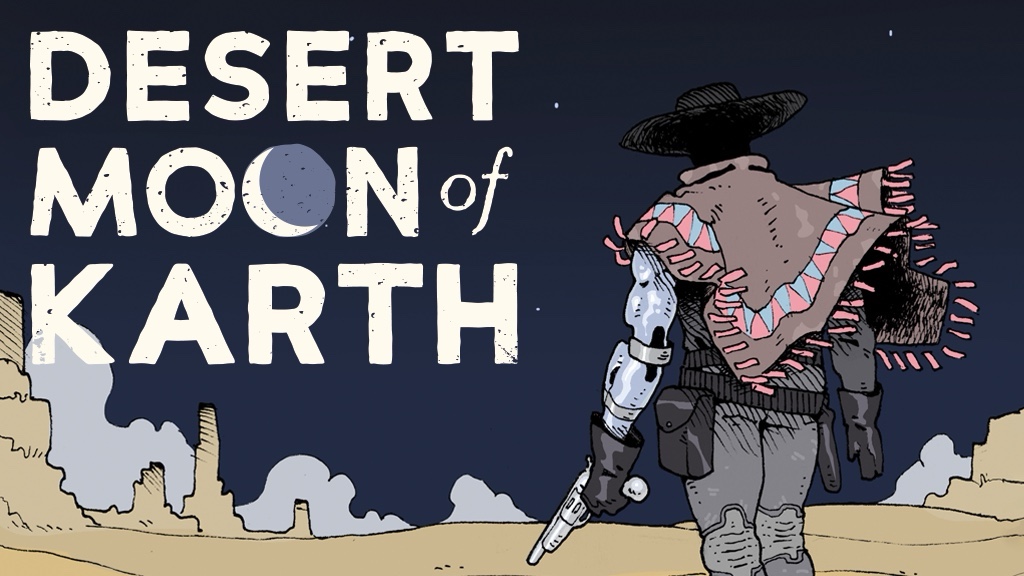
Desert Moon of Karth is a 52 page module for Mothership by Joel Hines. It’s fully illustrated by Logan Stahl, Francesco Zanieri, Glynn Seal, and Ben Smith. It’s a mini-setting in an unusual vein for Mothership, more inspired by Cowboy Bebop and Dune than by the working class horror in most other modules for the system.
The layout and art direction is beautiful in monochrome and clear to read as a cover to cover, with art reminiscent of Moebius that is gorgeous, sparse and characterful. I say clear cover to cover, as the inconsistent approaches to layout throughout the module, while striking, make it a little more challenging to find things when flicking through the book, although the vertical titling that always lies on the far left margin helps to locate sections well enough. It’s dense, interconnected and dense enough I think it’d benefit from an index or cross-referencing (like in Reach of the Roach God) to be easier to run, especially as you hear a lot about certain factions and characters well before they’re described.
Joel’s writing isn’t beautiful, but it’s serviceable in a way that feels workmanlike and elegant in a way that suits the setting. Regardless of whether or not it’s intentional, it works well: “bronze statue of a mutton chopped man with a cane and a beatific expression, left boot tip rubbed to a shine by hands seeking good luck.” In places, it’s too long winded for my tastes, but this largely occurs in places where the mechanics and traditions of the world are being described, where it’s a little more forgivable, rather than in location or character descriptions. Not precisely what I want, but perfectly usable.
There’s a lot of small locations in Desert Moon of Karth, rather than a few large ones, and breaking them down individually will be tedious to read, I think. My favourites on vibes: A dungeon inside a fallen statue and one inside a living sandsquid, this settings’ take on the sandworms of dune. The best though are probably the traditional dungeon that is Seahorse Mine or the social challenge that is the Dawnseeker’s Spire.
The real question is, should I play this? And it’s an interesting question to me, because is Desert Moon of Karth good? Definitely. Does it have traditional Mothership aesthetics or vibes? No, not at all. Would I recommend it anyway? Definitely. Mothership is a very flexible system, it works well enough. You could run an entire campaign based on Desert Moon of Karth, and if space cowboy is your vibe, this is the best package for you, I think — better than, for example, Orbital Blues (or it’s module Trouble on the Rock of Tariq). I’d wouldn’t recommend Desert Moon, though, as a starter module for Mothership, because the vibes aren’t Mothership enough. Perhaps I’ll second guess though, because the first time I ran Mothership — Dead Planet is what I ran — and half the group asked we never play again. Maybe a sandbox with a dash of horror is a better introduction than an entire zine of horrors? Depends on your group.
While Desert Moon of Karth needs a contents page, or an index, writing could be terser and prettier, the information design requires rereading and it features that most dreadful of creatures, an NPC generator, my main complaint is honestly that it isn’t big enough. I could see myself playing in this sandbox for longer than it could support it, and with little to no preparation either. Thats hardly a strong criticism, though, and if the space cowboy vibes are what you’re after, and you’re not interested in the harder horror of modules like Dead Planet, Another Bug Hunt or In Carmine, this is an excellent way to play Mothershiip.
I Read Games reviews are me reading games when I have nothing better to do, like read a module or write or play a game. I don’t seriously believe that I can judge a game without playing it, usually a lot, so I don’t take these very seriously. But I can talk about its choices and whether or not it gets me excited about bringing it to the table.
I’m sitting alone on my lunch break, so instead of socialising with the colleagues I’m reading The Adventures of Gonan: The Season 1 Adventure Game (TAG for short). TAG is a strange and remarkable beast of a game by Ricardo Peraça Cavassane: It takes the conceit of Yazeba’s B&B — you’re playing out the story of an imaginary 80’s cartoon — but applies it to a fantasy child’s series, and does it seemingly without having ever glanced at Yazeba’s at all. It’s 20 pages of two-column layout, with evocative black and white line art that knocks it out of the park by Felipe da Silva Faria. Apparently Ricardo is a prolific creator, but I’d never heard of them until now.
While tackling the same conceit, this comes at it from a completely different direction: A slim booklet, it’s relying heavily on the collaboration of the three players, who all share different aspects of the referee role, as well as one of the main characters. It’s clearly designed for 3 players, although theoretically adaptable up to 4, and more easily adaptable to 2 I think. The referee roles are Fan, Casual and Newbie, each responsible for the integrity of a different aspect: Continuity, Character and Logic. There are 3 stats with a mixed success model. Episodes have 3 acts, and the bulk of the game is a bunch of episode synopses that set you up for 14 sessions of play.
And I love these synopses. There’s a summary of the plot, a unique initiative order, a side character and a screenshot to give you one banger moment to build to. They’re brief, but with the weight of previous story and 3 players collaborating on the story, it’s so much to work with and potentially a lot of momentum. My main worry is that we don’t have that momentum for the pilot: I wish we got a little more scaffolding for episode 1, because we don’t know anyone yet, and we don’t have that weight of previous story to help us improvise the gaps. But, I suspect it’s presumed that when you get stuck, you’ll come back to the random tables at the end of the book, of which there are 2 pages, and which covers unique twists for each act, scene features, encounters and dangers. This is definitely enough to get me through a momentary lull, but maybe not enough for episode 1 I suspect.
Nitpicking: For me, while there are a lot of characters here, they’re defined mainly through their powers rather than anything else. For a kids show I don’t mind this: Often their power reflects their personalities, but I’m not seeing that here. I’d be happy with caricature, but even a one word personality trait or a guiding principle for each character would bring playing them (either collaborative or your personal main character) a whole lot of weight that they don’t have here.
There’s only 20 pages, so there’s not a whole lot else to talk about here, except: I love this, love this, love this. The Adventures of Gonan: The Season 1 Adventure Game is not a perfect game, but this structure is *chef’s kiss* and I want to see a proliferation of TAG clones that iterate and leverage this remarkable tech to more powerful and interesting ends. I haven’t been this excited for a basic game structure before, since No Dice No Masters, and it combines it with the best elements of the OSR in a way I adore. It’s PWYW with a recommended price of $3. At that price it’s a no brainer, and this is something you can play with adults or kids, and is fruitful space for design if that’s your angle. And if this does nothing but put Ricardo Peraça Cavassane on your radar, it’s worth it.
Bathtub Reviews are an excuse for me to read modules a little more closely. I’m doing them to critique a wide range of modules from the perspective of my own table and to learn for my own module design. They’re stream of consciousness and unedited critiques. I’m writing them on my phone in the bath.
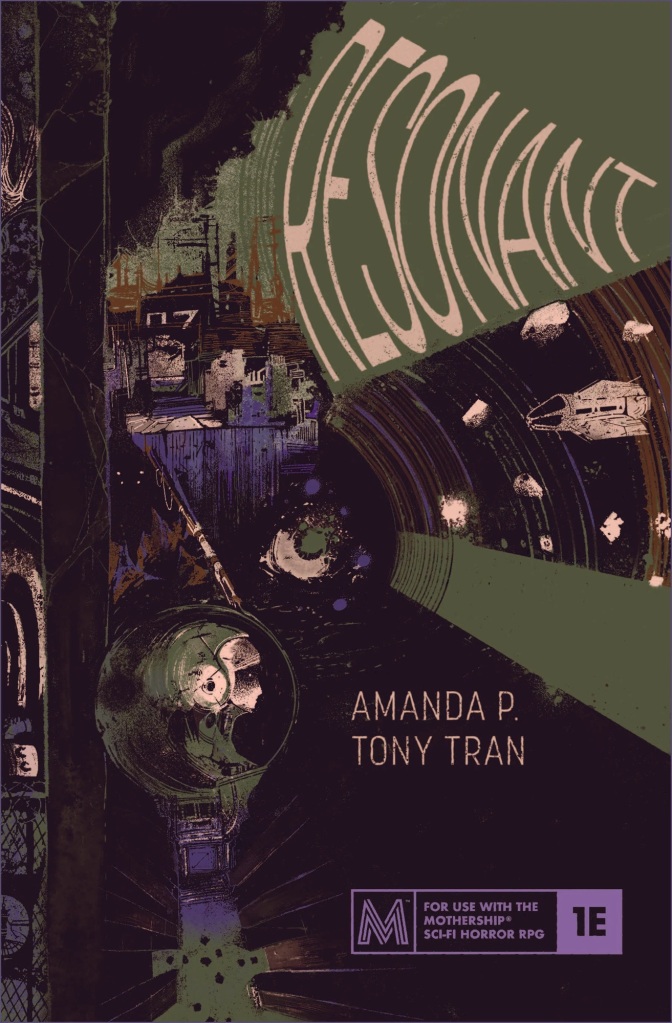
Resonant is a 46 page module for Mothership from Amanda P of Tannic fame with art by Tony Tran. I’m going to add a credit there for Dai Shugars, because the layout on this is absolute fire, and while I’m not always on board with Dai’s choices, here they’re at the absolute top of their game and they contribute a LOT. In it, the party are hired to assist with dam repairs and investigate the dam’s collapse on a far-off planet, and face an alien presence and the poorly advised science of a private military force. This is an unabashed horror scenario, but if you’re looking at Mothership modules, I reckon you’re anticipating that. Cards on the table, Amanda P’s a friend of mine, and we share some preferences, so I went into this anticipating Resonant would be good.
I’m going to start with layout and art else I’ll keep coming back to it: Shugar’s layout and Tran’s art perfectly complement each other and the writing. They’re grimy, messy without being illegible or unintelligible, portray the disguised corporate horrors with a cheerful guise and perfectly embody the working class science fiction horror typical of Mothership. I say without being illegible — the texture on the pages occasionally obscures text, but not often; it could’ve used a closer eye for this. Shugar’s maps are clear and iconic, and work really well for Mothership-style crawling, and are each rendered uniquely which helps with navigation. I’d like to call out the very cool in-world advertisements as something that could’ve come across as weak, but instead the writing and layout rendered them excellent. Headings are clear and feel bold and thematically sci-fi corporate, and (hyperlinked in digital!) page references help with movement around the document. This is an easy to read module, and easy to navigate. This is close to the best work on art, layout and information design I’ve seen in a mid-size module, and while its cohesive with the wider Mothership line, it adopts many of the strengths of that approach and few of the weaknesses.
It opens with a very brief timeline of recent events, which I appreciate a lot, having both written and read a lot of very comprehensive complex timelines that are sometimes challenging to internalise, and then a the mission description with the very elegant twist of having 5 secret side-missions you’re concealing from your bosses. Some of these secret objectives are spicier than others, and I’d choose one according to the preferences of my table instead of randomly choosing them as suggested. There are three factions detailed, and again there’s an elegant twist to their descriptions, in addition to the kind of thing you’d usually see in a faction description: A “how the PCs can get involved with them” section. I’m going to add this section to every faction going forward, and y’all should too, even if it’s pencilled into the margins.
Amanda P’s writing here is a little jarring, because they alternate between poetic and terse (“A home for some, a goldmine for others. A waking dread.” is so far up my alley as a description that you couldn’t have written it better if you had me in mind) and more traditional expositional prose (the description of how the Resonance works, which is on the same page as the previous quote). This makes for a very clear adventure at the expense of the poetry they’re capable of writing, and to some degree I think this is a sacrifice to the gods of science-fiction: Unlike in their module Tannic, this exposition feels more necessary because what’s going on in Tannic is magic. The trade off between science fiction clarity and pretty, terse, punchy writing is one where different people will land differently, but I personally don’t need the additional exposition at the expense of a briefer more beautiful word choice. That said, Mothership house style is one of wordfullness and clarity, and a high-white space terse Mothership text would be a little off-brand. For me, at least, while the clarity of the rules text makes the text more gameable, it doesn’t make it more compelling. I just…guess I don’t like rules text. That said, the encounter mechanic here is gorgeous, although I feel with a little finesse it could have been overloaded into fewer rolls. What’s nice is that in addition to the reaction roll being incorporated (not in Mothership core rules), it incorporates encounter positioning as well, which is neat tech that I’m going to have to steal.
Ok, now we’re into the location text itself, and it is glorious, and takes advantage of the brevity of Amanda P’s writing style. Individual keyed locations are a maximum of a paragraph long (in some cases broken up for clarity), and full of terse and evocative description: “Previously barred from inside, the cracked steel security bar lies in pieces. A yawning hallway extends east into the dark.” Chef’s kiss. There is more description of overarching locations — Forward Base and its Crashed Supply Shuttle are close to a page, which is too much for me to process, and would have benefited from a breakdown in my opinion — but overall this is exactly what I want the bulk of a module to look like. “Looks and smells like he’s been here for weeks.”, “She stands tall but twirls a wrench in her hands nervously. Drive: To live a quiet life, leaving her past behind.” I could just keep listing descriptions I adore in this.
The humans in Resonant feel real, which is something I crave in modules and rarely get. I wrote Hiss basically as an extreme example of dense, real-feeling relational connection because I value that in modules. The interconnection here is more subtle, but it’s plainly there, and easy to understand, and compelling in a way that I often term petty, but by petty I meanmundane and relatable. It’s something that really makes the module stand out, because you’re likely to immediately develop care for Gaspar and Lucy, or the aforementioned dam mechanic, or heroic android Ziggy. And this makes the horror ring far truer. My main complaint, to be entirely honest, is that the investigation ends up being quite straightforward, and the villain straightforwardly evil — the only stereotype in the story, in what will most likely be the final scene in the module, leaves me feeling a little hollow.
When Resonant’s writing is at its best — and that’s more often than most books — it’s succinct, concept-dense, and highly evocative. In rare character, it’s not dense in a high concept, gonzo way, but in a way that conjures character and relationships: The woman I quoted above, for example, in just two sentences, I can picture her and all of her behaviours from that brief glimpse. There are many things that make a good module, many of them purely technical in nature. But truthfully, the particular quality of the writing in Resonant is a perfect example one of the things that I treasure the most in a good module.
Combine that particular element of writing with the excellently coordinated layout and art, and thoughtful construction and informational design, and Resonant more than overcomes its few flaws. If you’re looking for a great Mothership module, with a straightforward investigatory crawl structure, that’s easy to run, and feels populated with real people, than to be honest this is the only thing out there, so we’re lucky it’s good. It immediately slots up there as one of the best Mothership modules I’ve read, but it does appeal to my specific predilections in a way most do not. It certainly doesn’t replace Gradient Descent or a Pound of Flesh for what they specifically try to be — it’s not a megadungeon or a city module. But of all those more typical, “crew venturing into horrors unknown” stories that typify the Mothership module, I was right to anticipate this release: If I had to choose one dungeon crawl to run for a new Mothership group from hereon in, I’d choose Resonant, not Dead Planet or Another Bug Hunt.
Bathtub Reviews are an excuse for me to read modules a little more closely. I’m doing them to critique well-regarded modules from the perspective of my own table and to learn for my own module design. They’re stream of consciousness and unedited harsh critiques. I’m writing them on my phone in the bath.
Chariot of the Gods is a 52 page module for Alien RPG by Andrew E.C. Gaska. It was recommended to me after my disappointed read through of Alien RPG a while back, as a fun player versus player module that benefited from the quirks of the system. Ever bound by the conflict-averse desire to be even-handed, I added it to my review queue. It’s sold as a pretty typical “there’s a distress call and there are horrifying monsters there” module (I don’t hate it, excellent trope), as an introductory module, and as something playable in one session despite the page count.
Let’s start with the obvious: The graphic design is the same illegible, sparse Prometheus-lite of the core book. I really don’t like it, and it tires my eyes both digitally (as I’m reading this) or in print format (how I read the core book). It also explains the page count; a Mothership module could have fit this into a zine half the size, I suspect. I won’t go into detail here, as I already did that for the core book and you can refer to that for my concerns.
The module has pregenerated characters with secret agendas that change for each “act”. I quite like pregenerated characters, particularly when they create interpersonal conflict if the players are keen for that (I’ve written about this before). My initial response to changing with the “act” of the module you’re in was hackles up, but it is actually analogous to an event table: When certain events occur, a bunch of possible new events open up, and new agendas relate to these events. As with everything in this module, this is presented in the most clumsy way possible, but you could present it as a neat three-part table and it would be right at home in a Mothership module. Structurally it’s a bit weird, because those agendas and the acts are described at the end of the module, which feels contrary to how central they are to the changing character dynamics which are pretty neat and honestly the selling point of the module.
The keying of the ship itself are exactly what I expected: Overly wordy, difficult to navigate, inconsistently laid out. There are only 28 rooms in this dungeon, but they would get a lot of use over the three developing acts, and I expect the plan is for the players to gain familiarity with the space in act 1, and then use it against each other and their enemies on act 2 and 3. Clever, then, to keep it relatively compact. Its undermined, somewhat, by spreading the maps over 4 pages and not signally clearly different rooms (some are boxed separately, some aren’t? not sure why?). The descriptions are functional and uninteresting, and given how cliched the location is (not a bad thing for an introductory module), largely redundant. It’s not a dungeon to crawl through, though, it’s an arena to fight in. It is an interesting, manipulatable environment to that end.
To some degree, colour me impressed. This is a fun, surprisingly complex and compelling module. I’d definitely run this, if it was vaguely legible. I literally couldn’t wayfind in this module without a huge amount of work. It would be the same amount of work if I were just to adapt the whole thing for Mothership, a system I prefer, with a cohesive and legible graphic design direction that I don’t have trouble reading, and I could easily do it in a third of the space. But, it’s a compelling enough module that I’m tempted to do that (if nobody already has). If you actually do run Alien RPG (if so, sorry about how much I dislike it), this is a hell of a fun thing to run for it, excellent first movie vibes, with a lot of backstabbing and body horror.
I Read Games reviews are me reading games when I have nothing better to do, like read a module or write or play a game. I don’t seriously believe that I can judge a game without playing it, usually a lot, so I don’t take these very seriously. But I can talk about its choices and whether or not it gets me excited about bringing it to the table.
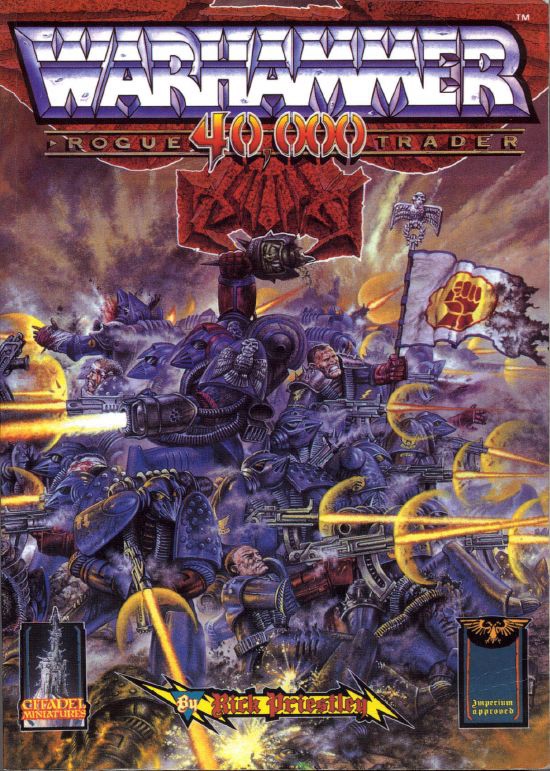
Elephant in the room: Rogue Trader isn’t a roleplaying game. Kind of. At least, the future versions of the game definitely aren’t a roleplaying game: The 2nd edition was called Warhammer 40, 000, and the 10th edition is the most popular war game in the world. Published in 1987, written by Rick Priestly, the almost 300 page Rogue Trader, though, is a bizarre beast, focused not on army lists, but on individual “personalities” and their accompanying units, and has equipment lists, and revolves around the players being Rogue Traders, basically state sponsored privateers from the Ages of Sail. Roleplaying games as we know it emerged from war gaming, and in Rogue Trader, you can kind of see the roleplaying game devolving back into a war game. But it represents an interesting direction that roleplaying games could’ve taken, that I’m kind of taken by.
The book is clearly aimed at combat, but it’s also intentionally vague on the matter: When I got to the last section in combat, I was thoroughly convinced this was a skirmish-sized combat game, that used a referee. Not until the section on player characters, “idealistic, young, inexperienced adventurers” in “adventures in which all of the players are on the same side – fighting opponents controlled by the GM.”, did I see the only mention of the “mass combat, battle and large scale carnage” that is now characteristic of the game; in fact later in the equipment section, it explicitly describes itself as a skirmish game about “clashes of small bodies of troops”. A solid quarter of these rules are dedicated to player characters in this solo hero style of play. And finally, the third of the book that is purely lore feels scarcely engaged with the idea of war at all, and is mainly setting up an arena for faction play, in a very interesting fiction-forward way.
In that spirit I’ll be reading the game with that roleplaying adventure game in mind, rather than what eventuated, a bourgeois mass combat war game with a focus on scale and absurdly expensive miniatures. And I’m doing it with little to no knowledge of the Warhammer 40, 000 universe, aside from what I remember from playing Space Crusade and the Amiga Space Hulk videogame as a kid. I know there are six-armed aliens and paladins in mechanical armour, and very little else.
Basically sci-fi Heroquest, and the extent of my experience with Warhammer 40k.
I’ll start with the section on playing heroes, which isn’t at the start. It’s explicitly intended to be simpler than Warhammer Fantasy Roleplay, the first edition of which was released the year before, but the reference to this is meant to imply that this mode of play is similar to that game, i.e. roleplay. Hero characters can be in charge of a unit, but it isn’t considered important in the game, i.e. they have what is known in the AD&D of the time as henchmen. Hero characters are mostly stronger than base units, level up, and are more likely to have mutations and psionics powers (which we’ll learn later, means likely to encounter relevance of the God-emperor). In this mode of play, those twists are random and reserved for heroes and enemy personalities. This gives a picture of a role playing game that features skirmish scale combat — 2 players, their hero and their hero’s unit, against the referee, participating in some kind of narrative arc. The narrative style described is mission-based, and includes a plot generator — it’s more flexible than the style we saw in 4th edition D&D and in Lancer, but it’s similar, with the players springboarding off a brief given by the referee, and then the referee responding to the action in that session in preparing the next brief. Pretty cool, very 80’s. I’ll be reading the combat rules with all this in mind.
The organisation of the book puts primacy on terrain, then on the individual units. Combat is obviously supposed to be primarily revolving around range combat and cover, with base size (this is meant to sell Citadel miniatures after all) not being a major consideration. Order is complex and rigid: Move – Shoot – Punch — Psyk, plus two extra turns that feel more targeted at the potential larger battle game that plays a part of it — reserves where you get new troops and rally where you bring routed troops back to the field. These are explicitly optional, though. Order of action is different in each phase — Move and shoot are alternating sides, but close quarters and aerial combat use the initiative score of individuals. My gut feeling is that these contradictions are mistakes, actually, and the intent was either one or the other, because the split doesn’t make sense in terms of turn order.
The actual combat roll is a little complex, I think. Calculate your range. If it’s half the max range of your weapon or less, get a bonus (depends on the weapon) or if over half, a penalty (depending, again). Roll 1d6, and consult a table, which gives you a value to roll over based on your ballistic skill (but that isn’t your actual ballistic skill). If you roll a 6, it explodes, to allow difficult hits. If you hit, cross reference your weapons strength with your targets toughness, to see if it does any damage, and if it does you do a minimum of 1 wound, or maybe roll a die for damage for more powerful weapons. Then, the target can make a saving throw based on their armour, to ignore the damage. There are various other rules leveraging these rules, but it’s clumsy as, even if it’s a little charming. I’m a little curious as to whether all this has been streamlined in the 40 years since, but not enough to look it up. All the small rules leveraging this and edge cases like grenades, close-quarters, aerial combat honestly make for a pretty interesting combat system — I love the charging rules, flyby attacks, grenade rules — I just feel like it’d benefit from a little more parallelism than it has. A lot of this complexity could be shaved away without much loss of salience.
There’s some strange and very cool worldbuilding here, regarding armour, and especially regarding dreadnought armour (apparently space marines are curled up in the foetal position inside those suits of armour, and can’t leave it without injury, and are incredibly weak in these full body prostheses), and robots (which are apparently substitute slave labour everywhere) are incredibly powerful but you have to give them orders a turn or two in advance like in Robo Rally.
Clearly an inspiration for Warhammer 40k
Other cool, weird things in this chapter I’d love to see more embraced by this weird little game: It recommends dice cups at the beginning; I got excited we were going to get a Perudo-based combat system. There’s a big section on psionics and on mutations, that wouldn’t feel out of place in Gamma World or 2nd Edition AD&D. It’s honestly a little shocking to me how much this game tries to walk the line between roleplaying game and wargame.
The equipment section opens with some solid Gamma World rules: Tech levels and learning to use unfamiliar equipment rules. It details planet-destroying equipment well beyond the scale of the game. The weapons range from bows to gravity guns to swords to conversion beams. It’s honestly a little goofy pitting all these against each other on a battlefield and I dig it. Vehicles and robots are here, and bionics, as well as a bunch of non-combat devices like snorkels and sunglasses. The latter equipment is surprisingly as fleshed out as the weaponry and armour, and really points towards a role playing game or at least to a much broader mission remit than before. Like most equipment lists, they’re pretty dry, but they support a broad spectrum of play styles.
We come to lore. I’m excited to see this unfinished version of the 40k universe, just based on what I’ve already read in this book. The galaxy is largely unexplored. Warp space is the source of psychic powers. You can’t jump into solar systems. Warp gates are slow permanent tunnels. You can enter warp space and there are creatures, like Enslavers, that live there and feed on psychic energy. Navigators are mutated humans that steer through jumps. Humans are superstitious, and confuse religion and technology. “This is not a rational age” The God-emperor is real and actually rules, but even in this form murders innocents to allow humans to travel throughout the galaxy by creating a galactic beacon network to guide navigators. There’s a priesthood and inquisition. Mutants, psykers and aliens are considered existential threats. It’s a feudal system. Space Marines are basically unchanged, which is interesting. They live in castles. But there are other, less special Space Warriors which have absolutely been eliminated in times since.
The titular rogue traders are “free- lance explorers, conquistadors and merchants, given a ship, a crew, a contingent of marines and carte blanche to roam the worlds beyond the Imperium” — they’re space privateers, seemingly based on the age of sail. This is much cooler and nastier than the name actually suggests.
So much detail given on the imperium is again weirdly suggestive of roleplay. Tech-priests, astropaths that are responsible for communication, the judges (of course also jury and executioners). Witch-hunters seek out psychic or mutant cults, terrorists or individuals. Psychics and mutants represent the two ends of the emperors’ grand spectrum: The future of humankind and its corruption. Psykers therefore must be part of the fold or killed; mutations eliminated or risk the destruction of humanity. It’s all just so compellingly fascist; it also seems to assume we’re playing these fascists without much insight or commentary, but it is Britain in the 80s, so I doubt it was actually as uncritical as it seems. It definitely falls prey to focusing on the powerful and not the masses. This might be a misreading by me, though, again, because I’m not British. Maybe what I’m seeing here is actually an assumption that you’ll play the fascist colonialist empire, and you’ll be interacting mainly with the uncivilised savages of the galaxy. Marne this is just another colonialist fantasy, just a grittier one? It is interesting how much all of these factions have potential for faction play; they just would be better I think were they more ground level.
There are hobbits, dwarfs and ogres here, basically underdeveloped mutant races, with no interest at all. Psychic space-elves get more attention, travelling the galaxy on mechanical planets. Orks are here, as boring and racist as they seem in the context of the supremacist-fascist humanity, and their gretchen slaves starting to remember what they’d become. There are savage frog-people the Slaadn. Cultureless orangutan-people (yikes). The tyranids are here and their organic spacecraft. There are random encounters here, that decidedly have no place as an army, like warp-spectres. ghosts and vampires and dinosaurs, and void-dwellers that are explicitly not able to participate in battle because they defy physics. Oh, gene stealers are here — they’re different from tyranids! I didn’t realise! At this point it devolves solely into a roleplaying game bestiary. I don’t hate that at all though. It’s just interesting to me.
Not Tyranids!
I’ve left a few things out: A cursory scenario, a bunch of painting advice (basically a full on guide!), and song optional rules. But that’s more or less it for Rogue Trader, and honestly I’m impressed and I love it. I love the parts that feel like progenitors to the modern, grimdark 40k, but even more I love how much sillier it is. The presence of halflings and dinosaurs and vampires in this galaxy, and the positioning of the players as galactic, state-sponsored pirates invading and taking advantage of indigenous populations, are strokes of weird and bizarre genius to me. But there are all the missteps of late 80’s design here too: The factions aren’t especially game-able, and it’s incredibly tone-deaf in its approaches to both its core fascist-supremacist-colonialist conceit and things like the orks and eldar. Most of the satire is in the art, which is clearly 2000AD inspired but, ah, less inspired. Basically you could characterise this as “what if D&D but you get to play Judge Dredd and you’d read a lot of Heinlein and also in SPACE” and I mean that as a compliment.
Like, I’m never going to play Rogue Trader. This book is terrible, and future editions developed in a direction that I have little to no interest in — the 10th edition is further away from what’s cool about the concept than this is. But it’s kind of an OSR system by accident, with so much in common with OD&D. But gosh, a micro-tactical version of this, with a stronger referee-based role-playing chassis, and more bickering and petty takes on these weird factions, would be so cool. And the very idea that the galaxy is so big and that communication and travel is deeply flawed could be leant into. This would result in the explicitly feudal medieval church vibe of the imperium becoming a network of petty and corrupt individuals pursuing their own goals and ignoring the desires of the God-emperor altogether because of how slow communication and travel is. That’s the implicit set up here. The space marines in this rather obvious reading are suckers believing in a dead radio god, pleasureless and trapped in a tin can, not heroes. This feudal piracy concept is such a cool set-up. And it’s an interesting, compelling one. But where they took this world — at least how I perceive they took it — is not for me.
But, like, Fantasy Name of the Rose in space with pirates? Hell yes.
P.S. 40k fans, please know that I don’t care to read up on the modern game or the decades of novels, and that I’m aware that there was a Rogue Trader CRPG like last year, and hold yourself back from commenting inanely about these. If you have interesting things to say about this version of the game or about its relationships with its contemporaries, I really want to hear it, though.
PPS. It’s tradition that I say why I had the time to read and write this: I got a tattoo and then had insomnia after my daughter wine at midnight screaming about ghosts.
Bathtub Reviews are an excuse for me to read modules a little more closely. I’m doing them to critique a wide range of modules from the perspective of my own table and to learn for my own module design. They’re stream of consciousness and unedited critiques. I’m writing them on my phone in the bath.
The Tragic Curse of Grimhill Fort is an 8 page module by written by Aleksandar Kostić, and was the runner up in the Shadowdark jam that ran mid 2023. You seek shelter from a savage storm in a ruined fort — what will you find there? In looking at it because I was told in response to my not so positive review of Shadowdark that “the theme really comes across in the adventures, not the rules”. Which, I’d believe, as the author of Shadowdark is an excellent and experienced author of adventures for 5e. I couldn’t find any of said adventures, though (just a zine, on the official website at least). Perhaps they’re kickstarter exclusives? Who knows, but I thought I’d check it out.
The Grimhill Fort map
Grimhill Fort is an interesting one: Is it well written? Well, no. And yes. The pedant in me can find no poetry here, little elegance of word choice, and many grammatical errors. But is it whimsical and evocative? Yes. Does it incorporate narrative subtly and environmentally? Yes. It’s a fiddle, rather than a violin, but what it plays is good. A lot of this is in the asides: “Chandelier is hanging from one of the beams. Pigeons have built a nest on it.”, but also in simple but effective design -— the two statues that, when reunited, banish two monsters and end the storm. The storm itself is a character, popping up in window descriptions and places the roof is collapsed. Genuinely excellent stuff, but good in a way that feels fresh and kind-eyed.
Layout is fine, marred by under-utilised block colour, and repetitive font choices that make it hard to pick sections or direction information quickly. The full colour map on the first page is striking and clever (detailing on the map how to enter), but everything afterwards is coloured anaemically by comparison. Art is colour shifted to match the colours used on the page, which seems like a good idea until you have a page of art in pale yellow. Colour is a powerful layout tool not taken advantage of here. An aside: In practice here, the Shadowdark stat blocks are pretty unobtrusive for something that is based on 5e; they work out roughly the same size as something for Cairn, which is nice.
It’s only 8 pages, so there’s only so much to say, but honestly, this is a location you need in your campaign. It’s a session or two of whimsical, lighthearted fun, that will probably stick with you.
Bathtub Reviews are an excuse for me to read modules a little more closely. I’m doing them to critique a wide range of modules from the perspective of my own table and to learn for my own module design. They’re stream of consciousness and unedited critiques. I’m writing them on my phone in the bath.
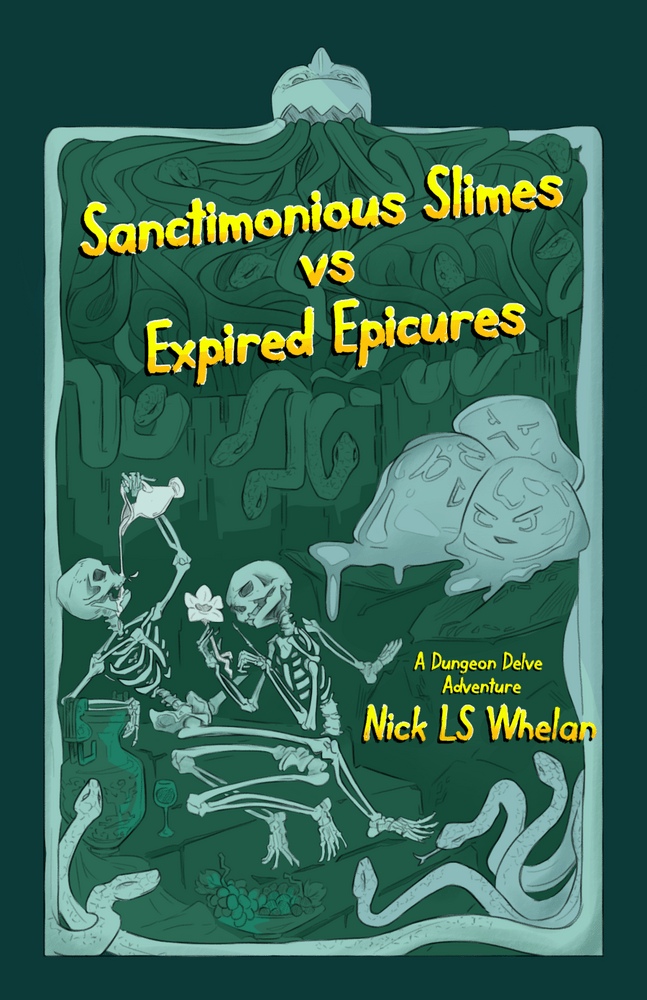
Sanctimonious Slimes vs Expired Epicures is a 25 page module for Errant by Nick LS Whelan. It’s fully illustrated by Morriebird, Samantha Miller and the author. It’s almost exclusively dungeon crawl with a strong focus on faction relationships. It consists a history, a faction summary, the 30 room dungeon, a 1-page bestiary, a few pages of random tables, and two testaments, which are religions for Errant’s version of clerics.
The focus and restraint this module shows is remarkable, almost entirely on the dungeon, with outside concerns only mentioned insofar as they feature the dungeon. The dungeon itself is concisely keyed with a subtle humour that fits well with the existing Errant product line. It uses a key system akin to Miranda Elkins’ Nightwick Abbey and the one I am using in Curse of Mizzling Grove, which is one I’m a big fan of as one of the stronger systems for communicating information clearly. And when I say concise, I mean it: It’s single column, minimal margin layout, with spot sketches only, with 4 to 6 rooms to a page, making it one of the denser keys I’ve read lately.
The fear with so dense keys is a loss of evocative writing, but while the style is very brief, it succeeds in remaining evocative in the few sentences provided. I must pause here to mention that Nick edited my own upcoming Bridewell, which also leans into dense evocative prose, and in my opinion SsvEE is a triumph here. Nick once said he didn’t have a way with words, and I disagree. There is something lost in the absence of more flowing, effusive writing like that of Gus L or Ben Laurence, but plenty gained in usability in my opinion. This is a very usable book in terms of the key.
Sadly, a little of that usability is lost in encounter placement and the pages of tables in the back. Suddenly, I’m flicking to and fro to find the random encounter table or the unique hazard roll (both roughly 2/3rds of the way through the book), or for the list of dungeon conflicts. These conflicts — which are really just 12 additional random encounters — are all more interesting than the core encounters, in that they display the factions interacting. They don’t come straight after the random encounter tables, but 4 pages later, bookended by other random tables that detail the effects of the seeds you may find, help you roleplay religious snakes, and things that taken on the surface. As they aren’t clearly signalled in the hazard or encounter rolls, I suspect I’d forget to use them. A cue would be nice. Moving these to the inside covers of the book — where the overworld map and testaments are currently — or the centre spread at least for the print edition— would make the module easier to run without having to xerox odd pages for reference.
The little consideration the module gives to the surrounding world renders the above-ground factions a little odd and out of place. It definitely feels assumed you’ll drop the villagers, snake cultists and the Church into whatever village is in your own campaign to plant the dungeon there, but their presence in the dungeon itself is negligible, as is the space spent developing them. It might have been better to spend space on providing hooks to encourage exploring the dungeon, or perhaps a brief village key a la A Wizard. It’s a little too much personality for an existing village, and not enough crunch to create its own. Even two or three villagers would do, I think, to make it runnable — and these exist, in the table in the back, just not quite accessible enough. The book opens with a map of the overworld, which is all the more jarring given the people in it only appear in a random table. In trying to walk the tightrope between efficient and elegant world-building and over-reaching and micromanaging design, I fear for me this fails to make the landing.
The factions in the dungeon, however are unique and vibrant, with skeletal hedonists, intelligent evangelist snakes and (different, opposing) religious oozes all fighting for space in a too-small territory. I wouldn’t have come up with this set up in a lifetime, and that’s exactly what I’m buying modules for, and these strong faction themes make the random encounters and conflicts fairly iconic off the bat. This would be a memorable dungeon to run.
Overall there’s a focus on simplicity here, that is both a strength and a weakness. The simple encounter tables, the concentration on the dungeon, and the simplified keys, all serve a singularly focused module, which really sings and is where the writing is as it’s best. The auxiliary content to that is where the module feels it needs to spend either more time, or less, but it doesn’t detract from the core of the module, which is an excellently written, faction-focused dungeon crawl in concise words with a particular set up that I’d never come up with myself.
The core module, in my opinion, is absolutely well worth bringing to the table, if your table likes the kind of weird juxtapositions present in the core factions. If they’re likely to think they’re absurd rather than fun — well firstly you’re playing a game about elves, why take yourself so seriously — but it’s probably not going to be to their liking. But we have a very well put together, simple and enjoyable module here, well worth dropping into your campaign, if it’s compatible with Sanctimonious Slimes and Expired Epicures, at least. Well worth the offensively low price of $8, in my opinion.
Bathtub Reviews are an excuse for me to read modules a little more closely. I’m doing them to critique a wide range of modules from the perspective of my own table and to learn for my own module design. They’re stream of consciousness and unedited critiques. I’m writing them on my phone in the bath.
Tomb of the Twins is a 30 page system-agnostic dungeon crawl, with attached stats for B/X, Mork Borg and Cairn, by Luke Simmons. It’s laid out in A5 with monochrome watercolour art and maps by Molomoot. Going into this, I’m a little concerned: I can see that it’s a twelve room dungeon, so it having such a high word count makes me concerned about it being over-written.
Certainly, the introductory text is clear, to the point and practical about how the module is to be run. It opens with three parallel histories with varying levels of discoverability (landmark, hidden, secret!), and a bunch of characters with terse descriptions and clear goals and methods. Factions are less clear, but intended more as supportive information for their representatives than to play a major part in faction play.
The tomb, being the tomb of a necromancer, traps ghosts in it, including the ghosts of the PCs if they die. This is a lovely touch, and the d6 table of NPCs is cute, although I’d prefer them to be a little more specific about what their names are, what they know, and how to role play them. It wouldn’t have taken much more space to full them out as full NPCs in a similar way to the three questgivers; if I played through this I’d want them to be the stars of the show.
But why? Because there’s only one faction inside this dungeon (it’s only twelve rooms, after all), and aside from their leaders and a nameless trapped Swampkin, they’re not given much personality. The twin necromancers have a fair bit of personality, and as an encounter is likely to swing from danger to comedy quickly — something most people enjoy. I think this dungeon would benefit from more internal swampkin politics, though.
The rooms themselves are competently written, in a classic style of description, seemingly modelled after the OSE house style. However because of the lack of NPC interaction and random encounters (aside from the aforementioned ghosts), it’s a pretty static affair of going from room to room.
The map quality here is a major failing, in my opinion, as the keying is tiny and difficult to parse, and while it’s thoughtfully included as a minimap in some pages, here it’s even smaller. I appreciate the graphic inclusion of the puzzle symbols though. I appreciate the unique art style here, and how the maps match the art, but overall it’s not a successful alternative approach. The layout however, is a resounding success. Clear, attractive, simple. A little font overuse — we don’t need to use bold, underline and italics in every entry — which makes it less readable on some pages but with a little more restraint it would have been stellar. This is where modules like Tomb Robbers of the Crystal Frontier and Aberrant Reflections use colour to a layout advantage, and where monochrome aesthetics lose out on utility.
Overall, this is a neat dungeon to keep you occupied for a session or two, but it lacks the strong faction and relationship play that would make it stand out from the crowd. This is all the more disappointing, because the questgiver descriptions strongly suggest that the author is capable of bringing characters to bear. Hopefully we’ll see a fleshed-out second release in the future.
Bathtub Reviews are an excuse for me to read modules a little more closely. I’m doing them to critique a wide range of modules from the perspective of my own table and to learn for my own module design. They’re stream of consciousness and unedited critiques. I’m writing them on my phone in the bath.
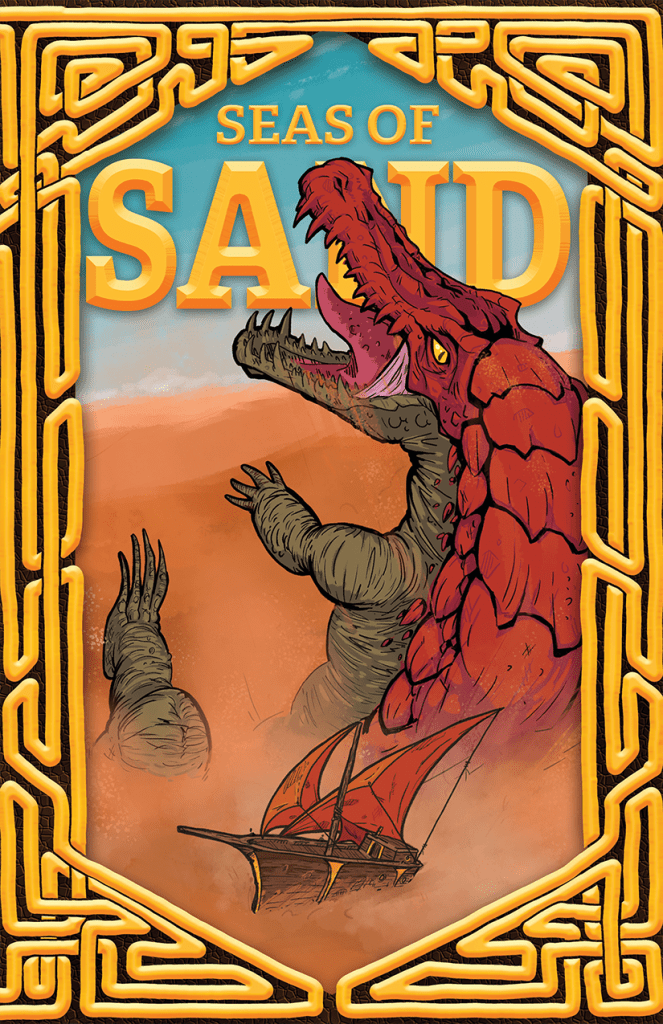
Seas of Sand is a 264 page setting toolbox written, illustrated and laid out by Sam Sorensen. It’s a fantasy inspired by Dune (as displayed by the magnificent worm on the cover), but that minimises the science fiction elements of its inspirations, and replaces them with a well-curated pulp fantasy focused on merchant caravan style play, the most prominent example of which is Ultraviolet Grasslands. It’s “system agnostic”, which in this case means started for B/X, but with conversion notes for a boatload of other systems. For disclosure, I was comped a copy of this for review but you’ve seen by now that doesn’t affect my opinions.
At the beginning: The opening summary page is stellar. Evocative as all get out, and an excellent sales pitch. If you’re the type to be attracted to striking, evocative, world building, you’ll probably be sold on this after the first page. There is a bunch of interesting, promising concepts alluded to here: A monotheistic god, the changing sands, a world that rewards knowledge of its environment, and an elegance and economy of design. What I’ll get to a little later, is that the pitch is betrayed by the greater sum of the works, in my opinion. If this affects your opinion of the book negatively or positively as a whole probably is a reflection of what you’re looking for in a setting toolbox, rather than a comment on the toolbox itself.
The big point of comparison here is Ultraviolet Grasslands, and I feel because of that I should start with layout and art to get it out of the way: While the scale and unique world-building is reminiscent of Ultraviolet Grasslands, this is a far more text-forward piece of work. Sam’s illustrations are simple and elegant and generously distributed, but there’s nothing in the scale of the full colour illustrations of Luka Rejec. What you have here instead is a more traditional, clearly articulated, striking layout. It feels written into layout with usability in mind, as most topics are limited to a strictly hierarchied, high contrast single or double page spread. The appendices (and maybe once in the main text) are an exception, where this visual consistency is compromised with a few absurdly long random tables. I’m not especially a fan of the boldness here, with heavy type being overused, but there are some elegant flourishes too, like subtle interruptions in borders indicating hierarchies and inverted colours signalling optional sidebars. It’s a layout that would probably be better in colour, but it’s a supremely usable layout, better in my opinion than UVG’s for practicality and reminiscent of Hot Spring Island in its functionality and aesthetic.
The first 35 or so pages are devoted to mapping out your Seas of Sand. I’m not usually a fan of these kinds of procedures — I think an imagination like Sam’s could give me a more interesting setting in the space taken by these generators, and I’d rather that than generate it myself. But there are one or two interesting aspects to the map generation in Seas of Sand that are worth noting. Firstly, there is worldbuilding built into the map making: “The direction of the flow” indicates “The path the worm travelled in ancient days”. This is a really neat approach, and a there’s a decent amount of world building built into this map-building chapter. Secondly, we’re generating a space thousands of nautical miles in scale. There’s a decent chance if you were to simply give me the map and a gazetteer, I’d have trouble remembering it. Making me make my own is a canny solution to this problem of internalising the map. On the other hand: By the end of this you’re given a complete map, more or less. It wouldn’t take too much to turn it into your own Seas of Sand. Would that be better, or worse? I’m not sure. In an ideal world, and this isn’t a short book, I’d get both, so I can bring my Seas of Sand to the table as quickly as possible. The port generation procedure is flavourful and bizarre in the most positive way, although as usual, I think that I’d prefer 15 pages of bespoke ports than this generator. The three example ports are all sparkling, terse, fantastic examples of what these generators can evoke, and we’d have fit an additional 40 or so if the whole port generation space had been dedicated to examples: More than enough.
Initially the choice to have 7 types of sands didn’t make sense to me. Reading through the next section, which covers sand and travel, made me realise that in this world without terrain, these seven types of sand replace it, making travel less monotonous. We have fantastic terrains, for the most part, but interesting terrains most of all. They can explode, or are tainted by the dead, are suck you beneath the sands, and these can be be manipulated by the people of the world using heat. You can learn about them, and the heat-sensitivity of the sand makes the variable weather more meaningful, with high and more temperatures having palpable impacts on the danger of the sands. Clever, clever stuff, and in retrospect I’m surprised more examples of these extreme weird terrains aren’t more wide-spread, as I imagine you could make for a lot more weird and interesting effects if you weren’t limiting yourself to things that you can do with sand. This is space ripe for innovation and future settings should learn from it.
Most notably, the travel isn’t hex-based, unlike so much in the space. You travel in miles, across a thousand miles map. Wherever you will. It calls out that this eliminates a core part of travel procedure, associated with moving through predetermined blocks of space and terrain, that is, hexes. It portrays travel as a ritual, which is, to me, a calming and interesting perspective on what is usually framed as procedure. “Eventually, return to the daily ritual montage of travel across the endless dunes.”, it says, in me of the most compelling sidebars in the book. This conscious choice, tying of course closely to the choices of map-making earlier in the book, is one I really appreciate, and it is the first sign of an interesting level of contrast that feels very Age of Sail to me: The one between the pace and violence and drama and politics of warfare and piracy, and the meditativeness of being on the open sea with little to do for weeks on end.
The rest of the travel section is somewhat unremarkable, although with elegant theme-reinforcing touches: The distance from trade routes impacts your encounter roll, for example, and there are rules for cannibalism when water and food are scarce. There are also touches which betray the promise of simplicity, though: There’s a lot to those pages on each of the sands, and the rules on starvation and heat exhaustion in particular add complications that I’d have preferred rolled into that elegance on the first page one, which equates water with money. To some degree, there’s an equivalency with inventory and heat exhaustion. If a similar equivalency had been found for food — and to be honest the heat exhaustion rules are a little too complex for my liking, I’d keep having to refer back to them to get them right I suspect — it would simplify book-keeping considerably. I recognise what these rules add to the game, and they exemplify the themes to some degree, they’re just strapped-on compared to how thirst is integrated, and because of the prominence of the elegance of water in the world, I wonder if it would have been a stronger choice to focus on thirst, a conscious decision between survival and riches, rather than to be more “realistic” and include other ways to die from exposure. The metaphor of thirst might be more powerful in the absence of these gestures. That said, there is indication they’re not supposed to be regular occurrences, and further there are humorous and world-building elements here, such as the revelations table which you roll if you’re exposed to near death by the elements add to the appeal of these systems if you choose to use them.
The time spent on naval battle suggests it’s going to be a not insignificant aspect of play, which is interesting. Bulk, zest and twist are flavourful stats, but it’s not immediately clear what they’re for — it becomes clear as you read the further rules, though. Formal roles emerge as part of this, giving the PCs a task in play, and there are special rules for wages, shares and piracy. The thoroughness of these rules give me an interesting new perspective on the drama of play: Early on, it suggests there is a traditional, dungeon crawl approach to the world and a trade caravan approach, and this is the first time where it suggests that the drama from moment to moment may be in the party’s relationship with the larger crew itself and the pirates who might plague them. Very, very cool, although they are a monolith here, something I suspect this model of play would require individualising (this is gestured towards in a later appendix). But that — that is a fun twist.
We “finish” the rules — noting that we’re scarcely a third of the way through the word count — with rules for trade and smuggling. This, to me, is something that’s transferable to any merchant caravan campaign, and is just so, so good at supporting interesting and dramatic play around trade. It leans heavily on the very clever and very long trade events table, which, in combination with seers, risks and rewards for smuggling, and risks associated with the crew being in port, make for exciting times both on the sands and off them. It’s filled compelling hooks for further travel, and reasons to avoid otherwise appealing ports. Excellent stuff, the best I’ve seen for supporting this kind of self-perpetuating play.
I said “finish”, because what follows really amount to a metric ton of appendices. We have a bestiary (including unique plant life, and I’ll throw in the phenomena which are locations and unique weather), which is…well, a work of art if you enjoy bestiaries, although it would benefit from weirder art. I usually don’t care about bestiaries — the last good one I saw was in Beyond Corny Grón — but this is half a book filled with encounters that if you use them one at a time alone, will likely make for a great session in and of themselves (although admittedly, there are a few slow burners in there). This is really great stuff. The best. My only criticism is that it doesn’t point you directly to the strongest asset it has: 7 sets of encounter tables designed to assist you in meeting these encounters, one for each type of sand. This is relegated to an appendix — delightfully, the last one. It would have been perhaps better to frontline them, or to arrange all the flora and phenomena and fauna together alphabetically, to make it easier to navigate all of these encounters as a whole with the tables. A rare mistake in usability, I think. I suspect I’d be printing that particular appendix out.
Other appendices are very useful for the style of play: Loads of trade goods and contents of pirated holds, rules for surfing and desert magic, and an NPC isn’t bad (and includes crew members, something I alluded to wishing for earlier). It doesn’t hit that key requirement for an NPC generator to be useful, though — the one the Zedeck Siew articulated in response to my complain about his generators in Lorn Song of the Bachelor — which is to tie these random NPCs to each other and the world. In this world, there’s nothing to tie them to, because most of it is designed to be created by you. But, they do make it easier to run your whole campaign from this one book by their presence.
I haven’t really spoken about the writing here, and I should. It’s workmanlike, rather than poetic in classic actuary-accountancy and naturalistic style, but full of character. And there is so much imagination on display here. That conceptual density is a major factor in my choosing to pick something up, and Seas of Sand has this in spades, and in a format I think can be really challenging: Lots of big, random tables that give you bite-sized inspiration. The entire set appendices — a solid third of the book — reminds me of the classic patch table from Mothership, but at massive scale. Here, random tables are used to their strength, rather than to less powerful uses — like map making and NPC generation. Really good stuff, that will be exceptional at supporting play long-term. And in general, a bunch of fairly subtle additions contribute to the overall evocativeness of the setting, without being full fleshed out, in the best possible ways: The never-spelt G-d that looks over everything, the unique and unexplained magics, and the odd creatures and phenomena that gesture towards an unexplained and unspoken of apocalypse. Solid anticanon writing after the style of the classic Psychic Maelstrom.
Overall, Seas of Sand is damned good, but in its desire to be a broad sandbox, I feel it ends up hiding some of its strongest ideas behind simply good ones. The drama of the crew, of survival on the deadly but fantastical seas, of self-sustaining merchant trade, could have served as front-page hooks that would genuinely have me begging to run this at my table next if they’d simply been leaned into harder. It’s a bit disappointing that this isn’t a more directed work, but instead seems to want to render its fascinating world more generic and less iconic and abstract. And I suspect it’s a gesture towards broadening appeal, but what it does is a misdirect, I think, from the power of the unique combination of rules and of worldbuilding, of random tables, that it provides. I think the book I general would benefit from a solid reorganisation with the true intent of play at the forefront, because I took it at face value when it told me it wasn’t just a merchant trade campaign, and not only was I wrong, but it wasn’t until I was a fair way I to the book that I realised it. The sales pitch here shouldn’t be “you can play this as a dungeon crawl or a trade caravan game if you want”, but rather, “this is the best damned merchant caravan toolbox out there, enough for years of play”, and that’s a very defensible pitch in my opinion. I didn’t feel compelled to run one even after Ultraviolet Grasslands, but now I do. In fact, give this an art budget to equal Ultraviolet Grasslands (impossible, I’m aware) and this would easily surpass it as a pitch for that type of gameplay. If you don’t care as much for art, this is a better book, in my esteem.
I alluded to printing sections of this book out, and that’s both a strength and weakness of Seas of Sand as a product. The organisation of the text is just a bit of a mess, partially because of the aforementioned misdirected play direction, partially because of the piles of tables being difficult to sift through. I don’t know that this could be easy to access in the format it’s in. It’s designed for what I’d call binder play: A big 4 ring binder full of notes on what my players have encounters and easily referenced tables and lists. I’d put together little forms probably, so I can quickly write down notes on my generated locations and the NPCs in the world, and all the delightful drama we’re setting up. But it kind of undermines the physical book as a useful purchase — yes, you get the digital version with it, but this is almost something that would be better in workbook format that in book format. It makes me want to return to the 90s when things were actually released in binder format. It could’ve included those supportive worksheets! And to a degree, I think this format failure reflects a lack of imagination in the broader indie publishing space, where an creativity in graphic design is considered to be sufficient white space or a square page format rather than considering more interesting formats that reflect the style of play of particular products — something that totally also reflects the lack of support in the market for weirder formats. Seas of Sand would thrive in a non-traditional format, though, rather than the generic hardcover half-letter it comes in, despite the beauty of the cover especially, and the striking layout choices. Absolutely thrive.
Despite what it says, this ain’t a dungeon-crawler. It doesn’t support it well. Most modules you might bring to the table would require a fair bit of modification to bring into this sand-drowned world, and it doesn’t bring a slate of dungeons with it. If that’s what your regular table looks like, and you don’t want it to change, this isn’t the book for you. Honestly, if you really wanted to try, I feel like the best source for those dungeons would be the main competition in the caravan space, UVG, but the aesthetics may be too varied for it to work well.
Of recent releases, Seas of Sand is the most compelling world I’ve dipped into since Valley of Flowers. It’s very compelling. Many of the modules I review I don’t think about after I finish them. There are exceptions: Atop the Wailing Dunes, Reach of the Roach God, Valley of Flowers, and now this. The fact that is compelling is huge for me. This isn’t something I’m happy to throw on the table for a session or two, it makes me want to scrap my regular table for a change in direction.
But! For me personally, as someone looking for a low-prep game, I’d choose Valley of Flowers over this. 5 years ago, before my kids got old enough to make significant prep for a regular game challenging, I’d have chosen this world in a heartbeat as a place to spend my time. I can see the Sea becoming a Duskvol-style pressure cooker for eternally sustaining play, where Valley of Flowers will eventually run out of content (at least until volume 2 is released).
If your table loves unique worlds, is interested in a seafaring or mercantile campaign, or wanted to enjoy Ultraviolet Grasslands but it felt too picaresque or undirected, this is a book for you. What it will require from the referee, though, is a lot of prep work, both before session 1, and between sessions, and a decent level of confidence with improvisational play. I’d recommend Seas of Sand if you enjoy binder play, and doing a decent amount of prep to sustain a campaign that will last you months of weekly play. I think the digital version of this is a no-brainer purchase to anyone interested in elf-games, and if Penguin Ink keep producing such beautiful books, maybe I’ll pick it up in print along with a few others when I get my tax return. It wants to be your Thursday night game, truly, and if you’re looking for one, take a look at Seas of Sand.
Bathtub Reviews are an excuse for me to read modules a little more closely. I’m doing them to critique a wide range of modules from the perspective of my own table and to learn for my own module design. They’re stream of consciousness and unedited critiques. I’m writing them on my phone in the bath.
Atop the Wailing Dunes is a sandbox by Sofinho for the exceptional stone age roleplaying game, Pariah. It’s a 70 page illustrated zine (primarily by Edd0) that is solidly focused on being a complete resource for running a Pariah campaign. As a sales pitch, this appeals to me greatly, because as much as I enjoyed Pariah as a read through, I struggled to conceptualise how to actually play it until I read Luke Gearing’s session reports.
Layout is functional, but never pretty. The use of colours is quite jarring to me, although I like the colour palette chosen; 12, 13 and 67 are full colour pages, and they stand out in a way that they just shouldn’t. The bulk of the zine consists of the hex descriptions, which are consistently laid out so that you could effectively spend a session just attending to one spread and then flicking back to the procedures in the beginning of the book at the tables at beginning and end; this is a supremely usable tool for the people it’s aimed at, but it also expects the referee running this to be a competent and experienced one. The full page art pieces are absolutely gorgeous, but the spot art looks squeezed into the space in a way that isn’t pleasing to me at all, despite generally being of good quality.
I’m inclined to treat Atop the Wailing Dunes as simply the second half of Pariah, because it opens with a bunch of procedures that honestly feel like they should have been in that book. They bring a structure and consistency that really helps ground the game in a routine that helps me understand what it means to play as stone-aged nomads, and brings the challenges they’re likely to encounter to the forefront, with a detailed hex-flower weather procedure, a procedure for local spirits and how they interact with the player characters, and procedures for setting camp and travelling by night. I’m not necessarily a procedure-heavy referee, but procedures help to support certain styles of play, so what I think isn’t necessary in all elfgames is very welcome in a game like Pariah where the playstyle isn’t as intuitive, at least for me.
This is a sandbox in the purest sense, and it’s delivered through two-page spreads that consist mostly of random tables. Each location has a genius-locii or local spirit, and a sub-hex map with a few locations (these appear to follow the landmark/hidden/secret designations, although not overtly, which is an excellent system for an exploration-heavy game like Pariah). The random tables are tied to specific sub-hex types, so you basically look at the hex on the mini-map for the spread, and match it to the icon to know which tables to roll on.
This is an elegant system that falls down for me on the specifics: Many of the icons are very similarly coloured, which makes it challenging to tell apart, and icons on them aren’t always unique making it sometimes difficult to identify which tables to roll on. The tables are unique to the location (although obviously many themes recur), and aren’t alphabetised, and so it’s often a little frustrating to locate the “small game” table, even though it’s on the same page. Sometimes the table you’re looking for is on the designated random table page (the odd page), but occasionally it isn’t (for example, the rumours table might be on the even page in some cases), and I suspect this is just because of layout issues, but it makes it less usable practically.
That said, while I can pick on specific problems, this is a powerful technique to iterate on. The negative, for me, is that being such a procedural approach, it leaves little room for Sofinho’s poetry to shine. There is only one “ ancient titan enduring an aeons-long malaise“; “slumbering elephant god around whom a great stone village has been constructed” or “small shrine to the Lord of Sun and Heavens, nestled in a lightning-struck tree” for every twenty “Rainbow arcs across the sky”, or “vultures circling”, or “sudden shear drop, narrowly avoided”. While in those random tables there are some very terse nuggets of gold: “Monkey says hello“, “Dead deer with a pariah’s face“, these concepts are often repeated (there’s a “Dead monkey with a pariah’s face“, too). There are swings and roundabouts to this powerful technique, and I think I’d prefer more of Sofinho’s writing than what I actually got. That said, the sheer amount of writing in this is impressive.
One elegant addition is that for each terrain type (hills, mountains, or volcano for example) there is a travel speed and a list of common features and themes that you can incorporate into your descriptions easily so that the terrain is unique. Like the dead monkey/dead deer situation mentioned earlier, initially I got very excited, but the further I read, I saw that these descriptions not as unique to a hex, as I expected them to be. I think making them more unique would make the experience of differentiating the hills here from the hills there a little more organic and interesting. But these and the layout of these heavily randomised hexes make the minute to minute gameplay of wandering through an unknown wilderness populated with strange people, awesome creatures and ineffable spirits as intended by the Pariah ruleset, very clear in a way that it hasn’t been for me before.
All together, Atop The Wailing Dunes is a groundbreaking sandbox, albeit that with extra polish and attention could have been one of my all-time favourite approaches to sandbox modules. As it is, despite the repetition and the concept density being softer than I hoped, it’s an excellent module. If you haven’t brought Pariah to the table, but wish you had, this will give you and your players the support you need. If you’ve only ever vibed with point-crawl exploration, and are curious how to play a campaign which gets into the nitty gritty of travelling mile-by-mile, this is a masterclass in how to make every mile compelling, without keying every mile in advance.
I use affiliate links where I can, to keep reviewing sustainable! Please click them if you’re considering buying something I’ve reviewed! Want to know more?
Have a module, adventure or supplement you’d like me to review? Read my review policy here, and then email me at idle dot cartulary at gmail dot com, or direct message me on Discord!






 Playful Void