The projects I write tend to spiral out of control. Whenever I find a glimmer that gets me excited, I add in a note that says something to the effect of: Who else in the world cares about this?
It looks like this. I’m writing about a small frontier city, and there’s a town square. I don’t abide having cities without people so I decide to place a travelling marketplace there. Just a few — 1d6 merchants — who might be there at a given time. When you pass through, you’ll perhaps see a new merchant.
I google what kind of merchants would frequent the type of city I’m thinking of, and I’m reminded of silk road merchants: Spices, incense, rugs, dyes, those types of things. And of course, there’ll be street food before too. And before long I have a coffee vendor, a roti vendor, an incense merchant, tattoo artist, kohl merchant, and some urchins playing. Some of these are northerners come south for riches and some are locals earning bread.
But why do these people matter? That’s the intratextuality. They all have to matter. That’s how your game has meaning. Now, do they all need wants and desires, so they all need to be DNA fleshed out NPCs? No. But, now they exist, someone else in the world needs that baklava at the coffee shop. A puzzle must requires incense to be solved. The roti must be used to feed someone hungry. The urchins must have gossip to provide.
So now, I must write those encounters. If I’m lucky “Oh! Of course the manticore encounter needed incense!” If I’m lucky, my 3 C’s of Challenges are begging for a rug-seller to bring a breadth of options to solve challenges. But often, I have tocreate those encounters and locations and NPCs to make the kohl seller meaningful.
And this is why my projects so often expand outside of their original scope. Intratextuality demands it. Everything should have meaning in the text, or at least be intrinsically capable of having meaning.
People are like Nova, your writing is too dense, and yeah, sure. I need not to apologise for it. This is why.
I don’t have a process for creating an more intertextual module, except for my actually writing process: I almost always write a massive outline with most of the rooms and outlines, haphazardly filled with my initial major ideas, but with headings for the stuff that I’ll need — perhaps it just says “timeline” or “rules for chases” or “how to generate a random city building” or “The castle”, whatever I think I’ll need. Whenever I write, I start at the top and read from the top until I find a thing I haven’t written, and I write that thing. And when I finish writing that thing, I make a note — I highlight it yellow normally —saying something like “The key mentioned here needs to be in the Keep somewhere”, or “This person should be related to the blacksmith” or “1d6 people regularly have coffee at the cafe”. And then I move on, leaving highlighter in my wake. And I also highlight stuff I haven’t finished, like the last three entries on the roti menu, or I’m not sure what crime they committed or whatever. And then I keep writing and these highlighted sections give me short discrete things to solve when I open the manuscript next time.
Which means, the more I do this, the more I’m leaving myself discrete chunks to write — I can do it on my phone while I’m waiting to pick up the kids or at the playground. And that’s a huge asset to me. Starting a project is hard because I need a document, but the more of that document I wrote, the less effort it takes to add to it.
Does this complexity get too much? Oh, yeah, definitely, as a creator. Like, it’s taking me forever to finish the Tragedy of Grimsby-Almaz because I decided that most of those connections will be social ones that connect to mystery-solving. But the complexity in Bridewell and Hiss absolutely pack play with hooks and points and people of interest, so I think it’s worth it as a player or a referee.
So, yeah: The takeaway: It’s cool to link your text together. Make modules like Chekov’s Toolbox: Everything you see and everyone you meet is important down the line.
In a recent Dungeon Regular episode, Hirward’s Task, I found a neat framework for challenge design that I’ve never seen before. This post will be an exploration of whether or not it has legs.
Basically, and perhaps unintentionally, this module had three clear, built in solutions to its primary challenge, and they were clearly geared for different player characters:
A combat solution
A cunning solution
A communication solution
Let’s explicate this a little:
A combat solution is one where fighting an enemy will solve your problem without cunning or communication
A cunning solution is one where using the tools in your world and environment will solve your problem without combat or communication
A communication solution is one where talking to the people in your world will solve your problem without combat or cunning
So, in this case, there was an air elemental loose in a laboratory, after a foolish wizard activated a cursed censer of air elemental summoning. The player characters obvious solutions are:
Fight the air elemental
Use the rod of negation in a nearby lab to destroy the censer of air elemental summoning
Talk to the air elemental, recognise that it actually hates it here and is held here by magical wards, and help free it
Now, it’s obvious and intuitive after reading those three solutions, that there are probably more than three solutions to this particular challenge. But that’s not actually my business as a designer. I’m using this as a shortcut to Arnold K’s OSR Style Challenges. Arnold’s advice is sound, but how do I personally make challenges that meet these criteria. It’s easier said than done.
You do it by using the three C’s. Then, you’ve opened your challenge up to a wide range of possibilities, and that means that even more possibilities will present itself. There is one corollary to using the 3 C’s though: You need to place the solutions in reasonable proximity to the challenge. That’s not necessarilythe entirety of the solution — a clue that points you to the solution in another castle, or to talk to a sage somewhere is perfectly valid as well. When I’m designing challenges, then, I’d simply design them as a table, and make sure that every part of the table is checked off when I’m writing up my challenge.
Here are some examples.
Jack o’ the Lanterns is loose in the village
Challenge Grid
Solution
Location
Combat
Defeat Jack
Town square
Cunning
Extinguish his lanterns
Thirteen make up a magical sigil around the town; Nana Bubu knows this
Communication
Persuade Nancy, the teen who conjured Jack, to unsummon him
Nancy is trapped in the barn, being threatened by bullies
The door to the wanderingmausoleum is closed
Challenge Grid
Solution
Location
Combat
Kill the mausoleum
The mausoleum
Cunning
Fly into the mausoleum from above
A hot air balloon can be found with an artificer in Gnometown
Communication
Answer the door guardian’s riddle
The answer to the riddle is found at the site of a defeated mausoleum a county away
The treasure horde has been enchanted and is floating away on a brisk breeze
Challenge Grid
Solution
Location
Combat
Defeat the wizard who is enchanting it
In a wizard tower, looking through a scrying globe
Cunning
Use the wand of breezes to control the breeze yourself
Found in the same wizard’s tower, in a storeroom
Communication
Negotiate with the wizard for a cut of the treasure
In a wizard tower, looking through a scrying globe
Anyway, there you have it. An easy way to pull together some challenges with multiple solutions that suit a range of approaches and skill levels.
I Read Games reviews are me reading games when I have nothing better to do, like read a module or write or play a game. I don’t seriously believe that I can judge a game without playing it, usually a lot, so I don’t take these very seriously. But I can talk about its choices and whether or not it gets me excited about bringing it to the table.
I was going to prepare for a meeting, but I am horribly anxious so instead I read Daisy Chainsaw. Daisy Chainsaw is a magical girl game by Charlotte Laskowsi and only by Charlotte Laskowski, her doing writing, art and layout, and features a striking gory 16-bit aesthetic (at least to my eye). It’s only 74 pages long, and the character sheets have pixelated blood spattered on them.
One of my largest pop culture knowledge gaps are JRPGs (a controversial term I understand, but I don’t know a better one) and this is appears inspired by SNES era games such as Chrono Trigger, as well as magical girl shows of the era such as Sailor Moon, with a good dose of splatter horror. I imagine there’s a source for that as well, but there — another pop culture knowledge gap. Irregardless, this particular melange of influences is a really compelling one, for me at least.
Your characters all have a mundane form of a normal high school girl and their magical form, which was given to them by a mascot, which is a randomly generated NPC that may help drive the action. The game is pretty uninterested in the mundane form, and character creation is a pretty straightforward process of selecting aspects (called weapons, quirks, spells and powers) from a list. These lists are manageably comprehensive, and are broken up by tier, so you get cooler weapon actions as you level up. I get strong impressions is more interested in weapon fights than magic, just from the space spent.
This is a technical combat RPG, and is an interesting one. Manoeuvres and afflictions are flavourful and not cribbed from other games, and play is on a grid. The rules are mainly in the weapons and ability descriptions, which is the way I like it. The main flashy rule is Pushing Your Limits, which means that when you’re suffering from specific dangers you can choose to gain certain buffs. It’s a deadly combat with crowds of mooks where status effects and controlling the battlefield are more important than manipulating it, which feels appropriate to the anime inspiration. I really look forward to figuring out fun combos with these flavourful powers.
But that’s more or less it! Which is my reflection and criticism. I really like what there is of Daisy Chainsaw especially the engaging and compelling combat, and I love games that are brief, but for me this would have benefited from being less brief. I don’t want this book to breeze over the teen angst that is core to the anime and focus solely on the combat. I don’t want only three examples foes. I want either a starting scenario so I can get playing, or some kind of session zero guide so I can do guided collaborative world building as we choose our mascots. I love a good tactical RPG, but for me it needs to be backed up by a little more RPG than this provides.
Oh shoot I didn’t talk about layout yet! It’s basic, single column, aesthetically striking. I like it a lot but it’s not flashy or usable. I really like the art when it’s there but I wish there was more of it. I think pulling in more artists and a layout artist would pay dividends but this’ll do, pig, this’ll do (this is a Babe reference, I’m not calling anyone pig).
That said, what is here is a cool, compelling vehicle for a fun tactical combat magical girls game, that’s flavourful in a way unique to the tactical combat games out there. If you’re the kind of referee that loves building a world out this will suit you fine, and if you’ve a game who naturally collaborates on world building you’ll probably do fine too. But I’m a time poor mother of two, a module lover for a reason. I want there to be punch and vibes from the moment I sit down to the moment we leave the table, with minimal prep, and this game shabby attempt to fill those gaps that I want filled.
For me, this is a really compelling little combat system that’s not strapped to a compelling RPG yet, but the first person to strap this to the personas of DIE RPG, or to a hack of the session one of Apocalypse World but for high school with mascots instead of psychic maelstroms, or just to some basic but solid lore or a starter module, and I’ll be back on Daisy Chainsaw like peanut butter on jelly. And a lot of it is available for free, if you want to check it out before you pony up the cash.
Appendix Nova is me, reviewing stuff that isn’t games. I just thought it might be fun. But, I as with everything I do, I always use these things to give me game ideas, and so I’ll loop it back around to that eventually.So honestly, this is a little bit just me taking notes, so they’ll be brief.Oh, and there’ll be spoilers. I’ll talk about what I want, but I’ll try to be vague.
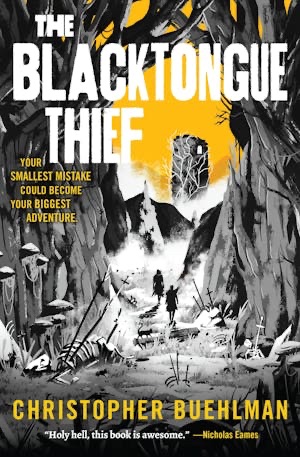
The Blacktongue Thief is a fantasy novel by Christopher Buehlman. It’s randomly violent picaresque where a thief with magical gifts of an unknown origin, a witchling, and a knight who can summon massive war birds out of her skin, go on an adventure through a land that feels low fantasy but is indeed not at all.
First up, I listen to audiobooks mainly, and the voices the author puts on here are really impressive and very much drew me into the story. The story, being a tour around the world, benefits from the people in those places having a range of accents was significant and giving the main character a brogue made for a compelling listen, as did his breaking into song every now and then.
The Blacktongue Thief is honestly a masterpiece of interesting and largely exposition free world building. Where there is exposition, it’s usually in the form of a fallible story from an unreliable narrator, and so each time a story is told it’s a Rashomon-esque twist on a story told previously about the world. Mostly, though, you stumble upon things as they are encountered in the world: You don’t realise that there was a plague that killed all the horses until it became relevant, you don’t know that there was a decades long war against goblins until you meet someone who fought in it, you don’t know what a goblin or giant looks like (or whether or not they are as horrible as it is said they are) until you meet one. I absolutely adore this drip feeding of the world through when that history becomes relevant and no sooner — I genuinely don’t think giants are even mentioned until the two thirds point, even though they’re incredibly key to the resolution of the story.
Also of note is how this resolves in ways that could not be figured out at the outset, because of its reliance on the core narrator. That narrator is reliable in the sense that he usually tells you, the reader, the truth (he doesn’t once or twice but with a wink and a nod), but is unreliable in the sense that he’s being lied to by his companions and the world around him, and he only discovers the truth gradually over the course of the story. The core mystery here is unsolvable, because Kinch doesn’t have the necessary information, and hence, neither do you.
Also remarkable here is how it subverts so many Dungeons and Dragons tropes: Ubiquitous magic, beast masters, goblins, giants, thieves guilds, krakens, apocalypses are all subverted in interesting and surprising ways, and this book is surprising enough that I’m reluctant to spoil any further.
There are occasionally confounding missteps, however. It seems to me that many of the companions along the way simply exist to prove the danger of the journey, and I never feel as connected to them as I do the core three characters. The Kugel-inspired picaresque structure occasionally feels like the scene or location was imagined, but its bearing on the plot has not been adequately thought through. In this way it surely feels like a D&D campaign, to be honest.
Overall though, it inspires me to stop explaining everything. There are joy here, in discovering things as you go. And while I appreciate the desire to understand what you’re running, I feel like the urge for explanation can run counter to bringing that joy: The referee can have that joy, too. There is a lot of lore finding its way into my current project, and reading this feels salient, because I don’t want to read as much lore as I’ve written, but I think it’d be better drip fed and hidden throughout the module, like I did in Bridewell: I know the economy of the valley, but I never describe it anywhere.
Anyway, the Blacktongue Thief: Strong recommendation, for a precisely R-rated picaresque with a compellingly flawed and spiky protagonist.
Bathtub Reviews are an excuse for me to read modules a little more closely. I’m doing them to critique a wide range of modules from the perspective of my own table and to learn for my own module design. They’re stream of consciousness and unedited critiques. I’m writing them on my phone in the bath.
Largshire is a 30-odd page system agnostic module for any fantasy roleplaying game, by Stuart Watkinson. It details a town intended to serve as a base of operations for a campaign. It is a peaceful seaside town with a dark underbelly.
Largshire heavily illustrated by Sam Wannan, and the consistent, sketchy art style feels like something drawn by the beach. The map is a frankly beautiful sketch, but the key is difficult to spot and needed bolder choices to be called usable. Layout is difficult to follow, and would benefit from more generous spacing, bolder headings, or other approaches (it doesn’t have page numbers!) to making the text easier to navigate.
The biggest strength of the layout is breaking locations down structurally into what in perceived the referee needs most: hooks, rumours and NPCs. This is consistent, with every location in every district — that’s 17 locations across 4 districts — featuring these subheadings. In addition, 3 major town-wide events are taking place and are alluded to throughout the module. Most locations take about half a page with all said and done, although some are longer; I’ve got to say that for those that outstay their welcome they don’t offer a lot in compensation, and probably needed a bit of an edit. These longer locations — the Pier Inn and Wellington’s Shop — feel like they are from an earlier version of this town far was more traditionally designed.
Because what this module doesn’t give you are the adventures. Your players want to fight in the underground pugilist competition? You’d better be confident to improvise it. Are they going to break into Zilindor’s Mansion? You’d better have a mansion map handy and a few hours to key it. This is as intended, and a referee with a good ruleset under their belt and a wealth of experience can make this town sing. But you need to work to make it sing, finding other modules to plug its gaps or designing your own forays between sessions. This is the antithesis of a low-prep module: It’s a module designed to make you do extra prep.
But the personality! Largshire is a lovely place to spend time in! The NPCs are kind and pleasant to get to know, although not as interlinked with each other as I’d prefer. The vibes here are impeccable, and pretty unique. It makes for an interesting, seaside mystery town vibe for your campaign which is quite frankly a pleasure.
I’m torn, to be honest. A lovely town, but high prep by intent. if you’re looking for something to inspire you with a specific vibe, and are happy to do the work — perhaps you’ll seed the town with encounters from other modules you already own, or make your own — you can’t beat it. If you want to have a town with all its interests fleshed out, this is not it. I’d love to have seen this fulfilling the promises it made in its hooks and secrets, because that would have been an exceptionally excellent setting and one to bring to the table immediately. As is, Largshire is a mixed proposition.
A 2d6 table, wordpress just won’t let me start at 2. Best used in a game with a world that acts independently of the players. Omens directly affect the world for 1d6 + 1 days.
Sun stands still at noon. A ruler will fall. Advantage on murdering nobles. The King abdicates his throne temporarily.
Falling star. A devil or angel takes action on the world. The church selects a random person after a long church to be their gods representative in the world.
Rook flying north. If you follow the rook, only positive reactions on random encounters. Merchants will only sell to North-travelling folk.
An uneaten dead hare. Undead will rise again if slain. Churches lock all their graveyards down for the week.
Green clouds at sunset. 1-in-6 chance fresh water is poisoned. The population only drink wine, resulting in increased drunkenness.
Double rainbow. Treasure found is doubled. The king raises taxes and sends out roadside inspectors.
The stars align. Grants a free flashback to when a player character prepared for a planned action. The king makes declares war on a neighbour.
Albatross flies over land. Disadvantage on any random rolls. No guests are accepted through the kingdom.
Blood moon. Any slain in the last day rose again. The King declares himself immortal and this a reflection of his splendour.
The moon is doubled at midnight. Advantage on all saving throws. Feasts are thrown for the doubling moon.
Meteor shower. The gods declare war. All churches become hostile to each other.
The omen applies whether or not you detect it. Any chance who is superstitious will notice it if they are on watch during the time it is visible. “King” here is short hand for whatever nobles are in power and have advise from astrologers.
I Read Games reviews are me reading games when I have nothing better to do, like read a module or write or play a game. I don’t seriously believe that I can judge a game without playing it, usually a lot, so I don’t take these very seriously. But I can talk about its choices and whether or not it gets me excited about bringing it to the table.
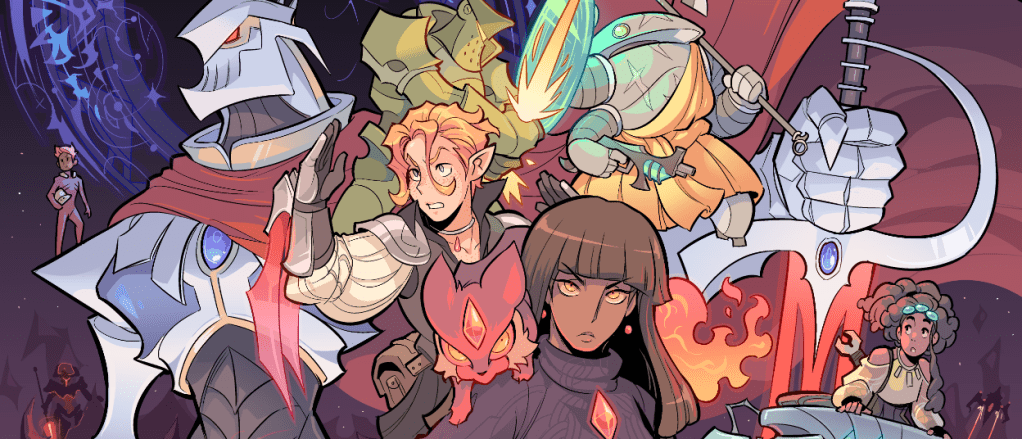
I was going to tidy the garage of the mess that inevitably accumulates, but I walked in and was overwhelmed, and instead I read Armour Astir: Advent. A lot of the games I’ve reviewed have been funded through Kickstarter and are showing signs of similar problems that could be attributable to the funding method. After my thoughts in my review of Mountain Home on slowfunding, I decided to look at other large-scale projects that slow-funded, and Armour Astir is one of those projects. Armour Astir is a 172 page game by Briar Sovereign about magical people and the mechs they pilot.
I don’t usually start with layout but I really struggle with Armour Astir’s layout, so I’m going to talk about it up front and forget about it. It’s in single column, small point A5, and I genuinely find it difficult to read. This is a game in desperate need of white space, or spot art, to break these walls of text up. I usually read on my phone, but I printed this one because that was actually impossible, and it was marginally better in text. My eyes glaze about a third of the way through every page. Admittedly I am perpetually tired, but the layout choices cause a barrier here that simply doesn’t need to exist. That said, within these challenges, it’s well broken up by headings and easy to navigate; these strengths just get lost in my overall difficulty with the text at large. I shall persist, despite the struggle.
Armour Astir is Powered by the Apocalypse, and in basic terms doesn’t stray from the template set 15 years ago, It does feature some cool innovations (I can’t speak to whether they are new here or not), such as confidence and desperation which are new ways to be at risk or advantage, which are tied to hooks which define your character. The basic rules are explained in a page, but the “main concepts” section is a long list of mechanics that admittedly blur into each other a lot, despite individually being quite neat. There are tokens that are downtime currency, gravity which are clocks that cause relationship conflict, and dangers and burdens which replace harm in sorties and downtime phases respectively. I’m hitting maximum new terminology threshold quickly, and am in danger of overheating.
We move on from the rules summary to Setting Up, which is a collaborative world-building exercise. The collaborative world-building is not a difficult or challenging process in and of itself — it takes two pages — but I happen upon a problem in Armour Astir where it feels like it has some specificities — magic mechs called Astirs, channelers, stuff like that — but then wants us to generate the rest of the world ourselves. For me and my table, I need a little bit more. It would be sufficient to give me an actual foe and organisation, and go from there. Unlike in say, Apocalypse World, where being surprised by the world is part of the appeal, here we’re rebels against some kind of empire, and so it makes sense to just give us that empire to kick start things. If I were to actually do some collaborative world building to lead into Armour Astir, I think I’d need to do something very different — perhaps a set up session of another game like Microscope — because this doesn’t quite get me there.
I’m not going to go through the whole moves listing here, but it’s pretty typical for a Powered by the Apocalypse game — they always feel a bit much to be honest, but a necessity — and these all have accompanying commentary which, again, is a longstanding tradition but one I don’t really love. I feel like your design should speak for itself, and I value brevity, so designer commentary is not something I appreciate. When I think Powered by the Apocalypse moves, I think juicy moments that spur difficult and dramatic decision-making, like the ones in Gran Guignol, Under Hollow Hills, or Pasión de las Pasiones. These are not moves like that: instead they leverage the mechanical set up in the core mechanics section, and do this quite well, in a way that feels reminiscent of Blades in the Dark. Now, this diverges from my expectations, but it’s not a bad thing — it just places this closer to Beam Saber in intent than it does to Firebrands, something I didn’t expect. Another interesting side-effect is that it moves interpersonal relationships squarely into the spaces of gravity clocks, hooks and desperation/confidence, setting up a separate “relationship economy” that operates in tandem with but influenced by the action that occurs, and creates interesting in game prompts. I suspect that in-game, we’d also have opportunities for characters suited up appearing in the middle of the battle because a hook was activated by a desperate move, which is very very gundam. Playbook moves largely follow the same pattern, although there are a few exceptions, like the Firebrand move for the Paradigm, and the Captain’s Force Multiplier, both of which introduce some of the more juicy narrative twists I expect when I hear Powered by the Apocalypse. I get excited about these kind of moves, but they’re largely narrative and dramatic and not relational, maintaining that dichotomy between systems.
An interesting addition that also feels inspired by Blades in the Dark is the Carrier and downtime, which runs on a token economy in which the Director (the GM role) gets their own tokens to interfere and interact during this phase. This makes for a fun, active downtime without need for that ambiguous “free play” blob that confused so many in Blades in the Dark. There is a lot of punch in this very brief list of actions, and I like this system a lot.
I mentioned the playbooks, but one feature of them that I really like is Gravity Triggers, which effectively give each playbook a different reason for conflict in their relationships. This is a neat way to differentiate playbooks based on their personalities, and adds some relational uniqueness and fuel to otherwise fairly mechanically inclined playbooks.
Ok, conflict is a big one, and is pretty complex actually. A combat system, where there are five approaches, and different ranges, which determine who is acting desperately or with confidence against whom. These approaches are assigned by your playbook or astir (your mech). Tier exists here to help differentiate scale — a Unicron-style planet cannot be defeated by a mech, and a mech cannot be defeated by a lone human. This, again, feels inspired by Blades in the Dark, and leans into the mechanical combat in Armour Astir.
We then go onto a long equipment list. Here, again, we have hints of a world in the mind of the creator that we’re not privy to. This is all pretty juicy and more heavily illustrated than anywhere else in the game; this is all very good, and it makes me wonder why it starts with how to make an Astir rather than with the list of Astirs and a “by the way you can make one”. And actually, that’s not accurate: I know why, because a guiding principle here has been make it yourself here, and so of course it holds here too. The high quantity of art here makes me feel like in an earlier draft the lists weren’t there, but were added on request by play testers.
The Conflict Turn is a heavily structured faction turn, and this, I must say, I like a lot. A lot lot. The divisions of the Authority all acting out of concert but against the resistance is stellar, their automatic moves are stellar, it really gives a strong sense that all odds are against the player characters. The Cause works differently, because it’s in isolated cells, and become exhausted with activity limiting when it can provide aid. They both fight over pillars — major places and people — which I suspect will be the driving force for the missions that the player characters go on. In the conflict turn, everyone switches sides and plays out cutscenes of the authority or wider cause’s actions, which is cool and fun.
We next come to GM tips, which are pretty typical to be honest aside from some optional rules and a cool mechanic for rivals. These principles and moves don’t leave me shocked and awed, but they’re functional. More interesting are the mission hooks and factions that follow — there aren’t enough of them, but they’re really, really good. The appendices are also really flavourful and useful.
One of the big impressions I’m left with in Armour Astir is that I’m really intrigued by the world that is implied by everything in this book, but the book doesn’t want to tell me about that world, it wants me and my friends to make up my own. The mechanics imply a lot of interesting things well, as do the naming conventions. It’s pretty rare that I ask for more lore as I am, in general, a lore disliker, but there are exceptions, and this is one of them: I’d like more support to play this game, and it’s not given me here. I’ve been speaking a lot about Heart lately, something I reviewed a long time ago, and I said that it has “impeccable vibes”, by which I meant that the art and non-technical writing was really, really good at communicating a sense of place. Armour Astir gives me hints, but refuses to communicate any sense of place, and for me, that’s what I need. It’s not a mistake, its the author’s intent, but it’s a design direction that just doesn’t work for me. Apocalypse World, for example has a similar amount of guidance, and I don’t bounce, and I have roughly equal familiarity (that’s some, but not a lot) with the genre it approaches. Why? I have a working theory, and that’s that the playbooks and equipment lists don’t communicate as much here about the world itself, because they’re really focused on the more complex systems at play, rather than the narrative. In Apocalypse World, the playbooks are roles in the world, but here they’re roles in the carrier: They don’t teach us about the world outside the carrier. They don’t automatically imply anything, even by their lack of existence. Where in many games, the absence of a Paradigm might been no gods in this world, here divine power is in the approach chart. The psychic maelstrom looms over every playbook in Apocalypse World despite it being vague, but it’s a very specific thing that bring mystery and danger and potential, where the Authority and the Cause are known and necessary causes. The focus here on known and necessary world building instead of world building that activates and implies always of a familiar world, is, I suspect, why I feel left wanting.
I honestly was surprised by what Armour Astir is, which is a mech combat game where that conflict is a means to resolving relationships. Saying that, I’m honestly feeling like I missed the memo: Obviously this is what it should be. That is Gundam. What I expected it to do is take the other angle: Be a drama primarily, that was also about mechs sometimes. This was initially jarring to me, and I’m still not convinced it’s the right choice; it feels like the game I imagined this would be would be a better fit for a Powered by the Apocalypse game, and the game it is would be a more natural fit for a Forged in the Dark game. Potentially the author agrees: Her current project is a Forged in the Dark mech game. But the very heavy modification and broad inspiration taken here makes what it actually is a very interesting beast all of its own, mainly because it feels like an old mech kept running through ingenuity and spare parts, and yet it still fights well. It’s full of small elegant innovations that help achieve its sideloaded goals. A remarkable achievement.
I think the biggest error with the design approach is that because it’s so combat forward (which it is, in my opinion, despite clearly trying not to be), thematically it comes across a little garbled. In many ways, making this about a high school would be clearer than making it about a rebellion, because the impact is that you bring your own theme rather than are supplied one. It’s characterised by what it tries to emulate rather than its own perspective, and while cool, and I suspect it will be very fun, it rings a little hollow as a result. Games are usually at their most interesting when the author has their personal perspective and story rooted clearly in the text, and hence this feels awfully board gamey in its sterility and reluctance to give you a glimpse into the authors psyche. But, board games are still fun.
Does this bear out my theory about slowfunding games? My opinion is a little muddled as I adore this less than Mountain Home, but I think so, yes. We have a similarly unflashy, often workmanlike approach, with a clear understanding of what it is and innovative approaches to doing so, and is a little idiosyncratic in its inspirations and its interpretations of those inspirations. It subverts Apocalypse World in a similar way to how Blades in the Dark does. What it definitely isn’t is bloated or poorly organised, although it’s cleverness in information design pales in comparison to Mountain Home’s. It does show that one disadvantage of the slowfunding approach is the likelihood of bringing those extra team members on board: This could’ve used a layout artist, in my opinion. But it lacks the bloat and aimlessness characteristic of crowdfunded work.
Overall, would I bring this to my table? I think I want a little more than this provides. Is almost there, but not quite. I think the combat would be thrilling, and I can see set up for some really exciting moments and conflicts, and the pieces of this game — the conflict turn, the interactive antagonistic downtime — I will probably hack into other games at some point. But I have to build the world myself, and at that point I’d rather write my own emotion-forward mech game, the inverse of this: Pasión de las Pasiones in high school with mech escalation. But, if the perspective this takes on the genre is one that vibes with your own understanding of it, and you don’t mind the extent of the world-building required, then Armour Astir: Advent just might be right up your alley.
I saw a TikTok (which thereafter disappeared into the algorithm) that talked about problem stacking in story writing and I was like This Needs To Be Said about module writing and home brewing adventure scenarios:
Don’t give the player characters one problem. Give them many possible problems.
We do this in a bunch of ways: Random encounter tables, action schedules, duelling factions, combat encounters, adversaries, hostile environments. In a dungeon or other exploration type scenario, it’s important to drip-feed these problems or we come across the problem of Why Would I Go To There.
So, in the beach module I’m writing, I think about the problems I’m stacking and how they’ll be fed to the player characters:
There’s a missing lighthouse keeper
People are being kidnapped off the beach
The caves beneath the lighthouse are tidal and often underwater
The bag-sistas are facing off against the franken-sharks over the treasure in the sunken pirate ship
The lighthouse-keeper has been possessed by a dark power that escaped the wreck
Plus there’ll be some random encounters, and some location specific problems. The tidal nature will be a surprise, and force retreat until they have a swimming solution. You’ll meet the one faction before the other, foreshadowing the complexity.
Stack up the problems. The player characters can choose to engage with them or not, but the stacking is what gives your module interest.
Bathtub Reviews are an excuse for me to read modules a little more closely. I’m doing them to critique a wide range of modules from the perspective of my own table and to learn for my own module design. They’re stream of consciousness and unedited critiques. I’m writing them on my phone in the bath.
Beyond Corny Groń is a 339 page (read: absolutely massive) system agnostic setting module by Kuba Skurzyński. It gets its striking names and inspiration from Polish folklore and history. It’s heavily illustrated, with English-language editing and sensitivity from Brian Yaksha, whose writing I’m a big fan of. It’s a sequel, or an expansion, to Corny Groń, a solo mapmaking game.
Because it’s such an intimidating text, I’m start with art and layout: It’s sparse and clear, with clear well-spaced headings and minimal font variation for signaling. The art complements this well, giving the sense of a barren and desolate wilderness filled with desperate and dangerous folk. This is supported by how the topographical mapping maximises white size, as do wide margins and very generously spaced tables. These map-graphics also do double duty as representations of other aspects of gameplay, although less elegantly than Is like. I’d prefer maps that were more immediately useable, though. For me, I’d rather, in this prose-heavy approach to module writing, have more font variation to help me wayfind, but as is the vibes, at least are impeccable, even if the legibility is not.
The scene is set early: This writing is beautiful but challenging: “Now, the nominal ruler of the Karpakian Valley is Her Solar Grace, the Empress of Styria and the Queen of Pannonia, Eleanor Angela I Dunburg, whose domain extends to the far coast of the Scythian Sea, into which streams f low from the southern slopes of Karpaki.” We don’t stray far from this Polish dialect of high Gygaxian, which is both a blessing and a curse: Flavour? Yes! Ease of use and retention? No!
The first section, after this dense and rambling introduction, is a system agnostic character creation procedure which is honestly, so, so charming to me. It brings detail, hooks galore, and a sense of locality (is that a word?) to the PCs. My main problem is actually the intertextuality of it: It would be hard for all players to sit at the table with this and do this together, because of the detail and relations to elsewhere in the book. Would it be worth it though? Undoubtedly, in my opinion. I could see a briefer version of this appearing in more setting books in the future, using elegant dice conceits as a streamline. On the other hand, stumbling upon that “You woke up with a headache” table is comedy gold.
There is a significant section on arms and equipment. There is very little world building in this, unless I squint: Marbles rather than ball-bearings are suggestive of a volcanic north, for example. I don’t think it’s worth the space. A lot of time is spent inconsequentially on black powder and coinage, which leads to naught in my opinion.
Next up comes our map generation processes…ah, this accounts for the minimalist maps. Procedural generation is both jarring (after an extended monologue about how this is thinly veiled Poland) and disappointing (twenty pages of how to generate the wilderness map rather than just providing one). The procedures themselves are pretty good and (again, if streamlined) they’d make for an excellent “travelling in the mountains” supplement to an existing map. But that’s the thing: They’re way I’d use to supplement keyed locations, they don’t replace them. They’re not an adequate replacement for what they’re in the place of, here. But they’re great in their own.
I’m going to pause here and talk for a moment about the actual experience of the sparse and increased whitespaced tables: They’re easy to read, but horrible to use. Instead of these pages after pages of tables to flick through repeatedly, I want some Mothership-assed maximalist design so all of this fits in just one spread. sure, it’s take a genius layout designer to make that mesh with the rest of the design work, but these tables are drag to use — I know, I tried — especially the way the rules are but consistently applied and so you must flick through them chronologically.
What we are getting here, between the mountains and the caves section that follow, are clearly related to the solo mapmaking game that this emerged from. And I’d use these! There effectively hexfill and generation procedures, and good ones. The cavern generators here would make a very cool dungeon if you combined them with, say, a bite-sized dungeon or one of the bigger Yora dungeons. But I want to know about Corny Groń!
We do find out about it, in the form of factions, in the next section. These 9 factions are at once elegant and lacking: their half page of prose rendering their half page of usable information moot. More structure and more (any?) specific characters would render this a stellar basis for faction play; as is, I need to figure these nine factions out, with a highlighter and come up with some members on my own, even when the faction is named for them.
Then we have a metric horse-ton of tables, followed by even more treasure tables. Then we have NPC generators. These are, again, largely good tables, rendered difficult to use largely through visually elegant design. Unlike, for example, the tables in Knave 2e, rate well organized so you could easily refer to them and find what you need. But neither are they entirely worth it: As I discussed back on Lorn Song of the Bachelor, an NPC generator is not my preference at all, let alone when it provides no relationship to the world around them at all.
I’m half way through, and the remainder is all bestiary. This is a good bestiary, reminding me at its best of the Monster Overhaul without the structure, and with more interesting monster inspired by specific folklore instead of simply being twists on existing fantasy fare (although the last section, Monstrosities, is specifically that). These are fire, to be honest. Unbeholden to structure, they range from laden with bespoke tables to customize your unique dragon, to a very specific and concise Skarbek. The extended prose here, while a little too much for me, usually doesn’t detract: I don’t have much of a basis for a lot of the monsters, and it feels good to weigh into it.
This goes for a lot of the examples that pepper the book. I want a book that’s just the examples, because they’re good. The example people, the example caverns, the example mountains. It’s absolute gold. But they total maybe 5 percent of the total page-count of the book. I want the 75 percent example version of Corny Groń. I want that Corny Groń, not the one I got in this book.
The appendixes vex me. The first are rules. To a game! Based on Knave, the game they say it’s best to play it in! Just make it a capsule game, and put this in the front! This is not a book that hurries to get started: There is copious preamble and explanation of intent and process in the introduction. Ten additional pages of rules there, would make a lot of the mechanical choices further in make more sense, and would (and perhaps this is why it’s in the appendix) have required the book to be more rooted in the ruleset, which would, to be honest, have been to its advantage. The second appendix is plants. And this is good stuff! It honestly just belongs in the book. Again, this is not a book that really cares about word length or rambling prose, so working these plants and their folkloric history into the mountain-generation or travel properly would be a right flavourful and interesting, unique thing to do. As it is, it’s just tagged on, ripe to be ignored. It’s always advantageous to lean into the unique aspects of your system. The final appendix is a pronunciation guide. 6 pages of it. And, sure, it’s nice to know how to pronounce, for example, Groń. But I’ve finished the book! Put the pronunciation in the book! Use parentheses!
The core problem, for me, with Corny Groń, then, it is this: In making a setting that is almost all tables, almost all quantum, almost all create-as-you go, you intentionally also remove any chance that you have to build relationships between whatever is created, unless you build your system of generation around relationship-building. There is no relationship-building here. Corny Groń does not have a networking algorithm built into it. The hooks the character find don’t lead anywhere, because nowhere exists until you create it. I can imagine a quantum setting like this one, that, with the right approach and forethought, could anticipate this anti-social side-effect and come up with a system that undermines it and creates a world that feels worth adventuring in, but I certainly don’t want to adventure in a world that feels isolated even from itself. I’m in your world for connection.
I’m going to come around to a counterexample here: I’ve spoken many times before about how Wanderhome is in my opinion inspired by the wilderness travel present in DIY elfgames and similar adventure games. Corny Groń has Wanderhome travel. But Wanderhome is not a game of Knave. Much of the pleasure in Wanderhome is the sense of discovery you get in collaborating with your friends in creating the world you travel through, and then choosing how to respond to it. That is not the pleasure I seek in my adventure games. I’m seeking the pleasure of stumbling upon world that presents at least partially the illusion of being bespoke and detailed, of existing outside of the moment I am imagining it. I want that world to feel real and solid, even though I know in my heart it is all smoke and mirrors. Exploration, for me, is about going somewhere I’ve never been, not creating a place together with my friends. Corny Groń, for me, mistakes these two pleasures for one and the same.
So, then, the recommendation is mixed: Corny Groń is not for me, although I may well dip into its location generation procedures and its bestiary at some point because they’re really interesting pieces of design, for me, as a referee, designing for my table or as a writer looking for inspiration for my next module. But that doesn’t mean Corny Groń isn’t for you: If the idea of playing Wanderhome as a party of faux-Polish adventurers in a Knave-fork in a savage mountain home filled with unusual monsters from northern European folklore appeals to you, then this game is absolutely for you. To be entirely honest, I think there’s a whole group of people for whom Corny Groń could be an interesting way to venture into the realm of lightweight fantasy adventure games for the first time, if their favoured experiences are games like Wanderhome.
I Read Games reviews are me reading games when I have nothing better to do, like read a module or write or play a game. I don’t seriously believe that I can judge a game without playing it, usually a lot, so I don’t take these very seriously. But I can talk about its choices and whether or not it gets me excited about bringing it to the table.
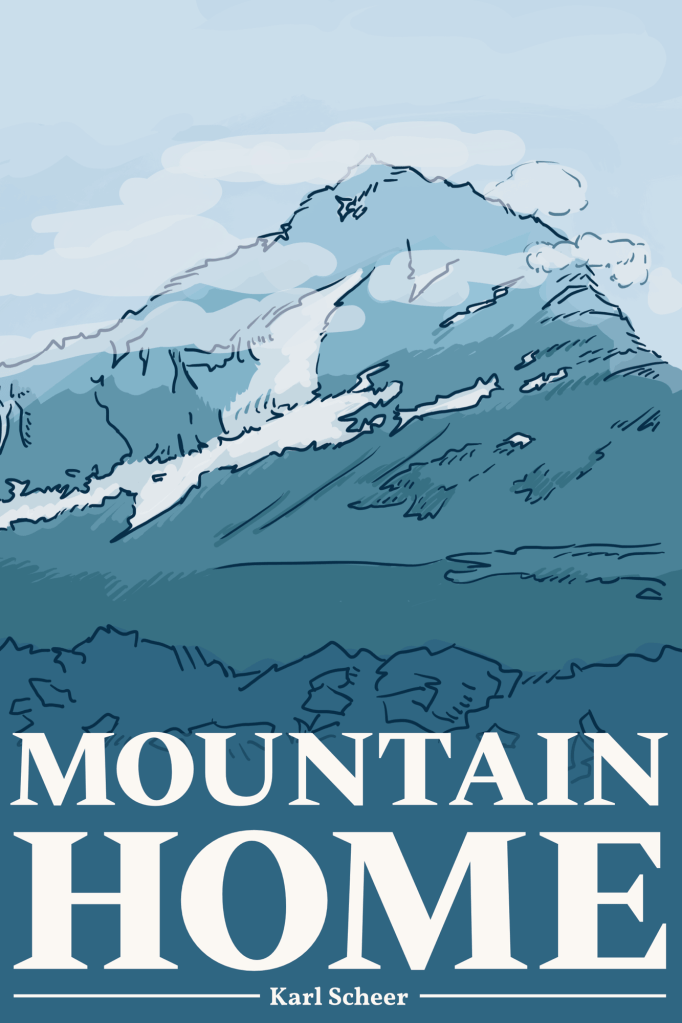
I threw a party for my 4 year old today, and now I can’t feel my feet, so I’m reading Mountain Home instead of doing necessary housework, while my feet soak in peppermint butter. After reviewing DIE:RPG and it being one of a multitude of fairly straightforward games, poorly organised to their detriment, that I had recently reviewed, I thought I’d review a complex game that is well organised, as a counterexample. I didn’t intend for Mountain Home to be that counterexample, but ah! Serendipity she visits us! Mountain Home is a 200 page game by Karl Sheer (duties including game design, writing and layout) about dwarves colonising a mountain. It’s in its final form, after a long development period in slowfunding on itch.io.
For anyone who is familiar with the Forged in the Dark framework, just how Forged in the Dark is Mountain Home? The answer is very, both in terms of sections and overall complexity. It’s been a while since I’ve run Blades in the Dark, but in terms of the core mechanical chassis, from memory this diverges almost not at all except for a few appropriate superficial changes, such as changing the actions to dwarfier versions, renaming vices to obsessions, trauma to weariness and position and effect to risk and reward. Everything you’d expect is there: Devil’s Bargains, Resistance Rolls, the phases diagram, playbooks. This is all covered in the first ten or so pages, although explicated in detail later. Ten pages in, I have an idea of how to play the game, that isn’t predicated on my previous knowledge of the system. It’s all here, softened for the PG-rated new theme, clear for beginners, and familiar to old Forged in the Dark hands.
But immediately it diverges: The playbook requires a little more customisation (less messy on the actual attached sheets than in the core book, sadly). Each of the characters (“founders”) gets a guild as part of their starting resources. A whole organisation! Based on the gang rules (I think that’s what they were called in Blades?) but everyone gets them and they’re a little expanded here. The playbooks themselves are almost all focused on resolving conflict through non-violent means (the Shieldbearer being the exception) and are flavourful as all get out: “A perpetually warm beer that heats your blood and prepares you for battle”, for the Artisan, “Just Like Old Times” for the Elder. They’re simpler than Blades of the Dark playbooks, but later we’ll see that simplicity is a trade-off for complexity elsewhere in the system. These early divergences are interesting, intriguing, and utterly at odds with the violent themes of its antecedents.
So we have the introduction to the rules, then the playbooks — and just the playbooks — and then we have How to Play: the aforementioned explication of the rules. This is both brief and thorough. It spends no time on poetics here: It describes the game clearly and in as few words as possible. And, if you’re familiar with Blades in the Dark or any other Forged in the Dark game, there are no surprises, except for some unique actions. You really can breeze through this chapter of you’ve played a few sessions of almost any derivative. And more concepts that contrast with its antecedents keep cropping up, despite a close mechanical hew: A cycle of phases, for example, usually a few days to a week in Blades in the Dark, are unambiguous years here. A game is expected to last about fifteen cycles for a much more leisurely pace, not indefinitely and ending in destruction.
The next chapter details the Settlement. The Settlement replaces the Crew, and again the pattern holds. It has tiers — the same ones! — and advancements and treasure! But wait, an end condition? Let’s talk about end conditions. These are really interesting, and a divergence from the typical Forged in the Dark pattern in a more contemplative and collaboration-forward direction: These are thematic goals, what answers we want from the story of our dwarven settlers. It feels akin to something we see more often in world-building games or like prompts more commonly seen in Dream Askew / Dream Apart and its descendants. This is a neat little addition, and again, moves gameplay subtly — this is a moment of your session zero, no more, but it shifts the direction of the entire campaign, because it dictates when the campaign ends, and that is when the questions you as players have about the settlement are answered.
Instead of Settlement types equivalent to different crews, we have goals — these are really just the story you’re interested in telling, whether you’re Thorin Oakenshield recovering a lost land or being driven from Erebor in the first place, among other options from stories I’m not immediately familiar with. Familiar stuff, just like Blades in the Dark! This is barely its own design — wait! Settlement map? There is no city here, and the tension of a zero-sum criminal game is absent; instead, we have a blank map and the tension of exploration: Because terrors lie in the deep, and other subterranean peoples, and dangers. But your settlement needs bargains and merchants and pubs, and you only find mushroom farms and gem mines in the depths so, really, the only way is down. I mentioned earlier that end conditions reminds me of narrative world builders, and here we have more world-building game influences. How do we do that exploring though? Oh, we have an expedition phase, not a score phase. This phase is follows this same familiar Mountain Home pattern: engagement rolls, methods, and then…wait, only one violent option, And the others are diplomacy, survey, forge or return home? The settlement phase does the same: It’s the same, the same, then there is…trade disputes? Union strikes? Earthquakes? Barrel taps?
What we see here is a really clever disguise, a lulling of the reader into a sense of security through the retention of familiar rules in straightforward ways; then once we arrive, realising that they are rendered in utterly different lights, and timeframes, and with utterly different objectives. This is not the lightly reskinned Blades that you see in Brinkwood, or in Sig, or in Scum and Villainy, and it’s not the brazen reimagining that is Band of Blades. This is a subtler beast. I’ve written this chronologically in order of chapter, and if you’ve been paying attention, you can see the game the information design is playing: A group of familiar mechanics, tried and true since 2017, followed by something new and surprising, usually something that turns the violent core of Forged in the Dark on its head. This is really clever information design.
We’re at the point in the book that the game expects all the players to read to: At this point, you’re very clear that this isn’t your teenager’s Doskvol, but rather your grandfather’s Council of Elrond simulator (there’s probably a better analogy to a PG-rated political text, but it’s not coming to me right now). I think 130 pages is a bit much to ask of every player to read prior to playing (or choosing to play), realistically. But, if you do get this far, you know exactly what you’re in for, and you’re probably already picking yourself a playbook and have a goal in mind, and if you’re still keen: The first session section comes next, and it’s time to play! I’ve mentioned before that this game appears inspired by world builders: Here, we do collaborative world building. There’s no Doskvol here. You make it yourself, in session zero. This is the point where the mask comes off, in my opinion: You’re in? Well, then Mountain Home’s cards are on the table: This is a collaborative world-building game, not just a politics simulator. Together we shape the politics of our exodus, what happens on the journey, and the spirit of the personified Mountain Home itself. Now, it must be said here: I think the degree of freedom here is a misstep for me. I’d prefer a slightly more concrete world with more evocative suggestions for threats and peoples. It’s really relying on your knowledge of the source material to fill in the gaps, and I think it’d be a more interesting game if it filled those gaps — the ones external to the dwarven settlement — with something concrete and evocative, even if I agree leaning to the anti-canon side of concrete is a good choice. I’m well documented to want games to bring the imagination and not require me to come firing on all cylinders all the time; or rather I’d like them to give me a track to race on rather than build my own. But wow! This is an interesting twist on the framework, yeah?
The running the game section — the GM section — comes next: This is bespoke stuff, clearly drawn from years of playtesting. The principles are beautiful: Carve the World From Jagged Stone, Delight in Their Creation, Emphasize Common Personhood. I’m a fan of directive-driven play, although I know a lot of players bounce off it, and I don’t think I’ve seen as compelling directives in just about any other game. And explaining the principles takes two pages! Amazing! Brevity is a blessing in a complex system. I already have a lot to juggle as a GM. A lot of this advice is, appropriately, recycled, and are to do with the grandfathered in mechanics; but new stuff on expeditions and inventions are really thorough and terse, the kind of thing you can flip through and fill out in ten minutes while the table snacks in between phases and then come back for the expedition phase to start.
Finally we have the lore and world building advice for the GM, because they need to bring the dwarvishness to life, and a bunch of spark tables to help when you get stuck. This is fantastic for the kind of exploratory and political play you anticipate here. But, it’s not equal to Doskvol, for the reasons I mentioned earlier: we get a lot on dwarves — understandably so — but not enough on the world they’re exploring. This is supposed to be collaboratively created, but as I mentioned earlier, I’d rather evocative and more specific prompts than these vaguer spark tables that are given. Duskvol understood that the important things to detail are the challenges you might face, but Mountain Home trips up here. Maybe. Maybe this is a rare failure of explanation in a well-explained text, because there is subtle but intriguing through-line here that player vs. player conflict is expected, because they represent distinct political forces within the settlement. There is a lot of time devoted to safety, and GM principles that include “Challenge Their Unity”. I think this would benefit from a more explicit discussion in the game text, as it’s both an interesting and challenging direction that this game is appears expected to veer into, over its 15 year cycle. But I wonder if the lore focus on the internal politics and culture of the dwarves is an implicit indication that this is a game where we are going to be largely plagued by internal conflict, rather than external conflict — certainly this is borne out by the settlement phase’s lists. To that end, the faction and claim generation stuff here is stellar, and lean into that in a way that makes more sense than in isolation.
I have a few design criticisms of Mountain Home, though: The sheets aren’t in the book. I’m not aware of a print version of this, but it’s tricky to flick between pdfs on a phone where I wrote most of my reviews, and space is infinite in a digital book, so there’s no reason they couldn’t be shown where they are referenced. The book is clearly designed such that you have the sheets in front of you when you read their explanations. Some of the lists, like buildings, really should be on the settlement map rather than in the book. But the sheets do exist, and they’re good ones: They elide a lot of the complexity, making the game much more welcoming from the first day, and I love the visual metaphor of the increasing depth of the dwarven delve being layers of paper on the table.
This is a complex game, as are most Forged in the Dark games. An immense mechanism of interlocking systems. But the structure of Mountain Home leads you gently through it, giving you moments of familiarity between twists and subversions, leaving one section into the next via questions raised in that section. The layout is not flashy and the art budget is modest, but the power of that art and layout is maximised by a focus on full page art for chapter separators (or to identify playbooks), and clear headings and heavy use of white space. Would it be nice to have more dwarfy art? Of course. Does it use those gaps to its advantage? Also yes. The combination between smart information design, clear consideration for section linkages, and clear if not flashy use of headings and in-text flags and differentiation, make for an immensely legible read despite the complexity of the overall systems.
It’s also interesting and important to that design commentary that there are a fair few examples of the lyricism of the author’s writing — I quoted a few flavourful moments earlier — particularly in the lore and oracles at the end, and so it suggests that the reversion of the voice in Mountain Home to a fairly technical and dry voice is a conscious one. There’s an artistic choice here, prioritising the clear communication of a complex idea over the choice to wax lyrical. There’s a humility to this decision that I really appreciate; a prioritisation of the integrity of the game text over the ego of the author. But there is a trade-off here: For me, at least, that lyricism is something I yearn for when reading a text especially of length, and while the compelling by system interaction and the constant surprise in this particular game keeps me reading, more concessions to the more beautiful writing in this book would be deeply appreciated.
It should be noted, though, that that complexity in concert with the lack of a pre-existing Doskvol equivalent means a lot more load falls on the GM, or at least the players as a whole if we assume that world-building is entirely collaborative. The GM irregardless really has to have this book under their belt, cover to cover. Familiarity with the broader tools is a necessity; I’d probably print a binder with all of the necessary rules and procedures and tables at hand. An explanation of how this gameplay loop looks at the table would also help: I imagine a session would be full of toilet breaks and snack trips where the GM frantically prepares something for the future; else the GM might prepare the whole claims map in advance and nary another moment of prep aside from faction actions. I’m curious the intent there, though, and some examples of play would help me bridge this gap.
There also is very little concession to wanting to play Mountain Home in different formats. This is a game that knows what it wants to be. There is a short section talking about solo play and about one-shots or shorter campaigns, but it’s clear almost from page 1 that it wants to be a 15 or so session campaign, and it’s tailored strongly to be that. I don’t feel like I need permission to hack or modify a game, and in fact it could be argued, having played the same games at many different tables, that we all house rule our games, often unconsciously. So for me, the focus on a core play loop is a huge strength in Mountain Home, rather than spending time and energy explicating game loops that are less than ideal in the eyes of the designer. I’m not saying there aren’t advantages in a broader approach: I personally would find it hard to commit to 15 or more sessions of any game. But the clarity of artistic vision is revelatory here, and the focus of the design benefits from it. This game is better for the knowledge of what it wants itself to be.
This is an unashamedly colonialist fantasy, although it carefully treads around the settler colonialism in most of the text. Only a few examples imply indigenous inhabitants, and the mountain is at once expected to be hostile but also empty places to delve. Of course, there are myriad ways around this: In the stories this is based on, the evil in the mountain is a literal demon, for example. And the existence of the personified mountain means there’s a lot of room for conflict that doesn’t come in the form of a displaced population. And finally, I’ve spoken about how there is a subtle undertone that the conflict is supposed to be internal to the settlement, not external. But in a settler colonialist fantasy, the lack of any comment on the potential for sensitive and complex topics to be broached stands out. In a similar way, one of the core stories this is inspired by is a clear analog of the Jewish diaspora, and it’s odd that in a game that focuses exclusively on this topic doesn’t make any motions towards acknowledging that either. Acknowledgement would be, in my opinion, sufficient if not interesting. I don’t possess a great desire to expunge our art of complexities or of reflections or analogies to real life, but rather to the contrary we should encourage it. It is the lack of any comment that brings me hesitance here, not the presence of the potential connections. And to me, leaning into these complexities would make Mountain Home better, even if it had meant hiring a sensitivity reader or cultural consultant or two. I really want Mountain Home to have more to say. My first impression, especially in the light of the avoidance of specific themes, is that it wants to avoid complex themes at all. But perhaps this is doing the game a disservice. The inspirations are really worn on its sleeve, and those inspirations are the game Dwarf Fortress and the book, the Hobbit, primarily, although there are others. The Hobbit is squarely a children’s book seen through a child’s eyes. It skips past scenes of violence altogether, and is largely concerned with a child’s view of politics and of interactions between mysterious fairy-tale quantities — ethereal elves, evil goblins, massive giants, iconic dragons. It is unconcerned with realistic politics, appropriately so in a children’s book, although it betrays its author’s biases certainly. These themes are central here to the exploration and to the design of playbooks and in the absence of concrete enemies. And Dwarf Fortress is a mechanical beast; it’s a creature of surprise borne of unexpected interactions and complex algorithms. And while the success of the complex interactions and oracle tables here is hard to assess without a full 15 sessions of play, you can see clearly these themes are also the direction the game is pointing in. It does feel, as I mentioned earlier, like these themes would have been better achieved with a little more specificity, and I wonder how much that specificity was avoided out of a desire for open-ended creation and how much out of thematic anxiety. But when push comes to shove, while there is some sense of awkwardness in the specific avoidance of certain complex themes, those themes aren’t off the table or in the table for you by default, you’re well supported by safety tools, and the themes the author is interested in are on full display. So, to call the avoidance of specific themes a failure in this game is probably unfair.
To close the loop with DIE:RPG that I promised at the top of the review, it is really easy to see by comparison how one can arrange and explain complex systems and unfamiliar subjects in a way that makes them grokkable. For me, at least, I have less of a grasp on how to play dwarven settler politics than D&D isekai, so conceptually Mountain Home is more challenging rather than less, and it’s definitely more complex a system. But thoughtful design and, I suspect, considerate playtesters, as well as editors that were happy with a back and forth over multiple phases, can render the opaque transparent. I also think there are broader economic factors that impacted the final forms of two games, that are worth discussing: Namely that DIE:RPG was a large scale, high budget kickstarter success from a relatively major publisher (keeping in mind a major TTRPG publisher is still a small business) and Mountain Home is a slow-funded labour of love that took 5 years to bring to completion. For the uninitiated, crowdfunding is a marketing-focused way of getting funding for a game, that relies on additional content to drive increased advertising and revenue. Crowdfunding campaigns like DIE:RPG earn hundreds of thousands in weeks. Slow funding is effectively paid playtesting: Games release in limited and affordable, usually artless “ashcan” form, and as the money rolls in, the cost of purchasing increases commensurate to the status of development. Slow funding campaigns are much less public about their earnings, but they take years, not weeks. There’s a lot of talk in the hobby about the negative and positive impact of hype-based crowdfunding, but I think there are manifest in these two games some of the core differences: Mountain Home is focused, well-playtested, and its text is measured and well-integrated. DIE feels scattered, it meanders in its explanations and the back half of the book often feels at odds with the front half of the book. There are clear indications that the deadlines and pressure associated with a crowd funding campaign affected DIE:RPG for the worse, but until reading Mountain Home closely I don’t think I had really realised that slow funding has such a positive impact on the design of the final product; perhaps it allows a more focused and systematic approach to design that minimises challenges being overlooked, and minimises the jarring or exhausting unnecessary “additional content” I so often bounce off. I’m interested in looking at other slow-funded products to see if this is a trend, although I’m also hesitant to review unfinished games.
I’m not sure how this fits into my review, but honestly the biggest challenge for me, reading Mountain Home in close proximity to DIE:RPG, is that DIE:RPG is trying very hard to be capital-A Art, and Mountain Home is not, and I want to talk about that. Because I don’t think it’s true that Mountain Home is not art, but I think it’s aspirations are to a kind of folk or pop art, rather than making gestures towards high art or the “Art Scene”, and this reveals itself in the way I respond to it. Games like Mountain Home and Mausritter are inarguably to me artistic masterpieces, albeit in diverging ways, but they don’t trigger myart radar as much as DIE:RPG does largely because DIE:RPG is about big emotions and trauma and childhood whereas Mausritter is about mice knights and Mountain Home feels like ASCII art and childhood stories. One could really say that I’m responding to the fact that DIE:RPG is more heavily art-coded than the other two games, and that to me is a problem, because the way you position or code your art should not impact whether it is actually received as art by the audience (that is, me). Of course railing against this is largely pointless: I’m never going to change the way art is received by the public, and there’s nothing wrong with aspiring to be pop or folk art. Art is art. I can, however, reframe the coding of TTRPGs for myself: TTRPGs, irregardless of theme, are inherently a participatory performance, and irregardless of what emotion that performance elicits — childlike joy, political intrigue or exploration of trauma — and because of the nature of the medium itself — it is the medium of TTRPGs that should be considered art-coded, potentially more so than most traditional non-participatory art forms.
Back to Mountain Home, though: Mountain Home is a compelling subversion of the Forged in the Dark formula, inspired by children’s books and videogames. While it is workmanlike and not flashy in its presentation, that brings with it a clarity of purpose and thoughtful informational design that makes it very accessible despite the challenges its subversions and disparate inspirations bring. I would love to bring this game to my table, and if I could get it to my table in the next week, I could run it with little more preparation than printing off some tables and sticking them in a binder. And from me, I think that’s a pretty strong recommendation to check Mountain Home out.
I use affiliate links where I can, to keep reviewing sustainable! Please click them if you’re considering buying something I’ve reviewed! Want to know more?
Have a module, adventure or supplement you’d like me to review? Read my review policy here, and then email me at idle dot cartulary at gmail dot com, or direct message me on Discord!





 Playful Void