• Rules Sketch: Spell Duels

    Like, I just wrote a whole psionic duel system, and I want a cool one for wizards and priests as well. They operate differently from one another, and I’m inclined not to do a priest duel, but honestly the most memorable duel I’ve ever run was between two clerics in 5e, so that seems silly.

    But they have to feel different from psionics duels. I don’t see them as two minds duelling, I see more of a joust: Making tilts at each other, but it’s all about power. I’d love to fit in into a single roll, but I think it’s more important for it to feel more all or nothing than the psychic duel. It should be struggle struggle struggle EXPLODE! To emulate that comic book visual of two beams of different coloured light being forced back and forth between two powerful creatures.

    Ok, so the meta here is wizard A casts a spell at wizard B, but the wizard B has a defence prepared against that particular spell. It shouldn’t be expending syllables, I think, because the spells don’t get cast. Do you need them memorised? I like the idea of it being a battle of raw power and knowledge and not simply “my prepared spell against yours”, but wizardly magic here is heavily flavoured Vancian, and so it doesn’t quite fit. Best memorised only; that also favours wizards of higher levels.

    If two spellcasters engage in a magical duel, they both act last in initiative. If either of them act during the round prior to participating in the spell duel, they cannot choose a spell in the spell duel. If the PC spellcaster suffers an injury during the round prior, or is forced to move to avoid injury, they take disadvantage on their rolls for the round. If the NPC spellcaster suffers an injury during the round prior, or is forced to move to avoid injury, the PC takes advantage on their rolls for the round.

    A spellcaster has arcane defence equal to their level. Each round in the duel they lose, their arcane defence decreases by one. When they reach zero, they are defeated.

    Each round, the spellcaster chooses an offensive spell that they have memorised. If their foe has no spell memorised that logically cancels that spell out (for example, “Fire resistance” against “Fire bolt”, “Cure Minor Ills”, against “Power Word Harm”), reduce their opponents arcane defence by 2. If the NPC has a spell memorised that logically cancels that spell out, a PC must make an Intelligence (for wizards) or Wisdom check (for priests). If they succeed, reduce their opponents arcane defence by 2. If they partially succeed, reduce their opponents arcane defence by 1. If they fail, they reduce their own arcane defence by 1. If they critically succeed, reduce their opponents arcane defence by 3. If the NPC makes the attack, the PC must make a saving throw vs Spell. If they succeed, they do not reduce their arcane defence. If they partially succeed, they reduce their arcane defence by 1. If they fail, they reduce their arcane defence by 2. If they critically fail, they reduce their arcane defence by 3.

    Repeat each combat round until one or the other is defeated. When a wizard is defeated, they expend all their memorised spells and the final spell cast in offence against them takes effect as if it were a critical success. The winning spellcaster expends only the final spell. For priestly duels, ignore references to memorisation. When a priest is defeated, they expend all their piety, and the final spell cast in offence against them takes effect as if it were a critical success. The winning spellcaster expends on the final spell.

    Ok, I need to test this out, but I think this vibe matched what I’m going for. I think there’s grounds for spell duels in Advanced Fantasy Dungeons, as justified in the limited approach to the problem in 2nd Edition that are spells like Counterspell and Shield. There’s less grounds for the priestly duels, but I’d rather leave that out in case the need for it arises: As I said, it’s arisen in my D&D campaigns before, and I wish I’d had rules like this for the occasion.

    Side note: I did a deep read of the Priest and Wizard handbooks as well as the Dark Sun psionics book, The Will and the Way today. I found two alternative names for psionicist which I think are justifiable because they fit the brief of feeling different from priest and wizard, but still exist thematically in AD&D 2e. They are Psiologist and Mystic. Mystic was also the name for the 5e unearthed arcana version of the psionicist, so I’m leaning in that direction. I’d also considered scrapping Monk as a class altogether -— as that’s mostly realised as a type of cleric in AD&D 2e (although it exists in its martial artist form to some extent) — and naming the psionicist monk, as it communicates the dedication and discipline side of things quite well. But it has connotations in the three editions since. What do you think?

    The Advanced Fantasy Dungeons index is here!

    Idle Cartulary


    Playful Void is a production of Idle Cartulary. If you liked this article, please consider liking, sharing, and subscribing to the Idle Digest Newsletter. If you want to support Idle Cartulary continuing to provide Bathtub Reviews, I Read Reviews, and Dungeon Regular, please consider a one-off donation or becoming a regular supporter of Idle Cartulary on Ko-fi.
  • Rules Sketch: Psionic Duels

    Starting to draft out a few spells for Advanced Fantasy Battles. I’m not sure if I’ll actually build out a bestiary or a spell list in total, but a few examples are probably necessary, and perhaps any fans can pad them out as they draw from the original sources for a more complete list.

    I realised, coming to drafting a psionic power, that I’d overlooked the psionic battle system, which in second edition is quite complex. And that makes me wonder if we want a wizardly battle system as well. Or rather, whether we can make a system that is generalisable between psionics, priestly magic, and wizardly magic, for competing spellcasters, based on the psionic battle system. I’m incredibly tempted here to pull out the Dungeon Crawl Classics spell battle system, but I want to hew to the original texts, as always here, so this is what it looks like in psionics:

    • Most creatures have open minds, and can be attacked directly and caused damage or effects by psionic powers. Psionicists and psionic creatures have closed minds, and cannot be directly attacked.
    • A successful power check hits the opponent, if you also beat your opponent’s score.
    • A successful attack against a closed mind yields a tangent; three tangents make “contact” causing the mind to be open to attacks.
    • There are five psionic defences and five psionic offences, and they’re more or less effective against each other.
    • Once you’ve made contact, you can harm and effect the psionicist directly.

    Ok. My problem with this is that it doesn’t feel as dynamic as a psionic (or other magical) duel should feel. I can see that they’re going for a sense of two powerful people, avoiding each other’s attacks. The most interesting thing here, I think, is the paper-scissors-rock aspect of the offences and defences, and I think we can lean directly into that.

    BlankShieldBarrierFortressTower
    ThrustStrongestZeroWeakWeakWeakest
    WhipStrongestZeroWeakWeakestWeak
    InsinuateWeakestStrongStrongestWeakWeakest
    CrushStrongWeakZeroWeakWeakest
    BlastStrongStrongestZeroWeakWeakest

    Firstly, the names are hilariously unimaginative for the defences. And they’re nicely differentiated in offences. Secondly, this is a bit of a mess, and I think intentionally, because by design you don’t get these all until higher levels, and in order. Now, that’s not interesting to me, but rather I think there can be some strategy in your choices, and that’ll impact your duel with other psionicists. Just to clarify, Strongest means strongest attack against that defence.

    BlankShieldBarrierFortressTower
    ThrustStrongZeroWeakestWeakStrongest
    WhipStrongestWeakStrongWeakestZero
    InsinuateWeakestStrongStrongestZeroWeak
    CrushStrongWeakestZeroStrongestWeak
    BlastStrongStrongestZeroWeakWeakest

    I had to make a few arbitrary choices here, but effectively what I did was take the same ranges of weakest to strongest, and then arrange them more evenly so all attacks have the same range of effectiveness against all defences. I couldn’t get that to be the same for all defences, though. So, mind blank remains a poor choice, unless you’re defending against insinuation. Fortress remains the strongest choice, irregardless. I don’t think I can refine this much further, without first knowing how the rest of the system works, so I’ll come back to this.

    If two psionicists engage in a psychic duel, they are both at the end of the initiative. If either of them act during the round prior to participating in the psionic duel, they are vulnerable to psionic assault.

    When initiative reaches them, they can both make two psionic actions from this list: Offences, Defence, or Read Aura.

    If they choose offence, they select one or two of the five offensive devotions. If they choose defence, they select one or two of the five defensive devotions. If they choose Read Aura, they know one of their opponents offences or defences, at random, before they select their other action.

    Deduct psi pool as usual. The player character rolls an ability check for their offences. Treat each successful offence separately. If they’re strong against any of the chosen defences, they cause double effect. If they’re effective against any of the chosen defences, they cause normal effect. If they’re ineffective against the defence, nothing happens. If they’re reflective, they reflect normal effect back at the caster. All damage is deducted from psi pool before it is deducted from HP.

    On the non-player character’s turn, the player rolls a saving throw for their defences. The same modifiers apply as previously.

    I can fix the table now:

    BlankShieldBarrierFortressTower
    ThrustEffectiveEffectiveReflectiveIneffectiveStrong
    WhipStrongIneffectiveEffectiveReflectiveEffective
    InsinuateReflectiveEffectiveStrongEffectiveIneffective
    CrushEffectiveReflectiveIneffectiveStrongEffective
    BlastIneffectiveStrongIneffectiveEffectiveReflective

    Ok! Well, this is functional, but it’s still a mess, isn’t it? It’s a mess because there are 10 selections and that makes for a huge, confusing matrix, even though it works. I often joke that we should bring back matrices in TTRPGs, but…well, it’s a joke. You don’t want to pull this table out. How do I fix this. I think I have an idea, and it goes back to my comment earlier about the uninteresting names. Here are the offences and defences: Mind thrust, ego whip, id insinuation, psychic crush, and psionic blast, mind blank, thought shield, mental, barrier, intellect fortress, and tower of iron will. I’ll combine the ones that are ineffective against each other above, to make just five choices.

    • Thrusting Mind
    • Whipping Thoughts
    • Mental Blockade
    • Crushing Intellect
    • Blasting Will

    I’ve rephrased them as stances, too. If they’re stances, they can act both defensively and offensively.

    If two psionicists engage in a psychic duel, they are both at the end of the initiative. If either of them act during the round prior to participating in the psionic duel, they are vulnerable to psionic assault.

    Each duelist chooses from the six stances: Thrusting Inquiry, Whipping Voices, Blasting Will, Mental Blockade, or Crushing Intellect, or Open Mind.

    If they choose Open Mind, they can predict their opponent’s next move. On their next turn, their opponent chooses their stance, and tells them before they choose theirs; but they have no defence this turn.

    The duelists reveal their stances simultaneously. If there is a short arrow between the two stances, the defender takes full damage. If there is a long around between the two stances, the defender takes half damage. If there is no arrow, the stance deflects the attack, and something nearby explodes or is thrown to the floor.

    All damage is deducted from psi pool before it is deducted from HP.

    Hell, yeah! This is fire. Simple, everyone understands the principle (you could even assign them hand gestures if you want). There’s a wildcard option in Open Mind, which is also a nice throwback. I think all stances should cause damage to Psi Pool, to simplify things, so these rules will have to modify the power descriptions for these ten powers. I’ll quickly render that graph as a table to make sure it’s coherent in different formats.

    InquiryVoicesWillBlockadeIntellect
    InquiryWeakStrong
    VoicesStrongWeak
    WillStrongWeak
    BlockadeWeakStrong
    IntellectWeakStrong

    Ok, so I’m noticing something, though. There are six stances, and six disciplines. So should I assign each stance to a discipline? Right now, the names don’t reflect that, and I’m not entirely sure how I could make that work, truly. This is all telepathy. But there are nine schools of magic (for wizardly magic), and sixteen spheres of influence (for priestly magic), but I feel like you could break those schools and spheres down into broader categories of six, and then apply this rule set to them as well. Perhaps. I’ll set that ahead of me. For now, I have a neat little ruleset for psionic battles, and a guideline for ten of the most classic psionic powers.

    The Advanced Fantasy Dungeons index is here!

    Idle Cartulary


    Playful Void is a production of Idle Cartulary. If you liked this article, please consider liking, sharing, and subscribing to the Idle Digest Newsletter. If you want to support Idle Cartulary continuing to provide Bathtub Reviews, I Read Reviews, and Dungeon Regular, please consider a one-off donation or becoming a regular supporter of Idle Cartulary on Ko-fi.
  • Rules Sketch: Monk Class

    I’m chipping away at the AFD ruleset now, and I can’t help but feel like I want to add in those missing classes: Barbarian, Monk and Psionicist. Monk is the last one!

    Our template for classes is looking like this, on Version 0.15 of Advanced Fantasy Dungeons, this is the Fighter class:

    Gain proficiency in a weapon of your choice and proficiency in an armour of your choice at first level. Take two advancements from the following list at first level and an additional two at each level. You have advantage on saving throws against steel.
    • Add a new proficiency slot
    • Increase Strength by 1 to a maximum of 20
    • Increase a saving throw by 1
    • Increase the size of your hit dice before 9th level
    • Increase your number of hit dice before 9th level
    • Add a second attack per round once from 7th level
    • Add 3 HP to your HP total from 9th level
    • Can take elite followers from 9th level
    • Add a third attack per round once from 13th level
    At first level, gain the armour and weapon you have proficiency in, and two other items, randomly.

    There are a bunch of Second Edition monks, and the one most typical of the martial arts monk that we know now can do these things:

    • Unarmed attack
    • Speed
    • Multiple attacks
    • Some thief skills, particularly climb walls
    • Extra damage against living creatures
    • Deflect missile
    • Successful saving throws always result in no damage
    • Early abilities:
      • Save vs. domination advantage
      • Instant kill
      • Soft falling if in contact with a wall
      • Immune to diseases
      • Immune to haste and slow spells
    • Mid level abilities
      • Faster healing
      • Immune to charms
      • Magical weapon hands
      • Immune to poison
      • Initiative bonus
    • High level abilities
      • Precognition
      • Astral projection

    The Monk then actually needs simplifying, because it’s basically a 5e power level in 2e. It’s a bit silly, and typifies the late additions to 2e:

    • Gain proficiency in unarmed fighting at first level. Take two advancements from the following list at first level and an additional two at each level. You have advantage on saving throws against steel.
    • Add a new proficiency slot
    • Increase Strength by 2 to a maximum of 18
    • Once per day, you can stun an opponent when you successfully hit them with an unarmed attack
    • Once per day, you can deflect a missile without making a saving throw
    • Do not take any damage from falling a distance equal to 10 times your level in feet
    • Your unarmed attacks are considered magical weapons
    • Gain resistance to poison, disease, or charm
    • You gain advantage on domination saving throws
    • Once per day, you can instantly heal yourself 1d6 HP of damage
    • Increase the size of your hit dice before 9th level
    • Increase your number of hit dice before 9th level
    • After 9th level, when you stun an opponent, you can instead choose for them to make a Transformation saving throw or die instantly
    • Add a second attack per round once from 7th level
    • Add 3 HP to your HP total from 9th level
    • Add a third attack per round once from 13th level
    • At first level, gain two other items, randomly.

    I’ll need to go back and state that anything you get once per day, you can choose to take again to do it twice per day. Also, all these fighting classes are difficult to differentiate between.

    Anyway that’s it for now with AFD additions!

    The Advanced Fantasy Dungeon Index is here!

    Idle Cartulary


    Playful Void is a production of Idle Cartulary. If you liked this article, please consider liking, sharing, and subscribing to the Idle Digest Newsletter. If you want to support Idle Cartulary continuing to provide Bathtub Reviews, I Read Reviews, and Dungeon Regular, please consider a one-off donation or becoming a regular supporter of Idle Cartulary on Ko-fi.

  • Rules Sketch: Psionicist Class

    I’m chipping away at the AFD ruleset now, and I can’t help but feel like I want to add in those missing classes: Barbarian, Monk and Psionicist.

    Our template for classes is looking like this, on Version 0.14 of Advanced Fantasy Dungeons, this is the Fighter class:

    Gain proficiency in a weapon of your choice and proficiency in an armour of your choice at first level. Take two advancements from the following list at first level and an additional two at each level. You have advantage on saving throws against steel.
    • Add a new proficiency slot
    • Increase Strength by 1 to a maximum of 20
    • Increase a saving throw by 1
    • Increase the size of your hit dice before 9th level
    • Increase your number of hit dice before 9th level
    • Add a second attack per round once from 7th level
    • Add 3 HP to your HP total from 9th level
    • Can take elite followers from 9th level
    • Add a third attack per round once from 13th level
    At first level, gain the armour and weapon you have proficiency in, and two other items, randomly.

    Psionics could be a big addition. I’m a little nervous. They look like this:

    • Con, Wis and Int prime requisites
    • Get 1 science every 2 levels, and 1 devotion every level (except you get two per level for the first 3 levels), and start with 3.
    • You also get a defence mode every two levels; that’s a specific telepathic devotion that you use to defend yourself against psionic attack
    • Can increase the power score of a specific devotion or science each level
    • Psionic Power Points are about Wis * 1.5, plus a bonus for high con and int.
    • They recover PSPs with a rest, and gain more each level (about 10)
    • Saves are strongest against Poison or Death, Petrification or Polymorph, reflecting the CON and WILPOWER aspects
    • They get followers as per wizards
    • They like simple weapons, but can’t use metal armour because it interrupts their psionicness

    Psionics itself

    • Uses psionic points
    • Each power has a power score
    • Requires a power check to use
    • Are split between sciences (major powers), devotions (minor powers) and disciplines (equivalent to schools).
    • Each power also has a maintenance cost (per round), range, prep time, area of effect).

    So in terms of converting, I need to keep power scores about the same level or I can’t use the existing list.

    But, on paper, the Psionicist is easy, like the wizard, because all the interesting stuff is in the powers. The main thing is I need to pick a prime requisite. I think Con is interesting, and nobody else has it (wait, did I give it to the barbarian?). The other big thought here is that if your energy and constitution are the limiting factor in manifesting your powers, then HP should probably be your psionic pool, right? That’s messy and has significant consequences, though. I’ve got an idea to soften it up.

    • Gain a psionic devotion at first level and proficiency in meditation at first level. Take two advancements from the following list at first level and an additional two at each level. Start with a psionic pool of equal to your Wisdom. You have advantage on saving throws against domination.
    • Learn a new psionic devotion, or expend two advancements to learn a new psionic science
    • Increase your psionic pool by 10
    • Add a new proficiency slot
    • Increase Constitution or Wisdom by 1 to a maximum of 18
    • Gain the instill psionic power or focus psionic power downtime proficiency
    • Increase the size of your hit dice before 9th level
    • Increase your number of hit dice before 9th level
    • Add 3 HP to your HP total from 9th level
    • At first level, gain an improvised weapon, probably a club or dagger, and gain two other items, randomly.

    Psionics

    Psionic powers are created by sheer force of will, and the body and mind can only sustain so many at once. When you use a psionic power, subtract its cost from your psionic pool. If your psionic pool is empty, you can instead subtract it from your HP. Because of this limitation, psionicists often spend as much time perfecting their body as their mind. When converting a psionic power, do not modify the power check, simply use the ability score to decide what check to make in order to use. Costs remain the same. Choose from any discipline.

    I think this is drastically different to Wizard and Priest to be interesting. I have always hated Psionicist as a term, though.

    The Advanced Fantasy Dungeon Index is here!

    Idle Cartulary


    Playful Void is a production of Idle Cartulary. If you liked this article, please consider liking, sharing, and subscribing to the Idle Digest Newsletter. If you want to support Idle Cartulary continuing to provide Bathtub Reviews, I Read Reviews, and Dungeon Regular, please consider a one-off donation or becoming a regular supporter of Idle Cartulary on Ko-fi.
  • Rules Sketch: Ability Scores, Part II

    I’m noodling away at the AFD ruleset, picking at problems. One potential problems is this distribution:

    • Strength affects all classes encumbrance
    • Dexterity affects all classes for surprise and for ranged weapons
    • Constitution affects all classes initial HP
    • Wisdom affects priests and Psionicists at first level, and morale at all levels
    • Charisma and intelligence have no effects at any level for any class

    Another potential problem is that these don’t all match up with the definitions for Ability Scores:

    • Strength is power and endurance.
    • Dexterity is agility and reflexes.
    • Constitution is health and resilience.
    • Intelligence is guile and education.
    • Wisdom is discernment and intuition.
    • Charisma is persuasiveness and leadership

    I’m going to experiment with asking you a few questions! If I didn’t give you an answer, answer in the comments!

    Answer the question first, please, before reading my thoughts, I don’t want to poison you: First consideration: While surprise and dexterity match (“agility and reflexes”, tick!), I’m not convinced despite convention that ranges weapons do (crossbows and longbows and throwing knives are not dexterous weapons at all). Do I scrap that convention, and instead add an equipment tag that is “finesse” that provides a Dexterity bonus, or allow certain classes (Monk, Thief and Bard come to mind) to use Dexterity instead of Strength? This feels like a better solution than just stick with the current rule.

    These are interesting, challenging questions. I’m facing problems with this noodling, where I’m finding flaws in the design, but I don’t want to resolve them based on my preferences, but rather based on the implied preferences of the designers of AD&D 2e. This can be really challenging in cases like this!

    To be very clear, is the inconsistency consistent with the design of AD&D 2e? Yes, totally. The skills associated with Ability Scores are all over the place. Strength is related to hit, damage, encumbrance, opening doors and bending bars. Dexterity is for surprise, missile attack, and defence. Constitution is for poison, hit points, system shock and resurrection survival. Intelligence is for languages, max spell level, and chance to learn spell. Wisdom is for magical defense, and the same stuff as Intelligence but for priestly spells. Charisma is related to Henchmen number, loyalty bonus and reaction rolls. None of it is directly related to one class, and there are classes with no clear connection, specifically Bards and Thieves (they get references to their dexterity in their class descriptions, though)

    Now, with regards to definitions. The Dexterity definition (which I’ve simplified above), clearly doesn’t justify why accuracy with ranged weapons is part of the remit, and that’s the word it uses: Accuracy. I feel like that better fits with Wisdom, than with Dexterity, or else Strength for the capacity to do anything with enough power to harm someone.

    Second consideration: Wisdom (“discernment and intuition”) doesn’t really vibe with either Priests (relating to their Piety) or Psionicists (relating to their Psionic Pool). Should starting Piety instead be linked to Charisma, to reflect the relationships they have with their flock or with their patron? Should starting Psi Pool instead be linked to Constitution to reflect their physical mastery, or to their Intelligence to reflect the long hours of study and focus required? I like the idea of sending Piety to Charisma, and sending Psi Pool to Intelligence, just because that leads to a more even distribution of mechanical connection to the ability scores.

    Wisdom’s definition is complicated, because I hacked apart Wisdom to form the basis of Intelligence, which was a profoundly problematic construct in 2e (“memory, reasoning and learning ability” is such an icky framing). So I pulled parts out of Wisdom to make it more about training (“guile and education” with common sense remaining part of this, I think), leaving me needing to simplify Wisdom from “enlightenment, judgement, willpower, common-sense and intuition”. I came down to “Discernment and intuition” (discernment covering judgement and enlightenment, I think), but willpower as a concept remained unassigned. This wasn’t a problem at all, until I built the Psionicist, for whom willpower is a primary matter. My gut feeling is that Willpower should be associated with Intelligence, because Intelligence as a construct here is to do with learning and study, rather than as an intrinsic aspect of who you are, and willpower is a learned skill.

    I hope some of you answer these polls, so I can get a sense for what your thoughts are as well, otherwise I’ll have to charge on as a bull in a china shop.

    The Advanced Fantasy Dungeon Index is here!

    Idle Cartulary


    Playful Void is a production of Idle Cartulary. If you liked this article, please consider liking, sharing, and subscribing to the Idle Digest Newsletter. If you want to support Idle Cartulary continuing to provide Bathtub Reviews, I Read Reviews, and Dungeon Regular, please consider a one-off donation or becoming a regular supporter of Idle Cartulary on Ko-fi.
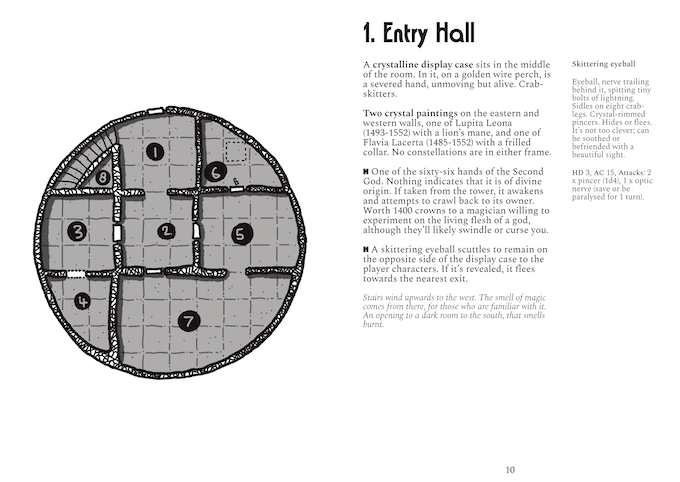
  • Colouring over inks

    I did some colouring (in the sense that comics have colourists) for Hodag’s cover for Advanced Fantasy Dungeons today, and it looked great! I’m really proud. I’d do some things differently, though, next time. I lost a lot of time figuring out the process and so I’m going to work out my process, for next time. So this is for my future knowledge!

    1. Make the inks transparent. You can do this in Affinity Photo more easily than in Procreate, but it won’t be perfect. You can make it perfect by using gradient map in procreate to eliminate the white outlines completely. Make the background bright to help identify its sorted.
    2. Pick a colour palette. I found that straying too far from the palette caused me problems because I winged it this time.
    3. Lay down flats, separated into their own groups, by depth (foreground, midground, background at least). Inks are top layer, background is lowest layer. Foreground is more saturated and usually brighter.
    4. Add highlights based on the light source (this time it was the dragon’s breath!), and put them in the same group as their flat. Highlights are based on the flat colour, just brighter and less saturated.
    5. Add shadows based on the light source, and put them on the same layer of their flat. Remember lay shadows form over shading as well! It makes a difference! Shadows are based on the flat too, just darker and less saturated. Oh I mainly used HSV values to choose colours for this because of this.
    6. Colour the light source (s) separately, in their own layer! I did two layers, one for the flame on the edges, and one for the white hot flame in the middle.
    7. Add in a brighter highlight. That’s the same value as the light source’s primary colour, but in a transparent layer over the highlights and I put in a few halos as well for reflections.
    8. Add some texture in its own layer, that was a transparent layer, too, and pure black. Use different textures to differentiate different subjects in the piece, in this case the cave, the dragon and the heroes got their own unique textures.

    I used faux copics for this, because they’re semitransparent and they’re not heavily textured, and I’m familiar with how to use them! But I reckon I could experiment with other semitransparent faux media like watercolours in future. I feel like layering opaque mediums like gouache and pastels wouldn’t work for this?

    Anyway, this was lots of fun. I’m usually highly critical of my art but this was something where I felt I actually achieved a product I was proud of. I can add colouring to a list of things I can do.

    You’ll see the finished product on Advanced Fantasy Dungeons’s front cover soon!

    Idle Cartulary


    Playful Void is a production of Idle Cartulary. If you liked this article, please consider liking, sharing, and subscribing to the Idle Digest Newsletter. If you want to support Idle Cartulary continuing to provide Bathtub Reviews, I Read Reviews, and Dungeon Regular, please consider a one-off donation or becoming a regular supporter of Idle Cartulary on Ko-fi.

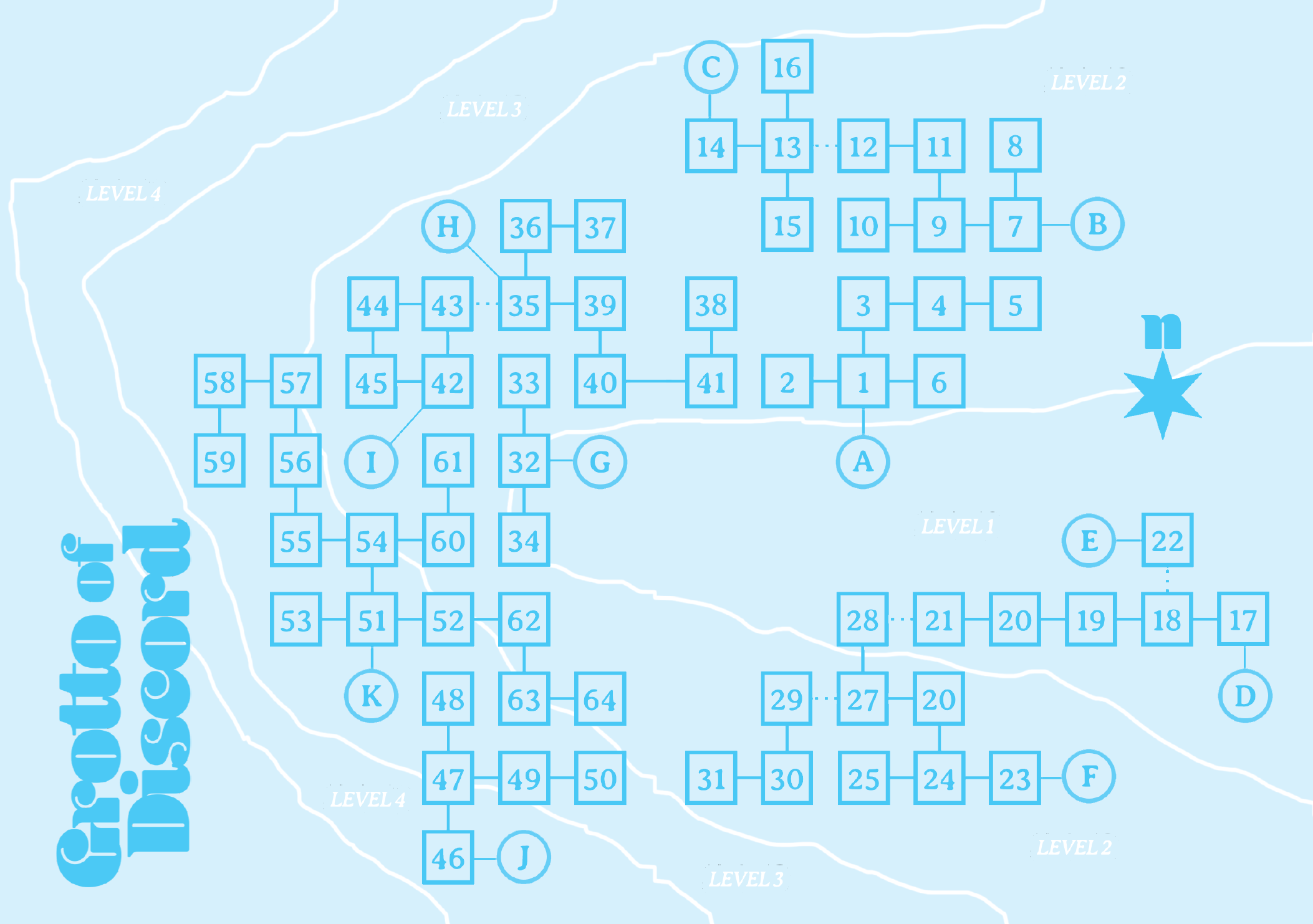
  • Megadungeon as an Overworld

    I started a low-pressure megadungeon. It’s the opposite of Dungeon23: I don’t have to do anything on it if I don’t want to, but if I’m stuck on something else I can go and just fill out a room or a faction or add an encounter or something. It feels a lot more feasible to me. It’s inspired by some of the same stuff Gus L wrote about here, through coincidence (I’ll refer back to that a few times).

    So I decided to not do a challenge this year!

    But, never content to let my mind be at ease, I realised…if it’s a megadungeon, perhaps some of the principles I thought about in Elden Ring and Overworlds apply, too, in an Underworld? Like, we have Tears of the Kingdom’s Depths to see a digital example of how it’s exactly the damned same, and while I can’t find a database that documents the depths, it’s basically all monsters, with only a handful of other points of interest at all.

    The Depths in Tears of the Kingdom

    Megadungeon Density

    Ok, the density information will have to be translated. This is a megadungeon, but if we’re treating it as an overworld after the model of Elden Ring, then we need to remember that the dungeons here aren’t dungeons (because the whole thing is the dungeon), we’ll call them sublevels. We’ll chunk it into Sets, where a collection of sets contains:

    • Five scenes: High uniqueness, low complexity, low hostility. ▲U/▼C/▼H
    • Five lairs: U/▲C/▲H
    • Two or three sub-levels containing traps, exploration and puzzles: U/▲C/▲H
    • One dungeon merchant or other utility (blacksmith, sage, trainer): ▼U/▼C/▼H 

    Ok, this is interesting. It gives us a little insight into those early Legend of Zelda dungeons, which had merchants in them. This is why this makes sense structurally. There, they were hidden: It makes sense that utilities be hidden in a hostile space. Also, there are some implications: Outside of sublevels, the megadungeon doesn’t have the same density as a traditional dungeon, which follows roughly a formula of 2 empty rooms: 2 monster room: 1 trap room: 1 special room. This works for the sublevels perfectly, as it proceduralises the complexity. Sublevels should be unique!

    The Betwixt

    What does the megadungeon look like outside sublevels, then? Let’s call it the Betwixt. Well, we have two options. We come up with a second formula, or we use something like Bloggie Award-winning Flux Space to abstract the Betwixt. Both of these are cool ideas, but I feel like using Flux Space is too big a goal for a design sketch here, and a formula for the Betwixt is actually staring us straight in the face.

    The Elden Ring map is 30 square miles. If you break it up into chunks that are equal with your vision to the horizon, that’s 300 chunks of map, or I’ll call them 300 lines of sight. In a dungeon, they’re rooms, right? Or potentially, areas where you can see into adjacent rooms.

    How many of these lines of sight contained stuff in Elden Ring? Per line of sight, we had 2-in-6 chance of a dungeon, 3-in-6 chance of a lair, 3-in-6 chance of a scene, and 1-in-6 chance of a utility (actually, a slightly higher chance of utility, but I’m liking the cleaner probabilities). These can translate directly across to the Betwixt as a d12 roll: 1-2. Dungeon; 3. Utility; 4-5. Lair; 6-7. Scene; 8-12. Empty.

    Let’s compare Sublevels and the Betwixt to get a sense of the difference in complexity:

    NumberBetwixtSublevel
    1LairMonster
    2LairMonster
    3Sub-levelMonster
    04Sub-levelMonster
    5SceneTrap
    6SceneTrap
    7EmptySpecial
    8EmptySpecial
    9EmptyEmpty
    10EmptyEmpty
    11EmptyEmpty
    12EmptyEmpty

    There’s quite a difference there in terms of complexity! That’s what we want to see. We have roughly 20% more hostility in the Sublevels than the Betwixt, and that will justify the increased reward.

    How many rooms are there in the Betwixt? If we assume areas are lines of sight rather than rooms, you’ll max out at 4 connected rooms normally, so let’s call it average and say there’ll be 300 lines of sight in the Betwixt, consisting of roughly 2 (1-4) rooms each, excluding sub-levels, so between 200 and 1200 rooms, probably 600.

    Building the Megadungeon

    So, how do we use this to build a megadungeon? For the whole megadungeon, we need to know:

    • Why is my megadungeon hostile to visitors?
    • Why visit the megadungeon if it’s hostile to you?
    • Where is the town? Is it at the surface, or in the dungeon?

    We don’t have to decide exactly where the town is in the dungeon if it’s there (maybe we just roll 1d6 each time we find a utility, and replace it with a town on a 6 the first time we do it), but we need to know if it’s in the dungeon. I’d recommend adding another town if we increase the size of the megadungeon beyond 300 lines of sight, as well. Our procedure will be:

    1. Generate Betwixt (until we roll Sub-level)
    2. Interrupt to generate a Sublevel (according to standard dungeon creation procedures, I wrote about one here, and plenty of other great procedures are out there like this one and this one and I’m certain Gus did a fire one as well) (add; Gus did! it was nominated for a Bloggie!).
    3. Repeat

    There are some things missing here, namely changes in elevation. Honestly, I’d probably just roll for a change in elevation every line of sight, because it makes sense to me for megadungeons to be a mess. Or, you could choose to have a broad flat megadungeon. Or, you could choose an arbitrary number of rooms per level; I’d recommend between 20 and 60 rooms per dungeon level, the lower number being the less traditional.

    Sub-levels

    Wait, but what characteristics separate a Sub-level from the Betwixt? In Elden Ring, they’re underground, but in a megadungeon that’s not the differentiator. I’ve got some ideas:

    1. Traps and puzzles found in greater quantities in sub-levels.
    2. Treasure is found in greater quantities in sub-levels.
    3. Sub-levels each have a unique visual or sensory theme.
    4. Sublevels are connected out of phase with the rest of the megadungeon.
    5. Sublevels have a unique ecosystem.

    I think most of these are self-explanatory. They can’t hold all the treasure or puzzles because that limits the possibilities for scenes. But most of it, certainly all the gold. They have to be readily recognisable from the Betwixt and from the other Sub-levels: “The Underwater Dungeon” or “The Lava Dungeon” or “The Fungus Dungeon” or “The Eyeball Dungeon”. Their NPCs or monsters should feel encapsulated, probably related to the theme, and have a faction or factions all of their own.

    The fourth point though, is important: Sublevels are both connected and disconnected from the Betwixt in surprising ways. They are the source of our loops. So, have them vertically between levels of the Betwixt, have them underneath the betwixt or above it, have them half between two sections of the Betwixt, or inaccessible from one. Have them lead from one area to another. They are our shortcuts deeper and our shortcuts back. They help us make sense of the labyrinth that is the Betwixt.

    Wandering monsters

    Ok, so our wandering monsters need to reflect this. Gus’ article also talked about this, the early example dungeons had multiple encounter tables for each level. I’m, not going to beat around the bush with that, but it’s a megadungeon, so we need a decently large encounter table, and we can use that to our advantage. So we’ll give each Sub-level a 6 item wandering monster table with equal chances of each encounter in the Sublevel, but structure it so that the rarest encounters in the Betwixt are at the bottom (i.e. rarest is item 6, but number them 6 to 12, trust me). Then, we build 5-item Betwixt wandering monsters tables, according to dungeon level (or whatever criteria suits your Betwixt design) and then put the rarest encounters are at the bottom (i.e. for this one, item 1 is the rarest). Whenever you’re in the Betwixt, you paste them together and roll 2d6. When you’re in the Sublevel, you only roll 1d6 for Sublevel wandering monsters.

    Sublevel Size

    The one remaining consideration is sublevel size. How big should a sublevel be? Is probably go back to the same 20 to 60 room hallmark, but it would be cool to vary it for surprise, particularly if we harken back to the predictable entrances principle: If we can identify our sublevels consistently, or even lay them out in similar ways using similar themes, we can use the expectations of the player characters to surprise and subvert them.

    Classically populated rooms are quite sparse of monsters, and really rely on Wandering Monsters to make up their populations, so I’d scale the size of the room up based on how many cool ideas you have: You have three cool traps, you’re aiming for eighteen rooms. You have eight cool monster encounters, you’re aiming for twenty four, etc.

    Polishing up and finishing off

    So, there are a few things missing from this procedure. I suspect I’d use Warren’s Punnet Monsters to populate the wandering monster tables. We need to pick an overall theme for what the Betwixt is. We need to figure out how we’ll structure the Betwixt, because that will inform how our Sublevels are generated. And, of course we still, no matter how much theorising we have to do, write a boatload of dungeon keys.

    But, that’s my thought processes in how we could build a megadungeon. I feel like it’s cool, because unlike anything else I’ve seen, it means that we can write it and map it in discrete chunks, of as little as 4 lines of sight or a maximum of 16 rooms.

    I’d love to hear ya’ll thoughts about this. This is wild dungeon design, and I’m pretty excited about it.

    Idle Cartulary


    Playful Void is a production of Idle Cartulary. If you liked this article, please consider liking, sharing, and subscribing to the Idle Digest Newsletter. If you want to support Idle Cartulary continuing to provide Bathtub Reviews, I Read Reviews, and Dungeon Regular, please consider a one-off donation or becoming a regular supporter of Idle Cartulary on Ko-fi.

  • Bathtub Review: Vaults of Vaarn

    Bathtub Reviews are an excuse for me to read modules a little more closely. I’m doing them to critique well-regarded modules from the perspective of my own table and to learn for my own module design. They’re stream of consciousness and unedited harsh critiques. I’m writing them on my phone in the bath.

    Vaults of Vaarn is a old-school post apocalyptic roleplaying game with new-school sensibilities, art and writing by Leo Hunt and layout by Guilherme Gontijo. It has been released firstly as the blog Vaults of Vaarn, then in an episodic zine format, and most recently in the deluxe hardcover version that I’m reading today. Despite there being a whole game here, the rules about 6 pages of a 140 page book, so its really a setting module in my esteem.

    I mentioned Gontijo because this book is good looking, inside and out. A striking embossed cover with white highlights and matching bookmark sets the tone for a gorgeous single toned ultramarine interior, fully illustrated by the author. Headings are super legible, with the exception of ancestries. Ancestries are marred by the management of large artworks, but they do make striking spreads, and while it compromises the in-session usability, these aren’t likely to be read in a session, or they? Typography is legible, elegant, and just a touch futuristic.

    I think a larger format would improve on these strengths, although at the moment Vaarn fits on my shelf along with the A5 hardback modules I have like The Isle, Witchburner and Halls of the Blood King, which is nice. The A5 format is certainly in vogue right now, and it’s convenient for carrying with you, but as a result the book doesn’t look as impressive on the shelf as Reach of the Roach God, but nevertheless it stands up there with that and Trophy Gold as one of the best looking elfgame books I own.

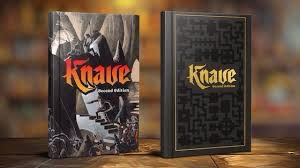
    Vaarn‘s rules are an elegant fork of Knave, a game I have little love for, as I feel it’s dry and ineloquent, but Vaarn’s Mystic Gifts rules and its barter system, are simple and flavourful additions for the post-apocalyptic fantasy world of Vaarn.

    From here on is world building by random table, disguised as character creation some of it uninspired, most of it fantastic. If you’re a synth, you might be independent because you realised “you must awaken the titans”, long dead gods of yore, or that “machines created humanity”. A mycomorph might be born mute but telepathic from the corpse of a king. These are short, immensely flavourful sentences. Mutations, however, feel plucked from the first edition of Gamma World, and not in a positive sense. Given an acknowledgement goes to Into the Odd, it’s a pity the mutations aren’t as intriguing as the ones there. This may be intentional, though, because Mystic Gifts are again bangers. A nano machine infection allowing you to see into the future; or randomly generate a gift (Grasping Sandstorm anyone?) Exotica are equally flavourful, a glorious mix of religious and faux technological that sell the setting perfectly. Vaarn’s character creation section is a masterclass in worldbuilding through implication, achieving what most fail at with aplomb.

    The bestiary is large (75 adversaries), fully illustrated and really fun. A favourite is the war camel with its hump-mounted flechette cannon. I would enjoy dropping these adversaries into a scene. I don’t love the hexflower approach to weather, even though I know it models it elegantly. I bought the print copy of this book, and so I’d have to print the flower and leave it on the table so I could track where we’re up to. The hexflower is also one of the few design missteps in the book; I think once I was familiar with it I’d be able to use it easily, but the patterns used to differentiate sandstorm from heatwave look similar at first glance, and the fills are shrunk in the legend and difficult to identify. On the other hand if you land in one spot you get “polychromatic light night like the tendrils of a jellyfish deity”, which is fire.

    I often complain about how random tables need specificity to work. Spark tables are to help you design and are a useful tool, but a module or game should have tables full of concrete things. Vaarn’s region generator, a full chapter of randomisers to help you create your personal Vaarn pointcrawl, almost nails this. Each location type is very specific at their best (although I don’t love columns of things like “Envy (Success) much at all). It’s a little uneven — some of these locations are immediately excellent on any roll, some would require a fair bit of work to get the fire burning. But I’m excited to make a Vaarn from this, even if it’s more prep than I’d like.

    If that was the whole book, I’d be disappointed, because at this point it’s asking me to make my own Vaarn, and attached some evocative rules and lists to that. But there are 40 pages to go! And those 40 pages go to the desert city of Gnomon and the adventuring sites that surround it.

    Gnomon is wordier than I’d like, the writing is solid. It’s easy to pick out excellent turns of phrase from amongst the paragraphs, although I wish I didn’t have to, particularly in the introductory sections. But from there, it gets terser and we’ll organised. Three sentences to a district, plus a few sights and sounds. An excellent structure to locations, similar if I recall to that used in Fever Dreaming Marlinko. These aren’t intended to be hooks, however, but rather vibes. “Elderly newbeasts play dominoes beneath a leafless tree” is poetic and casts the sense of a dry and lifeless world with life striving against it, but it ain’t adventure.

    Factions are where the adventure lies. There are 7 major factions that are fully detailed, 4 minor ones with minimal detail, and a further 7 specific random faction generators if you need more. Major factions take a page from Gamma World, with each having a condition to join, and expectation, and benefits. They also have what you expect: A leader and mooks, a goal and a look. A fantastic addition is advise on how to run each faction as a villain or as an ally, adding wrinkles such as a Baron held hostage by his captains or the grandmotherly Abbess instead burning unbelievers alive in rapture. The clear expectation is that the players actively engage with these factions, but no direct hooks are provided into them, which would add a lot. The sun total is a great toolkit that nevertheless requires manufactured desire for participation, desire that should have been folded into character creation if it wasn’t folded into setting.

    Finally, there are adventure locations, four spreads with maps and keys. They’re beautiful and well-written, but in a traditional style, rather than an evocative for improvisation style. I’m not usually one for balance in modules, but there’s a peculiarity in the level up rules here that rubs me the wrong way: You level up for selling or trading an exotica, a relic of the dead world. But each of these locations hides one in four to ten keyed locations. If they’re run as written and not improvised on significantly, you’re levelling up quite quickly. It occurs to me that a larger party, who as a whole require 4 or 5 exotica to level up, won’t progress too quickly though.

    Vaarn is a complete package when it comes to post-apocalyptic fantasy, a one-stop shop that is specific enough in its worldbuilding that it’s worth delving into. It is marred when it steps away from that. Inconsistent randomisers, that often could be some away with or made more specific. Descriptions that sometimes feel limiting. A lack of hooks to grant players opportunity to desire to look deeper, rather than expecting a reliance on meta norms. It expects a degree of preparation, but it’s scaffolded heavily, but a few weak points in that scaffold make it challenging to prep for someone who lacks confidence or experience in prepping this style of game. Luckily, if that’s not your jam, the locations already provided mean you’ll probably never need to use them if you chose, but despite a decent page count, they don’t feel likely to provide a lot of time at the table. That’s a lot of criticisms, but the consistency of evocative content and great writing in this is out of this world, and seriously outpaces books like Oz and Cess and Citadel in its ratio of imagination fuel to word count.

    I’m genuinely on the fence about whether the effort expected for me to run it, and whether it’s worth it. The writing and the vibrancy of the world — similar enough to other post-apocalyptic fantasies to be easy, different enough to be interesting — makes it appealing despite my misgivings. There are also a number of modules available, although I don’t know their quality. It’s a compelling enough setting that I could see myself writing something more to my own tastes for the game, which is probably a shining recommendation in and of itself.

    If you’re looking for post-apocalyptic adventure that’s light on mathematics, walks the line between gonzo and melancholy, and with a fairly good toolkit for generating content between sessions, this is probably the best thing on the market.

    Idle Cartulary


    Playful Void is a production of Idle Cartulary. If you liked this article, please consider liking, sharing, and subscribing to the Idle Digest Newsletter. If you want to support Idle Cartulary continuing to provide Bathtub Reviews, I Read Reviews, and Dungeon Regular, please consider a one-off donation or becoming a regular supporter of Idle Cartulary on Ko-fi.
  • Rules Sketch: Barbarian Class

    I’m chipping away at the AFD ruleset now, and I can’t help but feel like I want to add in those missing classes: Barbarian, Monk and Psionicist.

    Our template for classes is looking like this, on Version 0.14 of Advanced Fantasy Dungeons, this is the Fighter class:

    Gain proficiency in a weapon of your choice and proficiency in an armour of your choice at first level. Take two advancements from the following list at first level and an additional two at each level. You have advantage on saving throws against steel.
    • Add a new proficiency slot
    • Increase Strength by 1 to a maximum of 20
    • Increase a saving throw by 1
    • Increase the size of your hit dice before 9th level
    • Increase your number of hit dice before 9th level
    • Add a second attack per round once from 7th level
    • Add 3 HP to your HP total from 9th level
    • Can take elite followers from 9th level
    • Add a third attack per round once from 13th level
    At first level, gain the armour and weapon you have proficiency in, and two other items, randomly.

    Second Edition Barbarians can do these things:

    • Higher HD than anyone
    • Move faster while carrying load
    • Two-weapon fighting
    • Multiple attacks, as fighter
    • Can’t use fancy weapons or fancy armour
    • Better at jumping and climbing
    • Harder to surprise
    • When in their favoured terrain, they are better at survival, hiding, surprise, tracking and animal lore.
    • They can’t use normal magic items
    • Civilised people don’t get along with them
    • They can mimic the physical actions of animals from their homeland
    • THey’re restless; they don’t need sleep
    • They are great at weaponless fighting (as club)

    Honestly it’s fascinating how far they’ve changed in concept through 3, 4 and 5 editions. Here, they’re a combination of Ranger and Monk. When you delve into the Kits for Barbarian, though, you see traces of the Barbarian that is to come in the ravager:

    • Natural armour according to level
    • Can fail a save vs. death to go into a rage, gaining +2 attack and damage, +2 AC, -1 to attackers damage rolls, +2 to all saves vs. mental attacks. They also can’t change targets until the first target is slain, and must save again or become exhausted until they rest.
    • They can become involuntarily enraged in exceptional circumstances.

    I feel like I should name this class the Ravager for faithfulness, because the 2e barbarian clean is not very interesting.

    • Gain proficiency in a melee weapons of your choice and proficiency in unarmed fighting at first level. Take two advancements from the following list at first level and an additional two at each level. You have advantage on saving throws against steel.
    • Add a new proficiency slot
    • Increase Strength by 2 to a maximum of 18
    • Gain 1d6 of natural armour, that can only be used if not wearing additional armour
    • Gain 1 rage per day. If you have a rage remaining in your day, you can go into an involuntary rage if you fail a Domination saving throw.
    • Increase a saving throw by 1
    • You cannot be surprised
    • Gain magic resistance against 1 type of magic
    • Animal spirit. Choose a specific aspect of an animal, for example, leap like an eagle; bite like a wolf; strong as a bear, flexible as a snake; slippery as a salmon. You can take on this quality once per day. Negotiate with your referee what this means contextually.
    • You only need to sleep every other day.
    • Increase the size of your hit dice before 9th level
    • Increase your number of hit dice before 9th level
    • Add a second attack per round once from 7th level
    • Add 6 HP to your HP total from 9th level
    • Can take followers from 9th level
    • Add a third attack per round once from 13th level
    • At first level, gain the armour and weapon you have proficiency in, and two other items, randomly.

    Rage Rules:

    You can choose to go into a rage, or involuntarily go into a rage. You may continue to rage until someone is incapacitated or slain, but may not cease unless you just incapacitated or slew someone. While raging, you gain advantage on all attacks, roll an additional damage dice, gain 1d6 HP, and have advantage on domination saves. You cannot choose to change targets. When you come out of a rage, you take 1d6 damage.

    The Advanced Fantasy Dungeon Index is here!

    Idle Cartulary


    Playful Void is a production of Idle Cartulary. If you liked this article, please consider liking, sharing, and subscribing to the Idle Digest Newsletter. If you want to support Idle Cartulary continuing to provide Bathtub Reviews, I Read Reviews, and Dungeon Regular, please consider a one-off donation or becoming a regular supporter of Idle Cartulary on Ko-fi.

  • Surprise! New projects!

    Two new projects sprang fully formed into my head this week, so I thought I’d update you all on them.

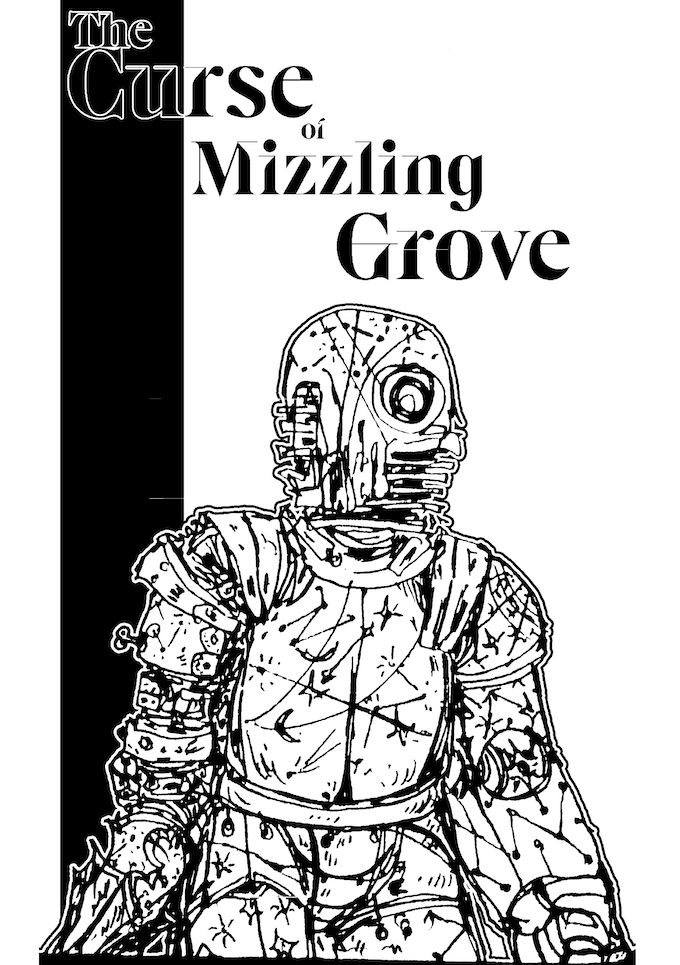
    Firstly I wrote a traditional, constrained dungeoncrawl called the Curse of Mizzling Grove. Just a small tower and its surrounds, a lot of treasure and some strange and eery creatures. I’ve written it, am seeking readers for detailed feedback (if you know me on discord and are interested, my DMs are open!), and am reaching out for artists to get it illustrated quick smart so I can fund it come ZineQuest. I’m going to use it as a test run for the Lulu kickstarter distribution arm, which I’m pretty excited about. I’m curious about the reception this will have; it’s about the most traditionally structured module I’ve written, drawing inspiration from some of the best short form modules I’ve read. I’ve statted it up for B/X, as well, so it’s well positioned.

    Secondly, after the positive reception I’ve had in trickles ever since I wrote the Advanced Fantasy Dungeons series, I’ve decided to bring that to publication. The reason I hadn’t so far, was because I hadn’t playtested it, but that’s not looking to be on the horizon. I’ve thought about doing it before — the positive comments have been pretty steady since it went live two years ago — but this time I’m actually doing it. It’s be a version for playtest I’m calling the Ashcan Edition. It’s not especially accurate a term, it’s a very pretty homage to the 2nd Edition Dungeon Master’s Guide. I’ll make it available on Lulu as well. It’ll be on Lulu for cost and for free in digital format, as it’s not exactly complete is it? But hopefully together, we’ll make it complete. I’m gonna whip up an Advanced Fantasy Dungeons discord when the crunch arrives, and make the invite freely available for people who’re interested in helping me develop the design further.

    Anyway, that’s my project update. Two new things coming soon! I’m still ticking away at my larger projects, as well, but this is giving me a refresh. My mothership module, the Tragedy of Grimsby-Almaz, is just complex work; Rats in the Cellar is challenging me on the mapping front; Bridewell is being held up by art, but also I’m considering reformatting that monster of a book; I’m also working on a holiday module inspired by Chris Bisette’s advent calendar modules; and my print edition of Hiss that I’m collaborating with Marcia B of Traverse Fantasy on is sitting with her for layout before I can make it available.

    It’s a good time to be creative, huh? Artists, keep on your toes, there’s a lot of work on the horizon if I can find the dollars for it!

    Idle Cartulary


    Playful Void is a production of Idle Cartulary. If you liked this article, please consider liking, sharing, and subscribing to the Idle Digest Newsletter. If you want to support Idle Cartulary continuing to provide Bathtub Reviews, I Read Reviews, and Dungeon Regular, please consider a one-off donation or becoming a regular supporter of Idle Cartulary on Ko-fi.
Want to support Playful Void or Bathtub Reviews? Donate to or join my Ko-fi!


I use affiliate links where I can, to keep reviewing sustainable! Please click them if you’re considering buying something I’ve reviewed! Want to know more?


Have a module, adventure or supplement you’d like me to review? Read my review policy here, and then email me at idle dot cartulary at gmail dot com, or direct message me on Discord!


Recent Posts


Threshold of Evil Dungeon Regular

Dungeon Regular is a show about modules, adventures and dungeons. I’m Nova, also known as Idle Cartulary and I’m reading through Dungeon magazine, one module at a time, picking a few favourite things in that adventure module, and talking about them. On this episode I talk about Threshold of Evil, in Issue #10, March 1988! You can find my famous Bathtub Reviews at my blog, https://playfulvoid.game.blog/, you can buy my supplements for elfgames and Mothership at https://idlecartulary.itch.io/, check out my game Advanced Fantasy Dungeons at https://idlecartulary.itch.io/advanced-fantasy-dungeons and you can support Dungeon Regular on Ko-fi at https://ko-fi.com/idlecartulary.
  1. Threshold of Evil
  2. Secrets of the Towers
  3. Monsterquest
  4. They Also Serve
  5. The Artisan’s Tomb

Categories


Archives

January 2026
M T W T F S S
 1234
567891011
12131415161718
19202122232425
262728293031  

Recent Posts