I just this moment realised that a month ago I started a podcast, and I haven’t told anyone what it was about.
Here’s the pitch: An episode a week, less than 10 minutes long, each about a single module from Dungeon Magazine. Tear it apart, find the problems and the great things about it, and translate them into things to apply to your home game.
How did I come to that? So, a year or two ago, I discovered Monster Man, a podcast that came in very short, bite-sized episodes, each about a monster from a monster manual from the history of Dungeons and Dragons. It’s an absolute banger, to be honest, and James Holloway must have some kind of background in folklore or mythology studies because what he brings is absolutely fascinating.
I started to think about other ways to use that capsule-sized podcast format. And the first thing that came to mind: Dungeon Magazine. This is before I started even the first, Twitter-thread version of Bathtub Reviews, when I first became interested in reading and analysing more modules to see what makes great, good and not-so-great modules tick. I actually recorded an episode back then, and then I fell sick and never had the capacity or energy to continue. The first episode, “The Dark Tower of Cabilar” has been floating about in my mind since then, and while I reconsidered it when I finally recorded it, my opinions haven’t really changed. In fact, my opinions on Dark Tower of Cabilar influenced my upcoming module, Bridewell, considerably, and solidified my belief that we have a lot to learn from even not-so-good modules.
So, I recorded a few takes of a first episode, polished the format a little, and am trying to figure out how to make my set up cleaner, but on a $0 budget it’s difficult. I figure it’s better to make a thing than make a perfectly produced thing. I’ve now released episodes for the first three modules of Dungeon Magazine.
If you want to listen to it, check it out on Apple Podcasts, Google Podcasts, or Spotify, or Podchaser, or probably any directory you want. If it’s not on your directory, let me know in the comments and I’ll add it! I’ll try to keep up a new episode every Sunday.
Bathtub Reviews are an excuse for me to read modules a little more closely. I’m doing them to critique well-regarded modules from the perspective of my own table and to learn for my own module design. They’re stream of consciousness and unedited harsh critiques. I’m writing them on my phone in the bath.
Midnight in Bonetown is a 41 page module for Cairn by Luke Simmonds. This is one of a few submissions I’m reviewing from the A Town, A Forest, A Dungeon Jam, as a part of boosting up and coming hobbyist creators. It’s about a village of the undead who have lost their necromancer and hire the party to get him back.
Layout-wise, it’s a decent effort. A single-colour effort, layout is clear, uses sidebars well, headings signal information clearly. It’s reminiscent of Clayton’s template, but the proportions are off enough I suspect it’s Luke’s own work. I don’t love the choice of high-level heading font — I find it a little challenging to read — but otherwise typography is simple and helpful. It doesn’t overuse the bold highlighting or use too many stylistic variations like so many modules do. Art is whimsical and suits the adventure; the map is amateurish but enough for its purposes and has character, I just wish the style matched the art better.
The writing here varies from way too wordy and just needs an edit or some dot points (the opening paragraph) but absolutely excels in its tables, a great highlight being the Bonetown Skeletons table which is jam-packed so the iconic, evocative characters to pepper the town with. Terse, punchy writing doesn’t come better than this, and Luke brings a dose of Nightmare Before Christmas whimsy to the narrative voice in spades (“Smoking on the corner in a leather jacket; uses slang incorrectly”). Falls short in other places, which is where a hobbyist like Luke needs an editor, (“Balstrava the witch is a former associate of Gebert who has gone mad from mushroom spores and runs around the forest causing chaos.”). If it weren’t such a huge commitment, I wish I could offer editing services to hobbyists like Luke who show great promise.
The factions and characters around the adventure add a fun amount of complexity to the proceedings, and twist and subvert expectations. There is a red dragon, for example, object of fear and awe and a high lethality game like Cairn, who provides a fairly challenging fetch quest for his freedom, and whose likelihood of betrayal, I suspect, is quite high. I love opportunities for drama and ways to bring disparate characters together and into conflict.
The final dungeon is a solid crawl, and I appreciate the hazard die incorporation but with a twist, the reliance on random encounters to tell the story, and the existence of wildcards foe the PCs to foolishly cause havoc with (what party with a resurrection stone won’t be tempted by the ancient dragon skeleton?).
All in all, Midnight in Bonetown is a commendable effort, that definitely makes for a fun detour in an underdark adventure. I’d throw this into a campaign, but I probably wouldn’t play it in isolation. With a little more consistency and attention to detail, this would be an instant recommendation, but as is, if you want a whimsical skeleton adventure, I honestly don’t know of a better one. It’s for certain worth more than the free it’s going for. I’d download it and see if it’s to your taste, particularly if you’re populating a map.
In a recent RTFM episode, Chris Bisette talked about how they wish there were more session reports. However, they aren’t the session reports I’m reading out there, which are usually narrativisations of play (the kind of reports we often write as records for our play groups themselves). They’re suggesting we talk about how the referee plays the game and why.
This stirs me, a little, but the problem is, “How did I adjudicate the session I’m running?” is a hard question to answer; I don’t know how I do that. I’ve been running variations of D&D since 1993 or so, inconsistently, and since 2010 consistently, so a lot of what I do is automagical, with no real conscious consideration.
Which, like: That’s exactly the type of referee we want active conversations about how they adjudicate. Like, an unsaid part of the conversation on Trophy Gold that exploded a few weeks ago as a result of the Bones of Contention review was, is it actually that Ram/Alex/Nova are all very experience referees that makes us feel like Trophy Gold is good? Does it simply lean into the strengths of experienced referees?
So, I reached out on the socials and discord, and got a lot of responses to the question “If you wanted someone to write commentary on how they ran their elfgame, what questions would you want answered?” Thanks to everyone who contributed, I won’t name everyone here, but you know who you are. I’ll add that Chris themselves linked to their own attempts at doing so. I’m going to distill it down into a proformer, that I might be able to use to help me verbalise some things that are going on when I run. I’m not running a regular game right now, though, so it may be a little while before I have a chance to implement it (although, I am writing a Mothership module, The Tragedy of Grimsby-Almaz, right now, so perhaps we’ll get some playtests to talk about). I might just apply it to a game that I’m playing in, though, as a test.
What did I change about the module? Why? How successful were those changes?
What rulings that weren’t rulebook supported were made, and why did I make them?
Did I have to work around the rules in order to facilitate play? How?
How did I use procedures to facilitate play?
What did I modify “behind the screen”, and why?
When did I tailor things to my table instead of randomising them?
Were there any pain points in the session, and how did I respond?
Were there any emotional or triumphant moments, and did I or how did you facilitate that?
How did I maintain pacing during this session? Did I have to work to balance attention between players?
Was there any prep that felt wasted or unused on reflection?
When did I have the most fun this session? Why did I think those parts were fun?
I tried very hard to reduce it to 10 questions, but failed. I removed some higher level questions suggested by Chris Chin and others, as well, deciding instead to focus on within-session dynamics, on refereeing rather than designing, as much as that distinction is tenuous.
Anyway, I’ll try to remember to apply some of these questions in writing future session reports, to make them more of a study into how I referee them!
Bathtub Reviews are an excuse for me to read modules a little more closely. I do them to critique well-regarded modules from the perspective of my own table and to learn for my own module design. They’re stream of consciousness and minimally edited harsh critiques. I’m writing them on my phone in the bath.
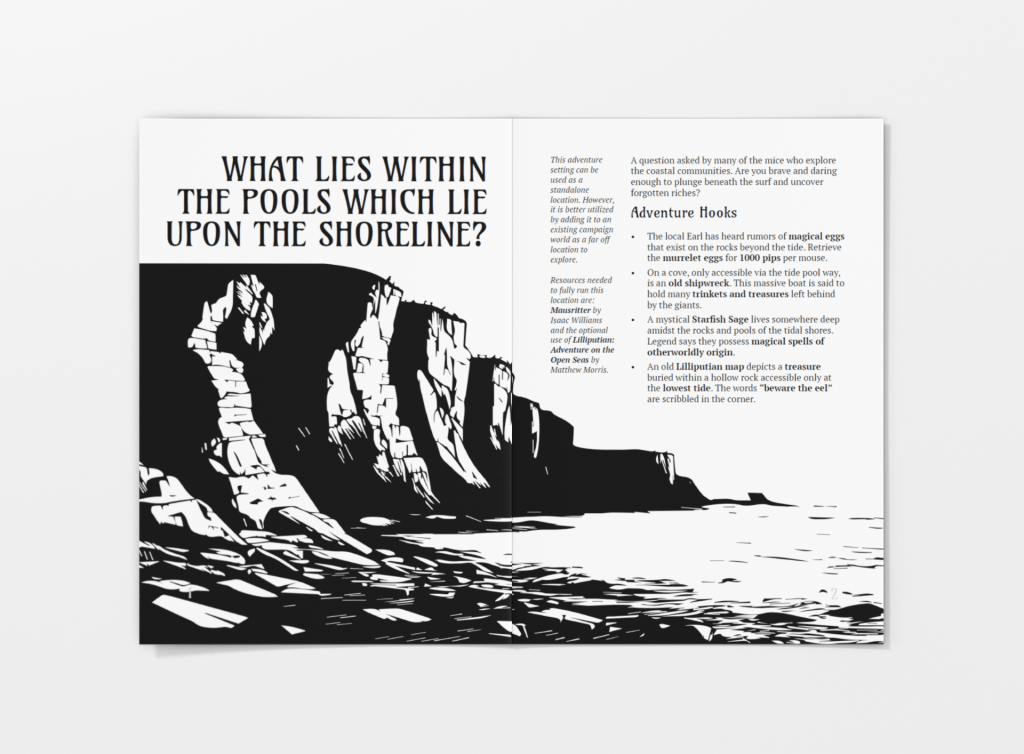
What lies within the pools which like upon the shoreline? (henceforth Shoreline) is a 24 page coastal pointcrawl for Mausritter, by Matthew Morris with absolutely stellar curated public domain art. This is a sandbox in a format that approximates the Mausritter house style, with an unfamiliar theme.
It’s the second module I’ve reviewed that utilised the Classic Explorer template by Clayton Notestine, and demonstrates the flexibility of the template in comparison to Howl. It is a great deal bolder, more reminiscent of OSE with its highlighted headings but using similar bold highlights, italic descriptions and dot points as core Mausritter. It has a clear but not flashy layout, relying on bold art for punch, and places mock equipment cards in the margins, which is a fun and unique use (otherwise, the sidebar is used just for tips).
I’m always eager to read more Mausritter modules, as Mausritter is an exceptional game and yet I struggle with releasing myself into the magic of the setting. Taking the familar-yet-unfamiliar Mausritter themes and placing it in tidal shoals makes for an interesting, iconic landscape with a wide range of inspirations from folklore to swashbuckling films. The vibes in Shoreline are impeccable; it feels like a grey day at the beach collecting shells.
The opening map which I assume is Morris’ work is simple, evocative and excellent. Clever touches mean that alot of traversal information is hidden within the map itself.
Mausritter itself is an incredibly terse text, and especially it encourages this in its modules, firstly through the significant amount of time it devotes to locations in the core book, and secondly through modelling in its starter module and in its boxed set, the Estate. In Shoreline, this terseness is replicated — something I hesitate to criticise — with mixed results. Pondering the subject of terseness, I think the key to my heart is specificity combined with terseness; brevity in and of itself is not a virtue. An excellent, terse rumour is “A magical sword was lost by a Sandpiper knight in a forgotten pool, lost to the sea.” In one sentence, we have a key item, a key location, and a clue as to the local flavour. A less successful random encounter is “An adventuring party from Coralridge”. There is no reference to this adventuring party elsewhere. I, as a GM, have to come up with, on the fly, a rival adventuring party, their motives, their names. Five words prompts can work, if their referents are elsewhere defined — in the same encounter table “The Gull out hunting” works just fine, because the Gull is detailed elsewhere.
I suspect where this occurs, it’s because of a familiarity with and an adherence to the Mausritter house style. For example, the factions are written out exactly as recommended by the core book (if my memory serves); this is in my opinion an exceptional way to lay out factions for your home game, but not sufficient for a published module. In a published module, I want a little more. For example, the Surfsiders gang aren’t clearly detailed in their faction section, and it only becomes clear they’re a gang of rat pirates on the back cover. They have no leader or named characters, and the location of their secret lair is not named. What is included is solid worldbuilding and enough for the faction as a whole, but not enough for me to run it straight from the book, which is disappointing to me. What is here is good, but feels incomplete.
There is a lot to love here. While the writing isn’t beautiful in and of itself, the imagination behind the locations and the images it conjures are exceptional. I’m playing Pikmin 4 with my children right now, and Coralridge Fortress reminds me of the monstrous children’s playthings of that game. These descriptions are consistent throughout the zine — I want to run these locations based on the initial text. But, descriptions of the paths occur here as well, which feels messy and might have been best as labels or as information on the map, and there is an encounter table for many of these locations which I’d rather be briefer (most are 8 items), with a little more detail. “An Octopus looking for a new home”? All I have here is the difficult to reconcile “Wants to assert dominance in its pool”.
This is a good module, that requires a little more preparation than I’d like to put into it. I think that these concerns could be easily remedied, and I see signs are there that the author can excel at these more specific, evocative descriptions, but are limited by the existence of the Mausritter house style, in a similar way to seeing Luka Rejec’s flamboyant style limited by the OSE house style. I’m starting to develop the opinion that the existence of house style templates that are pretty good (and Mausritter and OSE are two of those) are resulting in authors limiting their colouring to inside the lines, instead of feeling empowered to paint whatever they desire, leading to a good number of decent modules in those house styles, but that leave me with the impression that those authors would be capable of amazing things if they weren’t placing these limitations on them.
If I wanted to run a small campaign in Mausritter, I’d probably choose this. It recommends itself as an expansion, and I think this would be even better as an extension to the Estate, for example, because while this is a damned interesting setting; I probably couldn’t run it with as much ease as The Estate and it doesn’t come with as many immediate hooks. It’s much more striking a setting though, and well worth incorporating, although you’ll need to put some work into supplementing what’s here and preparing to run it.
Bathtub Reviews are an excuse for me to read modules a little more closely. I’m doing them to critique well-regarded modules from the perspective of my own table and to learn for my own module design. They’re stream of consciousness and unedited harsh critiques. I’m writing them on my phone in the bath.
I reached out on the Cairn discord to see if there were any up and coming module writers who’d be happy for me to review them, in the knowledge they were hobbyists. I got a good number of recommendations, which I’ll be tackling in upcoming months. One is, Ingrown Hairs. Ingrown Hairs is an 8-page module for Cairn by giantrobottackler. This is the definition of hobbyist: It’s on A4 paper, hand-drawn maps in Microsoft Paint, public domain art. But, one of the most acclaimed modules in recent release, Wolves Upon the Coast, ain’t got much in the way of layout, and relies on its writing to pull it through, so these reviews will be an excuse to focus on what’s important.
In terms of layout, Ingrown Hairs uses the A4 format very well spatially, with 1 location per column for the majority of the text. It uses a bullet-style presentation, which works well in this two-column format, although I think I’d do away with the dot points for the stat blocks and the exit descriptions, and distinguish them better with font choice and simply not being dot points. The paucity of fonts and point sizes in the text does contribute to a challenging read, but it’s functional. I especially like the touch of including sign (or what I tend to refer to as omens) on each of the exit choices.
The author opens with terse humour in a casual voice, and it works well in my opinion, although it probably needed a second person to read over it before going to print for some line-editing. I don’t mind the approach at all of writing an ostensibly horror module in a dry voice, but sadly the voice mainly exists in the introductory sections, where the location descriptions (the majority of the module) are in a drier descriptive style. I would have loved the humour to remain present throughout the module.
On the other hand, I really like the descriptions in the locations for the most part. They’re no more than three sentences per bullet point, and can be quite evocative, for example thorny vines “drawn slithering to blood, and a fresh supply causes them to become engorged and sluggish”, or a horse-sized crow “its skin itches with bark-filled bumps, desperate for growth”. It also has neat world-building clues scattered throughout, like “every good hearth has a small tending spirit, though most stay hidden”.
The authors good writing is held in tension with a lot of functional writing, particularly exit descriptions. My gut feeling is that here is where a better map may have made the module more runnable, because these descriptions could have been on the map rather than tagged onto the end of each location, and I’d spend less time looking forwards and backwards. The map actually shows a lot of information, and for a small number of locations (11 in total), it has some nice loops, including an additional route back to the village. Perhaps another solution that would fit a minimalist approach would be to number the paths.
Ingrown hairs is a damned good free module, all in all. Regardless of flaws, this is a module I could run from the paper without any preparation other than printing the map on a separate piece of paper and maybe labelling the paths on it for ease. It’s written well, and the mysterious author is one to keep an eye on for future modules, if this is anything to go on.
It’s been a big week for releases for me this week!
I mentioned a few days ago that I’d released my Mothership module written in collaboration with Hodag! It’s called HELL ON REV-X, and is a depth crawl through a derelict space hulk with four factions to interact with! I’m really proud of it and it looks hot! Get it here!
And today, I released a new edition of Hiss, this one with full stats for creatures and treasure for Cairn by Yochai Gal! I prefer the agnostic version, mainly because I had to shuffle the layout a little to fit all the extra text into the same amount of pages, but you can run Cairn straight from the zine now! If you bought the agnostic edition of Hiss, this one is free for the next month or so, but after it you’ll have to pay for the new edition. Get it here!
Yesterday, I finally released the first episode of Dungeon Regular, my capsule podcast reviewing the modules in Dungeon Magazine, starting with Issue #1, September 1986. I was inspired to start this because I love the short format of Monster Man, so each episode is less than 10 minutes long, but I’m not sure I can keep up that show’s incredible pace with everything else on my plate. I’ve been planning to start for a year and a half, and it took this long for the same reason! The direct link is here, but just look it up on your favourite podcast directory (I use Pocket Casts!). The production quality needs to be improved, so I’ve started a Ko-fi as well, to help fund hosting and better equipment and production software, and if we achieve those goals, also help me fund modules for Bathtub Reviews. If you want to support me that way, rather than buying HELL ON REV-X or HISS: Cairn Edition, My Ko-Fi is in the sidebar or support me here!
People wonder why I write modules in the unique style I do, and wonder how the hell I run games the way I do, and I’m always like “well, anticanon and blorb play aren’t mutually exclusive” and then they’re like “please explain” and I’m like “I can’t, read Bridewell or Hiss maybe that will help”.
Lich’s Libram gets it. I have no more to add at this time.
So today, I released HELL ON REV-X, a Mothership module I collaborated with HODAG on. Here’s the pitch:
The Revelation X, a derelict city-sized generation ship, is adrift. Something apocalyptic is amiss. A space cult! An extradimensional god! A resurrected alien civilisation! A malevolent AI! Welcome to HELL ON REV-X, a depthcrawl for Mothership RPG, by HODAG and me! Out now!
I did something unusual with this release. Instead of giving away free community copies, I charged for them. The minimum I could without accruing a cost after store and paypal cuts. But it’s not free. I still won’t make money from them, but they’re not free. With the proviso that if you can’t afford a community copy, I’ll just give you one of you ask me.
Why am I trialling this? Well, because I find it really hard to believe all 90 claimed community copies of my last release, Hiss, are actually getting played. I would love to believe they are or will be, but I doubt it. They’re just sitting in peoples libraries preventing 90 other marginalised person from actually playing it. Assuminggood faith on behalf of those 90 claimants.
But either paying a little, or asking me directly means a buyer is really interested in the module. So my hypothesis is this: I won’t give away as many community copies with a fee, but those that do charge or reach out to me will run the module.
If I’m right, I’m excited to see people playing this more. If I’m wrong, I’ll go back to the way I’ve always done it.
Update! My original arrangement broke itch.io’s systems, so I’ve changed it to having to choose between a discount copy and a full priced copy. Let’s see how successful this, less ideal version is!
Bathtub Reviews are an excuse for me to read modules a little more closely. I’m doing them to critique modules from the perspective of my own table and to learn for my own module design. They’re stream of consciousness and unedited critiques. I’m writing them on my phone in the bath.
Hounds of Hendenburgh is a 20 page module by Liam Pádraig Ó Cuilleanáin, for Cairn. It’s an entry to the A Village, A Forest, A Dungeon Jam that I’ve been looking at select modules from to draw attention to interesting and exciting things up and coming creators are doing. It’s about a village under attack by a pack of spectral hounds.
While the layout choices aren’t the prettiest here, Liam takes excellent advantage of public domain art and chooses an extremely clear layout and formalised structure that makes Hounds very easy to run. It’s broken clearly into sections, often devoting one entire column of its two column layout to a single section. Stat blocks and treasures are separated out and given unique highlighting. It’s a little formal for my aesthetic tastes, but it’s very clear who is who and what must be done.
The writing flits between overly verbose and the colourfully succinct, but needed a second pass. I loved “Shifty and beady-eyed, Elisabeth is avoided by the villagers, who avoid the barn she requisitioned as a makeshift morgue.”, for example, but the entire paragraph on the Crones is full of redundancies. I really like the villagers, who aren’t exactly dense on petty politics, but who often have their own secrets. I think this would be a fun village to run. The formal conceit isn’t too strictly adhered to here, either, to it’s benefit: some characters have the subheading “The Whole Truth” if they’re hiding something, but others do not but rather have “Might ask the party” or “Might offer the party”. This is excellent use of formal structure for usability.
I’m torn about the hooks and the “Defeating the Hounds” sections. The hooks are a little vague, and don’t directly tie into the hounds. One could make the argument the third, a deed worthless until the hounds are gone, is tied in, but it involves a fair bit of fluffing about. I appreciate the clarity the Defeating the Hounds section provides, but it also feels limiting, and I fear the party would become listless if they missed the next step in the algorithm. The adventure relies on the confluence of rumour, hook to make specific plot threads occur, and they feel not quite tight enough. This is actually one reason I pedantically call rumours secrets: The suggestion that this is just stuff people know and will talk about. You’re less generous with rumours. It might also be fun to frame it as gossip in a petty town like this one.
I really like the forest key here; terse punchy and evocative pretty consistently. “The most ancient of the crones. Stands 10 ft tall. Naked apart from the cloud of flies that cling to her old leathery flesh. Speaks in a sonorous and booming voice that shakes the treetops.” It does feel like the Highwaymen’s Tower could have been treated as a dungeon though, given its high importance to a key plot point. I would have preferred the random encounters incorporate a little more world-building, though: The Kryptwood is supposedly an ancient and evil place, so it feels weird that so many of these encounters are relatively mundane.
The dungeon, the Tyrant’s Tomb, has me feeling mixed. There is a lot to love: There are bored riddling skeletons. There is an evil wraith who’ll grant you your wish for its freedom. There’s a very cool sword that needs to be bathed in brains for a day and a night to be recharged. But then, none of the solutions to the spectral hounds involves not clearing the tomb, which is disappointing. More exciting would be for each of them to be very different. Currently you must escort the Pastor there. Make the other two options equal parts special mission. The problem with that (and with the Pastor approach) is the creeping, unstoppable guardian, a feature I feel might be an irritatingly unsolvable problem killing key NPCs, rather than the ticking xenomorph-like clock it’s intended to be. I think it would’ve been best to include a non-combat solution to it, though, so you can succeed at the tomb through planning, or at least given it some personality to influence or a program to manipulate.
Overall, I really liked what Hounds was going for here. It would require a few tweaks in terms of hooks and in the final tomb to make things a bit more exciting and I’d probably straight up provide the three options for defeating the hounds so they can choose the one they find most interesting. I could see it being fun to find one method, fail, then try again, but it might also just be frustrating depending on the group. But it’s flavourful, fun, and generic enough to drop into your home campaign for a few weeks of digressions.
This is a polish-up of a tweetstorm I wrote a while ago. I keep forgetting that it’s better to write here than on Twitter; force of habit I guess.
I saw someone talking about how “only certain important NPCs really need detail”. I came to thinking of how I applied the concept “all NPCs are major” when writing Hiss and Bridewell.
Obviously this is an impossible aim — after all, there are potentially infinite NPCs — but this was a driving force for incorporating the sly and suggestive approach inspired by Haiku and Sijo I took to describing characters (and everything else) in them.
During writing of Bridewell, I realised that by choosing which NPCs are the main characters of the story, I’m choosing the direction the story may take by limiting the referees choices. If all NPCs are major, then any route the story takes is the right one. I am constantly surprised at the routes players of Hiss and Bridewell have taken, because any route is supported.
The trade off is to fit this amount of opportunity into the module, I can’t fit all these major characters into a book if I give them all one-page character descriptions. So the referee has to take the seeds that my short descriptions provide and let them grow in their own minds.
Practically I’ve found that I have two levels of description. I’ve got multiple sentence descriptions, usually two or three sentences in length, but up to five, used for characters that definitely exist, and I’ve got single sentence descriptions, usually two or three words in length, but up to five, used for characters that exist to be picked out of the crowd. These shorter descriptions usually come in lists — d6 in Hoss and d14 in Bridewell — for when the PCs as to grab someone off the street. A useful technique to make the world seem more real, is to include some of the longer described characters in these lists too. This results in the result of the d14 druid roll potentially being one of the townspeople you met in the pub, an actual campaign–redirecting even that occurred in Bridewell for instance.
I have utter confidence in referees, even less experienced referees, capacity to do this.
So when you’re thinking about writing NPCs, consider that by grouping PCs into major and minor, you’re effectively providing a railroad through characterisation. It’s impossible to remove all guidelines. But what would it look like for all your characters to be major characters and none of them bit players?
I’d love to see what your version of this might look like; no doubt very different from mine. But if you’re curious what gesturing towards this may look like, Hiss is a load of fun to run and it’s the first release where I’ve tried to do this. Bridewell is yet to be released, but it’s the same, but on a far larger scale.
I use affiliate links where I can, to keep reviewing sustainable! Please click them if you’re considering buying something I’ve reviewed! Want to know more?
Have a module, adventure or supplement you’d like me to review? Read my review policy here, and then email me at idle dot cartulary at gmail dot com, or direct message me on Discord!





 Playful Void