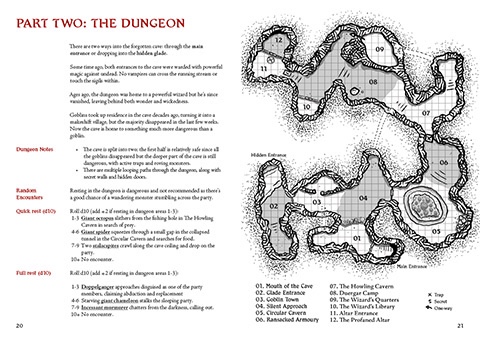
Hiss is the zine-length adventure I wrote as a palate cleanser after finishing my gothic horror sandbox Bridewell. It’s a 30 page adventure, inspired by one of my favourite classic modules, Against the Cult of the Reptile God. Previous Play Report here. Ferdrek and Ursaline, played by Sandro of Fail Forward and Marcia of Traverse Fantasy, had made buddies in the Wild Weasel Inn, and decided to leave them there, and head straight for the Church of the Willowmother, under which their captive cultist had told them the cult was based.
They climbed the giant willow tree in the churchyard, which was sickly and dying, and found a swarm of snakes in a bleeding hollow in its trunk. They decided to burn the snakes alive, and in doing so, the willow itself burst into flames, shuddering and shrieking. They fled behind the church, leaving a commotion behind, and abseiled into a crater that swallowed a portion of the church.
They descended into a sandy catacomb filled with red-clay sealed niches. On the descent, they stopped to investigate a strange tapping, and found a reptilian creature making golden jewelled scales in the middle of the night. They killed it, but not before an earthquake rocked the catacombs they were in and banging and screaming began to echo throughout the area. They followed someone who lit a candle, Ferdrek knocking them out with a headbut, but more followed! Ursaline made a vow to a god with no name to bring her vengeance, and was gifted a magical wooden sword! They opened the door, unleashing savage root-animated skeleton women who attacked the cultist who had come to investigate!
Dashing past the fight, they found both a culvert through which they could escape, and the sanctified bones of a long-dead priestess. They bargained with her furious spirit, animated with the anger and pain of a tortured goddess, to not slay all the cultists until they had slain the cultists’ leaders. The priestess agreed, but only for a short while. Her rage must be satisfied.
Down the culvert, they found their way to a huge geode and an adjoining dream-wrought temple, occupied by a house-sized snake god with a bulging belly, sleeping. They doused her with oil, but Ferdrek touched her mind and was overwhelmed, his mind near breaking point. Ursaline gutted her, to pull whatever she had devoured out of her belly, but it was not food but a child: a gestating galaxy the size of a dumpster. Avoiding it, they attacked with their magical sword and flaming oil, slaying the great snake as it thrashed and burnt, almost bringing the catacomb down around them.
With her final breath, the snake-god screamed an immense psychic scream, wiping Ferdrek’s mind and leaving him dead. Same psychic scream fried the snakes that inhabited the villagers, and awoke what villagers were not already awake due to the burning willow. Ursaline carried Ferdrek’s dead body to the surface, and laid him to burial, burning, upon the shore.
Wow. I don’t mind my zine-length module running it in two sessions, but Marcia and Sandro speed-ran this dungeon! All through legal means, though, it’s a significantly jacquaysed dungeon and they took some interesting routes, and chose to raid it at 3 am, which meant there were less (awake) foes between them and their goal.
It never ceases to amaze me how consistently my expectations for what players will choose to do are upended in playtesting. I never anticipated the burning of the willow, nor the freeing of the skeletal priestesses, nor the bargain with them. I appreciate the interaction of their description with Ursaline’s vow, not something I anticipated having to deal with.
It’s also great to know that I packed enough content into 30 pages that we can run two 3 hour sessions and still completely miss two entire factions and countless characters. Writing a module that can run equally as a high-speed raid, or a slow-burn base town, is really cool. I didn’t anticipate the high-speed raid, but it worked, and the pressure I tried to work into it was clearly a success (although rests may have helped Ferdrek survive the night).
I picked up on a few minor problems with the module, but honestly, the integration of maps and key was pretty good, I added and rewrote a few lines, but largely it ran as intended. Sandro tweeted about it here and Marcia here. I’m pretty happy to revise a little art, apply my changes, do a proof read, and publish Hiss, I think.
Y’all have probably heard people say “It’s just an elfgame, don’t take it so seriously” or some such sentiment. It’s always been a soft derogatory term, although some disagree. I think it’s soft derogatory because while elfgames are fun, they’re still, I think, important.
At some point, I was chatting to Marcia B of Traverse Fantasy, about how I don’t like identifying as OSR, for a wide range of reasons, but also didn’t love the alternatives.
I want to distance myself from the complex and sometimes problematic history of the OSR, I don’t want to define myself in relation to it like NSR and it’s variations do, sword-dream is well intentioned and has largely faded away.
And Marcia said (this is how I remember it) “I just want to play diy elfgames”
So now I use “diy elfgames” instead of OSR, because it’s a better descriptor (or rather actually describes) the TTRPG culture I’m a part of: That is, we all play our own games cobbled together out of rules crowdsourced from other games and random blog-posts, inspired by each others cool innovations.
It’s kind of a reclamation, but mainly it’s just what I play and what most of my friends play. We’re mainly about diy elfgames.
Bathtub Reviews are an excuse for me to read modules a little more closely. I’m doing them to critique well-regarded modules from the perspective of my own table and to learn for my own module design. They’re stream of consciousness and unedited harsh critiques. I’m writing them on my phone in the bath.
Wet Grandpa is a 32 page system-agnostic module written by Evey Lockhart with art by Anxy. It is a surprisingly complex knot of family and neighbourly interactions for such a short module, becoming untangled to reveal river gods and water curses.
The player summary is brief, directive, and well-written, with a map that subtly alludes to what is to come. The game master summary is compelling, but leaves enough gaps that it feels unsatisfying. From here, the zine procedes through the town of Fatfish, the river Naiads and their dungeon, and the Wet Grandpa and his family, ending with random encounters along the river Whey.
Evey writes very well, particularly when the topic has a dark fairy-tale magic in it. Her writing is at its best when it is loose and rambling, which unfortunately is at odds with the ease of usability in this module. I think more sense could be made with more conscious use of headings and more judicious use of bold, italics and small caps, which in combination make the read more challenging than it needs to be. The art here is all about the vibes, and varies from fantastic, evocative and useful, to jarring and out of place. The maps, especially, are perfect in service of aesthetics but not clear enough to provide guidance when the text is unclear.
The writing is uneven and feels unclear regarding its own identity, or perhaps is shackled to the past whilst desiring to innovate on the form. At one point, a two page timeline of the past fifty years of Fatfish history, detailing the slow decline in a pointless amount of detail. In another, a trap is given gygaxian detail, but the dungeon map is unclear where the trap is (or if it recurs) and key information regarding where it might be lies in a separate section. In a third, the naiads are statted out like gygax’s gods, but treated in the text as far more ineffable than those demons meant for slaying. Inconsistencies like this make it challenging to understand what Wet Grandpa is trying to be.
I think Wet Grandpa is trying to be exactly the kind of module I like. Fatfish is a fascinating town, dead and with a few small families living off its corpse. The river-naiads are ineffable gods, vengeful and fearful of the new Wet Grandpa. Wet Grandpa is a deadly power, a challenge to the gods, and entirely unaware and continuing to potter around their farm not knowing why his wishes come true; his children fleeing in fear. Nobody cares about the party; everyone is just getting on with their lives. This social aspect of the module so often hits the mark. But the naiads are pages to run a few simple characters, as is Wet Grandpa. I don’t think the gorgeous evocative writing adds anything to my running it; I’m a little hesitant to call it evocative, as there’s so much writing in places that I’m left without impression rather than with one.
I want to love it, and I kind of do love it? But running Wet Grandpa would be a labour of love, I suspect. I might be wrong, though. Perhaps the pace is slow enough that finding my way through this short zine wouldn’t be a barrier. Perhaps meeting these weird, doomed characters would be the exact pleasure I want them to be. Wet Grandpa achieves more in only a few pages than many modules achieve in hundreds. It doesn’t live up to its confused ambitions, but if a fairy-tale appallachian river cruise with horror elements feels like your jam, it’s worth reading, and hopefully it’s length abnegates it’s structural failings.
I wanted to playtest Hiss, the zine-length adventure I wrote as a palate cleanser after the huge effort that was writing Bridewell, and also as a way to reinforce some of the lessons learnt in Bridewell without putting so many of the restrictions I placed on myself in writing Bridewell. It’s a 36 page adventure, inspired by one of my favourite classic modules, Against the Cult of the Reptile God.
Ferdrek and Ursaline, played by Sandro of Fail Forward and Marcia of Traverse Fantasy (surviving characters from our playtest of Bridewell), had taken up a job as caravan guards for a quick buck on their quest to prove Ferdrek’s nobility, for a merchant named Clermont Noble. Their wagon’s axel broke just outside the village of Plum Oleander, and they, along with the merchant’s boy Salmon, dragged it to the wainwright in town for repairs. As they walked through town, they saw a strange figure staring at them from the porch of home they passed, who disappeared the moment they glanced away.
After washing off in the river, they asked if there was another inn in town aside from the one their boss was staying at, and a bypasser gave them directions, before making an off hand comment that “I don’t blame ye for not staying at the Wild Weasel”. Ferdrek inquired further as to the comment, and the bypasser made an allusion to “unsavoury and queer folk frequent there” before going on his business, nice to meet you. They decided to be sure their employer (and his associated paycheque) was safe before finding a room.
The Wild Weasel was clearly recently renovated and sterile, with an odd morose crowd, although the innkeeper was charming enough. Ferdrek pushed regarding renovations, but the Ould, the innkeeper, denied it repeatedly, getting a little worked up and hissing at Ferdrek. Meanwhile, Ursaline ventured out back, finding a tower where two men were talking about how they were going to get the new man in the fancy room – Clermont Noble. Ferdrek and Ursaline decided to take rooms here, to prevent their boss from being robbed.
In their rooms, they discovered a peep hole and a secret door, allowing unwanted access to their room. Behind the secret door was a narrow passage, with entryways to the other rooms in the inn, as well as a ladder leading to the tower. In the tower, they discovered a chest full of gold and jewels; too much to carry. Ferdrek headed to the local country store for a barrel, asked Salmon to be their watch at the price of a jeweled necklace. Ursaline drove off Humble, man who was reading an anatomy treatise disguised as the scripture book of “Mentis Chisor”, a deity she had never heard of. The three of them loaded the barrel three quarters full of treasure before the pair of men entered the passage, clearly coming to spy on them now. They quickly hid in their rooms, and acted natural for a while.
They decided to get their boss drunk to persuade him to stay in the same room as them, and their ploy worked. He passed out on their bed, and they put a bear trap in front of the secret door, smeared grease in front of the front door, and waited for the thugs to show. The first to show was Humble, whose leg was snapped by the bear trap, causing a stand off between the thugs who were bottlenecked by the secret door, and the party. After tense proceedings, the thugs retreated, but Ferdrek wanted answers, and pursued them, resulting in a combat where Ferdrek was struck by a blacksmith’s hammer in the gut, cut with a poison blade, but managed to take out two foes before the third fled. But not before he was offered to come with them to join their religion.
They bound the three unconscious foes and threw them on a bed, noticing they were hissing despite being asleep. Examining them closely, a snake leapt from the mouth of the wainwright’s wife at Ursaline’s face, narrowly missing her, and dove for the door when it missed her. It was caught up in the grease, lost speed, and was crushed by her cudgel while the wainwright’s wife began to fit uncontrollably. Ursaline healed her, and they examined the other two: One had a snake in his mouth, the other not. They extracted one snake, killed it, and awoke them both.
While the two that had snakes in their mouths knew nothing but the nights they were taken and fed the snakes, the other new that there was a secret cult in town, that threatened him and so he joined them against his will. He said that he had been secretly working against them – stealing from them even! But Ferdrek and Ursaline didn’t trust him. He also told them that not everyone in town had been taken by the snake cult. They agreed, they needed to stop this cult from doing what had been done to the blacksmith and the wainwright’s wife, to the rest of the town.
I was concerned that the first session of Hiss might be too slow a burn, but boy was I wrong! Two of the three major factions didn’t even factor into this session, and still it was full of action. I wasn’t even sure writing the module that the Wild Weasel Inn would be worth fully keying, as I didn’t expect it to be a major factor in play, but instead in this session it’s serving as a primary base and held up to a full three hours of play, and they haven’t even full explored it yet. We left off where we did because we ran out of time (we’re running early my time, but quite late Marcia and Sandro’s time), but there’s a lot of room to move.
I knew that once we were out of the initial orientation to the location this module would go off, so further playtesting will just enable me to streamline and make some specifics better; it was this initial session that was challenging. As with Bridewell, there’s a bit of flipping through the book because there are connections and characters all over the place, and it’s hard to predict where they’ll occur first. This is something that would be much easier to manage if I had the zine in my hands, as I’d dog ear or bookmark the relevant sections, and I’d be taking notes on the page. I ran it from the pdf, and so there were a few moments where I was scrolling for the page ref, which isn’t something I like to do as it slows play.
Overall a successful playtest. I think I’ve actually underestimated how much potential play is there in this module, although it is limited somewhat by the background events that tick away regardless of what the players choose to do. But with two extra factions that it doesn’t appear Ferdrek will encounter, and with them already on the trail of the cult, it will still be an action-packed second session.
I know these petered out last time I started session reports, simply because of time, and I imagine they’ll do the same this time, but I’ll do my best, and I figure occasional session reports are better than none! Regardless Sandro tweeted about the session here as well, as did Marcia both very kindly ☺️.
I Read Games reviews are me reading games when I have nothing better to do, like read a module or write or play a game. I don’t seriously believe that I can judge a game without playing it, usually a lot, so I don’t take these very seriously. But I can talk about its choices and whether or not it gets me excited about bringing it to the table.
I wanted to write some room descriptions for the Mothership module I’m working on, but my kids are being clingy, so instead I’m reading the Alien RPG while they watch Trolls World Tour. This has been on my shelf for three years, and I remember bouncing sharply off it when I first got it despite being excited to play it. I’m going to read it again, and this time take notes.
Alien is the exact large form factor high production value kind of book you’d expect from a big Hollywood IP. The art inside is technically exceptional (I couldn’t criticise any given piece of concept-style art in the book), but on the glossy all-black paper stock it all blurs together. The art misses out on the breadth of flavour of the movie (and it’s sequels) as well, with no scenes of camaraderie or joy, it often feels more inspired by Bladerunner and Dead Space than Alien itself. A friend described it as “Exhaustingly Prometheus and not enough Nostromo” and that hits the nail on the head with regards to the issues with art direction in the book for me.
Font and layout choices are surprisingly large-point and extended, with lots of empty (although black) space and leaving lots of space for the art to represent itself. It’s mainly in two column layout, with huge double page chapter headings. All of these things together give the impression of a smaller format book that has been zoomed out into a larger format. I suspect that in the environment it was released into, Mothership had just came out with cannons blazing and I wonder if some of the large-text, spacious layout choices were made specifically to stand apart from the major rival in the space. I find it surprising that the typographical choices appear to be trying to modernise Alien (or perhaps take their cues more from Prometheus). Even the title card isn’t quite the classic Helvetica Black of the original movie, if I don’t miss my mark. It’s an interesting choice to choose typography that isn’t reflective of the movie itself — there’s no Pump Demi to be seen — but rather the 40 years of science fiction the were inspired by it in turn.
For me, the combination of simplistic, unimaginative typography, gloomy art and layout, and black gloss pages, make reading the book a bit of a drag. It’s a layout that would shine in a zine, but loses its sheen in 390-odd page hardcover.
I’m not surprised it’s heavily overwritten, but it just seems like a huge miss that so much time and space is spent explaining things that are self-evident to the kind of people who would buy this book, like the careers likely on the frontier section. As someone who isn’t a huge Alien nerd, there are other decisions that scream trying too hard to appeal to casual fans, like the rendering of MU/TH/UR as Mother. The weird contrast, though, especially in the first 25 or so pages, is that it’s also overspaced — I’m certain the entire introductory chapter could take half the space, and Mothership 1e doesn’t even bother with an equivalent section because nobody is buying this book who doesn’t have a grasp on the Alien universe.
This overspacing, extended font choices and overwriting results in a usability problem throughout the book. Things that should and could be summarised in a spread are done in five. The relatively simple character creation could be a pleasure, but is instead a chore. I have to read 20 pages of class descriptions for 9 classes. For the typographically literate out there, we’re talking eight words wide columns at times; just terrible use of space. My hands are sore from turning pages so quickly because there’s so few words on each one.
The system itself is a simple dice pool system, with the addition of stress to simulate panicking (they’ll explain that in 45 pages time); you can bet stress to reroll, which is a neat risk-reward mechanism that fits well into the Alien worldview. It’s a mixed traditional and story game approach (it even has Story Points) which…well, maybe it’s just my predilections, but it’s like it doesn’t know what to be. I think a pure story approach would work pretty well for this kind of horror — I could especially get excited about a Forged in the Dark game based on Aliens — but this game seems afraid to stray from a more traditional conflict resolution framework.
I won’t go into detail about the way talents interact with skills, but suffice to say it’s neat, and maximises the tactical complexity of the system, while being a little too fiddly. I suspect you’ll forget when you’re supposed to use them. It should be said that most equipment and vehicles are fully illustrated, which is both impressive and contributes frustratingly to the poor usability of the text, for the same reasons as I’ve now stated at least twice.
I’m at half way through, and I’m exhausted. The layout and green on black text is just tiring for me to read. Everything here that’s said with paragraphs could be said with mechanics or more succinct worldbuilding methods like tables. I can’t bring myself to drag my tortured eyes over another page. I’ll skim through so I don’t miss anything major though.
Ok, there’s one other thing that stands out in the second half of the book: The final sections on campaign play and the starter adventure are both just solid good stuff. Campaign play is filled with simple Traveller-inspired generators, NPCs and locations. The adventure is full of interesting characters and appropriately keyed locations. The best stuff here effectively in an appendix.
Alien: The RPG isn’t the RPG as soft fiction reading, it’s the RPG as an art book. But the layout isn’t striking enough (fair, too, at 390 pages) and the art isn’t good enough to justify the direction, especially not with things like Ultraviolet Grasslands out there being great attempts at art-heavy RPG while still making things striking and useable. This game, if I spent some time making a decent cheat sheet, would be perfectly playable. It might, maybe, be better than Mothership. But the book itself is barely usable for me, for a huge variety of reasons, and why would I choose a difficult to use book, when it’s main competition is, while not in my opinion for beginners, at least as good, easy to use, has a massive amount of content and a hugely active community.
Bathtub Reviews are an excuse for me to read modules a little more closely. I’m doing them to critique well-regarded modules from the perspective of my own table and to learn for my own module design. They’re stream of consciousness and unedited harsh critiques. I’m writing them on my phone in the bath.
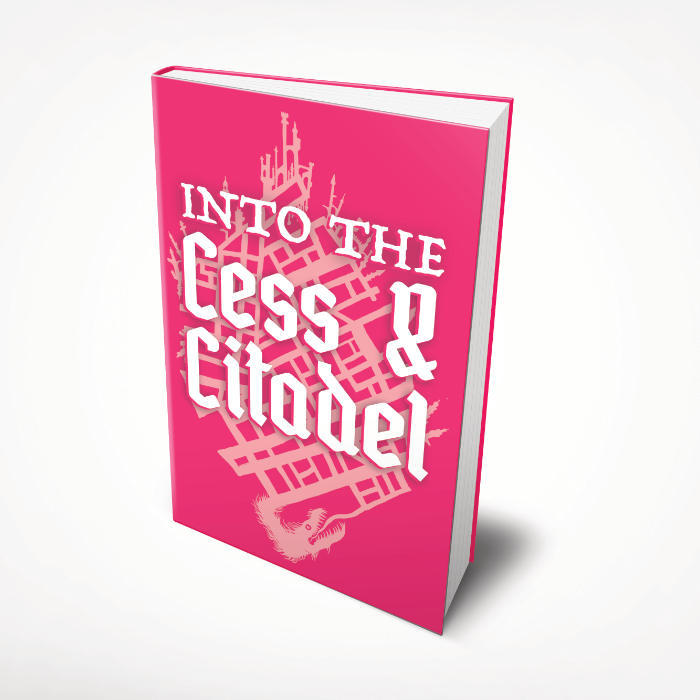
Into the Cess and Citadel (ICC) is a 282 page system agnostic city module by Alex Coggon and Charlie Ferguson-Avery. It aims to provide everything needed to run a city campaign. To me, that sounds like you should be able to run to your sessions straight from the book, or perhaps to provide a preparation toolbox. It’s a complex book, which I’m reading digitally, which for such a long book it not ideal in my experience.
Structurally the book is effectively broken up into four sections, with an interlude. There are introductory rules, generators, detailed districts and appendices, with one appendix weirdly placed between the rules and the generators (or perhaps it belongs in with the generators, as they have their own bestiaries in the same vein). Honestly it’s a bit of a mess structurally, and potentially would be more usable with better referencing and chapter ordering (although I’ll grant it an excellent appendix).
The bold text, and thin gutters encroached by simple decorations immediately state that ICC is going to be a complex and dense text, while still recalling a late medieval theme. Bold, simple colour choices and inverted textboxing make for clear and readable text despite this density. Some pages, should come across as less usable than they do. I count eight fonts on the page below, which normally I’d consider unreadable, but the fact that it most certainly isn’t points to excellent choices in terms of typography and layout.
An example of a challengingly complex layout rendered quite legible despite a lot of action.
The art by Alex Coggon, Charlie Ferguson-Avery, and Brian Yaksha is frankly all over the place, and while it provides a much needed break from the density of text, I think that it’s an indictment of the need for spot art in products like this. I’d rather the same artists provide their best work in fewer places, as the quality varies so much that I assumed they’d commissioned additional artists until I referred to the credits.
ICC holds itself to a system agnostic standard that is a strange melange of various systems, rather than stick to a single popular system. I’m not convinced about this approach; it may be the worst of both worlds. I’ve said before that I think the best system agnostic approach is something like the one adopted in Reach of the Roach God, which bypasses the need for conversion at all, and instead simply rewards understanding your system of choice.
The book opens with about 25 pages of city-traversal rules, which are (as an avowed disliker of additional rules) actually for the most part quite good, and I do think that running a city campaign requires specific modifications to facilitate the feeling of moving through a metropolis. This includes traversal rules (these are simple and neat), homelessness (pretty good), shopping (superfluous), reputation (feels too simple for a complex city), and hazards and diseases (I could give or take these). A lot of this is excellent flavour though: Dumpster diving might find twice-moulded bread or untapped marrow; you might develop Harlequin’s Fear. But also, a lot (most of the reputation for example) is quite generic: “Barred from most establishments”. In addition, the preambles of most of these actions are wordier than I’d like. I don’t need anyone to explain to me what reputation is.
Next up is a bestiary if single-page spread metropolitan monsters. This is a weirdly positioned section, the monsters are unique and fun and flavourful (brick tick, garbage shambler) but there’s nothing here I couldn’t create myself by giving the classic monster manual a metropolitan coat of paint. The art is still inconsistent, but they’ve focused some of the best art in this section, which is good use of art in my opinion.
The rest of the book feels confused regarding its intent. The next three chapters are three massive generators, one for the city itself, one for the dungeon below it, and one for the spires of the rich. These mirror each other in structure, and repeat (although not thematically) some of the content in the rules section, such as the equipment lists. The basic principles here are giving specific locations but randomly generating their connections and their layout. The writing in all three of these sections is very flavourful (“Agrimandcurioussilenceisobservedforallbutonehoura day.”; “Beautifulandstrangeanimals lazilyplodaboutthecages occasionallynibblingonfood.”) but also often generic again. I am left with the feeling that, rather than three separate generation systems and a bunch of random encounters, I’d be better off with an actual concrete city.
My misgivings are to a degree confirmed in the next three sections, which are specific districts within the city, and feature more character and specificity than all three previous chapters combined. The impression is that the lists here are meant to substitute for the tables given earlier, which would work just fine, but I’d rather just live in these three districts than on any of the randomly generated locations. The authors know these three are out of place, because they each get a unique colour scheme, departing from the magenta of the rest of the book. These are both the most puzzling inclusion in the book, and also the most engaging aspects of it.
The book finishes with a series of more lists: Magical items, spells, and additional locations. The additional locations are actually pretty great, and would be better incorporated into the rest of the book in some way. Finally, it includes a one page summary on how to run a city (better than the actual chapter on this), and a series of worksheets to assist you with doing so (would probably work, but seems a lot of overhead).
ICC is absolutely packed with content, but I don’t feel like a lot of this content would help me run a city, and in fact gets in the way of my using the book by making it harder to navigate at the table. There is a significant reliance on unnecessary random generation and a lack of interconnectivity necessitated by this approach. If you want spells and stat blocks and a million locations you could think of yourself but don’t have the time to, this is a book for you. That’s not what I’m looking for, however. If I wanted to design my own city, alone at my table, in order to run it in a campaign, it would be an excellent place to start, and perhaps that is it’s intended use case, but I’d rather a book that I can use to run the city at the table, something that is expressly possible as evidenced by many other products that achieve this end.
Overall, Into the Cess and Citadel places itself in impressive company, but fails to distinguish itself. The earlier chapters position it as a tasteful and unpolluted Vornheim in aesthetic, but it lacks the imagination of that book. It lacks the specificity and evocativeness that makes Fever Dreaming Marlinko the best city supplement in my esteem. The latter chapters aspire in some ways to replicate Magical Industrial Revolution but do not share the unique spark and cohesion. There is a lot shared between this and Oz, but Oz has a far more unique setting when it hits its mark than anything in ICC.
If you want an edgy, but not too edgy city of fairly generic theme, to assist you in preparation for a city campaign, or to supplement your game with spells, monsters and locations that reflect that theme, then Into the Cess and Citadel is a great product. For me, the need for the book to be a all things to all people conflicts with its ability be exceptional in any one part of the toolbox it tries to provide. There are a number of stronger city products with more limited scope out there if you have have different needs for your game, and for myself, I’d choose to go in one of those directions; but for a one-stop shop, you probably can’t do better.
Bathtub Reviews are an excuse for me to read modules a little more closely. I’m doing them to critique well-regarded modules from the perspective of my own table and to learn for my own module design. They’re stream of consciousness and unedited harsh critiques. I’m writing them on my phone in the bath.
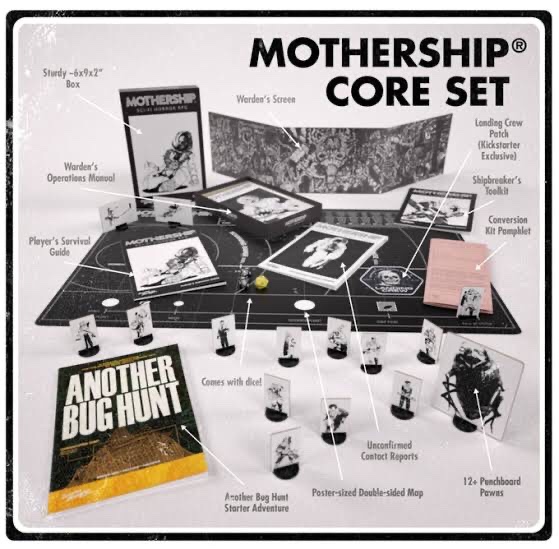
The highly anticipated Mothership 1e was just released digitally, and while there’s not a lot to talk about in the actual book, I thought I’d take a look at the introductory module Another Bug Hunt, the most recent iteration of the highly successful Mothership offical module series. Another Bug Hunt is a 43 page module for Mothership by DG Chapman, Luke Gearing, Alan Gerding and Tyler Kimball, although it must be noted that the editor, Jarrett Crader gets billing on the cover as well.
Not the actual cover
Another Big Hunt is a typically high production value Mothership zine, with exceptional art, striking colour choices, and bold design. A notable design decision is picking a three colour palette for the entire zine, and then choosing to switch which elements use the those colours in each of the four sections. This works to communicate the different sections, but I find particularly the second section with its burnt orange background for body text quite wearying on the eyes. Further, it acts contrary to the clear language set up using colour, highlighting and font choice to differentiate different types of information.
This is an introductory module, and the method the team has chosen to facilitate running this module for those new to Mothership is a character named WES who pops up in sections marked with a specific symbol. I think choosing a colour (as previously stated) would have been a better choice, but overall WES is a great tool for assisting new wardens. The advice ranges from managing specific situations to general advice. One thing I don’t like, is that later it addresses ways to progress, which I feel like might encourage wardens to force players into specific action; I suspect this has been playtested to all get out, on the other hand, and accordingly those pieces of advice may particular sticking points in playtesting.
Prior to the scenarios being presented, Another Bug Hunt opens with another innovation: Two parallel timelines, summarising what the players think has happened and what has actually happened. This is a very convenient way of summarising this information. I like a lot. The information that follows is a bit dense and long, though, for a new warden to process, and to be honest too long for me to prefer. Half of the page on the Shriek for example, repeats in wordier fashion what has already been said before. It might help me talk science to the players if a character of that persuasion is met along the way.
We then have four scenarios: The first is an extraction mission, the second assisting a settlement under siege, the third a rescue mission into an alien spaceship, and the final an alien assault on the human base. They are in order of narrative impact, but to be honest the second and last seem to be the most complex, with the first and third being straightforward dungeons. Writing across all four scenarios is, to be be honest inconsistent. “The worst manager you’ve ever written…the more annoying you make him the better” is an excellent description of a archetypical bug hunt character, from scenario 1; “One of the few personalities who can stand up to Sgt Valdez. Was in love with Olsson, and barely masks their grief.” from scenario 2, not so much. And it’s more of a sin in scenario 2, where you’re explicitly told to get into the NPCs shoes in order to make it work. There is writing in scenario 3 that verges on straight up bad: “he turns and speaks in a creepy voice “LEAVE…ME…HERE”. It’s disappointing to me that in a project with so much talent behind it, things like this can get lost.
I really like the first three scenarios in principle, and the fourth feels like it could either be a slog or a walk in the park, depending on luck and what has happened in the previous missions, as it hinges on retaking the Tower which may have been already handled in scenario 2. This one, I could give or take, but it’s only 3 pages anyway.
The first scenario is a classic crawl in the vein of Alien. Here, a single foe that you will encounter en mass later in the zine is the final boss, and is likely to TPK the party. It’s shorter than it appears, because the warden guidance is significant and exceptional. I’m not sure where it’s too much; certainly it expects the warden to study the material beforehand, because there is no chance it could be read and implemented during a session. This is telegraphed in the first WES passage, but subtly and I missed it; I suspect some new wardens might too. This first scenario is worth the price of admission, probably even for wardens with experience running other games.
The second scenario is a complex one, with three missions to complete, and the likelihood of surviving the third being low given the enemy advance and dangerous weather. There are ten NPCs at play across these three missions, but their descriptions aren’t strong enough that I could use them easily; they needed to be stronger archetypes taken straight out of Aliens, which appears to be the inspiration to this particular adventure. I’d struggle with this scenario if it were my second session as a warden, I think, particularly as it involves running a team of NPCs in addition to the mission. The missions themselves, however are each fun and interesting tactical crawls, through a decent map. I could redesign the characters to make this one an absolute ball to play in, but I wouldn’t expect that of the target audience.
Scenario 3 is an attack on the alien mothership. The map here is much less clear, and I actually had trouble understanding where the areas described are in relation to each other, until I realised in the context of all the maps what they were showing me. There are three routes in, and a final area. Two are harder to find, and one of those is clearly the deadliest; in the other two routes are traditional puzzles that can be used to resolve the scenario with player ingenuity. There doesn’t appear to be a benefit to searching deeper, and it’s not especially jaquayed in a way that will effect the final encounter. It feels a little fruitless, and might be better as a single complex rather than a series of routes, as most players won’t immediately realise how to use the traps to their advantage, or might miss one. The final encounter is weird, as if the android was waiting for the PCs to arrive for his surgery, but also has no need for them to be there, and also will turn on them after the surgery. The WES advice is the PCs will die but they put it there anyway because it’s in the world; I’m sorry, no: This is weak writing. A whole mission has no purpose but to reach this room. The players have been risking their characters for hours. You need to give them something to engage with at this point. There’s nothing here. Rewriting this final encounter, and adding rewards for finding the difficult routes in and hints regarding their existence, would make this a good scenario, but right now it’s not.
Because the weaker scenarios come at the end, I’m left feeling quite negative, but I need to check myself: The WES is great, especially in the earlier scenarios. I actually think it would be better to leave the advice in the latter scenarios too, because it’s still just a zine, and a new warden can only benefit from more gradually parceled advice; in fact they are more likely to take on new skills in later scenarios when they grow in confidence.
Because my favoured style of play in my own time is sandbox play, I look at the sheer complexity of these four scenarios and I wonder how anyone could run them from the zine itself. Sandbox play relies on emergent complexity. The players encounter things and the ripples cause things to become interesting. These scenarios, by attempting to limit the ripples (something that’s explicitly talked about in scenario 4, where ripples are impossible to avoid), require a lot more groundwork and reading to actually run. To me, this makes them appear to be too challenging for the beginner, but I wonder if my experience prevents me from seeing the truth of the matter. I know that these would be challenging for me to run, because of the combination of information design and pre-loaded complexity. This tension, between making this mothershippy and making it new warden friendly, really dictates the feel of the whole module. Did the authors, editor and designers succeed in navigating this tension? I find it hard to tell. It’s a challenging one; Mothership house style is anything but friendly to new eyes, even though it’s a certain type of beautifully pragmatic.
Irregardless, the earlier two scenarios are strong, the first moreso. The inconsistency here saddens me, as I said earlier, and I attribute it to loadsharing and a tight deadline. The WES provides excellent guidance on those modules, and less guidance although still helpful in the last two. It’s a beautiful, explosively laid out product even if not always easy to parse due to colour contrasts. But Another Bug Hunt is not the best Mothership module out there, and because of the failures in the latter two thirds, probably not the one I’d recommend to be your first as a Warden. That pleasure goes to Dead Planet or a Pound of Flesh if we’re official, or perhaps even to free module In Carmine whose review will be posted in a couple of weeks.
Addition: Changes have been made in the version going to print, to character descriptions and to some maps, as well as clarifying rewards and outcomes in the final section, addressing some of my concerns cited in this review.
Bathtub Reviews are an excuse for me to read modules a little more closely. I’m doing them to critique well-regarded modules from the perspective of my own table and to learn for my own module design. They’re stream of consciousness and unedited harsh critiques. I’m writing them on my phone in the bath.
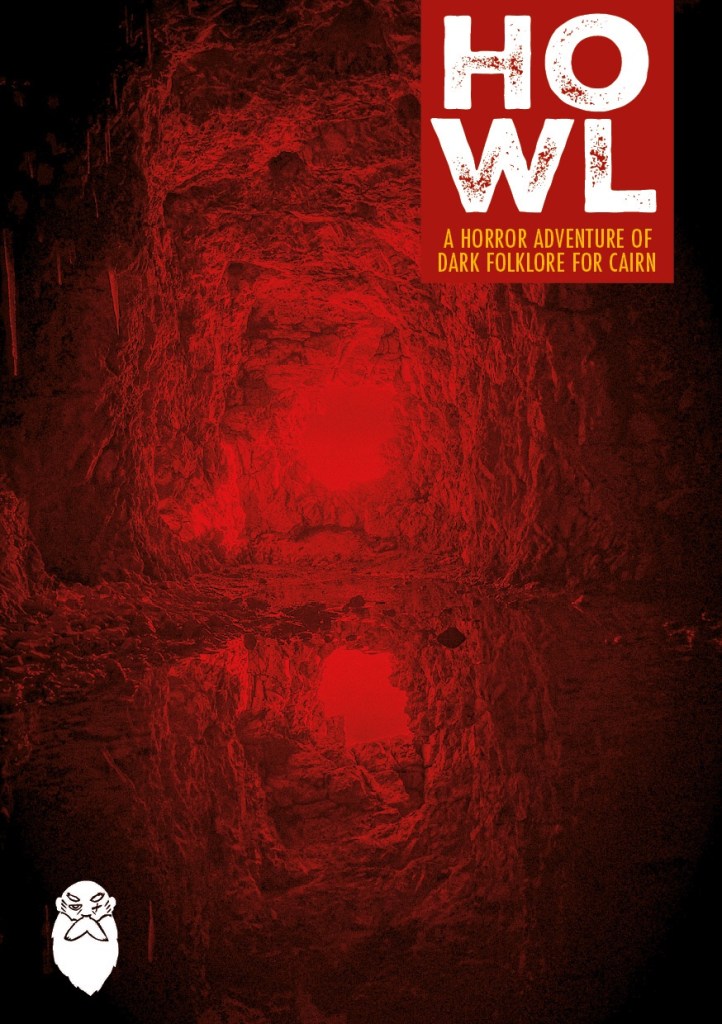
Howl is a 44 page module for Cairn by Colin le Sueur, re-released this year. It’s a horror adventure with folkloric themes, that has yet to be released in print format. I’m reviewing the PDF. It’s stated influences are Ravenloft and english folklore, but I’m seeing a module in the style of Against the Cult of the Reptile God, which is an old favourite of mine.
The “Running the Adventure” section is three sentences. The modules text proper starts on page four. Howl is an exercise structurally in getting to the point, and I am here for it. The summary of the adventure is neatly presented and limited in scope in such a way that I have trouble making room for alternative ways to progress; this can be a good thing for a small scale module with a specific story to tell.
This is a major challenge I think for small modules set in their own unique settings. The setting brings character and uniqueness, which is valuable, but if you give me a unique setting I’m less likely as a player to abide by the meta of the exercise: There is one interesting thing here, please investigate it. If I’m instead given relatively little in setting, it’s easier to incorporate the story of interest into my own, and the players are more likely to want to abide the meta. Here, I’m not sure the investigation will be at the front of the players or the characters minds, because they have multiple competing interests that aren’t directly addressed by the module.
Howl is the first example of an adventure I’ve read that uses the Classic Explorer Template by Clayton Noteskine, and excellent tool that I fear will result in a plague of similar looking adventures. As the first, though, Howl looks excellent, particularly the body text with bold simple colour choices and minimal in text font switching. The trade off is an overused sidebar, containing some headings and tags for the body text, in addition to mini maps and exits. These mini maps are a great addition, an a huge improvement on using abstract maps in isolation, a trend I’m seeing more and more in zine modules of late. Art and maps range from excellent to poor, the latter a result of the scourge that is the desire for spot art in adventure modules. I’d rather no art, than art that doesn’t add to the module, although there are a broad range of ways to do so.
The module begins with an elegantly handled shipwreck, where success provides the party with additional hirelings — survivors of the crew. If you want a scene with a necessarily foregone conclusion, this is how you do it. I’d probably prefer if it was more overt: You won’t save the ship! Do what you can to save the crew! This would also help to set the tone so the party is more likely to address the horrors that are to come.
The writing here is workmanlike and applied with Gygaxian thoroughness, making for very toyetic scenes, but not always the most evocative. An example is the first encounter with the beast that is the center of the adventure:
The shadow of a hulking black beast with menacing red eyes glares down at you, as if peering into your soul; after what seems like an eternity, it turns and disappears into the darkness.
I want my writing, especially read aloud text, to be full of descriptions I’d never have thought of. This one, a key moment in the adventure, needs more bang in it. I can see the author is capable of this more evocative writing:
The pond opens into a sprawling underwater cavern, impossibly deep. At the limits of vision, strange shapes undulate and writhe in the shadows. Studying the shapes adds the name “C’tegra” into the character’s inventory…
So it’s disappointing to see it not applied evenly; my gut feeling is that the clarity of the structure here works against the authors inclination for prosody. This makes for an exceptionally usable text, particularly a very fun and toyetic dungeon in part 2, but detracts from the horror elements significantly.
But, you’ve heard me say this more than once already, the content here will make for some very enjoyable sessions, if you accept that you might have to bring your own horror. There are mysterious vials, magical lions with manes of moss and mushroom, glow-poisons, unique spells. Two solid factions to interact with. An excellent small dungeon. My only criticism of the dungeon is that the factions aren’t as well signposted as everything else in the adventure. It would have been an easy fix, I think.
The town follows a fairly typical structure, but one that I’m not especially enamoured with, which is that certain characters have certain information, turning the social situation into a potential fail state. I think it would be more effective if all the rumours and secrets were separated from the characters, ensuring information is always available.
The big twist ending doesn’t quite land for me. It is intended to expand the world into a Ravenloft-style dark kingdom, with an evil queen (and if you’re reading my work outside of reviews you know I have Opinions about this), but the manipulation doesn’t quite make sense, the revelation also doesn’t quite make sense, and this is a long standing problem with vampire lords in elfgames in my opinion: Nobody’s quite sure why they’re there. I have figured my personal answer, and I suspect the answer for Howl lies in the sequel which is yet to be released, but at the moment this is a little unsatisfying.
Howl overall then is an excellent village and dungeon after the tradition of Against the Cult of the Reptile God. Drop it into your campaign for a few sessions of good eerie dungeon crawl fun, which you can run right from the book. I’d probably drop the shipwreck and the final twist as right now, it would be more fun to take what you find and learn here, and continue adventuring in your own world.
There was a weather themed blog carnival with unusually little uptake last month, and I think it’s because weather kind of sucks. Like, if it’s only ever a drag to have weather, why bother?
These can all be used as one would expect, but also collecting them en mass can be used to create magical items. Ten silver linings and a master smith’s time gives you a sword that is strong against undead, for example.
They could be combined in unique ways, too, both with traditional autogathered resources and with each other. A gust of wind and flaming puffshroom spores to create drifting cinders. A bottle of lightning and a puff of fog to create a static mist.
There should be some kind of tiering as well, but basically 1 bottle for a minor effect, 10 for a moderate effect, and 100 for a major effect. Probably best to equate this to level 1, 2 or 3 spells, or +0, +1, +2 weapons or something that fits your system. Or, like, not. Whatever floats your boat really.
I’d probably still have negative weather side effects, because yes, being lost in fog or blizzards and being slowed by storms or blustery winds totally makes things feel palpable. I prefer simple rules for this, like single hex delays for difficult weather and always wrong hex but always finding a secret when lost due to weather, then just playing the weather into encounters. I suggest being able to hide in fog, random lightning strikes in storms, visible ice in cold weather that can be used as a trap. Stuff like that.
Anyway, that’s my thoughts on the weather. If you’ve got extra ideas for weather resources, extra ideas for how to use them, extra ways to make weather impactful in encounters, or any other thoughts, comment and I’ll add it in if you’d like!
I Read Games reviews are me reading games when I have nothing better to do, like read a module or write or play a game. I don’t seriously believe that I can judge a game without playing it, usually a lot, so I don’t take these very seriously. But I can talk about its choices and whether or not it gets me excited about bringing it to the table.
I was supposed to play a game today, but most of the table were sick, so instead I’m going to read Brindlewood Bay, because someone was talking about it on Twitter the other day (or X, I guess? I still have the birdy on mine) and that reminded me I was excited about this innovative murder mystery game back when it kickstarted (although to my knowledge the print copy hasn’t been released yet, as I haven’t received my copy). The pitch for Brindlewood Bay is Murder She Wrote meets Lovecraftian horror, with the mechanical twist that the mystery has no canon solution: The characters come up with one as the clues reveal themselves.
It doesn’t brand itself as a Powered by the Apocalypse game, but shows significant inspiration from that lineage. Most of the basic moves themselves are awkwardly named, giving no indication of their use (“Day”, “Cosy”, “Meddling”). One is pointlessly vague: “imagine what your actions would look like as a move”? I’m not a fan of game design that asks the players to game design on the fly. There’s one unabashedly excellent basic move, a Murder She Wrote reference that’s well named and well written. I’ll come back to the Theorize move later, as it’s a big one. Regardless of the quality of the moves, I appreciate the designer commentary that accompanies them, although I feel they’d be unintelligible without them, which implies the author knows they aren’t their best selves. Overall, I don’t think it demonstrates a solid understanding of the powered by the apocalypse approach, sad on a field already filled with half-assed skins with little to no understanding of how the original functioned. Mechanical twists are clumsy and uninteresting, like three-dice advantage and disadvantage, and Crowns, which are so difficult to parse that I wrote this explanation wrongly the first time.
The layout here is fine. I really like the art all the way through the book. There’s not much else to say; it’s a serviceable book, but to a degree it fits the elderly lady theme. The structure, however, is the real design problem.
The structure of the book is a mess. We have a description of the character sheet (repeating a few rules and foreshadowing others), then goes into the rules for sessions that aren’t the first session (which has its own rules), then custom moves (I’ll come back to these), then two chapters of GM advice, then four additional chapters of GM lore and how to use it, and then a bunch of mysteries, and then how to run your first session. Hire a developmental editor, for your reader’s sake, please. I honestly couldn’t imagine a worse organised book, although I recognise some of the reasoning behind the choices here.
The custom moves are absolute fire, each based on a classic crime solver, granting a maven (PC) a special move. My favourites are Michael Knight, “You have a trusty mode of transportation—an oversized sedan, a motorbike, or an old truck—that has gotten you out of more than one sticky situation.” and Tintin, “Pick this move because talking dog.” These are flavoursome and perfectly on theme. The love for the source material is very clear in this chapter.
From here we’re start 130 pages of explicitly GM only advice. This is a game I’d like to run. I’m curious enough to run it at the absolute least, as I’m very interested in playing investigative games. But oh boy 130 pages of GM guidance is offputting. The back end of the book makes me want to put it straight in the box in the garage where dull games go to die. The contents of these chapters isn’t bad at all, it’s just a huge amount to process. I can’t imagine at whose table this will be the main game of, but I don’t need an advanced gamemastery chapter that spends two pages each on how to respond to specific basic moves.
The next three chapters are instructions on how to run the underlying evil dark god storyline. Two chapters of this are basically a menu, some actually random tables and some not, that you can use to plan your storyline. There is similarity between these sections and the tabular randomised content in Trophy and Trophy Loom, but that similarity is jarring and inconsistent three chapters. Consistency of approach would be better, but regardless these are the worst possible versions of this content. If I want to create my own story, I can write my own story. Restructure this huge amount of writing as three or four different whole versions of the story that I can choose to take whole cloth or modify as I wish, instead of this mess. I’m not here for a setting toolbox. The chapter of pre-made mysteries is exactly what these chapters should be! The chapter of mysteries is great! Interesting well described characters! Clue lists! Scenes! Locations! Structure is always better than vibes, because we can just change your specific writing, but it’s harder to create something fresh and less worth my time to do so.
I just got to the end of the book, and realised that despite specifically looking for it, I never figured out what ‘Putting on a Crown’ was. I had to piece it together by searching the pdf for “crown” until I figured out that the mavens can do these specific things in game to bump their success level up a notch. Either one about your personal life or a more structured one about the evil cult. This is quite poorly explained, and that’s disappointing, as this is a pretty good tension mechanic.
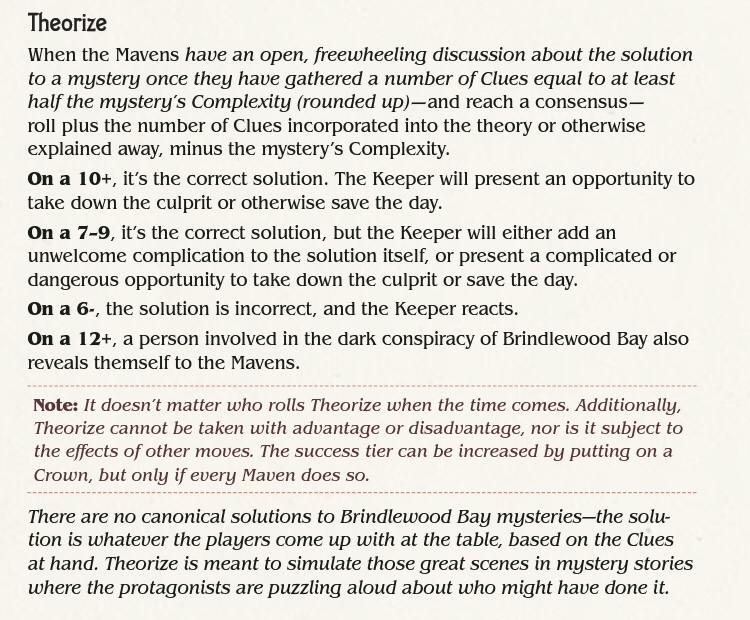
Now, the elephant in the room: No mystery in this game has a set solution. This is precisely the kind of idea that may be clever and may be complete foolishness. The entire solving of the mystery is supposed to be reminiscent of the scene in classic detective stories where the detective presents a long explanation, solving the mystery. It’s tied directly to a move:
In the context of this move, it is further obscured whether this is foolishness or cleverness. I’m leaning towards clever, for the pure reason that the detectives can be wrong and that their likelihood of being right improves the more clues are accounted for. To me, this makes it feel less like “the detectives make up the answer” and more like “the answer reveals itself to the whole table”.
Gauntlet games tend to fall solidly into the “we’re telling a story together” end of the spectrum, and this way of concluding a mystery really leans into that feeling. I can enjoy that kind of gameplay — Fiasco has been a favourite of mine for many years — but there’s something jarring about the structural contrasts in Brindlewood Bay, where it feels like you’re solving a mystery that is pre-existing by solving pre-existing clues, until you make the theorise move and suddenly you’re negotiating a motive and means for murder together.
Anyway, that’s Brindlewood Bay. It’s probably a good game, but it’s buried in bad structure and an obscenely constructed GM section that tries its hardest to drive people away from it. The smoothness and simplicity of art and layout clashes with the jarring content and structure. Honestly, if I hadn’t paid for a print copy, I don’t think I’d bother. But I’ve paid the money, and I like the premise, so I’ll probably run it, resentful all the whole that I’m going to have to wade through 130 pages of guided novel-writing to run a powered by the apocalypse game about elderly detectives.
I use affiliate links where I can, to keep reviewing sustainable! Please click them if you’re considering buying something I’ve reviewed! Want to know more?
Have a module, adventure or supplement you’d like me to review? Read my review policy here, and then email me at idle dot cartulary at gmail dot com, or direct message me on Discord!






 Playful Void