I was writing a post about a timekeeping technique called Time Bubbling (coming soon!), and I realised that there was a worldbuilding technique that I think is essential to most fantasy worlds that we play treasure-hunting in: Apocalypsing. Don’t worry, this one will be a quick one.
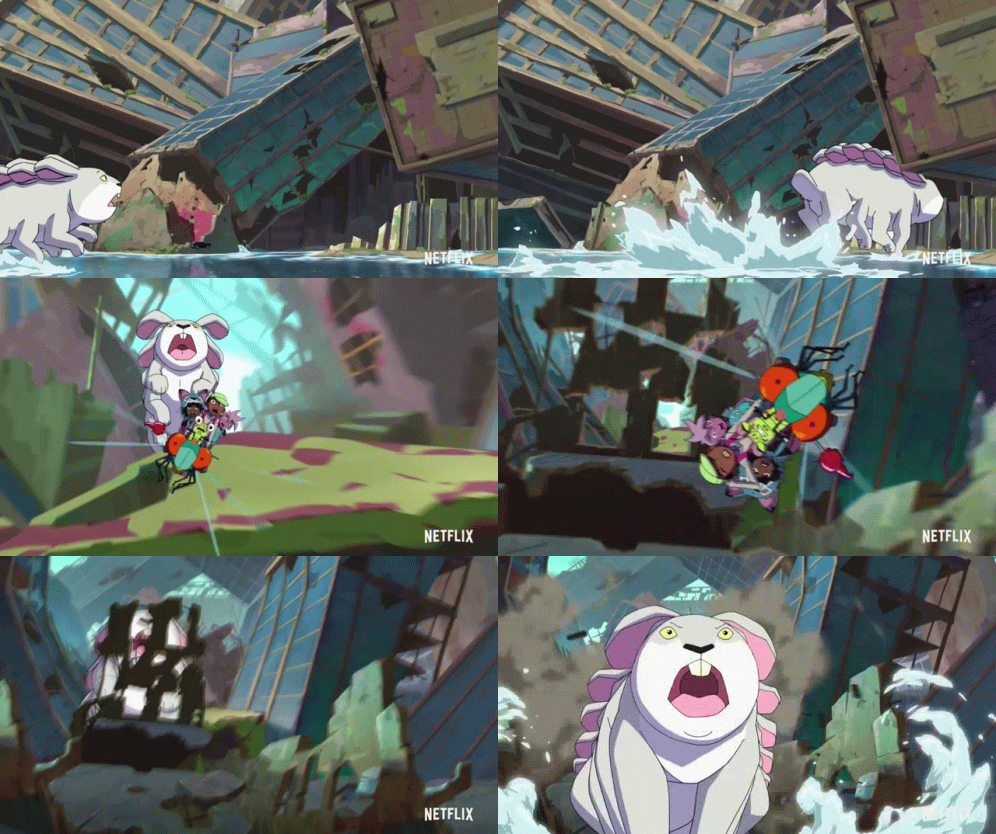
Kipo and the Age of the Wonderbeasts has one of my favourite apocalypses
Most D&D-likes are post-apocalyptic. When you’re world-building, the first thing you need to decide is: What was your apocalypse, and what were its consequences? Because this is a fun question to ask, and it says a lot about your world.
The size of an apocalypse
The main decision you need to make about your apocalypse is whether is was a local apocalypse or a global one. A local apocalypse might look like this:
The kingdom of Magras was once a noble kingdom well-known for its Oogrish stonework and its advances in automation. It was destroyed in a war with the Moondark Queen, and now only remnants remain in a twisted wilderness peppered with the ruins of the old kingdom and cultists of the now-dead Moondark Queen.
Whereas a global apocalypse might look like this:
One thousand years ago the God-priestess of Som Nam used her secret and blasphemous arcane research to open a hole between the mundane and the eldest divinity, allowing the divine to engulf and infect the world. The portal was wedged closed by a consortium of long-dead knights, however not before the world was shattered by the destruction caused by Darkness of Possession, the Devouring Void, and the Ecstasy of Destruction. Were these three elder gods ever truly vanquished?
Choosing which sized apocalypse you want to write about is more important than the nature of that apocalypse, because it will often dictate the nature of your campaign and how much sense treasure-hunting makes in that context.
The nature of your apocalypse
The nature of your apocalypse helps dictate what kind of hazards might be encountered, what kind of treasure there might be, and what kind of community remains.
Our two earlier apocalypses were military and divine in nature respectively, but there are many opportunities for other apocalypses such as war, famine, climate change, the summoning death-gods, causing divine wrath, creating intelligences that turn upon you, accidentally merging your dimension with another dimension, mountains falling from the sky, or an army of sorcerers suddenly trying on each ther because their access to magic was tainted.
Choosing the nature of your apocalypse is less important than the consequence that that apocalypse has on the world now. The nature of the apocalypse is just lore. Don’t put too much thought into it.
Fun apocalypse consequences and tensions
Instead focus on the consequences of the apocalypse and the tensions it causes. Let’s take our two earlier apocalypses.
In the first, the war has left only a remnant: Let’s say there are the remnants of the militant nobles, now solitary but organised and patrolling the wilderness to protect the most sacred object of Magras, the remnants of the innocent civilians, reduced to subsistence in walled villages or living in caves, and the remnants of the cultists, in the desecrated temples of the past empire. In the ruins are automated technologies that only need to be activated or repaired to be implemented. Outside of Magras, there are likely places unaffected by the war who have an interest in the technology of Magras, and who are in opposition to the Rangers and may ally with the cultists or the remaining magrasians in exchange for passage or information.
In the second, a thousand years have passed, but there are wastelands that new communities and old have had to learn to avoid and overcome. There are zombie wastelands of the Possessed, there are whirlpools and black holes rendering swathes of land uninhabitable by the Void, and roving bands of the crazed devotees to the Ecstasy of Destruction roam the lands chaotically. There is a mystery here, too: Is this all still remaining, or are the elder gods still here and biding their time?
Consequences can also be mechanical: Time is broken, and now different groups travel in different timelines. Magical artefacts are rogue, and now they must be tamed. Violence was banished, and now combat can only occur in certain arenas. The benevolent gods fled, and now the only gods hide their curses behind blessings.
Note how tensions are harder to extract from a thousand-year-old apocalypse. Easier to extract treasure, or hazards, or enemies that have been trapped or held in stasis. But having elder gods hibernating beneath the land is cool! How do we bridge the two?
Layered apocalypses
Well, we layer apocalypses. We can have our thousand-year elder god apocalypse, our recent war with the Moondark-Queen, and the kingdom that stood on the same ground that was destroyed 500 years ago by its hubris in attempting to harness the power of prism-batteries.
There is a danger in layering apocalypses, however, because the more we layer apocalypses, the more we need to explain why the previous apocalypse hasn’t been demolished and looted. This can be fruitful, though: Stone is expensive to mine, so if there is stonework it’s likely to be repurposed. What does this look like in modern or pre-modern architecture? Did they respect the ancients and preserve it? Treasure is likely to be taken unless it’s dangerous. Most communities will mark danger with signs that are meant to be universal (see physical waste markers). What are these signs? How did subsequent communities use the treasure or the technology they found that was not dangerous? Why are there no dinosaur skeletons? Why are the ruins beneath the ground? Did they live in dungeons, or did the apocalypse bury them? Ask these questions, these are the fun questions to ask, that will bring weirdness to your world.
That’s it, really. Let me know your thoughts, and tell me about your apocalypses!
Addendum: Mechanical consequences was added to the consequence section.
Dan inspired me to empty out the drafts folder of Playful Void so I can start fresh in the new year. Here goes: All the things I worked on this year and never finished!
Comparing contemporaneous versions of D&D
Solving the problem of disruptive skill systems in high level and domain play
Planning a procedure for a collaborative Gygax ‘75
Finishing my ambitious Curse of Strahd by-memory demi-plane (I wrote five or so posts though, if you want a taste)
Designing a danger flower to replace the hazard dice
Randomising monster types and traits for interesting encounters
A Fallout B/X hack
Gaoltown again
NPC microadvice inspired by The Laws of Fantasy Economics
Making alignment languages make sense from a worldbuilding perspective using parasites
Independently evolving domains
The City of Snowick Bush
Animal Crossing in Into the Odd
If you’re interested in my finishing any of these, or if you’re interested in any of these you can be inspired yourself!
There are a few I’d like to finish, though. I’m not sure I will, though, but it’s more likely I’ll be able to attend to them after the purge.
Intentional Reviews for Mausritter, Spire and Trophy Gold
A more intuitive version of Welsh-Piper involving a drop method
Part 3 of my Western series
Using public evolving maps as replacements for rumour tables
Bit now I’ll delete all of the purged posts from my drafts folder and start fresh this year!
You have made a Covenant with the Curator, Magpie God, Memory-of-Things, Museum of Eternity and Edge; god eminent of the preservation of history, display of objects, recording of meaning, and reminiscence of creatures. The Curator is represented by an owl holding a pair of scales. Zealots in covenant with Curator are the only ones who know his true name, which is Thirst. They are rumoured to be able to identify the veracity of any artefact without error. They delve into the depths often to find objects for their collection, hoping to bring glory to the Curator and to be admitted to see the collection of all he contains.
Blessings
The blessings of the Curator grant you special abilities, which you can perform at will.
Remember this. From out of nowhere, create a souvenir or keepsake worth a few shillings of anything in your collection.
Amber and arsenic. When time is able to be spent with a creature or object in submission to you, you may spend 1 favour per threat, +1 bonus, or rarity, to perform divine taxidermy or to preserve it in a time-resistant coating of divine amber.
Doctrines
Your covenant with the Curator grants you the power to perform miracles, supernatural acts related to the eminences of your covenant.
The First Doctrine. Miracles in the manner of calming of flora and fauna, identification of ancient objects, and comprehension of languages.
The Second Doctrine. Miracles in the manner of the unerring seeking of objects, protection of objects, the evocation and displacement of wards, compulsion of fauna and some sentient creatures, and invoking minor aspects of the Curator.
The Third Doctrine. Miracles in the manner of calming vicious or suspecting creatures, true sight, true knowledge of the history of an object, and the bestowal of a major aspect of the Curator.
The Fourth Doctrine. Miracles in the manner of calming into submission supernatural creatures, binding and caging of epic creatures, manipulation of time and the preservation and theft of moments into physical form.
The Fifth Doctrine. miracles in the manner of calming into submission supernaturally indomitable wills, preserving in amber an object of supermassive size, time travel.
Gaining Favour
For 1 favour, accept a donation to your collection; visit a great or long-since-abandoned collection; bring into your collection a living thing rarely seen.
For 5 favour, be present to preserve a moment of historical importance, found a museum in a major city, or reveal a history that was never before known, bring into your collection the last specimen of a type of living thing.
For 15 favour, preserve an entire kingdom for collection, or collect a lesser god for donation to the Curator.
For eternal favour, preserve the entire world in amber, or place a god of great things in stasis for donation.
The Curator’s Table of Woe
Target experiences the pain of a single life, inflicting 1d4 damage.
Target begins weeping uncontrollably.
Target is placed in stasis for 2d8 hours. While in stasis they cannot be injured, but they cannot take action.
Whenever the target closes their eyes, another pair of the eyes are there. This second pair can read any language with no living speakers.
For the next day, the target sees the future death of everyone they see. This experience is so overwhelming they cannot speak to anyone unless they are alone together.
Target becomes unable to tell lies but can also sense when others are lying.
Target experiences the battle that took place here from the perspectives of every warrior in an instant. Take d6 damage.
Target’s eyes become large and owl-like, and able to see in the dark as day. Daylight becomes uncomfortable, and their gaze is unnerving.
Target experiences the lifetimes of everyone within a kilometer in an instant. Age d6 years.
Target must record a recollection every day for d20 days, or lose 1d4 presence.
Target is deafened for the next hour but becomes able to hear the voices of the dead.
Target is unable to sleep until the collect d20 objects for donation to a collection.
Target is struck with the weight of history, and ages decades in minutes. Target must make a physique saving throw or have their physique halved permanently.
Target becomes a living taxidermy, their blood no longer flowing, their flesh brittle and their organs incapable of activity.
The flesh sloughs off one finger, forming a key. It has a 1-in-6 chance of opening any lock.
Target’s left eye sees 10 seconds into the future, and target’s right eye sees 10 seconds into the past.
All within 30 feet of the target must make a presence saving throw or be assaulted with the last 100 years of history of the area, permanently losing 1d4 points of presence.
Target begins to sprout feathers and cough croaks. Each day after the beneficence, target must make a physique saving throw. If the target successfully makes three saving throws in a row, the effect ends. If they fail three times in a row, they are turned into a magpie.
The next time the target does something of historical significance they must make a presence saving throw. If they fail, they are preserved in amber, killing them instantly.
Target’s flesh begins to mummify. They must make a presence saving throw. If they fail, their body stiffens in taxidermy, killing them instantly.
“The collector’s exquisite pleasure, is that her desire should know no bounds, and though she reaches out into the infinite always seeking, she shall be never complete.”
From the Book of Curation
This was my second Animal Crossing themed Errant testament. I tried implementing my previous observations, which made this one easier, but as with Mister Nook, it’s the Table of Woes that is most challenging and time consuming. I still think the subject matter is making choosing eminences difficult. What do you think, should I continue with my Animal Crossing theme or move on to more original gods?
You have made a Covenant with Mister Nook the Bold, Tanooki King, Thief of the Stars, with a Tongue that Spoke Silver into Being. Mister Nook is represented by an inverted leaf; a silver leaf on a field of green is preferred. It is said that zealots in covenant with Mister Nook hear coins tinkling from far away, and spontaneously laugh when a merchant near by plays an out-of-towner for a fool. Often, they are not welcome long in a settlement.
Blessings
The blessings of Mister Nook grant you special abilities, which you can perform at will.
They with the silver tongue. You may exchange 1 favour as many times as you wish to increase the sale price of an item you are offering by 20%. The buyer must accept it; they may have to go into debt to you to do this.
Just what you wanted. You may exchange 1 favour to reduce the rarity of an item by one from what it would usually be in the settlement you are in, as many times as you wish. You may be exposed to legally grey markets in doing so.
Doctrines
Your covenant with Mister Nook grants you the power to perform miracles, supernatural acts related to the eminences of your covenant.
The First Doctrine. Miracles in the manner of a purse of shillings appearing when it is needed, clouding the mind of another for a moment to gain an edge, making a promise that seems honest even if it obviously is not.
The Second Doctrine. Miracles in the manner of a purse of guilders appearing where it is needed, and the rejuvenation or improvement of a product, the evocation of trust, and invoking minor aspects of Mister Nook.
The Third Doctrine. Miracles in the manner of the creation of a shopfront of your choosing, insight into another’s deepest needs and desires, and the bestowal of a major aspect of Mister Nook.
The Fourth Doctrine. Miracles in the manner of permanent creation of great riches, the granting of land and title, compulsion of another against their will, turning things to gold with a touch.
The Fifth Doctrine. Miracle in the manner of the creation of cities and islands, apocalyptic hail of gold and rivers running with noble wine and saffron.
Gaining Favour
For 1 favour, convince someone to make a minor offering to Mister Nook; make a minor sale to a stranger; trick someone.
For 5 favour, put someone into debt in exchange for their life, open a shop or sale-wagon, or perform a great deception to selfish benefit
For 15 favour, change the economies of kingdoms, or trick a god.
For eternal favour, bring Mister Nook into this world to and provide him with. The opportunity to perform the greatest trick ever pulled.
Mister Nook’s Woes
Pennies grow on the target’s skin like warts, inflicting 1d4 damage.
Target vomits pennies whenever they open their mouth.
At the point of effect, the target’s flesh begins to turn to copper. The target’s limbs are slow and hard to move for 2d8 hours. When the entire target is copper, the effect resolves and they are purified of all ailments, and may make an appeal to Mister Nook.
A small tanooki head appears beside your regular head. This head knows exactly how much money anyone they see has access to, and can whisper it to you.
For the next day, every bargain, sale or purchase costs twice as much.
Target becomes unable to tell lies but can also sense when others are lying.
Shillings push their way out of the target’s skin like splinters, inflicting 1d6 damage.
Every month, the target’s eyes are afflicted with a blindness to items worth any amount of gold until they sleep with gold coins upon their eyes.
Target ages d6 years.
On a random limb, target’s skin turns to silver, but continues to function normally.
Target can hear nothing but the sound of coins for the next hour, however can accurately predict the number of coins they hear.
Target is transformed into talking tanooki until such time as they sell d20 items.
Half of the flesh on the targets body turns to gold. Target must make a physique saving throw or have their physique halved permanently.
Target’s bones turn to gold.
Target grows a tanooki tail. Whenever anyone grabs it, the target must dance wholeheartedly for 1 minute.
Target can hear the thoughts of anyone standing on their left-hand side through their left ear.
All within 30 feet of the target must make a presence saving throw or be assaulted with the weight of all the world’s greed, permanently losing 1d4 presence.
Target begins to grow soft hair in patches over their body, and large ears and a tail. Each day after the beneficence, target must make a physique saving throw. If the target successfully makes three saving throws in a row, the effect ends. If they fail three times in a row, they are turned into a human-sized tanooki.
The next time the target gives a gift freely, they must make a presence saving throw. If they fail, they become a magnet for all coin nearby, instantly being crushed under the weight of the world’s wealth.
Target feels something writing under their flesh. They must make a presence saving throw. If they fail, their body is instantly turned to gold, killing them instantly.
“Being a wolf in sheep’s clothing is preferable to simply being a wolf. Having a fleece of gold is more preferable still…”
From the Testament of Mr Nook
I was complaining about how challenging writing testaments was for me (Ava says there are lots of currently inaccessible testaments but for now we need to create our own). Chris encouraged me with his work on his own Errant campaign, and Marcia B and Sandro were talking about running an Animal Crossing campaign, and these two things merged in my head strangely to inspire this.
Thoughts on writing testaments: If you’re writing a woe table variation having at least three discrete and unrelated eminences to your god will make creating variation much easier. Next time I’ll write eternal favour and fifth doctrines immediately after eminences as they affect an agenda, which helps drive decision making elsewhere.
This was a lot of fun. I may make more, if I have time.
I’m two weeks in, and I don’t like my lovingly prepared dungeon. However, I’m really enjoying the day to day drawing and keying of the dungeon. I just got bored with this level after a week, so week two isn’t as much fun. I’m not surprised by this: My prep often needs to be modified as I see what the day to day involves. I want to do Dungeon23 though, so I’m going to pivot, aiming to make it easier to increase the amount of dopamine hits the creative process gives me in a given week or day.
I’m going to start using a different weekly and monthly schedule, aiming to make a sub-level each week and then arrange them onto larger 24-28 room levels at the end of each month.
Schedule
Tuesday: Take the next layout from Marcia’s Bite-Sized Dungeons for this weeks’ sub-level. Generate a theme and faction for the sublevel using oracles. Detail the local faction and its punnet. Based on these, sketch the sub-level’s map.
Monday to Sunday: Draw and key a room. Detail any monsters, traps, treasure or NPCs in the room using oracles.
Every fourth Monday: Arrange four sub-levels in a way that makes sense. Make a wandering monster list with one to four entries per sub-level based on these four levels. Populate the universal encounter table or recurring characters table as appropriate. Revise factions with relationships with other factions that make sense.
Marcia’s Bite-Sized Dungeon layouts, largely because then I don’t have to google it every Monday.
I didn’t start on Sunday because weekends are probably when I’ll have the least time to myself to do extra work; Monday and Tuesdays I have the night and sometimes the day to fit things in.
Sketch Procedure
Roll 1d12 for nature of exits: 1-2. Blocked or stuck door; 3-4. Locked door; 5-7. Unlocked door; 8-11. 40’ foot corridor; 12. 40’ corridor containing a one turn obstacle.
Roll 1d12 for nature of room: 1. Natural Hazard; 2. Trap; 3-4. Guarded; 5-6. Occupied; 7. Weird or magical feature; 8. Trick, puzzle or riddle; 9-10. Sign or spoor, warning, clue or password revealing wandering or nearby encounters. 11-12. A mosaic, fresco, basrelief, inert feature or mundane items revealing history or current use.
Roll 1d12 for the nature of treasure. 1. McGuffin or unique magical treasure; 2-4. 1d6 gold bags or equivalent (~1000gp each); 5-6. Incidental silver treasure (~100gp or a bag of silver); 7-8. Incidental copper treasure (~20gp or a bag of copper). 9–10. Valueless keepsake or trinket; 11-12. No treasure.
Inspiration here from Warren and Emmy, as well as Marcia with thanks. I differentiated types of blocked doors; eliminated long corridors and transferred the time sink into an obstacle. I used Marcia’s economy for ease of treasure, and increased the incidence of minor treasures.
After this step, it looks like this.
Oracles and details
I’ve found I’m enjoying drawing additional information onto the map, even though my skills are still developing. This is also why I’m putting passage omens on the map. I’ll lean into it:
Add oracles to sketch
Write room description , aiming for Wolves upon the Coast or Through Ultans Door rather than OSE.
Assign all nouns I can to be drawn onto the map in a separate sentence.
For each exit to a known room, add passage omens to the map (sight, sound, scent and taste or touch).
Simple three cards oracles for each element I’ve pre-assigned based on the two simplest tarot draws.
After adding the oracles to the sketch, it looks like this.
NPC (or monster): Personality, Body, Hopes/Fears. Don’t stat. Use hit, strong hit and crit as attack detail, and heavy, light and no armour.
Location (room or levels): Aesthetic, History, Current Use.
Faction: Foundation/Aesthetic, Proactive/Selfish Agenda, Method. Remember that power and wealth are not agendas.
Traps: Theme, Goal, Functional? (Y/N)
Hostile Factions: In addition, use Monster Punnets using Melee/Ranged and Damage/Special axes.
Treasures: Origin, Theme, Twist. Treasure Punnets using Magical/Non-magical and Functional/Decorative axes. Add spare treasures to the incorporation list.
Using these, I detail and key one room and it’s treasure per day, Tuesday being optional. Passage omens are a little Diogo and a little Anne. On good days I don’t write more, because I’ve found I draw more. I’ll leave my hard day rule in place and if I come up with a story I will work them into empty rooms.
And after detail, looks like this.
Wandering monsters and other encounters
Wandering monster tables are a difficulty, because there are going to be 50 or so sub-levels. I’m going to write one rolling table, with d4 entries per level. I want easy inspiration for interesting encounters, though, so I’ll draw from Keystone Encounters and Structuring Encounter Tables, and try to remember the maxim “Make an undesirable demand on the players attention”:
Roll 1d6 for nature of encounter: 1. Indefinite threat omen; 2. Indefinite threat; 3. Definite threat omen; 4. Definite threat; 5. Threat aware of an unknowing second threat; 6. Two threats interacting.
Roll 1d12 for indefinite threats, that are only threats if interfered with: 1. Lost; 2. Hurt; 3. Trapped; 4. Sleeping; 5. Sick or starving; 6. Eating or cooking; 7. Excreting or bathing; 8. Weeping; 9. Socializing; 10. Building or demolishing; 11. Artistic pursuits; 12. Doing drugs or drinking.
Roll 1d12 for definite threats that are likely hostile: 1. Tracking Prey; 2, Lying in Ambush; 3. Fleeing; 4. Committing a crime; 5. Searching; 6. Holding Captives; 7. Spying; 8. Scavenging; 9. Religious ritual; 10. Gloating; 11. Plotting; 12. Returning home
Rolling on this giant encounter table, I’m not entirely sure about. I suspect it will be something like 2d6 + Dungeon Level, with 1 always being “Roll again on the universal encounter table” and 12 always being “Roll again on the recurring characters table”. The universal table’s goal is to tell the story of and something of the history of the dungeon, and the recurring characters table I can populate as I go with the most enjoyable NPCs. This means I’ll need a few running lists to fill out gradually:
Incorporation
Recurring characters
Wandering monsters
World anchors
Universal encounters
That’s my revised process. The first test sub-level I made was a crumbling dinosaur-worshippers temple filled with ancient matter warping technology occupied by marooned space pirates. The second was a tower filled with reliquaries that a sect of monks dedicated to forgotten gods seek to use to beam the ghosts of their past worshippers to evangelise them back into existence. Both of these stayed exciting for all six to seven rooms, with the primary barrier being how I string them together and develop them a story. But at least this is more fun.
I can’t speak for the Dark Souls games, but in Sekiro, which I’m told is similar, story is told obliquely, through torn off pages, off hand mentions, and item descriptions.
Robert’s Firecrackers from Sekiro: Shadows Die Twice
We were talking about this on a discord this morning, and I was thinking about how it worked, so I’ll use an example from the game.
Item description for firecrackers:
Firecrackers from across southern seas. Can be fitted to the Shinobi Prosthetic to become a Prosthetic Tool. Makes a deafening sound, frightening to animals. Sold by little Robert and his father to raise funds for their travels. Their voyage brought them to Japan, where they would seek the “Undying” in an attempt to extend Robert’s life.
Incidental speech from a boss:
“For the sake of my son…Put down your sword.”
“Roooobeeeert!”
In catacombs behind a monastery:
The mummified corpses of many children who were killed in experimental procedures by the monks to create the Divine Child of Rejuvenation, who cannot die. None survived.
There are many other stories, some linked to locations (the undying gorilla boss at directly below where the waters of rejuvenation flow from a later level), some to items and characters like this one. But, I think they have two or three of these in common, and always the first point:
Only tangentially related to any main plot
Mentioned in item lore, item name or by an NPC
Implied through description of a location
Implied by special ability
I can give myself a procedure then: When I describe a location, grant an NPC a special ability, name an item or give an item a history, I must add at least one of the other two to my list of “future lore to be incorporated”. I strongly doubt the writers of Sekiro wrote the story of Little Robert and then chose to incorporate firecrackers into the gameplay. It was the other way around. The thing is there, and then I decide who brought it into the dungeon, why they did, and what clues are left after they’re gone.
A kobold wears a helm the shape of a charging boar. One of the six Beast-Knights once ventured into the forest, seeking the Crown of the Forest Wild, which was stolen from Her Verdant Majesty. His word his bond, his corpse is upon the Bridge of Duels, affront the bones of many enemies. The Rod has the images of six beasts upon them; one is a charging boar.
By doing this, I can begin to give my world or dungeon the kind of lived-in depth that I saw in Sekiro and that people talk about in Dark Souls and Elden Ring.
The first post was my prepping templates and principles to make the day-to-day participation in #dungeon23 easier. This one is about preparing the overarching yearly and monthly arcs of the dungeon, so I’ve got some more levers on days that are too much, and so it’s somewhat cohesive overall. This has the more challenging post, as it’s actually work, which my brain abhors.
Step 3: Dungeon Overview
To begin on step three, I pasted the guiding questions from the Dungeon Architects Handbook and overwrote them with my answers. I was finding this, more detailed and preemptive work that commits me to something for a whole year challenging, but then I realised I wrote a dungeon theme oracle, so I’m going to hack that and Ty’s tables that are in it to get the juices flowing. This’ll result in more text than I prefer, but it’s planning-facing text, not something I’d put in the product or tell the PCs except as secrets discovered.
Themes and Architecture
I rolled for the individual levels (see below, obviously I’m writing all of this out of order), but I struggled to generate a concept that will keep me motivated for a year, so I used MTG random and spread them as a celtic cross to develop my main theme and story. This was entirely too much, but once I had sufficient seed, the remainder went into characters and factions.
Present: Sleep; Challenge: Ring of Gix (Not every cage is made of bars); Subconscious: Rapacious Dragon (surely it won’t notice if I take – Theria the sky’s last words); Past: “Pound the steel until it fits! Doesn’t work? Bash to bits!” Future: Searing Touch; Near future: Magus of the Balance; Internal Influences: Soul of Ravnica; External Influences: Relentless Assault; Hopes & Feats: Memorial to Folly; Outcome: Ruby Leech (its gems didn’t stop pulsating until they were completely removed).
Not every cage is made of bars.
In the town square of Snowick Bush, Harrawyn, the Restful Tree, shades the town and with white flowers that glow with a aura gold. Beneath the tree is a short circular stairwell, leading to a barred gate. Only fools enter, but there is no shortage of fools travelling to Snowick Bush. Harrawyn is dying, and no-one knows why.
For a thousand years the devil-princeling Geas has been bound to sleep with bonds wrought from the feathers of angels, and sunken beneath the earth in the mausoleum called Memorial to Folly. If he wakes, he will sear the lands seeking vengeance on those that betrayed him. Harrawyn has grown from the prince’s angelic bonds, and glows with their divine light.
The recondite boons that led the hoar-priests of the Burning Lands to bury Geas here were present unbeknownst to them because even deeper below is a sleeping god: The Ruby Leech-god, slowly feeding until it’s metamorphosis. Few still worship the Leech-god, more ancient even than Geas, but as her age approaches, her psychic tendrils reach out to whisper to truth-seekers just as tendrils of her god-flesh reach out into the earth.
The greed-serpent Rapace had long tunnelled through dark and deep, but in time found the Memorial to Folly, smelling the treasure buried with Geas to be taken to the dream, and settled her supplemented horde amongst Harrawyn’s upper roots.
The delving of various recent and distant companies for various reasons formed the burrows connecting the Greed-serpent, the devil-princeling and the Leech-god. As the community of Snowick Bush grew, the nature spirits known as Freshet, Leafmould and Morimori were driven into these tunnels, which became known as Three Spirit Burrows.
Minor and Major Factions
Major factions claim two or three levels of the dungeon at status quo. Minor factions, only part of one. This gives me five major factions and however many minor factions and one-person factions (I’m calling them bosses for brevity, but some are fundamentally good or at least natural, and some are indomitable god-things, so not necessarily to be fought) as the dungeon supports. I’ll give them some of the following traits to begin, but I’ll not complete them all so the dungeon has room to grow: Faction, name, description, drive, allies, foes, schemes. Oh and a level suggestion.
Capi Gammo College (Minor – Level 1). Fugitive students from an arcane school, taking shelter, investigated for chaining a nature spirit. Don’t know what’s below, but will soon learn and become covetous and fractured.
Leafmould, the Autumn Spirit (Boss – Level 1). A very tall figure, in a long robe of decaying leaves that are left in a trail behind them, wearing a wooden mask that changes expression only when you look away. Bound and brought here by the Capi-Gammo College. Silent; brings rot and decay to living things, and moreso to plants and the dead.
Myfstadt Town (Major – Level 2). Family-oriented gnome-sized trolls, recent immigrants. Driven to be cosy and defend their town. Schemes to access cosy decor from outside the dungeon via a black market, and pay for it with dungeon loot.
Freshet, Spirit of Winters’ Thaw (Boss – Level 2). A salmon-skinned, horse-headed, heavily-muscled woman, driven here by Snowick Bush Dam. Seeks allies to free her back to Pellucid Stream. Water flows uncontrollably where she is near.
The Persuaders (Minor – Level 3). Body-warping human-faced beetle-men often with hammers or other tools for hands. Driven by a desire for uniformity, industrialisation and greed. “Pound the steel until it fits! Doesn’t work? Bash to bits!”
Morimori, the Guardian of the Forest (Boss – Level 3). A kind, blue, humanoid stag-mammoth, captured by the Persuaders to power the Eternity Machine. Loud, full of gusto when free; chants for the plants to grow.
The Friends (Major – Level 4). Pallid creatures, on their back several useless black-blue levitating umbilicals. grown from lilac glass cylinders and tended to by silent black and white cats. They are clones of intruders into the dungeon. Driven by a desire to reconcile memories of their stolen bodies they are haunted by. Schemes to bring more and more genetic materials to the cylinders for future generations.
Moss Maids (Minor – Level 5). Miss-covered women of sweating stone, seeking to serve Freshet whose life begat theirs. Slow, grinding, immovable, slimed.
The Greed-serpent Rapace (Boss – Level 5). Single-minded and voracious in its pursuit of riches, but cunning as are. Poisonous, darker than the earth it slithers though. Speaks in your skull like a hiss cutting your flesh.
The Philosophickers’ Society (Major – Level 6). Studious, tiny clockwork men, a product of the Eternity Machine. Driven to experiment without fear of reprisal. Scheme to dissect the Greed-Serpent. Scheme to taxidermy all creatures living in the dungeon.
Enlightened of Rapace (Minor – Level 7). Berobed and pacifist Hamstvolk. They feed their worldly desires to Rapace, their Greed-god. Allies: Rapace Foes: Redcloaks.
Sunfire Knights (Minor – Level 7). Heavily armoured, goblin-proportioned hamsters known as Hamstvolk. Their armour and weapons are bronze and more effective against hellspawn; blunts easily against the mundane. Seek glory by bringing all demonic life to an end. Known as redcloaks.
Three Fallen Thrones (Major – Level 8). Angels imprisoned for treason, and their lesser creations. Driven to return to heaven. Scheme to persuade allies to harvest the Angelic Bonds and return them to Plymiris, the Weeping Angel.
The Devil-princeling Geas (Boss – Level 9). A handsome, sharp-featured boy. Possessed of great command, but must collect his emblems of power to gain his full power once more. Buried with him, but they have been scattered throughout the dungeon and one was never buried: It remained the crown of the kings and emperors who succeeded him, for a time.
Church of the Divine Leech (Major – Level 10). Wearing liturgical clothing, in disrepair as are their decaying bodies. Driven to free the Ruby Leech God. Seek to remove all thirteen rubies from its flesh to free their god.
The Ruby Leech God (Boss – Level 12). A huge ruby-studded leech-like entity waiting to transform into her god-form. massive tendrils of god-flesh strangle the dungeon and can be found anywhere. They incite mistrust and feed on blood. Inactive until enough violence is performed for her to ascend.
I have no idea how I got from “thirteen is too many, let’s have five only” to sixteen factions, but they’re fun to make, and no doubt a few will not gel. There will be two, sometimes three factions per level to choose from, every level, for locations and wandering monster tables.
Wandering Monsters
Six random encounters for the whole dungeon and six wandering monsters for each level. I suspect I shall want more than six encounters per level; I like intruding encounters from other levels, it’s important. I’ll overload the table, and let the GM decide how to access the extra entries.
The gist of the second dice: 1. They left a sign or omen. 2-3. Chill activity. 4-5. Proactive activity. 6. Two wondering monsters encounter each other, roll again. If you roll a second six, roll on the random encounters table instead of, or in conjunction with the wandering monsters table.
An example of a wandering monster entry: 1d4 giant red azaleas (1. pollen trail, 2. dormant and closed, 3. feasting after a hunt, 4. hunting for soft live flesh, 5. seeking red rubies).
An example of a random encounter entry: Therya the Sly. Foolhardy and eternally curious adventurer. “Surely it’ll be fine if…” Stats as thief. 1. triggered trap or complete puzzle, 2. roasting red-azalea fronds over a flame, 3. reading The Adventures of Maigan Longshanks, 4. about to be defeated, 5. having just uncovered treasure, 6. seeking an assistant with an upcoming challenge.
Other ideas random encounters are they Magus Justice seeking to solve the mystery of the white tree’s impending demise, Geas’ dreaming soul wanders the halls, charming and persuasive, seeking freedom, Rapace roams the dungeon, seeking valuable treasure over they wake, a mercenary rival adventuring company, willing to turn coat for gold, an omen or visitation from a nature spirit.
Step 4: Themes for Levels
I’ll pull from Sean’s weekly prompts for now. Here’s what I rolled: 1. Decay; 2. Pit; 3. Empire; 4. Chaos; 5. Flood; 6. Greed; 7. Cut; 8. Solitude; 9. Sleep; 10. Darkness; 11. Death; 12. Love. This is already sparking my imagination: Water flow linking Decay to Flood; Greed as a storehouse of Empire and Chaos as what came to destroy it; Solitude leading to Sleep. A doomed undead romance connecting Darkness, Death and Love. I would like to say holy shit those last three couldn’t be better themes for the deepest three levels of a dungeon. I’d like to remind myself that I should add & not every cage is made of bars to every level prompt; I want to work that theme in with at least one individual or faction on each level.
Concluding Thoughts
I’ve got a ton of juicy, contradictory content that I can use or ignore as I choose next year. And I’ll call the megadungeon A Cage of Feathers, for now, and keep it if the theme holds or unless something juicier appears.
I realise there are a few items that’ll need building over the course of the year: A secrets list, a hooks list, twelve random tables, better faction and boss summaries, NPC summaries and stat blocks if I ever decide what to stat it for (Errant? B/X? ITO? Cairn?). A lot of the factions can just be generic bestiary stuff, like as goblin for hamstvolk.
I think I’m ready. I started the last post on the 8th and am posting this on the 14th, this prep took serious work, but I enjoy prep work to be honest, to the point of favouring it over the creative work. I’ll try to report back monthly on here next year, both with the status of the dungeon and with updates on how my processes are going.
I’ve been listening to the Wheel of Time audiobooks, and thinking of the extra-dimensional dungeon that Mat enters to face the Snakes and the Foxes, this worlds’ version of fae. This dungeon’s layout is asserted to follow rules alien to the human heroes that enter it.
One example is following a hall that turns to the left, until it seems as if you must be walking in a circle, the inside windows displaying the outdoors, despite that. Another is having to return back through the same door as you came through a number of times back and forth, before reaching your destination.
I’m calling. this extra-dimensional because I’m sure a mathematician somewhere will be frustrated with my calling it non-euclidean, but that honestly feels like a better term because architecture and geometry is what is alien in this dungeon, not all of physics.
A friend on discord gave some interesting suggestions when I remarked on being unable to figure out how to do this in a way that was 1. Systematic; 2. Reasonably Solvable; and 3. Fun to Figure Out.
We draw dungeon maps with six directions, so the easiest solution is that I map each real life direction to a non-euclidian version, with the number of repetitions of the new direction being equivalent to distance, one square being equal to one repetition.
We need to set some rules for description:
The PCs know the world is not like ours, and that they need to figure it out; give them a guide to start, or a riddle or something.
Windows are in all hallways, except that does replace hallways when they are present.
Windows are sealed and unbreakable, in order to cue PCs into the uncanniness of the geometry.
Keyed rooms always have doors that are marked in some way, to provide clear cues to identifying the six rules.
Keyed rooms may have multiple entrances, but the direction you exit in is irrelevant to the direction you go.
If a hallway requires doors, they are unmarked doors alternating on both left and right, for each cycle of hallway.
Failure to complete a direction correctly results in re-entering an identical room to the one you started in.
Describe how the outdoors doesn’t respond to the movement inside the way you’d expect from the geometry the PCs can see.
Both indoor and outdoors should be described as strange or wrong. Dr Seuss feels like a good reference here, perhaps Paul Nash, Hernán Bas, or the World of Edena by Moebius.
I need to think about what it might mean for a hallway to change direction, in terms of description, when I choose my six directions. If I turned west from south, for example, the PCs may not be able to tell, rendering the puzzle unsolvable; as would up a level from east. This suggests that different directions might need alternative descriptions.
Time is also important. It’s typical that these extra-dimensional dungeons warp time in certain ways. Potentially we add a speed multiplier affecting parties travelling in a certain direction.
North: Follow the hallway a full circle to the left. Sinuous. 150% speed.
East: Do not follow the hallway, rather pass back through the entryway you just came through. Sinuous. 100% speed.
South: Follow the hallway until it disappears behind you. Angular. 50% speed.
West: Go through every second door you find in the hallway. Sinuous. 50% speed.
Up: Go through every first door you find in the hallway. Angular. 100% speed.
Down: Follow the hallway a full circle to the right. Angular. 150% speed.
I feel like this won’t make total sense until I build a small dungeon, so here’s one. We’ll describe the path taken while traversing the pink arrow, assuming all rooms are keyed.
You arrive through the twisted red doorway into a room with five walls and an oddly high roof. You walk out the strange, trapezoidal archway ahead of you, seeing a long hallway with marked with strange, sinuous patterns, that curves out of sight to the right, lit by strange yellow lights that span the width of the hallway. You return through that doorway and return to the room you came from. When you return to the doorway a third time, it is no longer trapezoidal, but pentagonal, and you teach a new room. You pass through the same doorway twice this time, and then the patterns on the walls change to an angular, regular pattern. You follow this hall until it disappears behind you, coming to a room with three exits. You choose one, and follow the hall until it disappears behind you before finding a pentagonal door to a new room. You leave and find the sinuous patterns have returned. You re-enter this door five times, enter a new room when the trapezoidal door becomes pentagonal, and exit through the first door you see, finding angular patterns on the walls of the hall. You exit the first door in the hall that follows, and leave the new room you find to enter another hall. This hall is sinuous, so you enter the second door, which leads to another sinuous hall. You enter the second door here, and there is yet another hall. You enter the third hall again, this one also on the right, and find a pentagonal door, and a new room. You follow the hall, now patterned in an angular fashion, in front of you until it disappears behind you and the patterns turn sinuous, pass through the door you find twice, and find a room with one exit. You take it, curving to the left; you turn around until you are back at the beginning again, and repeat it again, and then the hall straightens and doors appear. You take every second door, three times, and find yourself at the Courtroom, your destination.
Phew, that was alot. But it works. This might be too hard a puzzle, or too punishing a fail state, but pepper the dungeon with treasure and battle and the bloody scrawl of those who’ve come before, and we have a compelling life or die puzzle. And in the Courtroom you get to bargain for three wishes with wicked devious entities.
I’d love to see other takes on mapping and running extra-dimensional or non-euclidian dungeons, if anyone has thought about it. This is but one way, the only one I could come up wjth
Plan (or randomly generate) themes or factions on each floor to be scrapped if I want.
That’s not too much for someone who spends most of their time at home or in hospital, in my opinion.
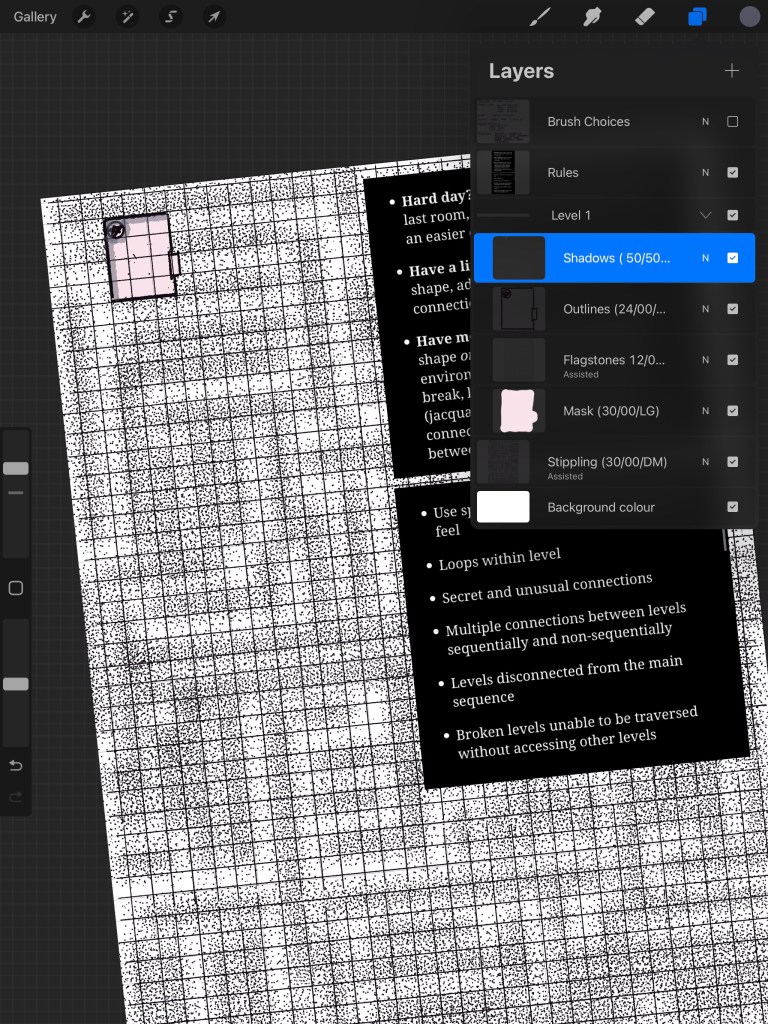
Step 1: Procreate Template
Here’s what it looks like.
It’s got stippling and flagstone detail already on it sitting behind a mask, so I don’t get too bogged down in that kind of detail. I just outline, fill in, and I’m done. What are the rules in the top right corner?
Hard day? Draw a square, next to the last room, add shadows. Connect it on an easier day.
Have a little time? Draw an unusual shape, add shadows. Draw some connections.
Have more time? Draw an unusual shape or a level-wide feature like a environmental feature, sequence break, loop or change in elevation (jacquaysing stuff). Draw some connections and make them secret or between levels.
And below them are principles, to remind me to keep it interesting.
Use space to define a room’s purpose or feel
Loops within level
Secret and unusual connections
Multiple connections between levels sequentially and non-sequentially
Levels disconnected from the main sequence
Broken levels unable to be traversed without accessing other levels
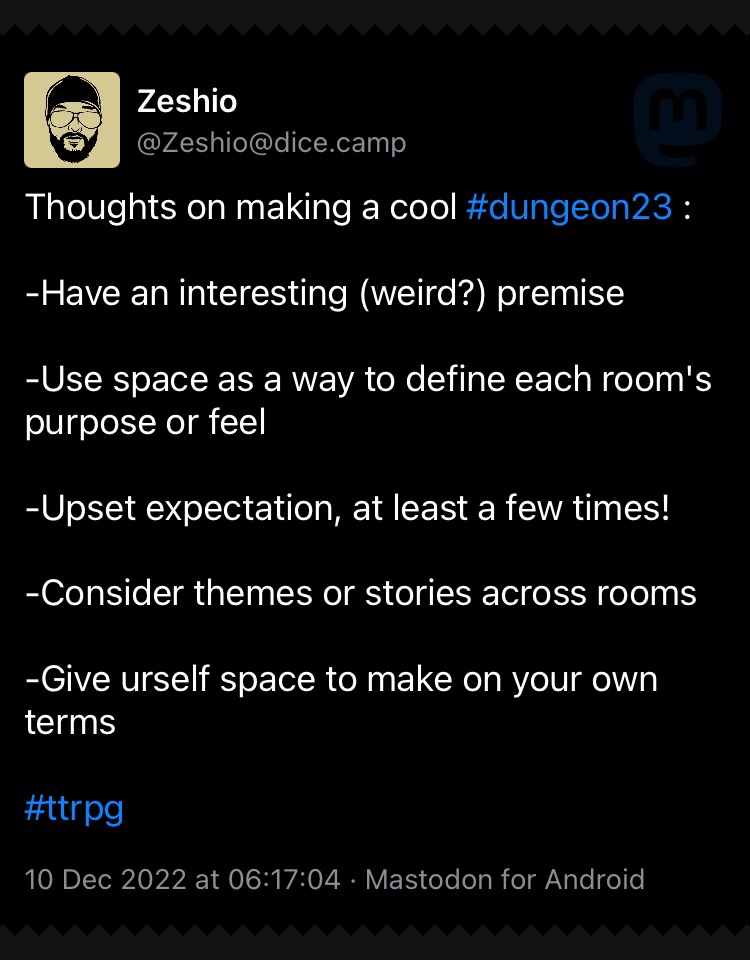
Zeshio’s thoughts on making the dungeon cool, where I found one of my principles.
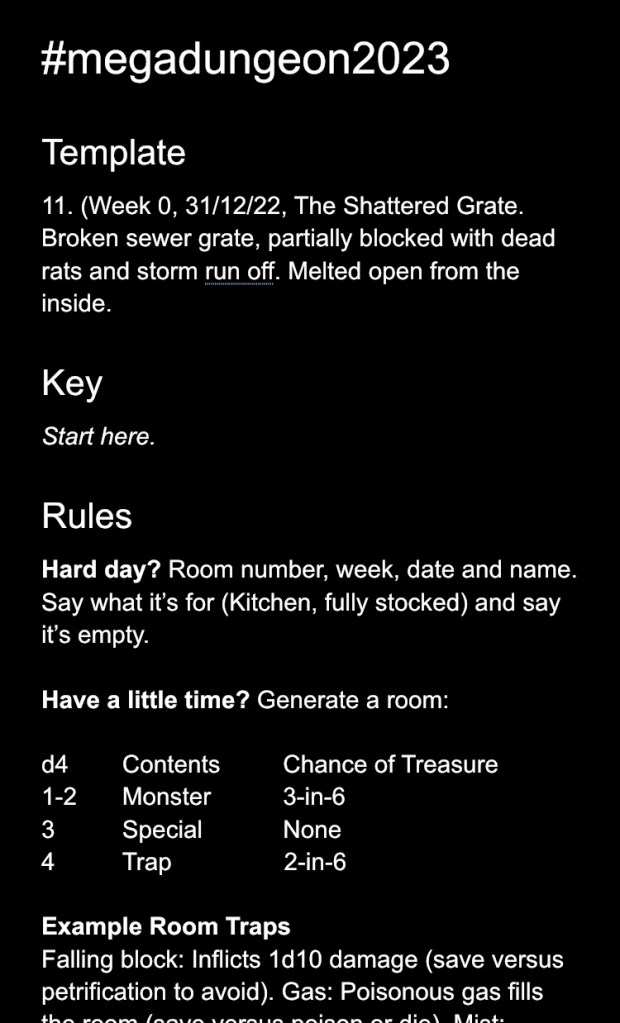
Step 2: Google Doc
Here’s what it looks like.
What are the rules at the bottom?
Hard day? Room number, week, date and name. Say what it’s for (Kitchen, fully stocked) and say it’s empty.
Have a little time? Use OSE’s dungeon tables to give it a feature and maybe treasure.
Have more time? Use Dungeon Architects Handbook to generate some extra story, or add to the levels encounter table.
In addition, Gus points out there are a few elements that I’ll be wanting to template aside from rooms: Stat blocks, magic items, traps, and puzzles. These templates are in the rules section as well: I’ll use Into the Odd for stat blocks, because it’s easier to stat for quickly, and say things like “as orc” as much as I can. For NPCs, they need an asset (or secret), an agenda, an ally and a foe, a common experiences with a PC, and a recognisable profile. Traps and puzzles need a fail state.
Concluding Thoughts
This post was getting too long, so I’m breaking it into two, so tune in in a few days for steps 3 and 4. I’m happy to provide access to my google doc or procreate template (I’m not sure how to send a procreate file though) if anyone wants them, and if you don’t like them I recommend Gus L’s worksheets as a starting point if you want a bit more than what I like.
I posted recently about spaghetti westerns, chanbara, and Red Dead Redemption 2, and I came up with a list of what I called themes, but could be considered aspects or something else I guess. In this post, I’m going to think about how to take those themes, and how I’d implement them into a Dungeons and Dragons game, by breaking them down into what element of game structure they impact and how they impact it. I want all these to translate in grippiness, a term I misremembered from Dogs in the Vineyard, but which I think is honestly self evident and I like. You want these elements to be potential levers that pull the player characters out into the world and dangerous or complicated situations. I won’t detail the world or the procedures here, I’m figuring out what they need to be. I’ll do that next.
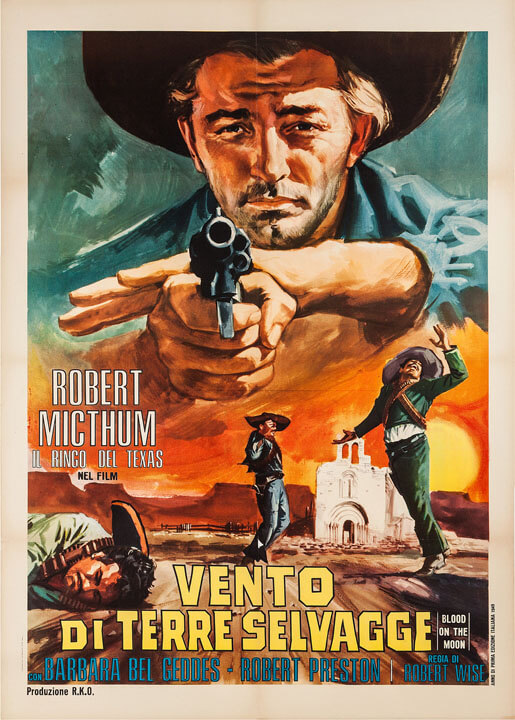
Blood on the Moon
The World
The landscape is a character that is out to kill you.
There are outposts, and the further west you go, the less industrialised and more isolated they become.
There are saloons in most outposts, and they feature music, romance, gambling, drinking and brawling.
Law is disorganised and unofficial the further west you go, organised, aggressive and allied with capital the further east you go. Lawmen believe in justice dispensed through the court, gaol and the noose.
Lawless believe in justice dispensed through retribution and through duels.
Non-player Characters
Non-player characters have a personal sense of honour that often conflicts with duty to an employer, patron, government or family.
Non-player characters will kill for gold, revenge or politics, if they can.
Homesteaders are desperate, kind, and mistrustful. They often seek liberation from oppression.
Fossickers are desperate, gullible, and untrustworthy. They often seek assistance in their endeavours.
Lawmen are desperate, broken, and noble. They often provide contracts to the player characters for bounties.
Rivals are desperate, protective of their gangs, and spiteful. They often seek revenge for past misdeeds or invasion on their turf.
Minions are desperate, callous, and believers in their baron’s cause. They often report on the player characters to lawmen or barons.
Barons are comfortable and vengeful. They steal land, livelihood or labour from hard-working folk. They may be captains of industry, matriarchs of successful fossicking families, corrupt authorities, or fallen religious figures. They often seek retribution on the player characters.
The gang and the player characters
The gang is home, family, and necessary for survival. The camp is safe until it is discovered by a foe.
The gang has as many non-combatants as combatants, and all have relationships with each other. People can join the gang, and leave it.
The gang needs supplies and money, and forays out from camp require supplies.
Gang business includes confidence jobs, robberies, jailbreaks, lending and collecting debts, collecting bounties, and fossicking for riches.
Gang members are uninterested in or unable to engage with civil society
The gang would prefer to settle down in one place, but is driven on by mistrusting locals and accumulating heat
The player characters contribute to the gang’s finances and to assist the other gang members in their contributions.
Luckily, most of this is world-building. I can just write most of this stuff, tell the players to pretend they’re Wild West outlaws but in dungeons and dragons, but I’ll need special systems for some of these things:
Gang Generator
A gang and camp generator. We need pre-existing relationships, tensions, and roles, one for each gang member including PCs, although more can develop.
Camp Events
The gang must change, interact, create opportunities and bring challenges regularly.
So, take all our previously generated relationships, tensions, plus an events column, and we make a spark table from them. Each session a new event occurs.
Alternatively, a crew sheet cribbed from Blades in the Dark or more likely a variant like Songs from the Dusk. But I’m not sure I want to upgrade or invest in my camp? Is this worth developing?
Supply, heat and gold
The gang needs supply and gold , which should be abstract, it’s easier that way. I’d run it like Errant does (I’d probably play in Errant, it has a few subsystems like duelling that are useful), just supply and gold go into and come out of a central pool.
Heat is a currency like supply and gold. You get it when you’re caught doing things the locals don’t like. When you get too much, the law are after you, which may or not be a big deal depending on how far west you are. Individuals have heat, the gang has the total of everyone’s heat. You can pay off heat in a region if you can persuade the local authority.
Moving camp
I don’t see why it has to be any more complicated than “move out of the region, into a clear hex”.
The Saloon
The saloon, is more challenging, actually, because I’ve always struggled to make these situations interesting and they’re important. So, lets say that a saloon is always where you go to find jobs. There’s a job list there, and when you check the job list, you also carouse. Carousing can result in positive results, negative results, and you get to talk to the person who gives you the job. If you don’t like it, you continue carousing, this time at a disadvantage, and so on and so forth. Mechanise both the saloon and the carousing, and whether players wish to play out the saloon or not, the saloon is a key part of gameplay.
I think that’s enough for today. I don’t know what the world looks like, and most of this is simply world-building and not mechanics-building, which honestly, I didn’t expect. It’s gratifying, because it means that maybe I’m going to do a little world-building on this blog soon. I don’t enjoy writing lore, so it’ll be fun to try to write out a vibes-based fantasy wild-west. Next I’ll look into the procedures.
I use affiliate links where I can, to keep reviewing sustainable! Please click them if you’re considering buying something I’ve reviewed! Want to know more?
Have a module, adventure or supplement you’d like me to review? Read my review policy here, and then email me at idle dot cartulary at gmail dot com, or direct message me on Discord!




 Playful Void