If you’re walking in on the middle of this series, there’s an index here.
This is a big task and one that I won’t fully flesh out in this post, but rather scratch out the principles. Just like proficiencies, I’ll get to the actual lists later. I’ll start with commonalities:
No hit dice increase after 9th level, instead gaining individual hit points.
Paladins and Rangers get spells at 9th Level, Wizards, Priests and Bards from 1st Level.
Thieves gain followers at 10th level if they build a secret hideout, Rangers get followers at 10th level but don’t need a stronghold, Priests at 8th and can still build a stronghold from 9th level regardless of if they build a temple, Fighters at 9th Level if they have a stronghold. Bards can build a stronghold and attract followers from 9th level. Wizards and Paladins specifically don’t get benefits from a stronghold, or followers.
There’s a wide variety in terms of class ability, and abilities are not considered equal. Spell-like abilities are clearly more valuable, though, and proficiency-like abilities (rogue skills for example) are not considered very valuable. On average, though, classes have 2 downsides and 5 upsides, which is something we can shoot for in developing these out.
HD appears to have been chosen solely for a wide selection of polyhedral dice use. There’s no discernible reason why bards, priests and warriors are all styled as able fighters but have d6,d8 and d10 respectively. I feel like HD should reflect whether your priest or bard is a warrior, not the class itself.
Spell progressions are unique across classes, but somewhat arbitrarily, with priests capping at 7th and wizards with no caps.
Racial and ability score restrictions are throughout and seem arbitrary and silly.
So, what can I pull from this:
Advancements are irreversible choices, made at each level, chosen from a class picklist, consisting:
Proficiency slots
Proficiency-like abilities that balance with spells in some way
Spells with downsides to balance with proficiency-like abilities
HD size increase
HD number increase
And at 9th level for all classes:
Attract followers
Begin building a stronghold
No more new HD
Maybe new proficiencies
Picklists are interesting, and limiting in a way that eliminates the need for downside traits. If we say you simply pick three at first level, or even that you get these two at first level and pick a third, we can do away with downsides.
But downsides are well established in Second Edition design. And I like downsides, just not as sticks, but as carrots. I wonder if these downsides can be folded into the alignment or ethos system, and perhaps incorporated into experience, to maintain this aspect, but also build up the parallel systems of alignment and ethos in terms of importance. If that is the case, I’ll set this aside for later.
I’m not sure I want to nut out the class details until I’m sure this sketch makes sense in the entire framework. So, I think next I’l look at heritages. This has been a part of the Advanced Fantasy Dungeon Series! Let me know your thoughts on this approach, whether I’ve overlooked anything glaring, or anything of the sort!
Advanced Fantasy Dungeons is a project where I design a paraclone of the second edition of Advanced Dungeons and Dragons. A paraclone attempts to realise the designers intent, free of simulationalism, tradition and legacy. This is a place to index what I’ve written so far and plan what I’ve yet to write. I’ll continue to update it regularly.
Once this series is finished, I’ll build out an alpha rulebook for feedback and for myself to test, and if sentiment is positive, maybe forward from there!
If you’re walking in on the middle of this series, there’s an index here.
Second Edition proficiency checks are simply ability checks, with a modifier applied to the target score. You suffer a penalty if you don’t have proficiency on everything, and you can’t perform the proficiency without the necessary tools, you can specialise further for bonuses or to allow special abilities (like point blank range use of ranged weapons).
Now, the basics are already folded into the ability check rules: Without proficiency, you cannot have full success. But specialisation has to be sorted, and exactly what a proficiency is needs to be sorted.
Important points from Second Edition: They’re specific, they usually require tools (sometimes to learn them – like a library – sometimes to perform them – like a smithy), they require formal training.
This places a ban on these things in terms of ability checks: If they require training, you can’t do it with an ability check, you need to seek training and get a proficiency. This is neat to me! But I’m not sure what ability checks are actually for now, and we’ll have to come back to that.
So, proficiency is sufficient training to succeed at simple tasks in low risk circumstances, and to have a chance to perform them well at all in high risk circumstances.
Specialisation – I feel like mastery is a better name, given that’s what they talk about in the PHB – is sufficient training at a specific subcategory to do this with a bonus, increasing the likelihood to pull it off in high risk circumstances. You get mastery by taking additional proficiency slots, but that only equates to a +1 bonus in the original. Weapons get a damage bonus.
This feels stingy, but if you’re allowed to sink as much into mastery as you want (at a cost), and have a strong ability score, you’re approaching 5% failure rate. Bonus damage should be reflected in non-weapon proficiencies too.
When you attempt a task, consider whether it requires training, or whether anyone can do it. If it requires training, you need proficiency. If it anyone can do it or you have proficiency, and it is a simple task or the consequences of failure are negligible, you succeed. If it is complex or the consequences of failure are significant, perform an ability check.
To perform an ability check, roll 1d20. If the result is less than your ability score, you succeed but face a consequence. If it is not less than your ability score or the result is 20, you do not succeed and face a consequence. The game master chooses the consequence.
If you have proficiency, roll 2d20. If both dice are a success, you succeed without consequence. If you have a disadvantage, roll 2d20 and only take the lowest score.
If an item, ability or mastery grants you a numerical bonus, it is subtracted from the result of the roll. If your result is less than zero, you get greater effect than intended. You can always trade advantage for special effect or greater effect, by negotiation with the game master.
The actual proficiency rules are a part of the advancement and maybe character creation rules. The average profile is 5 slots to start, plus an additional slot every 3 levels, and I don’t see why to vary except perhaps as a bard’s special ability. So it looks something like this:
At first level, you have 5 proficiency slots. you gain a proficiency slot at 3rd, 6th, 9th 12th, 15th and 18th levels. The first proficiency slot you spend gains you proficiency, and for each slot spent thereafter you gain a +1 mastery bonus. Examples are (will be) given of proficiencies and bracketed are examples of mastery.
Proficiencies do not leap unbidden and fully realised into your mind. After first level, you must train, study, and practice to learn a new proficiency or gain further mastery. This occurs during downtime (refer to downtime section).
The proficiency list will be a suggestion and I’ll probably pluck it straight from the PHB, maybe supplemented by Birthright as I want some from 9th level concerned with domain play. My gut is they’re just available, but are useless until you have land, mainly because you can choose these useless proficiencies to tell a story about an exiled noble or the like. I’ll come back to lists later, I think.
So, the Ability Check continues to take form. This is still fun! This has been a part of the Advanced Fantasy Dungeon Series! Let me know your thoughts on this approach, whether I’ve overlooked anything glaring, or anything of the sort!
If you’re walking in on the middle of this series, there’s an index here.
This sketch is actually quite straightforward from the read-through, because a huge chunk of this chapter is individual subsystems that are fun but need to be elsewhere – in magic, proficiencies, combat, death and healing, for example. This leaves me mainly needing to write a little, but not much.
I’ll start by, divorcing ability scores from “natural ability”:
Ability Scores
Ability scores do not represent your characters congenital ability, but rather the totality of a lifetimes work, play and study. You are not born strong, but you become strong working the Fourgoth Mines. You are not born intelligent, but become intelligent competing at the College of Six Seers – or perhaps become instead charismatic.
These are the six ability scores:
Strength is power and endurance.
Dexterity is agility and reflexes.
Constitution is health and resilience.
Intelligence is guile and education.
Wisdom is discernment and intuition.
Charisma is persuasiveness and leadership.
Then, simplifying generation, to match up with the new check procedure:
Rolling Ability Scores
Roll 3d6 six times and jot down the total for each roll. Assign the scores to your characters six abilities however you want.
And then, having spent a bunch of time trying, I just can’t fit associated statistics into the ability scores neatly, because they’re so heterogeneous. Instead, I’ll pull the interesting systems out and put them into sections, and add a few skills as proficiencies, later.
Proficiency: Bend bars, lift gates (climb walls?)
Magic: Magical defence and immunity
Social: Loyalty and starting attitudes
Health: System shock, resurrection
Equipment: Encumbrance bonuses
There we go, ability scores sorted. The only gap between these first two sketches is when you check abilities, which I can fill later. This has been a part of the Advanced Fantasy Dungeon Series! Let me know your thoughts on this approach, whether I’ve overlooked anything glaring, or anything of the sort!
If you’re walking in on the middle of this series, there’s an index here.
With Brian’s help I realised I’d miscalculated the mathematics on the last Rules Sketch (I find anydice challenging at any time, let alone on my phone, which is where all my writing is happening right now). I also realised I’d forgotten to implement one stated principle from the read-through which happens to help with the problem, so here are my modifications.
To perform an ability check, roll 1d20. If the result is less than your ability score, you succeed partially or with consequence. If it is not less than your ability score or the result is 20, you do not succeed and face a consequence.
If you have proficiency, roll 2d20. If both dice are a success, you succeed without consequence. If you have a disadvantage, roll 2d20 and only take the lowest score.
This is basically the same rule as before, but it implements the unstated principle from the proficiencies chapter: You can’t do a thing well if you don’t have proficiency in it. But, it limits the utility of dice pools in resolution. How do I fix this?
The option of adding a bonus to the target causes the issue that with a good ability score and a few sources of bonuses, you can’t fail. The “on a 20” rule mitigates this, but not sufficiently. The other option is to subtract a bonus from the roll, which is less intuitive, allows me to remove the “on a 20” rule, and also allows me to add a “critical success” rule if a roll goes below zero, which is appealing to me. However, it reduces intuitive compatibility – still not hard, though, to treat negatives as positives.
If an item, ability or specialisation grants you a numerical bonus, it is subtracted from result of the roll. If your result is less than zero, you get greater effect than intended. You can always trade advantage for special effect or greater effect, by negotiation with the game master.
This corrects the mistakes in my previous post and incorporates more principles I’d pulled from the read-through. Feels more like 2nd Edition, but keeps the interesting choices, drama and clear results. I don’t like 20s are always a miss as a rule, but it’s necessary if I’m using bonuses. It necessitates a more complex differentiation between proficiency and specialisation, which is disappointing, but is still present in the original text.
This has been a part of the Advanced Fantasy Dungeon Series! Let me know your thoughts on this approach, whether I’ve overlooked anything glaring, or anything of the sort!
If you’re walking in on the middle of this series, there’s an index here.
Second Edition checks are roll under ability score, d20 rolls. Level success is subsumed into difficulty; by which I mean you choose your degree of success before you roll, by taking modifiers, then pass or fail. Proficiency is simply one of these modifiers.
Placing choice in a modifier list, adds complexity and reduces drama in my opinion, both not in the spirit of the game. So, I’d prefer a different approach to level of success, one that still supports the basic roll, for Advanced Fantasy Dungeons.
To perform an ability check, roll 2d20 and compare against your ability score. Rolling under your ability score is a success. If both dice are a success, you achieve your goal. If one dice is a success, you succeed partially ir with consequence. If neither dice is a success, you do not succeed.
I like this a lot. Faithful, dramatic, Now, options for bonuses or penalties:
Numerical Bonus/Penalty
Additional dice, drop lowest/highest
Increase in level of success/consequence
Option 1 is highly compatible, and scales up with levelling up until it’s impossible to fail. Option 2 is messily compatible, and scales down with levelling up until the advantage is negligible. Option 3 is neat and more narrative, but places a lot of weight on the GM to adjudicate or negotiation becomes a greater part of play. I think choice might be good here:
If you have relevant proficiency or have gained the upper hand in some way, take advantage by rolling an an additional dice and favouring success. If you do not have a relevant proficiency, or are on the back foot, take disadvantage by rolling an additional dice and favouring failure.
n You can have either advantage and disadvantage multiple times, and they cancel each other out. You can always trade advantage for special or greater effect, by negotiation with the game master.
I think this feels like AD&D, but adds a lot! Every +1 is +1d, players have interesting choices before rolling, there is drama during the roll, and results are clear post-roll. Probability curves plateau pleasingly, increasing probability of success but always leaving possibility of failure.
This has been a part of the Advanced Fantasy Dungeon Series! Let me know your thoughts on this approach, whether I’ve overlooked anything glaring, or anything of the sort!
So, people have asked me to work on Advanced Fantasy Dungeons (name TBC) in public, so, based on my close reading of the PHB, DMG, and some splatbooks from Second Edition, I’m going to start developing some systems here on Playful Void.
Consider the role of the expanded product line in the games identity
I’m expecting a series of interlocking or sibling systems that will need to be hashed out initially and then re-considered in light of each other before there’ll be a playable beta. I’ll start with sketching out these milestones, to break a significant task into manageable chunks. I’m focusing on rules here, not on principles, so a lot of cool things in the read through won’t be documented until a later pass. I’ve given each section a theme as well, based on the read-through, to keep me focused on what the subsystem is for.
Basic principles
Timekeeping
Checks
Bonuses
Pools (Advantage/Disadvantage)
Clocks
Devils bargains
Player Characters (Theme: Unique Capabilities)
Creation
Ability Scores, Associated Statistics and Proficiencies
Campaigns (Theme: Living world, Superficial Preparation)
Multi-character, multi-party
Keeping time
Making maps
Acting factions
Telling secrets
World Supporting
0-Level characters
Sketches and portraits
Societal and religious ethos
Treasure
Changing money values
I knew this was big, but wow. Maybe insurmountable. I’ll just work on things as they dawn on me, I’ll drop a system in and a system out, and when I reach a critical mass I may start going back and reworking them in the light of new systems. I suspect this is going to get unwieldy soon in terms of linking back to previous posts, so I’ll stop trying and figure out how to index on a blog. I don’t know if this list will remain accurate, but we’ll have to come back and summarise eventually, and that will be an interesting retrospective!
There are other important things from this the read-through unaddressed: Safety, Expectations, World-Building. I think I’ll be putting those on hold for now, and coming back to them.
The other question I need to ask myself: If this is an alternate universe edition, and I’m not aiming for textual fidelity, how much leeway do I give myself as a designer, to fill gaps in the design? What I perceive as significant additions or necessary gap-fills are italicised in the list above.
Let me know your thoughts (if you have any), here or on twitter. This is interesting, and I’m interested in other peoples opinions, particularly if I’ve missed things, or overstated things, or understated them!
I’m reading through 2nd Edition as an educational exercise, and considering writing a retroclone for it titled Advanced Fantasy Dungeons. The purpose of the read through and writing the retroclone is more a design exercise as it is a necessary addition to my shelf. I started with the Player’s Handbook and then the Dungeon Master’s Guide. In this one I’m going to spot-read through a few supplements specifically to fill gaps implied by the design of the core books, and then look at a module or two and a bestiary to look at where I want to seek compatibilities. This is a long one, and you can just skip to the end for a summary of my thoughts. Let’s get started.
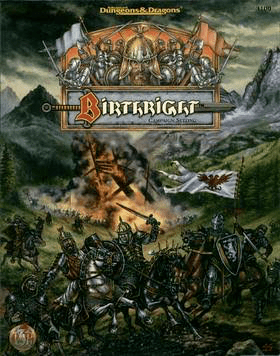
I’m going to start with the Birthright Campaign Setting, as one of the big surprises was that war and political intrigue was envisioned as a major part of this edition. Birthright cares about the minutiae of managing a kingdom more than I imagine any players will, but intrigue and war are directly incorporated in the Domain Turn, which basically is a series of larger-scale actions including the movement of armies, the cost of moving them, and politics in general. The idea of incorporating a formal Not Adventuring Phase has already been floated in response to other rules implications, so using this Domain Phase as part of the core rule set makes sense.
In Birthright, Domain Turns are seasons, if a PC has a domain it’s assumed they have a cast of characters surrounding them, random events initiate each season, you gain and spend power and chunks of 2000gp, to raise armies, build and upkeep holdings and castles and hold court. How you do these things impacts your popularity among the people. Domains have a level of population and development, and for each level you can build 1 holding of each type: law, temples , guilds, resources, plus as many armies, courts, castles, lieutenants, trade routes, and treasuries as you can afford to support. There’s got to be some kind of domain character sheet to manage all this, but I suspect it’s simpler than it appears.
The fun Intrigue is domain actions: Agitate, Espionage, Build, Grant, Decree, Muster, Order Troops, Declare War, Diplomacy, Finance, Trade. There are also character actions, which means this is literally just a downtime phase. Each action is a little subsystem, but I think these could be aligned – they already are – and simplified. Honestly, they scream for clocks: Random progress, you can hurry it along with power or gold, you can set two actions in motion per season, plus adventure. The size of the clock might relate to the action or to the intent of the action, and the subsystem structure clumsily supports that, rather than the tables of bonuses and penalties, I’d just do an increase difficulty list and decrease difficulty list, or do a position/effect thing.
The designers of Birthright clearly were wargamers, but my sense is that again, AD&D 2e players don’t want a wargame, they want to direct armies and fight in battles as decisive strike forces. Army building is already in the core rules, but Birthright expands it to larger scale, using unique troop types. To capture this, I think a Risk-like simple force size approach would be more interesting, with social forces being worth 1, 2 or more troops, but costing exponentially more. Declaring war gives you four moves, but you can buy more with more Domain Actions. Movement also costs 2000 gold or 1 power. Defenders can choose to retreat rather than fight, but won’t learn the power of the opposing force. There are terrain rules which contradict the DMG, and I’d simplify to passible by land, sea, or air. Castles count as a free troop. We need some kind of rule for strike forces: Perhaps a decisive strike (an adventure) would add a troop to the attack – this is a strange and unexplained omission. Wars end with peace treaties or total defeat.
Overall, this is a really neat framework for a downtime phase for AD&D 2e, keeping systems simple and familiar. There’s an advantage to systems across pillars (to borrow a fifth edition phrase) mirroring each other, but for downtime to be fun it needs to be quick and simple because it’s relatively solo. I also feel it should be tied to mid-level proficiency: When you get a holding at 9th level, you get access to rulership proficiencies, but perhaps you don’t get all actions at once, maybe you choose your sets. This way, the party might need to work together as rulers as well as as adventures: More rhyming systems, more maximising utility of existing systems.
Next up, The Complete Paladin’s Handbook. I’m looking for more information on alignment, and that appears to be in Chapter 3: Ethos.
If laws are just and applied fairly, it doesn’t matter whether they originate from a democracy or a dictator.
The paladin must act within his means: It is no failure not to stand one warrior against an army.
Kill to promote the greater good, or to protect himself, his companions, or anyone whom he’s vowed to defend.
Patrons impose commands, instructions, and traditions that must be followed to the letter.
Always be courteous, honest, honourable and valiant.
This is better than “lawful good”. Give the paladin a list of solid rules they can’t break unless it would be pointless to their patron, and then have them defend their borderline choices choice before court. Cool. There are rules for courtly love, which needs to be core paladin downtime in my opinion. Should all classes have unique downtime? Wizards do!
The Complete Ranger’s and Bard’s Handbooks fails to address the alignment requirement in any meaningful way, although the animal companions become interesting NPCs, rangers get an ethos similar to Clerics, and an interesting reputation mechanic that functions neatly as a proficiency (the first sign of the d20’s supremacy) is introduced for bards.
There are remaining gaps in dungeon exploration, suffering from the focus on wilderness exploration and movement subsystems. Wandering monsters are mentioned but no rules are noted, but in random encounters it mentions a 1/10 chance, every 6 turns, plus loud noises, and encounter tables by level. This is clumsy and feels like a transitional phase to the complete lack of dungeon structure in later editions. It’s assumed in a bunch of sections, but its not clear to me if the designers regarded it as a residual appendage or something so essential it didn’t need to be mentioned.
The rules in the DMG on “monster reactions” (which, I admit, I missed until I went searching for systems supporting social pillars of play), are the flight-friendly-indifferent-cautious-threatening-hostile scale, but apart from in the bard reputation optional rule and the performance rules, they aren’t reference. This is to suggest that the concept here is that there are minimal social rolls unless you have a special power or ability, but that the right talk, bribe, etc. can move you up and am down the scale. It doesn’t state outright that this could be universalised, but it’s implied by the bardic rules I think.
I think these all of these rule sets would benefit from being drawn forward from a common point, instead of being unique systems. Ethos could be standardised or even worked into alignment. Reaction and encounters could mirror other systems sensibly, potentially drawing from downtime or proficiency structures, or reflecting the theoretical environmental interaction simplifications.
Now looking at the Monstrous Compendium 1 for extended creature stats. All entries get ecological data (climate, frequency, organisation, intelligence, alignment, diet, active cycle, habitat, society and ecology) although these are absent if they’re not relevant. In terms of mathematics, we have treasure, AC, movement, HD, THAC0, Attack #, Damage, Special Attacks & Defences, Magic Resistance, Morale, XP and Tactics (called combat). The DMG gives this abbreviation for random encounters: Creature—APP #, AT #, THACO #, D #, AC #, HD #, MV #, special notes on attacks and defenses.
When reading through a selection of modules (A Wizard’s Fate, The Price of Revenge, The Iron Orb of Duergar and Kingdom of the Ghouls), they add Morale and Treasure. References to any other mechanics apart from spells are very rare (I found references to wisdom and strength checks (only mentioned, now that I look back, in the PHB glossary as a roll-under), save vs massive damage, percentile penalties to thieves skills, and damage as weapon).
Summarising thoughts: I think I have enough gaps filled by now to begin developing an approach to Advanced Fantasy Dungeons. I doing think it will end up being a retroclone, but instead a kind of paraclone or anticlone: What second edition could have been had the designers had free rein, or perhaps what third edition would have been if they had focused not on the detail but the intent of the second edition design.
The difficulty will be to avoid pulling more modern design decisions into it. It’s screaming for clocks and usage dice, and finding a solution that isn’t anachronistic will be challenging. Do I have to? Both of those solutions came out of retroclones of earlier editions. Do I need to set myself limitations, or should I design whatever I desire and see what comes, keeping in the spirit of the original text?
Speaking of which, that spirit is well summarised in fifth edition terms: A fantasy role playing game, built on five pillars: Combat, Exploration, Social, Intrigue and War. A role playing game that changes its nature as characters gain experience: Not all pillars are available at all experience levels, downtime changes and supports different actions while still supporting play over large distances and long time periods. Support for a broad range of solutions to any problem, but those solutions are unique to specific characters to give them their own spotlight in multiple domains. I think this is the game that Second Edition is trying to be.
So, I’ll start trying to write that game. Should I do it, live, on this blog, or work offline and publish it all at once, or publish it in development on itch.io? Please, let me know in the comments!
I’m reading through 2nd Edition as an educational exercise, and considering writing a retroclone for it titled Advanced Fantasy Dungeons. The purpose of the read through and writing the retroclone is more a design exercise as it is a necessary addition to my shelf. I started with the Player’s Handbook (1989), and in this post I’ll look at the Dungeon Master’s Guide. I’ll hit the ‘Races’ chapter in this post, as well, so content warning for racism. This is a long one, and you can just skip to the end for a summary of my thoughts. Let’s get started.
Interesting that this book literally opens with a screed against rules lawyering. Don’t just let the game sit there, and don’t become a rules lawyer worrying about each piddly little detail. Given the reputation this edition would develop. In addition, the parallel organisation of this book and the Player’s Handbook is an interesting choice. Whilst I think some chapters aren’t necessary, it’s a neat call-and-response in many, that focuses the dungeon master on the player characters.
Chapter 1 is Player Character Ability Scores. It’s interesting that it’s largely accepted that players will have multiple characters across the world, and that you might bring characters from one game to another. There’s a discussion about balance in this context, acknowledging tables are different and that moving from world to world might cause balance problems. But, the whole chapter is largely framed as “how to control players”, when it’s pretty apparent that expectation setting could cover most of this without the necessary advice, which was better and more respectfully given in the Fourth Edition DMG’s “types of players” section.
Chapter 2 is Player Character Heritage. It outright states here that the only reason class and level limitations exist are to make humans appealing, but there is no strong defence here for the approach chosen. Based on this and the previous chapter on the same subject, the same approach and spirit would be to choose two positive and one negative trait from a heritage list, to achieve the same outcome, and give humans some damned features, as there is already precedent for not having all of your special abilities.
Chapter 3 is Player Character Classes. Interesting concepts introduced here: What it “means” to have character levels, 0-level characters being 1d6 hit points and having 2-3 proficiencies (and no other stats), the idea that it’s rare to be a leader in the field and have levels because “Their talents in the field are too valuable to lose, and their effort is expended on their art, not on maneuvering and toadying.”, introducing political intrigue at around level 9 (although no recommendations as to how), and retirement. Retirement suggestions “Avengers Reassemble!” Style one-shots against absurd threats, which is honestly an awesome approach to higher level play.
One expectation that I haven’t seen stated before is having low-level play inform characterisation. As an expectation, this would actually be a lot of fun to mechanise in some way:
Did Rath the Dwarf save the day by fool-hardily charging into battle when he was a mere 1st level? If he did, the odds are good the player will try it again and will begin to play Rath as a bold and reckless fellow. On the other hand, if Rath was clobbered the first few times he rushed in, the player would begin to play Rath as a cautious, prudent fellow.
One thing I overlooked about classes is addressed in this chapter, in creating new character classes. Basically, XP to level up increases for every power a class has, which is why the absurd paladin has a bunch of restrictions. This is pretty clumsy an approach, though, and I think it’d be more interesting to take powers (or increase them) at each level up, from a list, and then keep the same experience chart, as a way to make characters more unique but retain class “balance” without weird artefacts like “must remain lawful good”.
Chapter 4 is Alignment. It opens with a paragraph that should have been the introduction to the book:
In all points of disagreement with your players, listen to their arguments when your understanding of an alignment differs from theirs. Even though you go to great effort in preparing your game, the campaign world is not yours alone–it also belongs to your players.
Which is nice, because while it wasn’t said outright until the 15th chapter of the game, the designers clearly think it’s primary, and it should be forefronted. There are some nice alignment definitions which clarify what an alignment actually is supposed to tell you;
Alignment is a shorthand description of a complex moral code. It sketches out the basic attitudes of a person, place, or thing. Alignment is not personality. Add characteristics that make [a character] interesting, adapting these to fit the character’s alignment.
But that the definitions fail to do clearly, in my opinion (as evidenced by my being challenged by the rangers’ good requirement and the bard’s neutral requirement).
Societal, location and religious alignments, if alignments remain in the same form with words like “evil” and “chaotic” in them, are racist as shit and have to go. It’s not crazy, though, to say a society or religion has shared beliefs though: It’s squishing beliefs into the nine-part-grid that’s the problem. I’m starting to wonder if a solution would be, similarly to classes and heritage, breaking the sections defining each alignment into concepts and having characters pick a few core beliefs for them, or their society, or religion, might be a more flexible and less loaded approach to alignment.
This is an example of where I really enjoy the world building in Second Edition, even though it’s sparse:
Sometimes characters try to use spells or magical items to learn the alignment of a player character or NPC. This is a highly insulting, if not hostile, action.
And this, implying people in this world know that their alignment is “lawful evil”:
Asking another character “So, what’s your alignment?” is a rude question. A chaotic evil character with any wit would reply “lawful good.”
Chapter 5 is Proficiencies. It continues here to lean on simplified NPCs (assume proficiency in whatever they’re carrying), identifies proficiencies as a barrier to creativity, and talks about changing the list to choose the flavour of a campaign. This last point makes me feel like to match the assumptions elsewhere in the game, an evolving proficiency list according to “tier” (level 1, level 9, whatever high level is) might make sense to reinforce the expectation for intrigue, politics and war to feature at these levels. This makes me wonder if I need to read Birthright as part of this series, to be honest, and maybe Battlesystem to flag these expectations out more, so far left vague by the rules.
Chapter 6 is Money and Equipment. It ties living conditions to healing, rest and to quest hooks (you can’t do noble stuff unless you have wealthy living conditions), as well as burglary which interests me as an underdeveloped subsystem. There is a horse personality table which is my favourite table in the game so far. There are a bunch of item saving throw and equipment damage tables, which are dull as. Second Edition wants to have equipment and wealth interact with the world in both directions, but struggles to facilitate it in a predictable or exciting way, because it leans towards “realism”. I feel like a more straightforward option here would be to allow devil’s bargains: Your magic sword is destroyed because you deflected the fireball, it has no effect on you or the villagers you protected.
Chapter 7 is Magic. The only interesting thing here is a rule to let wizards learn spells by research, above and beyond their “spell limit”, in a way akin to a long-term project in Blades in the Dark.
Chapter 8 is Experience. Characters should get XP for surviving desperate situations through their own wit or will and for accomplishing “story goals” like rescuing the princess, but more importantly by being your class: Fighting, Furthering your Ethos, Researching spells or magical items, or getting rich. I feel like these are yelling for more solid mechanic support: Each player sets a goal for a session, they get “desperate xp” similar to Blades in the Dark, they have a clock for their Ethos or Research goal or for each level’s gold or fight goals.
Characters should level up every three to six adventures, which according to the Player’s Handbook are two to three sessions each, and each consisting four to eight hours. That’s conservatively 24 hours of play per level! These designers had a lot of time on their hands! Honestly I like the idea of slow play, but this speed feels blind to the reality of how much play most people can achieve. I think my idea in the previous session, though, satisfies the designers desire for consistent progress without levelling up every session (which they’re critical of as the lowest possible bar).
Chapter 9 is Combat. It says it’s not a combat game, and not to be concerned with the rules so much as what’s happening at each instant of play, describing the ideal combat as: One orc ducks under the table jabbing at your legs with his sword. The other tries to make a flying tackle, but misses and sprawls to the floor in the middle of the party!” Which leads me to believe that the rules in the Player’s Handbook are being utilised by the designers very, very differently. Part of this is why a longer turn is cool: There isn’t a lot of scene in 6 seconds, but you can do a lot in a minute. The challenge, then, is rebuilding or restructuring the combat chapter to support the kind of combat the designers want it to support.
Other points: Armour doesn’t absorb damage, it prevents it. No definitions for hit points; injuries can be specific or complex as the story requires. Different armour types are strong or weak against different damage types (slashing, piercing, bludgeoning). The simultaneous declaration is general (“I charge!”) and specifically to avoid tactics and make it more anarchic (“but now I can’t fireball them!”). Called shots are harder, and cause normal damage plus something special. There is no opportunity. Charging makes you vulnerable, but causes more damage. Firing into melee is inaccurate. There is a section on throwing boulders, which implies boulder throwing is a major part of the game. I approve.
The saving throw definition is remarkable and appears to imply a more major role in the game: The saving throw is a die roll that gives a chance, however slim, that the character finds some way to save himself from certain destruction, or at least lessen the damage of a successful attack.And it redefines them into broader categories: Strength of will, physical fortitude, magical attack, physical transformation, stamina, dexterity and spells (which is ‘other’). I find it a stretch to believe these 6 categories aren’t responsible for the eventual transition to ability-score based saving throws, via the three-category saving throws. It just also supports wider use: Saves for everything, armour for preventing damage. So what’s to-hit actually for? Did these designers envision PC-only rolls? If they did, fascinating!
Magic resistance is probabilistic, which I love. The morale check is a convoluted 2d10 roll under, that just needs to be simplified with something like advantage, disadvantage, or a dice pool. There is level drain, which always sucks and is too complicated. Poison rules are uninteresting, they need unique effects. Death is inescapable at 0 hit points.
Chapter 10 is Treasure and Magical Items. There are assumptions potent magical items, potions and scrolls are for sale; although later this is dismissed as reducing the fun. Land deeds, privileges, titles, offices are all treasures as well as gold. There is a section on “why are there hoards of treasure everywhere, and why are they still here?” Absurd relic rules are here, as in future editions.
Chapter 11 is Encounters. An encounter must present the possibility of a meaningful change in a player character’s abilities, possessions, or knowledge, depending upon the player’s decisions. This is honestly a damned good definition. Planned encounters consist keys and triggers, random ones provide a build and release in tension (“will they still achieve their goal?”). They speak of “wearing down”, but not of increasing risk associated with being in the wilderness or dungeon. It gives solid advice on notation and on including non-combat encounters in your tables. Advice to introduce complications if random encounters cause significant imbalance is great.
Chapter 12 is NPCs. It’s a little listy, however this gem is in the list: Assassination is not a discreet occupation per se, but a reprehensible mind-set. Hirelings and henchmen are all people, and it is difficult to find the right people and to read them: This tidbit would benefit from a random table more than the Military Occupation Wages table. Spellcasters are off-the-grid or else are hucksters; another neat piece of world-building. Walk-on characters should have an exaggerated personality trait, physical trait, and habit. Create only as much as the players will see.
Chapter 13 is Vision and Light. Infravision is heat vision, meaning they can’t see cold-blooded creatures and can blinded by heat. Lots of repetition from the Player’s Handbook, and I feel simplifying the endless lists, distances and resource management into a more straightforward subsystem is appropriate.
Chapter 15 is Time and Movement. The discussion around timekeeping between adventures focuses on managing multiple parties in the same world, but while there’s no chapter on downtime, it’s heavily implied that downtime happens in these gaps. A more consistent downtime subsystem would be beneficial. I’m happy that “terrain effect on movement” is optional, because honestly it’s incredibly dull for me. There is a differentiation and separate rules for “just lost” and “hopelessly lost”, which is hilarious.
Chapter 15 is A DM’s Miscellany. It doesn’t add much, simply more rules exceptions and sub-systems for specific cases. The appendices appear to be tables, but there are some fun things: Potions are unidentifiable. Maps are considered magical items due to their value. Rods, staves and wands require a command word.
Summarising thoughts: While continuing to be overwrought, the designers intent is clearer in the DMG than in the PHB, and actually appears to have been informed by a radically different play style than I ever interpreted as a child, or as the editions that followed. Shared world-building, minimal DM roll, system-minimisation (although clearly this latter tendency is clearer in the realms of social and politics than in combat or travel), multi-character and multi-party play is very clearly developed here.
The previous hallmarks I noted in the previous post are to a degree re-interpreted here, particularly combat, heritage, classes and alignment are clarified and all in an unexpected direction. Proficiency is recognised as potentially problematic, and the key question to come out of that is why has a solution to this problem not been found in three subsequent editions? Environmental interaction subsystems are doubled down on, with a bunch more DM-facing and PC-facing systems, re-iterating their importance and the necessity of finding a way to support it without so many separate sub-systems.
I did not expect to come out of this and expect the DMG to point me towards a radically different take on a Second Edition retroclone, but here I am. Advanced Fantasy Dungeons remains a very interesting prospect if some of the more complex barriers can be overcome.
Let me know your thoughts (if you have any), here or on twitter. This is interesting, and I’m interested in other peoples opinions, particularly alternative readings! I’ll try to find time to read some of the Monster Manual next week – this should be easier, because I’ll be taking samples. So far, essential reading feels like the Paladin, Ranger and Priest’s Handbook, perhaps the Bard’s, potentially Birthright and Battlesystem to round out the intrigue and war pillars that exist in Second Edition along with Social, Exploration and Combat that do not exist in more recent editions and that aren’t adequately covered so far. If you’re familiar with these older books, is there anything else I should look at, or look at instead?
As I previously mentioned, I’m reading through 2nd Edition as an educational exercise, and considering writing a retroclone for it titled Advanced Fantasy Dungeons. The purpose of the read through and writing the retroclone is more a design exercise as it is a necessary addition to my shelf. I’m starting with the Player’s Handbook (1989), and this is a long one so please forgive me for typos and poor editing. I’ll hit the ‘Races’ chapter in this post, as well, so content warning for racism. This is a long one, and you can just skip to the end for a summary of my thoughts. Let’s get started.
Interestingly, the Foreword actually lists the design goals for 2nd Edition:
To make it easier to find things, to make the rules easier to understand, to fix the things that did not work, to add the best new ideas from the expansions and other sources, and, most important of all, to make sure the game was still the one you knew and enjoyed.
This is valuable, because to be honest, a bunch of my previously stated design goals for this read-through match up: Simplify; Draw existing systems to their logical conclusions; Consider the role of the expanded product line; Remain in the spirit of the original. This comforts my approach to a degree: If my design goals and the designer’s match, then this effort may be less doomed.
Prior to Chapter 1, is a chapter called The Real Basics. This is the “What is a roleplaying game” chapter, and while it doesn’t knock it out of the park, it does say two interesting things.
Firstly, it defines a the essential element of a roleplaying game. I’m going to paraphrase as this section is in need of editing, but it’s something like “The player adopts the role of a character, pretends they are in the midst of an unknown or dangerous situation created by a referee, and must work their way through it”. The key interesting implication is that the game is about working your way through problems, and suggests that rolling is a last resort. As I’ve talked about Second Edition as a transitional edition, it’s notable then that subsequent editions took the optional proficiency rules in Second Edition and started to head down the ‘roll to solve the problem’ track. Second Edition aligns itself with prior editions: Player skill is as important as character skill.
Secondly, the purpose of a session: “Not to win, but to have fun while working toward a common goal.”, where that goal is defined by the adventure. This raises questions to me about the place of expectation setting and safety in the rules, because in order to have fun while working towards a common goal, that goal must be clear and agreed upon.
Chapter 1 is Player Character Ability Scores. It gives six (!) methods of rolling them, the primary being 3d6 in order, and the rest being specifically for “characters of truly heroic proportions”, including the now default method of 4d6 drop the lowest and assign as desired. The definitions of the ability scores are problematic at best, but more interestingly they all have associated statistics, that tell us a lot more about the ability scores than the definitions:
Strength is hitting and causing damage with a melee weapon and lifting weight.
Dexterity is about reaction speed and aiming missile attacks.
Constitution is about surviving bodily harm like poison, petrification, and Polymorph.
Intelligence is about capacity and opportunity to study, is about mainly magic and languages.
Wisdom is about resisting magical effects.
Charisma is about retainers, retainer morale, and baseline non-player character attitudes (not the ability to influence them).
All of these are implied by the associated statistics – things like “Bend bars”, “Resurrection Survival” and “Spell Immunity”. And these associated statistics are a mix of percentiles, adjustments and specific dice rolls. These are all flavourful and say a lot about what the designer thought was important, and I think should be included; but most of these subsystems – eleven in all – could be simplified and reduced, potentially into the optional proficiency system, although a few, like Charisma and Constitution, may not fit as neatly.
Chapter 2 is Player Character Races. Let’s call them Heritages instead. This whole chapter is a racist Gygaxian mess, with ability requirements and adjustments, class restrictions, and level limits, “reflecting the natural tendencies of the races”, despite not being “bound by these generalities”. The book also says these exist for ‘play balance’, because non-human heritages can also multi-class, where humans cannot. All of this needs to be scrapped, but fantasy heritages are an important part of the game, so how can Elves, Dwarves and Halflings be redeemed?
The range of abilities is quite small and overlap a lot between the different heritages: Sense Slope, Direction, Depth, or Safety of Tunnels, Sense Secret Doors, Infravision, Resistance to Sleep and Charm, Bonus to Surprise, Bonus to Attacks (either specific weapons or specific enemies), Bonus to Save vs Poison or Save vs Wands, Staves, Rods, or Save vs Spells, and Malfunctioning Magical Items. Languages are already a part of the proficiency system, the first seven abilities fit neatly into the proficiency system as well, and the others are effectively ability score bonuses (or bonuses to their associated statistics), leaving the best feature: “Dwarves cause magic items to malfunction” as the odd one out. Furthermore, a bunch of these abilities have a chance of not appearing in your character, which is an excellent choice that should never have been excised, and I think would support a picklist of heritage traits and bonuses, allowing less rigid and racist approaches.
Chapter 3 is Player Character Classes. I’m expecting this to be meaty, but I honestly remember the class handbook line better than the four classes contained here: Warrior, Wizard, Priest and Rogue. There are subclasses, although they aren’t called such: Warrior has Paladin, Fighter and Ranger, for example.
Warriors can use any weapon or armour, but can’t use all magical items or spells. They also get multi-attack.
Fighters get an experience points bonus for being strong, they can have Weapon Specialisation (part of the optional proficiency rules), and start developing a war band at 9th level.
Paladins can detect evil, all saving throw, are immune to disease, can lay on hands, can cure diseases, have an aura of protection that becomes a dispel magic field if they’re wielding a magic sword, can turn undead, devils and demons, can have a warhorse (like, it’s strange, it phrases it as “call for a warhorse” which sounds like summoning, but it also requires a quest?) and can cast priest spells. But! Paladins must act lawfully at all times or atone for their sins, and can never do evil or lose their Paladin-ness. They have a magic item limit, have to give away all their gold, don’t attract followers but can hire them but can only hire lawful good retainers.
Rangers can fight with two weapons, get tracking proficiency, can hide in shadows and move silently in natural surroundings, get bonuses against special enemies, can befriend and are otherwise “good with animals”, as well as have an effect on the baseline hostility of animals, can cast priest spells, and get animal followers. They must be good and their abilities only work in light armour, they must fight their special enemies preferentially, can’t do evil, and need to give away any treasure they can’t carry on their person.
These two, Paladins especially, are a lot. I like the idea of trade-offs being a major class feature, but I can also see the complexity that future editions foregrounded creeping in here. I’m also interested (given what Gygax has said about lawful good) in what the alignments section says about law and goodness, given how they factor in. The limitations on these classes also probably require the expanded material to make sense of, as I can see conflict being introduced from the pressure of “losing my cool abilities”, which is not a fun kind of conflict to introduce.
Wizards cast spells, use any magical item and create potions and scrolls. Spells are hard to learn, and only a limited number can be kept in memory, but you can create new ones. They can’t wear armour (“complicated gestures and weird posturing”), and can only use a few weapons. Specialty wizards have racial restrictions, can’t cast spells from “opposition schools”, but get extra spells, get bonuses to chance of learning, bonuses to saving throws. I don’t like the racial restrictions, but otherwise, specialisation is neat.
Priests have limited armour and weapon selection, limited magical items, have access to certain “spheres of influence” amongst the spell list, can turn or bind undead, can attract followers and build temples. Specialist priests get special powers, but are limited in how they act by “ethos”. Druids are a type of specialist priest, and the rules just say “make your specialist priest up but be fair about your powers”. I love it, but the idea of a “generic priest” is just so weird and protestant I can’t even.
Rogues “feel the world owes them a living”, which is the best class definition I’ve ever heard. They can be thieves or bards, but regardless can speak more languages, read magic writing sometimes, can climb, are dexterous, pick pockets, detect noise, all utilising a percentile roll.
Thieves can open locks, find and remove traps, move silently, and hide in shadows in addition, can backstab, can speak in thieves cant, can read scrolls, and can attract followers to start a gang, but have armour and weapon limitations.
Bards can use any weapon, are proficient in singing and a musical instrument, and have some random spells due to their dabbling. They can use performance to influence crowds, or inspire or rally allies, can counter magical songs, knows stuff sometimes, can use magical items from other classes, and can attract a following. But, they can’t use a shield or heavy armour, must have neutral alignment.
Interestingly, all classes stop gaining hit points in large amounts after ninth level, the level many classes gain followers. There is a distinction between class switching and multiclassing, which seems pointless and is unexplained, except perhaps as a reason to play a human? Must be a historical reason for this decision I’ll have to look into.
Chapter 4 is Alignment. I’m mainly interested in the relationship of Lawful Good to paladins, Good to rangers, and Neutral to bards, and what this means as a restriction given in exchange for additional power.
Let’s start with Lawful Good:
An orderly, strong society with a well-organized government can work to make life better for the majority of the people. Laws must be obeyed. Strive for those things that will bring the greatest benefit to the most people and cause the least harm.
Honestly, this alignment provides opportunity for a really interesting conflict for a character, if the punishment for making the wrong decision wasn’t losing all your cool stuff. What about unjust laws? Corrupt lawmakers? Who is the most people? How do we choose their benefit? What about a sliding scale, where powers came and went? Or what if a paladin was in conversation with whoever grants them power about what these things mean?
Bards being neutral do not make sense:
Foe every force in the universe, there is an opposite force somewhere. The same is true of good and evil, life and death. What is important is that all these forces remain in balance with each other.
This clashes with “the world owes me a living”, but also I just don’t feel like a bard would believe these things by default. And alignments are phrased consistently as beliefs, where perhaps that’s not what they are?
Rangers, similarly, don’t really make sense:
A good person, however, worries about his errors and normally tries to correct any damage done. Remember, however that goodness has no absolute values.
Being a ranger has nothing to do with this. Chaotic good or neutral good might make more sense, but honestly they don’t introduce any interesting internal conflicts: In which case, what’s the point of giving a character a belief system? In addition, clerics have a separate belief sub-system.
The stated goal of alignment is:
…a guide to provide a clearer idea of how the character will handle moral dilemmas. Always consider alignment is a tool…it certainly doesn’t prevent a character from changing his beliefs, acting irrationally , or behaving out of character.
But from reading the definitions, most are either amoral or don’t provide a clear decision or a clear potential for moral challenges. The goal is sound, but how can we think about these alignments in order to provide clear decision decision and conflict points.
Chapter 5 is Proficiency, and it’s technically optional, but it has so many references already in the text it’s not really optional at all. You can be proficient at weapons or non-weapons. You are bad at weapons you’re not proficient in (even if you can use them), and you need to train in proficiencies in downtime. Fighters can get double proficiency (specialisation). Proficiency checks are only done if likely to fail or difficult.
My impression here is that this is a fun and flexible system, that weapon proficiency rules should mirror non-weapon proficiency rules more (penalties to things you’re not proficient at, auto succeed when you have proficiency and it’s low risk of failure – perhaps specialisation could even auto-hit!). It’s interesting that risk of failure and not risk of consequences, which is what most modern sensibilities would emphasise.
Chapter 6 is money and equipment. The most interesting thing here on money is this:
Coins have no guaranteed value. A gold piece can buy a lot In a small village but won’t go very far in a large city. This makes other forms of wealth, land for instance, all the more valuable.
Suggesting that a subsystem around changing values would be interesting, although challenging, and is expounded on in a fair bit of detail.
Weapons have speed factor and damage large creatures differently to others; they also have neat size rules that mean a halfling can wield a long sword two-handed, but not one-handed like an elf can. Speed factor isn’t explained, but appears to factor into initiative which is fun.
Four pages are devoted to encumberance, which suggests it’s importance, but simple encumbrance rules aren’t to be seen: You must total the weight of everything you carry. It impacts movement, attack and defence though, and there are 5 encumbrance levels. I can see a slot based version of this that could maintain the impact but minimise the bookkeeping.
Chapter 7 is Magic. Spells are hard to cast, easy to interrupt and lose. Component rules are optional but haven’t changed even in fifth edition. Spell lists must be later.
Chapter 8 is Experience. It’s received for overcoming obstacles as a party, but also individually according to class: Fighters for fighting, Wizards for magical knowledge, Rogues for gold, Priests for serving their deity’s cause. This is neat.
Chapter 9 is Combat. This has so many interesting discarded ideas: Simultaneous declaration of actions. One minute rounds. Group initiative. Weapon speed modifying initiative, not dexterity. Firing into melee rules. Ability checks as Saving Throws are intentionally sidelined. “The more hit points a creature has. the harder it is to defeat.” not kill. Slow healing. Consequences for being raised from the dead.
Speed run through a few short chapters: Chapter 10 is Treasure, three pages largely spent on how to store your loot safely, which is all in-game advise and really emphasises how the rules consider not being able to build a stronghold to protect your wealth a significant negative class “feature”. Chapter 11 is Encounters. Another fun chapter. Surprise is weirdly a d10 roll, 1-3 means surprised. Chapter 12 is NPCs, but is really about hirelings, followers and henchmen, and your obligation to them. Salary, fee, share, food and board. Ransom when taken prisoner. Healing and resurrection.
Chapter 13 is Vision and Light. Even basic vision during the day is absurdly detailed here. Light sources focus on drawbacks, particularly in terms of burn rate. There are rules for fighting through a mirror! Infravision is deferred to the DMG, interestingly, anticipating how disruptive it becomes to gameplay over subsequent editions.
Chapter 14 is Time and Movement. It distinguish Game Time and Real Time, but doesn’t explain why, which is an interesting holdover from Gygaxian 50 player campaigns. Rounds are a minute, Turns are ten minutes. Outdoor movement is measured in tens of yards, weirdly, 360 feet per round for a medium creature and half that for a small one. Indoor movement is in tens of feet, again, a weird choice, 120 feet per round for a medium creature, which equates to much slower than fifth edition, which would allow 300 feet. Jogging is double speed, running is quadruple, with a rest penalty after for an equal number of rounds, and limited by Strength check. Cross country movement rates are double miles, and you can sustain that speed for 10 hours. You have swim proficiency or not; proficient swimmers are olympic-level, if you’re not you can dog-paddle. Breath holding rules, climbing rules, all take a lot of space to put up barriers only a few characters can overcome. These environmental barriers are neat in my opinion, but I think we can redeem these complex subsystems more elegantly and similarly.
That’s it for chapters! There is an important appendix, though: Spells! I’ll pick a spell at random: Wraith Form. It is a 4th level spell, has components listed, lasts rounds equal to your level (I like spells that level up with you), is flexibly (combat, social and utility) with drawbacks can’t attack. Very cool spell. What does a 1st level spell look like? Floating Disc lasts turns, moves at small creature speed, and so isn’t a reliable long-term. transport even at higher levels. Interesting. Higher level might be associated with broader utility (sleep, magic missile and spook are similarly narrow). At the other end is Wish with infinite utility at the cost of 5 years of life. That’s cool!
Summarising thoughts: Second Edition is as overwrought as I remembered, full of complex subsystems governing rare occasions. But, it reveals more about the intent than I expected: This is an overland travel to a dungeon system, where you’re expected to gain followers and build strongholds. In the Player’s Handbook, it doesn’t allude to competitive multi-party, multi-character play, but it’s clearly still possessing much of the legacy structure of Gygax’s original table. The characters are less mortal, though, with Dragonlance’s legacy of heroic play starting to manifest. These characters are too complex to die easily, and heroes in this game lead armies, but aren’t one-person armies.
In terms of design, there are a few hallmarks that I’ve identified here. Unique character skills, usually with percentile dice, I suspect to expertise. Subsystems around environmental interaction, really creating great opportunities for characters to shine in dungeon crawling and overland travel challenges. Combat is much more interesting than I expected, particularly with initiative around weapon choice and simultaneous declaration. I didn’t anticipate being potentially very cool, just in need of simplification. Classes and heritage are very different than anticipated, complex, with a lot of interesting concepts, particularly cost/benefit choices around abilities, that aren’t as expanded out or universalised as they’d benefit from being. Alignment is poorly positioned as a driver of positive conflict and character direction, but that’s its stated and implied intent, and that’s cool. Spells increase in flexibility and power with leveling up! I was honestly not expecting much, but so much cool stuff here!
Coming out of this and thinking about a retroclone, a textually faithful clone would be abysmal for me. But, taking these main themes and simplifying them, while maintaining the drama and direction, is a fascinating take on a Second Edition retroclone. I think Advanced Fantasy Dungeons (I’ll take suggestions on better names) might actually have legs, particularly if things like spell lists can remain compatible.
Let me know your thoughts (if you have any), here or on twitter. This is interesting, and I’m interested in other peoples opinions, particularly alternative readings! I’ll try to find time to read the Dungeon Masters Guide next week – the Player’s Handbook took a long time, and I suspect I’m in for a denser read!
I use affiliate links where I can, to keep reviewing sustainable! Please click them if you’re considering buying something I’ve reviewed! Want to know more?
Have a module, adventure or supplement you’d like me to review? Read my review policy here, and then email me at idle dot cartulary at gmail dot com, or direct message me on Discord!


 Playful Void