
Bathtub Reviews are an excuse for me to read modules a little more closely. I’m doing them to critique well-regarded modules from the perspective of my own table and to learn for my own module design. They’re stream of consciousness and unedited harsh critiques. I’m writing them on my phone in the bath.
No Room for a Wallflower is a narrative module for Lancer RPG by Miguel Lopez and Tom Parkinson-Morgan. It’s a solid effort, and appears to be an attempt to produce something akin to what Horde of the Dragon Queen was for D&D 5e when it was released. That means, we have more artists, more production value and more words, and an attempt to solidify a house style for Lancer outside of the core book. I feel like I have to defend given what style of games that I focus on here that I’ve actually run a fair bit of Lancer, and while this module was a gift, I think it’s interesting to look at a module that’s trying to be a fifth edition module, but that (looking at the credits) actually has some solid indie cred behind it. It’s a big book, so this will be a long one.
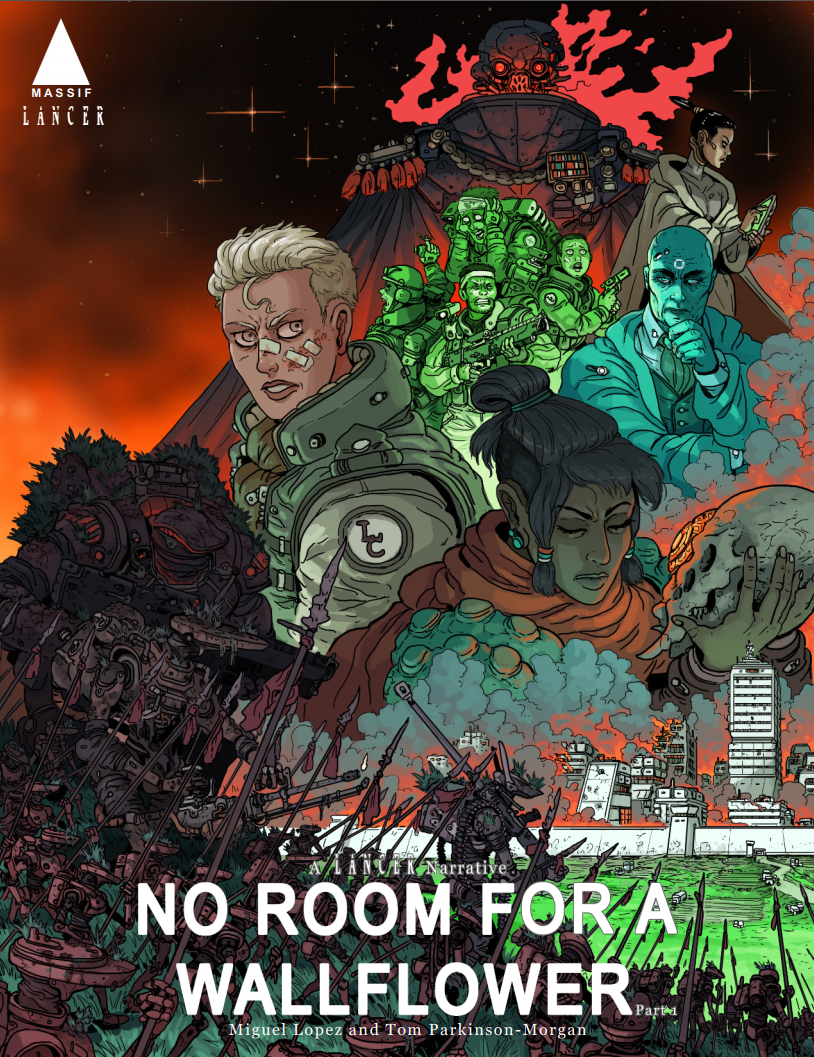
The introductory chapter is exactly the kind of introduction that grinds my goat, not suffering from any specific deficit but rather from but not knowing what its target audience is, and hence what to leave out. The result is a bloated rules introduction that feels aimed at a beginner who is likely grappling with complex Lancer lore and rules already. From the start, I’d be remiss not to mention the art, which indeed is universally excellent, and fits Lancer style, but I won’t make mention of it again, as none of it is functional and it doesn’t really factor into how useful or good the module is.
The introduction is a gazetteer covering the backstory (for the GM only), gazeteering the planet, the factions, and then a one-page on what the player characters might know. This chapter could have been presented in half the words, probably less, and more effectively, but this is very much Lancer house style, and if you’re conditioned with that expectation I wonder if you’d be disappointed with a lower word count? Irregardless I remember the hours it took me to digest core Lancer lore and can’t imagine this additional lore would make the book welcoming to me coming straight out of that. A lot of this secret lore is never going to be told, and in fact is explicitly hard to find out by player characters, and you’ll find that further in, most of the characters players might interact with have the lore they know listed with them. Secret lore secrets doesn’t drive interesting play in my opinion, but rather should be generously doled out, and if this section is to be useful, it’s best as a list of “things people know” that is referred back to in order to be communicated to the player characters, or just relegated to the existing sections of information that specific characters know. Everything here would, if brevity was not on the cards, have benefited from more structure to render its size and density less opaque. Present it as a dossier rather than a gazetteer (I’ll come back to this suggestion). Lots of subheadings, headshots of major players, tables and things to tie back into later. Make it more practical. Make it both GM guidance and player handout.
I should briefly detour into an explanation of how this book modifies typical Lancer structure to make it a “narrative” module. Normally, Lancer missions consist a number of combats, after which the player characters increase their license level. Wallflower introduces “beats”, formal forking narrative intermissions between the combats, illustrating the progress of the state of the planet Hercynia over a year of war. The bulk of the book is the actual content of these missions and the beats that are interjected into them. There are five missions and a couple dozen beats, and the strengths and weaknesses are repeated throughout. My first impression of Wallflower is that it’s well laid-out, taking after Lancer’s core book with bold colours, clear tables, and simple iconic sans serif fonts. Every page looks good on impression. But on closer and further reading, fonts multiply rapidly, highlights like boxes are used inconsistently (used for briefings, combat descriptions, stat blocks and specific parts of stat blocks), and the writing exacerbates the problem, at times with almost entire pages italicised or bolded, becoming incredibly difficult on the eye. There is a clash of layout, typography and writing choices in this book that results in something very challenging to read once you get past first impressions.
The first page of Mission 1 appears to be three quarters read-aloud text, which in my opinion is egregious. I’ve never had a table willing to sit through reading an A4 page of text themselves let alone my reading it out loud to them. The writing is decent, evocative for the kind of James Cameron military sci-fi vibe they’re appealing to here, but there’s just more of it than is practical. The same brevity complaint comes for characters. They’re well-realized characters, however the conversational half-to-full-page style doesn’t lend itself to my easily slip into those characterisations. Give them a strong structure if you want this much information to be provided per character, else make them stereotypes and give them one or two quirks and let the GM bring their own flair to the roleplay. A half decent map would describe the colony better than the text does, and because the map is neither co-located with the locations nor half decent, locations fall into the trap of describing geography (“well downriver, on the east side of the river”) and then describing the banal (“the day to day functions of Evergreen’s Stable Reactor Plant are largely automated”), while burying the useful and interesting (“Currently, the bridge…[can’t] support mechs”). The “Scenes of Daily Life” table is excellent, but a missed opportunity, lying on the same page as GM advice is right next to it “You may wish to include a scene or two in which combat can be heard in the distance” which should have been right there in the scenes of the daily life table! I could go on. It feels unedited, but it’s definitely not rationalised.
This is impenetrable prose, that would be best rationalised and removed to more appropriate locations. Incorporate your advice straight into the table. Incorporate your gazetteer straight into the handouts or character sheets. A dossier on arrival in the colony of Evergreen; let it be passed around the players to read when they’re tuning out of the next thing the text wants you to read aloud to them. Record a newscaster over stock static and tell the GM to play it in the background (maybe if you have to read your writing yourself you’ll realise you’re using too many words). Use dot points (forgive me for suggesting them). A wiki. Give me something to work with so I don’t have to transcribe your gazetteer into something more useful. Lancer as a game always points to combat as the core activity of the game, so expending too much of the GM’s time on this stuff doesn’t behoove it’s incorporation in play, or their interest in your module.
The mission and combat structure itself is pretty cool. You’re provided stakes, get to choose how to approach it from limited options, do that combat, and the beats you progress to change algorithmically as you progress through the story. Your choices and successes fill clocks that contribute to events occurring further into the story at different stages. This semi-rails experience isn’t for everyone, however with planned and structured combat missions like those required for Lancer, it’s an excellent way to scaffold supported storytelling into the mission structure.
Overall structure here is also a little challenging. I’m not always an advocate of a summary of the ‘story’, because these are supposed to be roleplaying games, and the ‘story’ should be dictated by the actions of the players. But in this case, some kind of summary of the potential outcomes of the algorithm would help the GM a lot, because this is a big document, with lots of text, poor signaling, and I don’t think it’s fair to expect someone to read six to twelve months ahead in order to understand what’s going on and provide the player characters with true and relevant information. An alternative would be better signaling regarding the themes, goals, or potential outcomes of each beat.
The story itself ends on a significant downbeat, and a direction which is impossible to divert from. This is the structure Wallflower commits to, but it is a little disappointing how little impact player choice has on the overall story. A lot of the time, it feels more like a videogame where you can choose evil or good, but choosing evil will always deprive you of opportunities for fun. I think for this algorithmic structure to work, it would help to provide the GM with the algorithm, and for both sides of all forks to provide meaningfully different information or outcomes. If you don’t want to do that, you probably should be making a purely linear narrative, which is perfectly ok for a Lancer campaign in my opinion.
Overall, would I run this for my table? I probably wouldn’t. It doesn’t provide me with battle maps for the many combats which is an absurd thing to leave out as what for me is one of the most time-consuming parts of preparation, neither does it provide me with any tactical advice for running the combats. In aggregate, using this module would probably cause me to run a less interesting game with more preparation time and less flexibility than if I ran it based on the (admittedly absent) story summary. The elephant in the room, I should add, is that this is an Act 1 that released the same year as Lancer released, but Act 2 is yet to be released, if it ever will be (a casual google indicates the authors now work full time in game development for one of Massif Press’s opponents); purchasing this also comes with no promise of the story being finished, and if you feel you need this book to tell this story, you’re probably going to feel ill-prepared to finish it on your own fumes.
Let me meander for a moment. For me, a good Lancer module should come with battle maps, tactical advice, and much briefer and more rationalised story linking them together. If I was to provide no battle maps or tactical advice, we’re in the space where a freeform Lancer sandbox is a perfectly reasonable expectation from a 200 page product. And if you do, it’s not, and this algorithmic approach is the best possible, but it’s pointless if choices don’t have meaning. Both are useless approaches compared to preparing your own campaign unless the content takes less time to digest and provide to your players than simply regurgitating ad hoc the hundreds of pages of lore you’ve already memorised from reading the core book, and winging it, allows for the flexibility and surprise we love about roleplaying in the first place. This module doesn’t tick any of these boxes, sadly. This a module that’s modelling itself after Horde of the Dragon Queen, when it should be modelling itself after Pathfinder 2e adventure paths or old D&D 4e adventures, or, even better, paving its own way.
25th July, 2023
Idle Cartulary


 Playful Void
Leave a reply to Aern Cancel reply