
Bathtub Reviews are an excuse for me to read modules a little more closely. I’m doing them to critique well-regarded modules from the perspective of my own table and to learn for my own module design. They’re stream of consciousness and unedited harsh critiques. I’m writing them on my phone in the bath.
Into the Cess and Citadel (ICC) is a 282 page system agnostic city module by Alex Coggon and Charlie Ferguson-Avery. It aims to provide everything needed to run a city campaign. To me, that sounds like you should be able to run to your sessions straight from the book, or perhaps to provide a preparation toolbox. It’s a complex book, which I’m reading digitally, which for such a long book it not ideal in my experience.
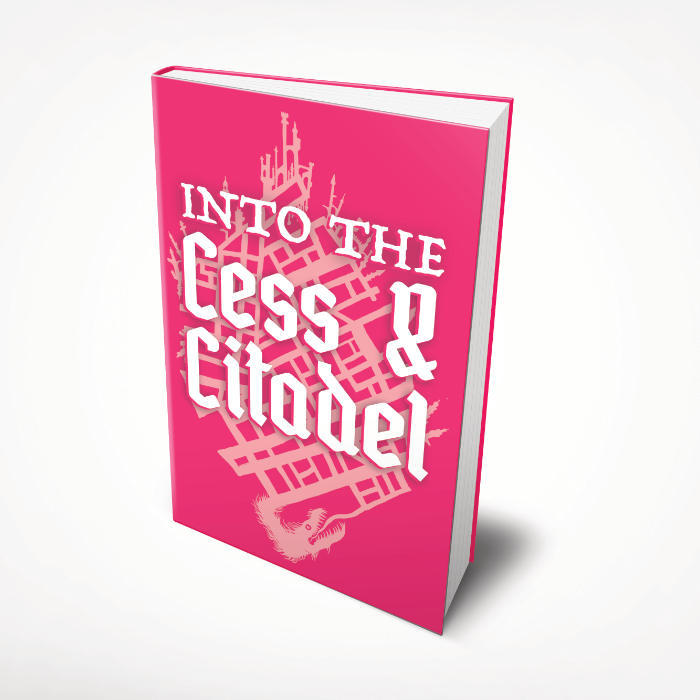
Structurally the book is effectively broken up into four sections, with an interlude. There are introductory rules, generators, detailed districts and appendices, with one appendix weirdly placed between the rules and the generators (or perhaps it belongs in with the generators, as they have their own bestiaries in the same vein). Honestly it’s a bit of a mess structurally, and potentially would be more usable with better referencing and chapter ordering (although I’ll grant it an excellent appendix).
The bold text, and thin gutters encroached by simple decorations immediately state that ICC is going to be a complex and dense text, while still recalling a late medieval theme. Bold, simple colour choices and inverted textboxing make for clear and readable text despite this density. Some pages, should come across as less usable than they do. I count eight fonts on the page below, which normally I’d consider unreadable, but the fact that it most certainly isn’t points to excellent choices in terms of typography and layout.

The art by Alex Coggon, Charlie Ferguson-Avery, and Brian Yaksha is frankly all over the place, and while it provides a much needed break from the density of text, I think that it’s an indictment of the need for spot art in products like this. I’d rather the same artists provide their best work in fewer places, as the quality varies so much that I assumed they’d commissioned additional artists until I referred to the credits.
ICC holds itself to a system agnostic standard that is a strange melange of various systems, rather than stick to a single popular system. I’m not convinced about this approach; it may be the worst of both worlds. I’ve said before that I think the best system agnostic approach is something like the one adopted in Reach of the Roach God, which bypasses the need for conversion at all, and instead simply rewards understanding your system of choice.
The book opens with about 25 pages of city-traversal rules, which are (as an avowed disliker of additional rules) actually for the most part quite good, and I do think that running a city campaign requires specific modifications to facilitate the feeling of moving through a metropolis. This includes traversal rules (these are simple and neat), homelessness (pretty good), shopping (superfluous), reputation (feels too simple for a complex city), and hazards and diseases (I could give or take these). A lot of this is excellent flavour though: Dumpster diving might find twice-moulded bread or untapped marrow; you might develop Harlequin’s Fear. But also, a lot (most of the reputation for example) is quite generic: “Barred from most establishments”. In addition, the preambles of most of these actions are wordier than I’d like. I don’t need anyone to explain to me what reputation is.
Next up is a bestiary if single-page spread metropolitan monsters. This is a weirdly positioned section, the monsters are unique and fun and flavourful (brick tick, garbage shambler) but there’s nothing here I couldn’t create myself by giving the classic monster manual a metropolitan coat of paint. The art is still inconsistent, but they’ve focused some of the best art in this section, which is good use of art in my opinion.
The rest of the book feels confused regarding its intent. The next three chapters are three massive generators, one for the city itself, one for the dungeon below it, and one for the spires of the rich. These mirror each other in structure, and repeat (although not thematically) some of the content in the rules section, such as the equipment lists. The basic principles here are giving specific locations but randomly generating their connections and their layout. The writing in all three of these sections is very flavourful (“Agrimandcurioussilenceisobservedforallbutonehoura day.”; “Beautifulandstrangeanimals lazilyplodaboutthecages occasionallynibblingonfood.”) but also often generic again. I am left with the feeling that, rather than three separate generation systems and a bunch of random encounters, I’d be better off with an actual concrete city.
My misgivings are to a degree confirmed in the next three sections, which are specific districts within the city, and feature more character and specificity than all three previous chapters combined. The impression is that the lists here are meant to substitute for the tables given earlier, which would work just fine, but I’d rather just live in these three districts than on any of the randomly generated locations. The authors know these three are out of place, because they each get a unique colour scheme, departing from the magenta of the rest of the book. These are both the most puzzling inclusion in the book, and also the most engaging aspects of it.
The book finishes with a series of more lists: Magical items, spells, and additional locations. The additional locations are actually pretty great, and would be better incorporated into the rest of the book in some way. Finally, it includes a one page summary on how to run a city (better than the actual chapter on this), and a series of worksheets to assist you with doing so (would probably work, but seems a lot of overhead).
ICC is absolutely packed with content, but I don’t feel like a lot of this content would help me run a city, and in fact gets in the way of my using the book by making it harder to navigate at the table. There is a significant reliance on unnecessary random generation and a lack of interconnectivity necessitated by this approach. If you want spells and stat blocks and a million locations you could think of yourself but don’t have the time to, this is a book for you. That’s not what I’m looking for, however. If I wanted to design my own city, alone at my table, in order to run it in a campaign, it would be an excellent place to start, and perhaps that is it’s intended use case, but I’d rather a book that I can use to run the city at the table, something that is expressly possible as evidenced by many other products that achieve this end.
Overall, Into the Cess and Citadel places itself in impressive company, but fails to distinguish itself. The earlier chapters position it as a tasteful and unpolluted Vornheim in aesthetic, but it lacks the imagination of that book. It lacks the specificity and evocativeness that makes Fever Dreaming Marlinko the best city supplement in my esteem. The latter chapters aspire in some ways to replicate Magical Industrial Revolution but do not share the unique spark and cohesion. There is a lot shared between this and Oz, but Oz has a far more unique setting when it hits its mark than anything in ICC.
If you want an edgy, but not too edgy city of fairly generic theme, to assist you in preparation for a city campaign, or to supplement your game with spells, monsters and locations that reflect that theme, then Into the Cess and Citadel is a great product. For me, the need for the book to be a all things to all people conflicts with its ability be exceptional in any one part of the toolbox it tries to provide. There are a number of stronger city products with more limited scope out there if you have have different needs for your game, and for myself, I’d choose to go in one of those directions; but for a one-stop shop, you probably can’t do better.
18th August, 2023
Idle Cartulary


 Playful Void
Leave a comment