
Bathtub Reviews are an excuse for me to read modules a little more closely. I do them to critique well-regarded modules from the perspective of my own table and to learn for my own module design. They’re stream of consciousness and minimally edited harsh critiques. I’m writing them on my phone in the bath.
What lies within the pools which like upon the shoreline? (henceforth Shoreline) is a 24 page coastal pointcrawl for Mausritter, by Matthew Morris with absolutely stellar curated public domain art. This is a sandbox in a format that approximates the Mausritter house style, with an unfamiliar theme.
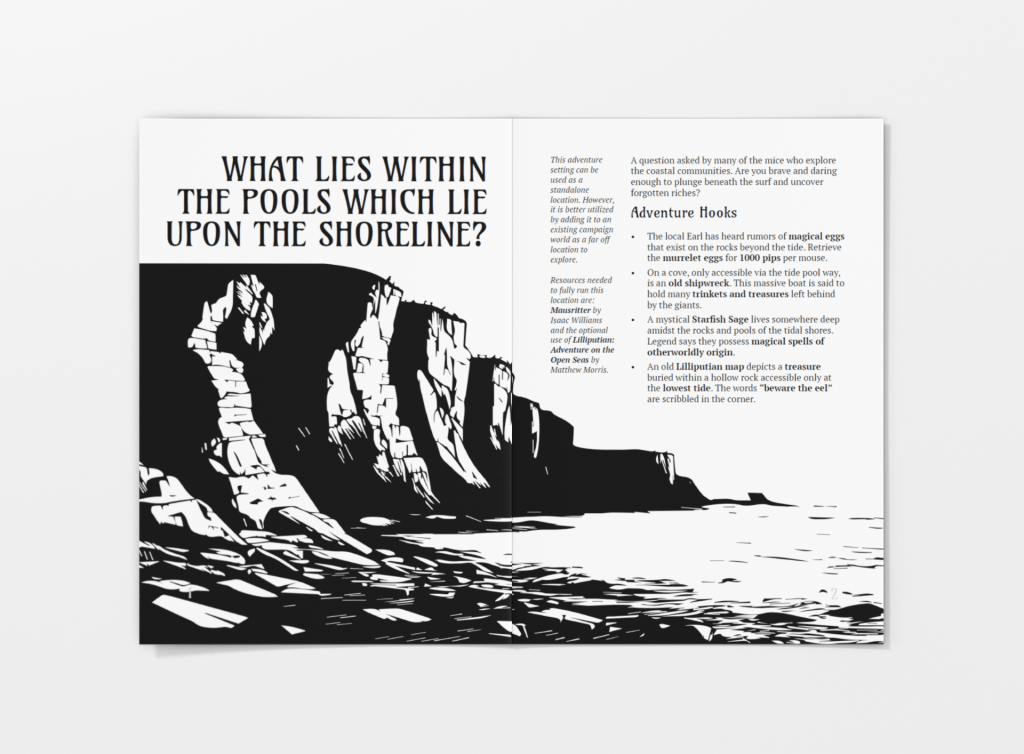
It’s the second module I’ve reviewed that utilised the Classic Explorer template by Clayton Notestine, and demonstrates the flexibility of the template in comparison to Howl. It is a great deal bolder, more reminiscent of OSE with its highlighted headings but using similar bold highlights, italic descriptions and dot points as core Mausritter. It has a clear but not flashy layout, relying on bold art for punch, and places mock equipment cards in the margins, which is a fun and unique use (otherwise, the sidebar is used just for tips).
I’m always eager to read more Mausritter modules, as Mausritter is an exceptional game and yet I struggle with releasing myself into the magic of the setting. Taking the familar-yet-unfamiliar Mausritter themes and placing it in tidal shoals makes for an interesting, iconic landscape with a wide range of inspirations from folklore to swashbuckling films. The vibes in Shoreline are impeccable; it feels like a grey day at the beach collecting shells.
The opening map which I assume is Morris’ work is simple, evocative and excellent. Clever touches mean that alot of traversal information is hidden within the map itself.
Mausritter itself is an incredibly terse text, and especially it encourages this in its modules, firstly through the significant amount of time it devotes to locations in the core book, and secondly through modelling in its starter module and in its boxed set, the Estate. In Shoreline, this terseness is replicated — something I hesitate to criticise — with mixed results. Pondering the subject of terseness, I think the key to my heart is specificity combined with terseness; brevity in and of itself is not a virtue. An excellent, terse rumour is “A magical sword was lost by a Sandpiper knight in a forgotten pool, lost to the sea.” In one sentence, we have a key item, a key location, and a clue as to the local flavour. A less successful random encounter is “An adventuring party from Coralridge”. There is no reference to this adventuring party elsewhere. I, as a GM, have to come up with, on the fly, a rival adventuring party, their motives, their names. Five words prompts can work, if their referents are elsewhere defined — in the same encounter table “The Gull out hunting” works just fine, because the Gull is detailed elsewhere.
I suspect where this occurs, it’s because of a familiarity with and an adherence to the Mausritter house style. For example, the factions are written out exactly as recommended by the core book (if my memory serves); this is in my opinion an exceptional way to lay out factions for your home game, but not sufficient for a published module. In a published module, I want a little more. For example, the Surfsiders gang aren’t clearly detailed in their faction section, and it only becomes clear they’re a gang of rat pirates on the back cover. They have no leader or named characters, and the location of their secret lair is not named. What is included is solid worldbuilding and enough for the faction as a whole, but not enough for me to run it straight from the book, which is disappointing to me. What is here is good, but feels incomplete.
There is a lot to love here. While the writing isn’t beautiful in and of itself, the imagination behind the locations and the images it conjures are exceptional. I’m playing Pikmin 4 with my children right now, and Coralridge Fortress reminds me of the monstrous children’s playthings of that game. These descriptions are consistent throughout the zine — I want to run these locations based on the initial text. But, descriptions of the paths occur here as well, which feels messy and might have been best as labels or as information on the map, and there is an encounter table for many of these locations which I’d rather be briefer (most are 8 items), with a little more detail. “An Octopus looking for a new home”? All I have here is the difficult to reconcile “Wants to assert dominance in its pool”.
This is a good module, that requires a little more preparation than I’d like to put into it. I think that these concerns could be easily remedied, and I see signs are there that the author can excel at these more specific, evocative descriptions, but are limited by the existence of the Mausritter house style, in a similar way to seeing Luka Rejec’s flamboyant style limited by the OSE house style. I’m starting to develop the opinion that the existence of house style templates that are pretty good (and Mausritter and OSE are two of those) are resulting in authors limiting their colouring to inside the lines, instead of feeling empowered to paint whatever they desire, leading to a good number of decent modules in those house styles, but that leave me with the impression that those authors would be capable of amazing things if they weren’t placing these limitations on them.
If I wanted to run a small campaign in Mausritter, I’d probably choose this. It recommends itself as an expansion, and I think this would be even better as an extension to the Estate, for example, because while this is a damned interesting setting; I probably couldn’t run it with as much ease as The Estate and it doesn’t come with as many immediate hooks. It’s much more striking a setting though, and well worth incorporating, although you’ll need to put some work into supplementing what’s here and preparing to run it.
10th October, 2023
Idle Cartulary


Leave a comment