
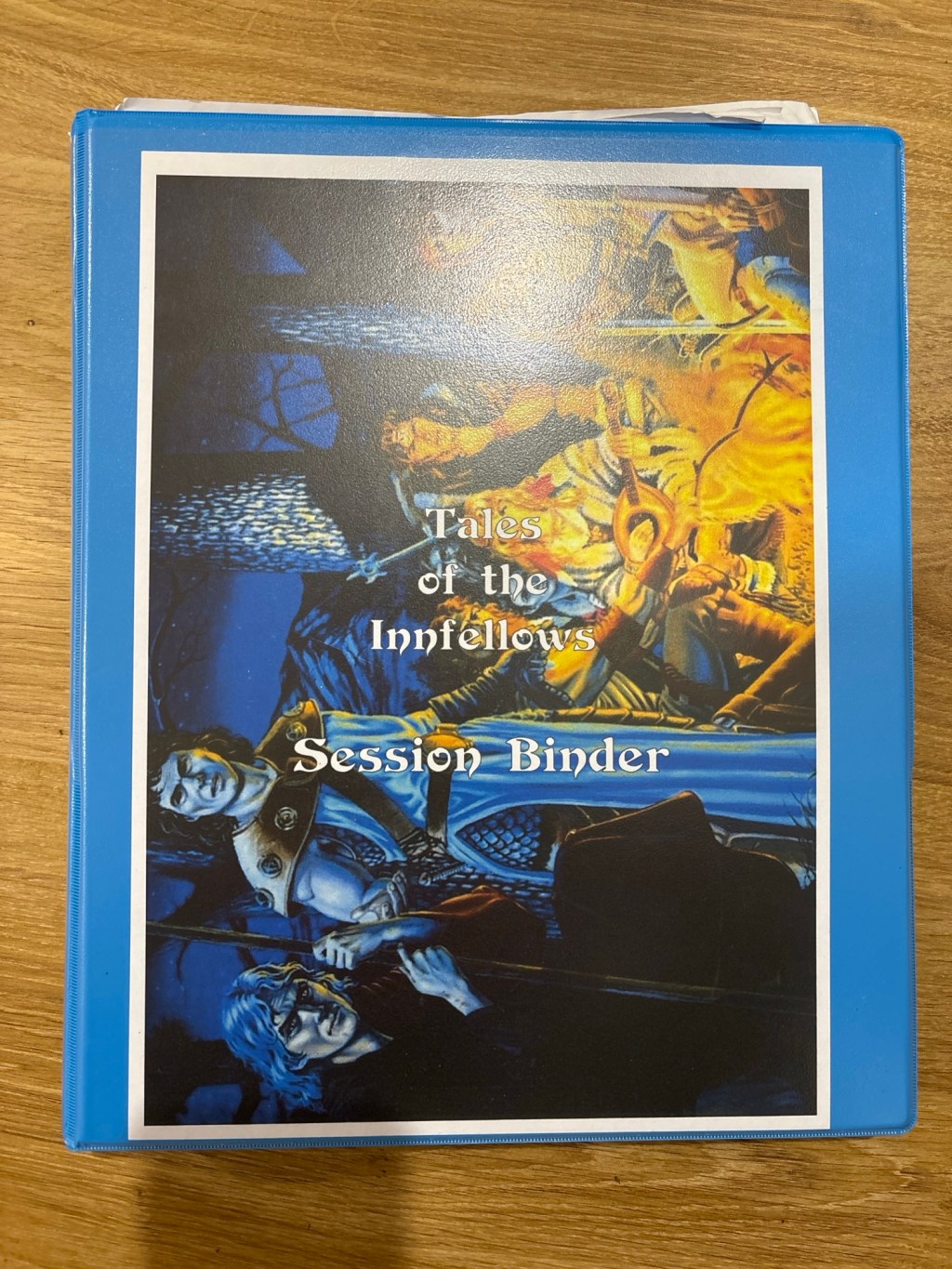
Something that keeps coming up on the OSR and NSR discord servers is that a few years ago I ran an epic adaptation of the classic DL series of modules, as a sandbox, in fifth edition. People keep asking me, how the hell did I do it? And I keep saying “one day I’ll write it up”, and then I never do, mainly because I don’t have all the old documents. But I found my session binders the other day, when clearing out the garage, so I can at least take photos of things and talk you through my processes in setting it up, and running it week to week. There will be photos because I’ve lost original files; I’m sorry about the bad lighting.
I read through the entire DL series of modules, stripping them for parts. The parts will go into the next two sections, but basically I was looking for a few major things, which were inspired by the Return of the Lazy Dungeon Master: Major locations throughout the modules that would need prep, usually ones that were pre-mapped; Major monsters that would need to be statted up; Major NPCs that would need to be detailed and incorporated or else amalgamated into less NPCs; PCs that varied across the modules (because that’s a strange quirk of the DL series), and secrets and intelligence that serve as hooks to draw conclusions about the overarching mysteries of the world, and to draw the PCs to new locations.
Step 1. Player characters and internal conflicts
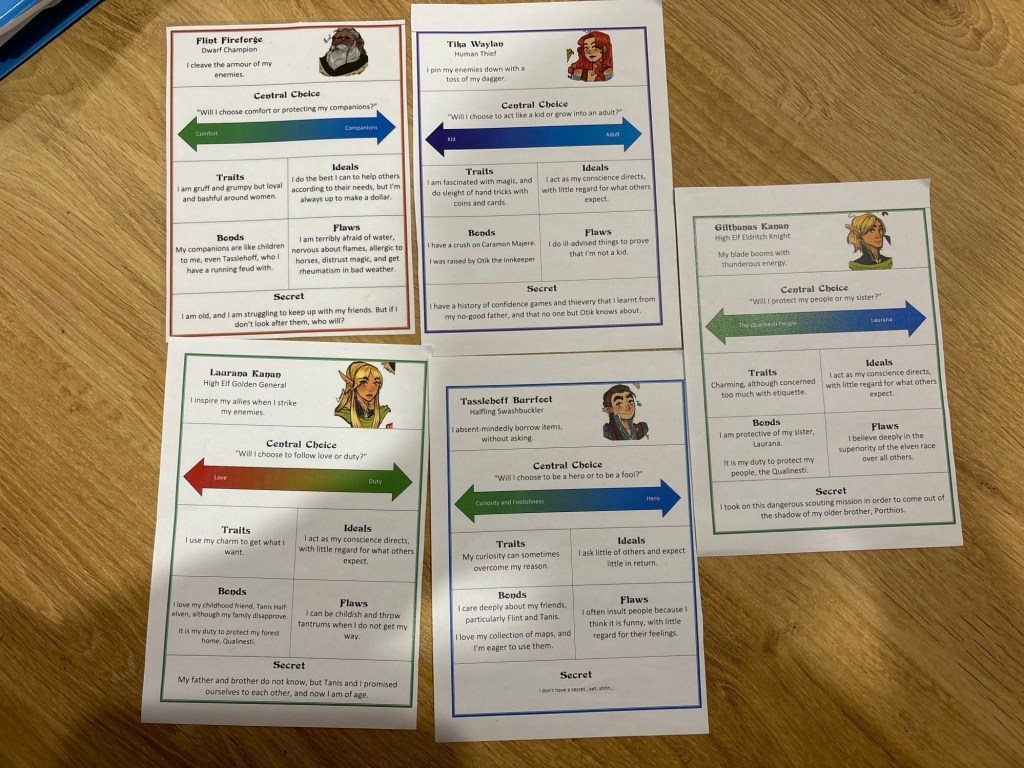
I wrote about internal conflicts a while ago; the first thing I decided was that if I wanted the campaign to feel like the Dragonlance books, the relationships would need to be intact in broad strokes. To me, Dragonlance is really about those core characters. and their relationships! It’s teen melodrama! I took my list of player characters, sketched out and made pregen characters for each of them. I didn’t hand out character sheets though! I handed out little character cards that talked about their goals and motivations, and for the most part paired them up. I had a big session zero, and got everyone to pick the characters they were interested in playing, and then I modified them according to needs (for example, some characters didn’t have their pair, so we figured out how to make them work in isolation). Here’s a few of the ones I made (I don’t have the original files or I’d just give you them — but you can see the approach); I only have the ones that didn’t get played, because the players kept theirs!
Step 2: Secrets across the world
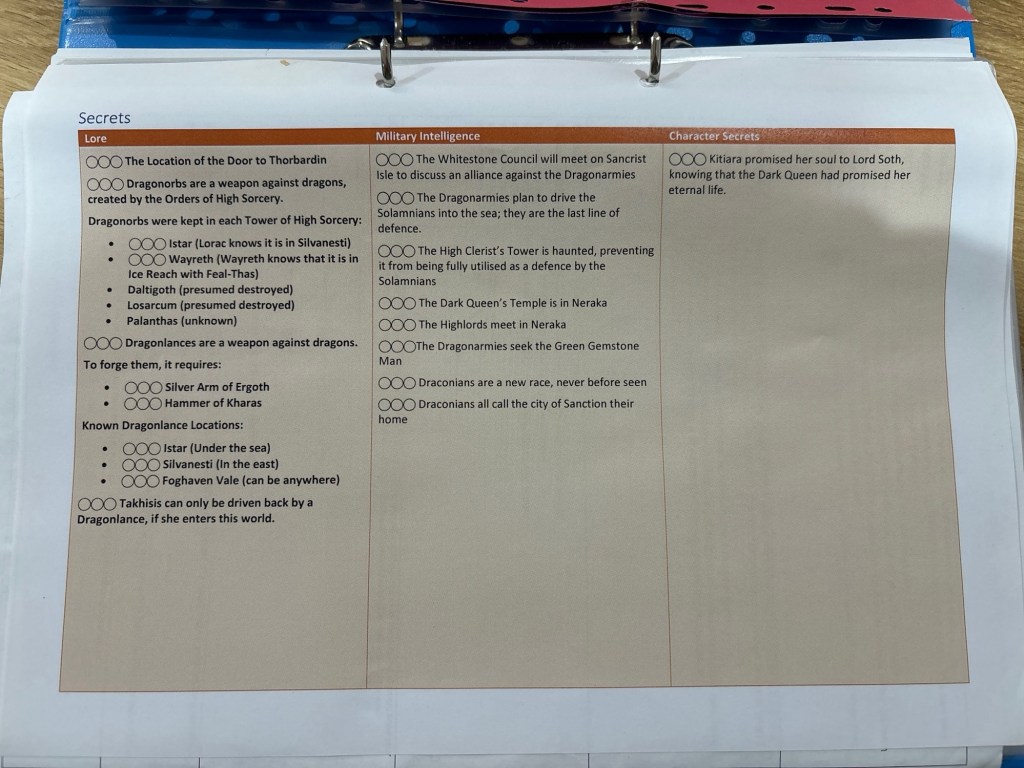
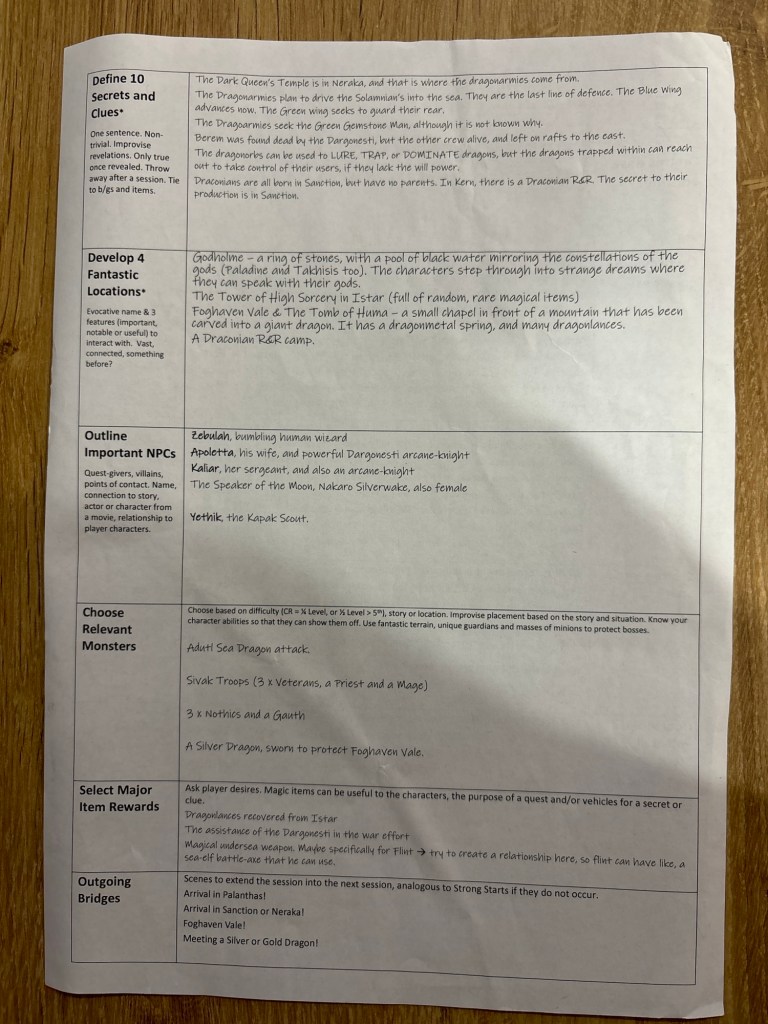
I gathered together basically every secret for the entire campaign into one page, gathering them into three categories — X, Y and Z. Keeping in mind the Three Clue Rule, I simplified them all down and divorced them from context, to be awarded generously.
Step 3: The NPCs
As I said earlier, I just listed every single character that might show up, so I had my cast ready.
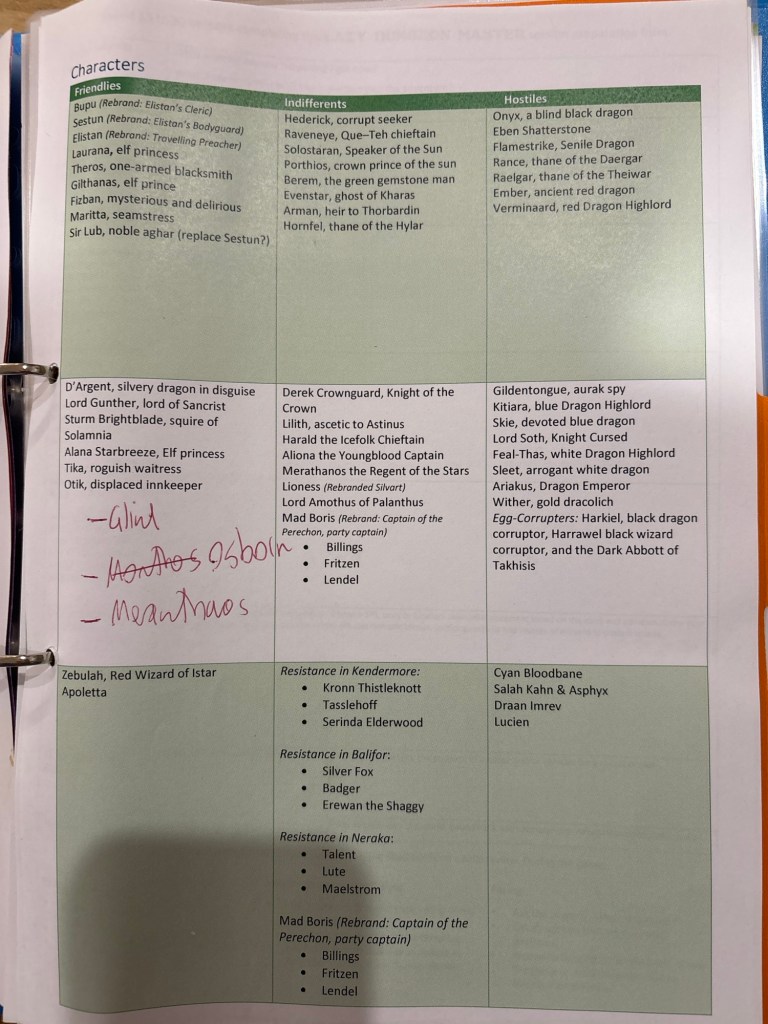
Step 3: Setting up the Gazeteer
I mentioned that I had more than one session binder for this campaign back in the introduction: This is why. I printed out or photocopied everything I had on the world of Krynn, for easy access, in a separate gazeteer binder. I wanted this gazeteer here, because it’s important that if I’m running something in a set world — especially one that I absorbed as a pre-teen as much as I did the Dragonlance setting — it be blorby as it could be. This ended up not being so useful as I ended up going to the Dragonlance Nexus. I also printed out every character description from the 3e edition of the trilogy — a terrible product, but it summarises enough for me to be able to write anyone up quickly from its descriptions.
Step 4: Improvisational tools
I also developed a bunch of improvisational tools, specifically ones that would help me out for the whole campaign: Names by ability score for surprise NPCs, the three-moon calendar for strict time records to be kept, a bunch of inns that I stole from Drop the Die’s Inns, Taverns and Taprooms. I also collected a lot of maps — every one from the modules, plus a bunch of generic ones from Dyson and other places, so I could throw a map down if I ever needed to improv a location for a heist or something.
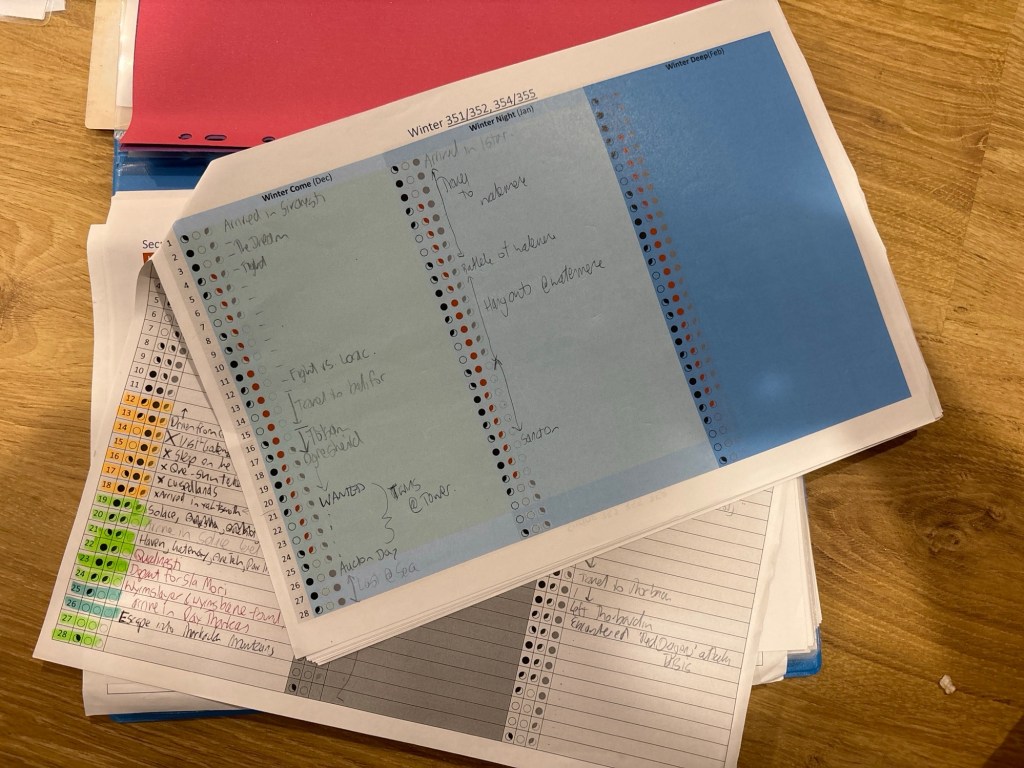
Step 5: Play!
So, week to week, I used the Lazy Dungeon Master prep approach, modified a little, to stay a step ahead of the players. Basically, I asked the players what their plans were for next week, and I prepped accordingly. The prep sheet I used basically made me think of and plan for possibilities: The stuff on the sheet wasn’t a script to follow, it was ideas for me to adapt. The most important thing was that I always had an explosive start: The PCs couldn’t retcon what they’d done last week, and this week always started with a bang.
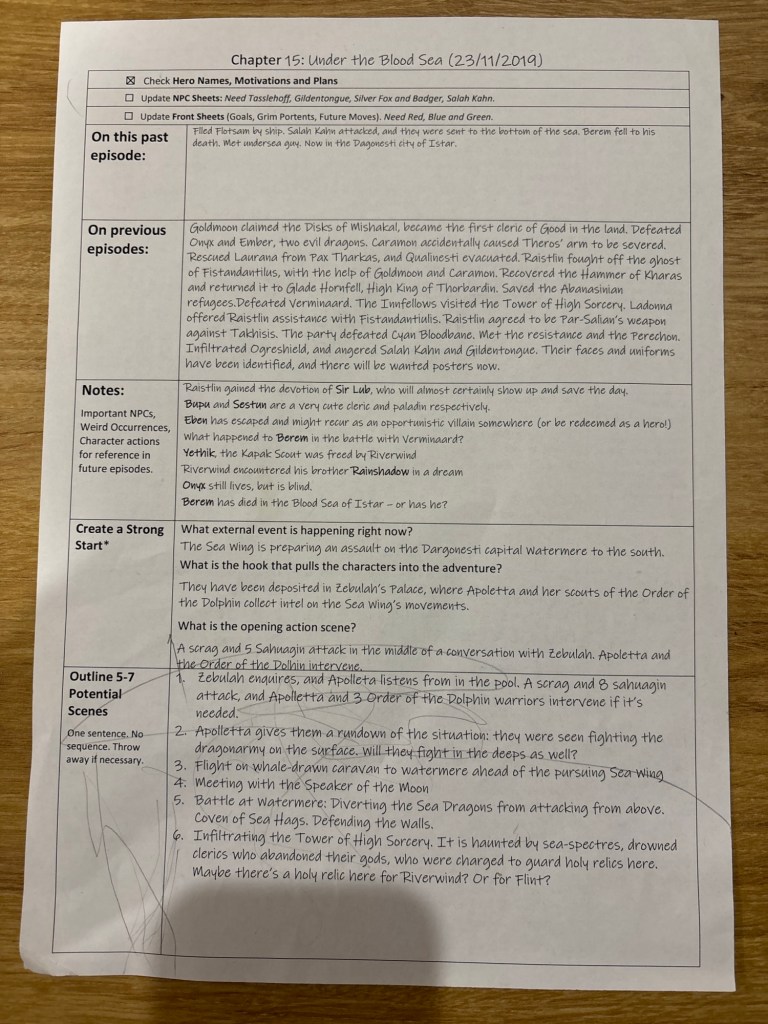
The prep was typical prep: major NPCs were described, locations & dungeons were mapped, factions were created. There’s no shortcut for this, but luckily there’s a wealth of information, so I’m only really creating when something is boring in the text: Making factions more interesting and one-note, mainly, and occasionally prepping for a weird situation to anticipate (dragon riding rules! a council! a battle underwater! a ship vs dragon battle!). The rest of the time I’m just matching existing maps and characters to ones in the system I’m in (custom stat blocks are for special occasions!), and adding points of interest that appeal to the current batch of players.
What I didn’t do
Don’t key a hex map. Ansalon is just too big to work as a hex crawl, and changing the map was just too much work. So, it effectively became a point crawl, between points of interest that the players were identifying, where I filled in those points of interest as they were approached. I didn’t build out the entire map of Ansalon day one, I just built out the things connected to the PCs current locations. If they had a distant goal to the east — as was the case for Silvanesti and for Sancrist — they just learnt what was next. Some sessions were entirely the travel between points of interest, however: I remember the wintery mountain travel to Pax Tharkas and the cross-desert trip to Silvanesti both being huge. To be honest and someone analysed this themselves and I can’t recall who, the hex map operated as a point crawl anyway (addition: I’m told this was Justin Alexander), as regions are carved out of the original hex maps already. I wasn’t using that hex map, but rather the one that came with Tales of the Lance, which I printed out for my Risk game (what Risk game? you ask).
Addition: If you want to key a map, here!
Don’t stick to the Script. In planning an open-ended sandbox version of the War of the Lance, I could keep major sequences up my sleeve and drop them in when appropriate, but a lot of the really memorable stuff came from sequence skipping or going completely off the rails. The Goldmoon/Laurana romance; the epic underwater battle at Watermere; A charge against Lord Soth at the High Clerist’s Tower. None of these happened in the books or in the modules!
Don’t toss away the original modules. They helped me prep in a bunch of different ways! They were invaluable, even if the modules over wall are ahh…questionable? A bunch of the maps are stellar! The magic items are so much fun! There is gold in them their hills — if you didn’t get the impression I love mining classic modules for gold you clearly haven’t listened to Dungeon Regular.
Don’t let space be a tyrant. Ansalon, as I said, is a huge space. At the beginning, distance was a fun barrier for a low-level group of heroes. By the end, they had a ship, a hot air balloon, and eventually their own dragons! Let the space be their oyster! Let them travel the world at speed! Just remember that the enemy have flying citadels and dragons of their own! Memorably, the PCs encountered one major character after another battle with a dragon downed them in uncharted territory, affording me the opportunity to use the random sky encounter “Attacked by a metallic dragon protecting its territory” into a plot accelerant and facilitate the discovery of the Dragonlances!
Don’t back cool toys. The modules are so coy with cool toys, Don’t be. Let Flint have the Hammer of Kharas, let them use gnomish flying machines, let them wield Dragonlances and make Dragon Orbs powerful and dangerous. Have Fistandantilus bribe Raistlin with unique spells.
The Risk Game
There was one other thing I did, to keep the war ticking along in my head, and to keep things off script. Remember the calendar I mentioned a while ago? Each month that passed, I was playing a game of Risk in the background, solo. At the beginning, the Dragonarmies were at one end of the map, working together, and the soon-to-be-allies were not working together, but owned a significant portion of the map. They only began working together as the player characters brought them together! Finally, at the big Council that was help on Sancrist, they brought everyone together, and the tide turned, leaving only one special unit on the table that was beating the allies into submission: Dragons!
And hence, while at the beginning the game of Risk has almost no impact on game play, by the end the PCs were getting scout reports directly as part of their roles as members of the Council of Sancrist, and hence it started driving play towards finding the metallic dragons and then finding out what happened to their eggs.
Ok, going through my binders, that’s most of the preparation I did, both before and after, that I have still with me. I’m sure you have questions, if you’re interested in running a Dragonlance campaign.
Please, comment below! I’ll add the answers to this!
I hope this has been helpful!
Idle Cartulary
Playful Void is a production of Idle Cartulary. If you liked this article, please consider liking, sharing, and subscribing to the Idle Digest Newsletter. If you want to support Idle Cartulary continuing to provide Bathtub Reviews, I Read Reviews, and Dungeon Regular, please consider a one-off donation or becoming a regular supporter of Idle Cartulary on Ko-fi.


Leave a comment