
Bathtub Reviews are an excuse for me to read modules a little more closely. I’m doing them to critique a wide range of modules from the perspective of my own table and to learn for my own module design. They’re stream of consciousness and unedited critiques. I’m writing them on my phone in the bath.
Sooty Beards is a 46 page setting module from Furtive Goblin and John Gregory, with Charlie Ferguson-Avery on art and on layout. It details a town framed as “Khazad-dum meets dying coal town”, and the people and potential for adventure therein. While it’s system agnostic, it’s compatible with Troika! and B/X, but feels intended to be played with Troika! in ways I’ll detail later. It’s available now, with digital sales being used to fund a print run; I was provided a complementary copy by the author.
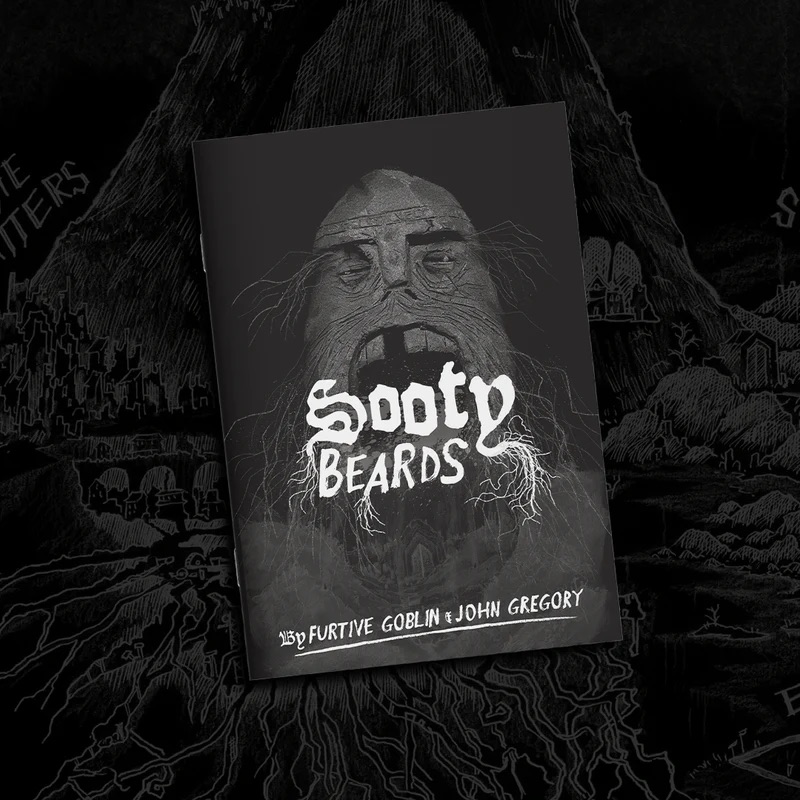
The writing here is luscious and conversational, with a dry humour, but in unashamedly meandering style. The goal here is to immerse the reader in the world deeply enough that they remember and regurgitate the atmosphere more than the details — or at least that’s the effect. It’s a pleasure to read, but using Vesallberg at the table means for me a lot of sticky notes and highlighting. I’m reading in digital, and I’d recommend the print version, when it’s available, for that reason. In digital, it’s a pleasure to read and a struggle to use. These sections of prose are interspersed with more clearly gameable content, in the form of random tables, stat blocks and items. These are regularly repeated throughout the districts covered by the module that consist the majority of the book.
We open with a general overview of the city, including the major factions, and reasons to be in the city in the form of 20 backgrounds. These backgrounds are lovely for giving characters unique goals, and really impact the direction and interactions you might take for the city, fulfilling everything you want, really, from them, except that they don’t provide specific names or places or locations in any instance — you have to provide those yourself, either improvised or from your memory of the book. That little extra detail would have gone a long way, in my opinion. The factions here are framed as a kind of classic era gazetteer covering local politics, and hence doesn’t provide the kind of clear list of projects or goals that would make this kind of failing city really pop. This is disappointing, because I feel like it could and should be a veritable powder keg ready to blow. You could, with some effort, top these political factions up with characters and clocks detailing their immediate goals, but it’s disappointing that legwork wasn’t actually done for us, because I would’ve launched into the primary body of work on fire with ideas if it had been.
For each of the districts — there are 8 — there’s an introductory paragraph, 3 or so quotes from NPCs about the location, a table telling us what used to be there and what has replaced it as it fell into disuse, a creature and its’ stat block unique to that location, and a list of 3 or so items that people there may carry. Oh, and a three word summary right at the top, which serves as a kind of mood board for those of us easily overwhelmed — a nice touch for people like me. Overall, these pages are a framework from which to improvise action within these districts. To use this well, you’ll either have to rely on an anti-canon approach — sharing filing the gaps with the other players — or be a very confident improviser, because either you are searching the pdf for references to Pewter Boys and Hog Dogs or you’re winging it as you go and creating continuity flaws that you’re going to have to contend with. This might have been managed with referencing, as was used in Reach of the Roach God, but as is, given the structural and prosody choices, you’re going to have to have an excellent memory or risk creating continuity errors whenever you introduce a new term. The referee advice supports the loose canon approach: When things get aimless have something from a table in the district happen. I think there needs to be more explicit advice, though, because enough of the features are misleadingly named or do double duty, that it might not be immediately apparent how to use them on the fly. But their utility could be more clearly communicated: for example, groups and factions are introduced in “what’s here now” sections such as the aforementioned Pewter Boys, and many of the quotes are actually from NPCs that’ll likely become favourites, and that can point clearly to goals and points of interest.
A point of interest is the bonus content, 36 backgrounds for Troika! This set of backgrounds continues the theme of information being disguised in the form of other information throughout this module. As characters, you explicitly aren’t from Vesallberg: “You’re not a local. You can’t be, if your instinct is to move toward Vesallberg instead of away from it. No, you’ve come from somewhere else with a reason to visit the mountain.”, so these backgrounds are effectively useless to players unless you break a core tenet of the text. But they’re very good backgrounds, coming each with an in-character quotation, a solid Troika-esque description, and a special that’s flavourful (“a photographic memory of every dead face you’ve seen” — yes please!), as well as useful unique advanced skills (Drakk Wrasslin’ and Aquire Grant Money). The equipment —“leaden eartrumpet” — is even fun! These backgrounds, by implication, are another way to build the world, and they’re more likely to be used by the referee in improvising characters than by the players, as no fool from within Vasellberg would ever stay there.
The layout and art here is gorgeous and complementary, with maps and sketches filling in the margins, clear headings and consistent repeating structures making it a very legible text. In print, this is going to gorgeous, messy and legible, but in pdf it takes time to load as you flick through it quickly, because it’s structured in multiple layers that always load sequentially. This is a little frustrating, because finding specific information here without any index or referencing system requires the use of search, and on Acrobat in my current gen iPhone, when searching for “rusted”, it takes 5 seconds for the next search term to load.
Where I was expecting something akin to Stuart Watkinson’s Largshire, Vesallberg in Sooty Beards is closer to what I’d imagine you’d get if Daniel Sell decided to write a guide to the city of Troika — it’s compelling, filled with weird little guys with unclear goals, but is impressionistic and hyperdiegetic to a fault, and very reliant on improvisation. In fact, to be honest, this is a perfect guide to a possible city of Troika, something that has been thus not forthcoming. It doesn’t attempt to be a definitive guide, and so if you’re looking for that in a city supplement, this is absolutely perfect. It’s just that that isn’t what I personally look for in a city supplement.
What this isn’t is a source for definitive adventure hooks — “Startlingly wide and deep, its bottom covered in shadow. Something is down there.” is typical of the hooks here. We don’t have definitive factions with definitive goals. We don’t have definitive buildings, but randomly generated. Honestly, that’s what I want in a city supplement. I recognise that the scope and scale of a city — Vesallberg is the size of a mountain, after all — makes it both challenging to fill practically and that in a city of significant size, many of your encounters are random and impressionistic. But the problem is that you travel through cities between landmarks, and Vesallberg doesn’t have any of these, either in its descriptions or on its’ map. So if you’ve the engineer background and you’re searching for wondrous schematics, there’s nowhere to look. And if you do ask, there’s no way to find out what they’d say, easily. So, as a referee, and a player rolls that, I have to pdf search for “steam” or “rusty parts”, and I do find things, but the text does nothing to help me to find those things.
Overall, I have heavily mixed feelings on Sooty Beards, because I prefer something that offers immediately gameable situations — if I’m going to buy this kind of setting at this size, Largshire is more my cup of tea. But knowing the popularity of modules that are entirely world-building, and the popularity of settings that are entirely Troika! backgrounds, I think there will be a large audience of people for whom this is exactly what they’re after, they just never knew it until now. Sooty Beards’ writing is excellent and characterful. It’s a pleasure to read. The districts themselves are compelling and personal. It takes Troika’s hyperdiegetic backgrounds and expands them the scale of a city, and a dying dwarven mining city, at that. Similar to Goblin Mail, Sooty Beards is a welcome next step in the development of creative responses to Troika. If impressionistic and fun-to-read are high on your list of desired qualities, and you take pleasure in improvising your city around those impressions and quote-length character snapshots, Sooty Beards is for you.
Idle Cartulary
Playful Void is a production of Idle Cartulary. If you liked this article, please consider liking, sharing, and subscribing to the Idle Digest Newsletter. If you want to support Idle Cartulary continuing to provide Bathtub Reviews, I Read Reviews, and Dungeon Regular, please consider a one-off donation or becoming a regular supporter of Idle Cartulary on Ko-fi.


 Playful Void
Leave a reply to Anonymous Cancel reply