
Bathtub Reviews are an excuse for me to read modules a little more closely. I’m doing them to critique a wide range of modules from the perspective of my own table and to learn for my own module design. They’re stream of consciousness and unedited critiques. I’m writing them on my phone in the bath.
The Ruins of Castle Gygar is a 64 page megadungeon by Onslaught Six with art by Brandon Yu, for Old School Essentials. This is a pure dungeon crawl, unbeholden to any plot or external hooks. Stripped right down to basics. The intent here is to place this at the center of your campaign and spend most of your time here. It’s also the first Dungeon 23 megadungeon I’ve seen in print.
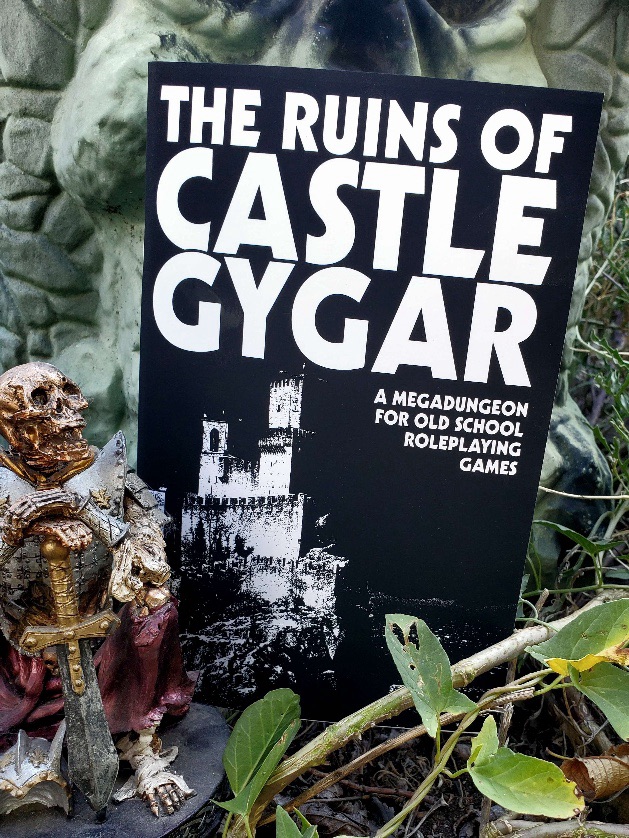
This module is terse. The most exposition we get is a column on the inside cover, with only a paragraph of explanation of each level when they come, and aside from that, the key starts on page 4 after procedures and unique monster types are detailed. Then we get an entire book of keying, often 10 rooms to a page, except for the very back which is a 2 page bestiary (mainly the random encounters — everything else is in-key), details on the trading sequence (I’ll get back to that), and a unique random encounter table for each level. No hooks, no rumours — If you want a hook, I’d pick something out of the trading sequence — although that may be disruptive, potentially, in the long term.
Layout is very low on white space, and highly information dense. Minimal margins, locations detailed on the bottom of each page with the number. Text is on an all black background for rooms in darkness, and black header with clear background for rooms that are lit. The same convention is used for the maps, which is neat. Highlighting is kept for only NPCs, treasure, and references to other rooms. Greyed out sections are stat blocks, for differentiating columns in tables, and very occasionally for information that might belong in a sidebar. There’s not a lot of art, but what’s here is good, monochrome line art in the spirit of the early megadungeons this is an homage to. I love Brandon Yu’s work here, but it isn’t the star of the book — the key is.
This hyper-dense layout wouldn’t work for me at all, if the text sprawled, but it doesn’t: It’s terse to a fault. Empty rooms are a single sentence: “A single candle illuminates a simple altar to the God of the Earth.”, and longer keys are workmanlike. Any additional description almost always speaks to the intentions of the inhabitants: “A small plaque reveals that the Medusa Queen believes this to be her husband.”, “Defeating him causes all Demons to become friendly, out of respect.” or to interactions with the room and its puzzles. This keying is about as minimal as it can be while retaining content, to be honest. What it doesn’t manage to maintain — and I think this is a conscious choice to keep things as tight as possible — is a really high level of connectivity and clarity. For example, there’s no section summarising the factions and how they act: You need to surmise this from the text, and the text is pretty obtuse regarding, say, what the Medusa Queen wants. I think that spending a little more time on making clear the agendas or needs of the many, many factions (aside from those participating in the trading sequence) would make play a little more compelling. This dungeon is old-school in the sense that this is intended to emerge organically, rather than intentionally. I suspect it will, too, particularly with persistent use of a reaction roll.
There are 12 levels in this megadungeon, connected in a loop such that in effect there are 2, 5 level dungeons in parallel with each other, with a climactic final pair of levels. I think that the overall macro-dungeon design could be more interesting — particularly as you get deeper, it would be really cool to find shortcuts — “I can skip through level 3 to get to 6, then to 10 once I have the chaos emerald”, but alas this opportunity isn’t taken. You’re incentivised to explore, though, through the trading sequence. There’s a few unique levels — a hex crawl, a non-euclidean level — but the maps of the upper levels feel like they got more attention in terms of being separated into distinct spaces, where the lower levels feel too looped and more like collections of rooms generated automatically, than bespoke spaces. Especially in a large space like this, having distinct sub-spaces helps with navigation and inference, turning the entire dungeon into a puzzle of exploration, making the whole greater than the sum of its parts.
The one significant piece of really intentional relational design is the aforementioned trading sequence. It’s is a really cool alternative to a meta-plot here, based on the video game Links’ Awakening — this whole trading sequence of 11 items is really long and a fun way to incentivise exploration — each item is on a different level — as you get bonus stuff along the route, and meet a bunch of NPCs. The main flaw here is that most of the NPCs on the list don’t know where their item is, and the levels aren’t really “in order” due to the spilt, which means these might end up being less purposeful and more “ooh! they were looking for something like this!”; they also don’t indicate rewards, which makes sense in a way: Why would I bother doing the petrified meat quest, unless I knew Rufus would trade me for a crystal ball? I think that more large spaces would benefit from this kind of overtly gamey trading sequence, to be honest, as it’s a fairly low effort way to increase interactivity and provide additional hooks within the dungeon, but I think that more clarity about what the NPCs know and have to offer would help with direction.
Overall, this is pretty special module, I think. It fits a whole megadungeon into a 64 page zine — a hell of an achievement. What that means, is that in a thin zine you can run years of gameplay. As a minimalist, traditionalist take on an old school style of play, this is one of the best I’ve seen. It’s missing some faction and interrelational aspects I normally appreciate in these kind of dungeons, but it makes up for it in easy of play and potential for emergent play. I’m reading this digitally, but I understand this is being published as a zine: I have some reservations there, but mainly because this contains so much play time I suspect a zine isn’t sturdy enough, and it probably needs to be a properly bound book to last the amount of play it offers. But if my main concern here is “oh no, the book will get so much play it might destroy the book”, I’m nitpicking. If you’re after low impact, old-school group week after week, The Ruins of Castle Gygar is a very low impact, easy to run, easy to carry megadungeon that will provide a year of weekly entertainment at least.
Idle Cartulary
Playful Void is a production of Idle Cartulary. If you liked this article, please consider liking, sharing, and subscribing to the Idle Digest Newsletter. If you want to support Idle Cartulary continuing to provide Bathtub Reviews, I Read Reviews, and Dungeon Regular, please consider a one-off donation or becoming a regular supporter of Idle Cartulary on Ko-fi.


 Playful Void
Leave a reply to Bathtub Review: Oubliette (n.) 0 & 1 – Playful Void Cancel reply