
Each holiday season, I review different modules, games or supplements as a thank you to the wider tabletop roleplaying game community. All of the work I review during Critique Navidad is either given to me by fans of the work or the authors themselves. This holiday season, I hope I can bring attention to a broader range of tabletop roleplaying game work than I usually would be able to, and find things that are new and exciting!
Chain x Link is a 64 page game by Ethan Yen, with art by Tony Tran and Andrew Beauman, with consultation by Spencer Campbell. In it, you are the leaders of revolutionary factions, that have been exiled to a dungeon deep beneath your civilisation. You work together to survive and escape, while plotting against each other to smuggle assets out of the dungeon to your factions above ground. Meanwhile, you also play your faction above ground, trying to seed their very own revolution.
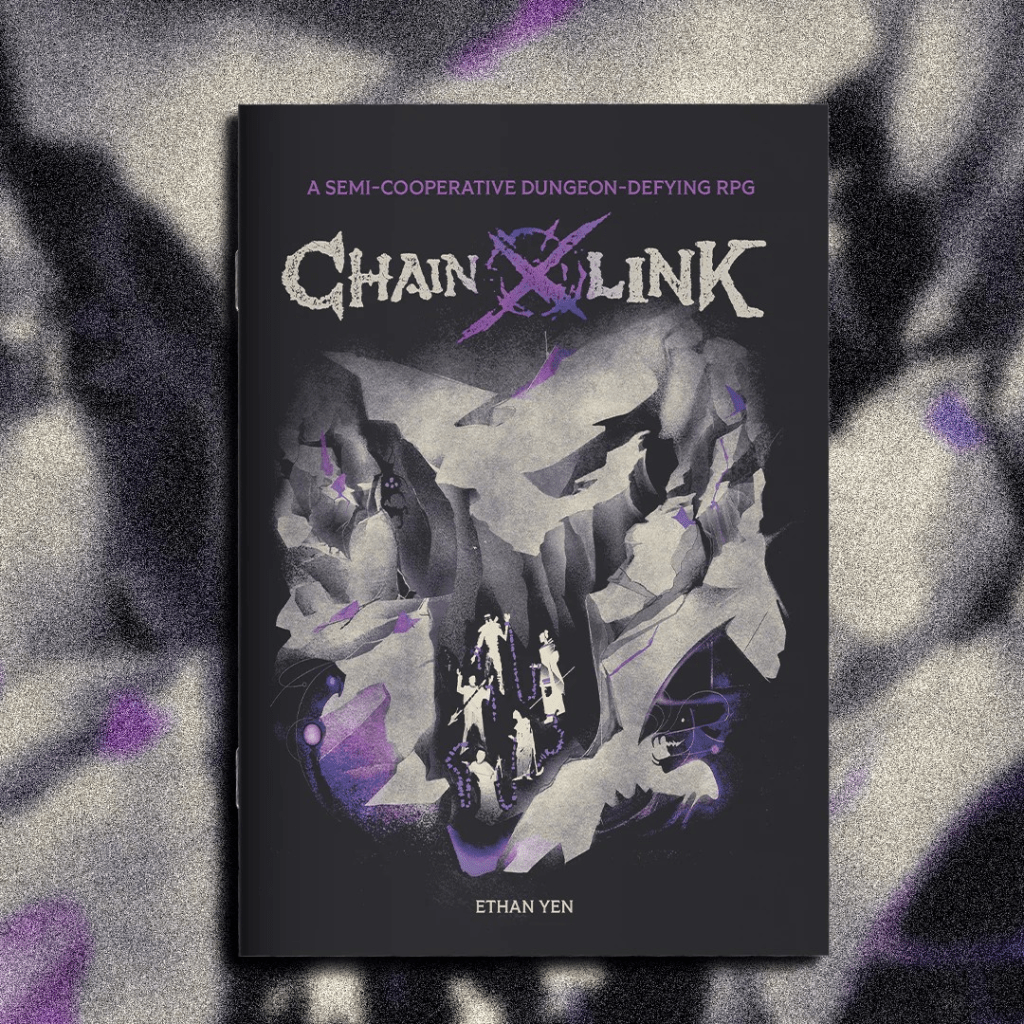
Let’s talk visual design first, because it’s worth talking about but I suspect it’ll get lost if I leave it to the end. The layout, also by Andrew Beauman, is excellent. It’s full of visual aids and graphics, it has a lovely faded purple highlight palette. It’s clear and relatively easy to navigate; I think there are so many moving parts here, that choosing a larger page format would have enable concepts and procedures to be pinned more commonly to spreads, and that would have made it better again. Within the format chosen, though — looks to be A5 or half-letter — it works very well. The information design isn’t terrible, although it front-loads a lot of information. Later in the book, in Spadefront section, it starts walking the referee chronologically through what she needs to do to run that first session — I think the game as a whole would be better off to have been presented in that way, given that rules —are at least complex in their unfamiliarity.
So, those rules. There’s a lot going on here. Your core loop consists of entering a new level, completing a faction trial for one of the factions, and completing a grave trial for that level. If you can complete the ascension rite, you can enter the level above, or if you’ve ascended far enough, escape. If your faction has completed all 3 of its’ goals, you get to have a revolution. As a Breaker (what characters are called here), you have skills and assets, and those assets can move between your “chain” (that’s your party), and your faction on the surface (by smuggling). The goal is to both escape (and hence you need loyalty to your chain) but also to start a revolution, where the other breakers in your chain all desire very different revolutions to you. You also have equipment and experiences, which operate similarly to assets and skills, but are earnt or bought. Very neat way to represent a revolutionary leader’s acumen. When you ascend a level (or in a scene on the surface), you play out a trial. The trial has an objective, an opposition, and stakes, and the referee determines the difficulty of the trial, which the breakers are trying to beat. You each make a contribution adding to the dice pool for your various equipment, experiences, assets etc., and roll them all. You pick one die as your contribution score — the next player will have to pick a higher score, so best to pick a low one, or the others won’t be able to contribute. But the final breaker gets to be the leader next time, which is a powerful advantage. One of my favourite small mechanics in this game is opportunity: You’re all leaders of powerful factions, which means you’re masterminds, you bide your time. So each of you have a d10 which is the opportunity die. The longer you wait to strike during a trial, choosing lower contribution scores, the greater the number you can choose to substitute your choice for when you do choose to seize the opportunity. If total contribution beats the difficulty, you succeed, and the new leader distributes any rewards. If you don’t succeed, you suffer consequences. Then the leader gets to enlist someone in opposition during the trial, to smuggle an asset to their faction. The same rules apply to faction trials as to grave trials, which I appreciate very much. I love the tension in these relatively simple, 1-pass rules, between gaining leadership and risking danger. I appreciate that there’s this core complexity to the game, lots of fiddly parts, but it’s re-used in different contexts and features a lot of internal tension. It’s great.
There are a few things I don’t think are clear. I got the impression you’d face a maximum of 2 trials per level, but the Ascension Rite has me second-guessing that impression. If I fail a trial, do I repeat it again and again, unchanged? That may get repetitive. I don’t quite understand whether contributions are simultaneous or turn-by-turn — I think simultaneous would make more sense, with the push-your-luck of contribution score. What does revolution, or reaching the surface, entail?
One of my favourite touches in Chain x Link is the additional resources; it relies heavily on the breaker, chain and factions sheets in the rules, so they aren’t really bonuses, but the trial sheet structures the trials visually for the referee, which I appreciate, and more importantly it comes with a folder of pregenerated breakers, factions and chain, so you can simply skip that entire section of the rulebook. The rules in Chain x Link are unique enough — at least to me — that it takes a fair bit to wrap my head around, so reducing that cognitive load from 60 pages to 30 is a hell of a scaffold to get me to running the game.
The end of the book is the entire lowest level of the Grave. This slaps! It’s full of characters, interactions, it’s an absolute powder keg! And I love that it provides an example of what you’re supposed to be designing as the referee for future levels of the dungeon. One way this diverges from inspirations like Blades in the Dark and Agon is that the referee is expected to design the levels of the Grave. It’s a weak criticism to say that I want more of this, but it’s good. The same goes for the worldbuilding as a whole; there’s a gesture to collaborative worldbuilding in the character creation section, but I really feel this needs more information, even if brief, on the surface, and the specific contexts of the faction and the world. Certainly, if the book were twice as long, with 10 times as much of the actual location content, it would make my job as a referee a hell of a lot easier — the referee already has a lot of improvisational load in terms of the surface, so reducing the preparation load would make this more likely to hit the table for me, simply by virtue of my being time poor between work and children.
I like Chain x Link a lot. The feeling I got out of Chain x Link after reading through the book, felt a lot like the feeling I got out of Blades in the Dark the first time I read it — there’s a lot of mechanical heft here, but it’s elegantly presented, and while it might take a lot to wrap your head around, it’s going to result in a really compelling game filled with really compelling stories. One of the inspirations listed is Spire, and I always felt like Spire would’ve been better as a Forged in the Dark game: No. This is the game Spire should’ve been. It’s clearly inspired by John Harper’s work, but it really pulls things together in a neat and compelling way. I’m disappointed it isn’t organised and explained a little more clearly — it needs space to breath and it needs to be in a bigger format to do so — and I’m disappointed it doesn’t come with more information about this compelling world and the levels of the Grave. It also feels cut to the bone to fit the page count, leaving some end-game crucial elements uncovered. But those aren’t dealbreakers for many people, and if I can find time to do all the prep, this is a game I’m definitely going to try to bring to the table next year, despite those misgivings. If you’ve always had the same feeling as me about revolutionary games that fell short like Spire and Brinkwood, I think you should bring Chain x Link to the table as well.
Idle Cartulary
Playful Void is a production of Idle Cartulary. If you liked this article, please consider liking, sharing, and subscribing to the Idle Digest Newsletter. If you want to support Idle Cartulary continuing to provide Bathtub Reviews, I Read Reviews, and Dungeon Regular, please consider a one-off donation or becoming a regular supporter of Idle Cartulary on Ko-fi.


 Playful Void
Leave a reply to Idle Cartulary Awards for Excellence in Elfgames – Playful Void Cancel reply